|
TRANSLATE THIS ARTICLE
Integral World: Exploring Theories of Everything
An independent forum for a critical discussion of the integral philosophy of Ken Wilber
  Frank Visser, graduated as a psychologist of culture and religion, founded IntegralWorld in 1997. He worked as production manager for various publishing houses and as service manager for various internet companies and lives in Amsterdam. Books: Ken Wilber: Thought as Passion (SUNY, 2003), and The Corona Conspiracy: Combatting Disinformation about the Coronavirus (Kindle, 2020). Frank Visser, graduated as a psychologist of culture and religion, founded IntegralWorld in 1997. He worked as production manager for various publishing houses and as service manager for various internet companies and lives in Amsterdam. Books: Ken Wilber: Thought as Passion (SUNY, 2003), and The Corona Conspiracy: Combatting Disinformation about the Coronavirus (Kindle, 2020).
Check out my other conversations with ChatGPT The War That Was Supposed to Be EasyMiscalculation, overconfidence and the recurrent folly of starting warsFrank Visser / ChatGPT
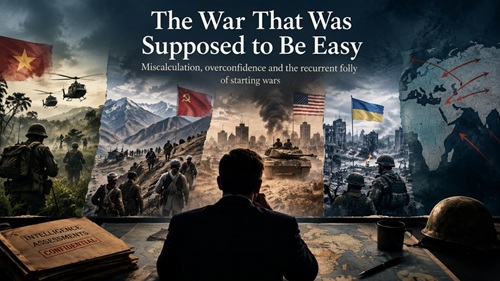 The recurring patternMany wars begin with a fundamental miscalculation. Those who initiate them believe that military force can achieve a political objective quickly, that the enemy will be weaker than expected, and that resistance will collapse once confronted with overwhelming power. Again and again, history has shown otherwise. Vietnam, Afghanistan, Iraq and Ukraine are very different conflicts, undertaken under very different circumstances, but they share a disturbing pattern: the initiator underestimated the opponent, overestimated its own ability to control events, and failed to anticipate what would happen after the first military objectives were achieved—or failed. This does not mean that every war is simply the product of stupidity. Governments may have legitimate security concerns, leaders may knowingly accept considerable risks, and sometimes military force really is necessary. But the decision to start a war almost always involves assumptions about how the enemy will behave. When those assumptions prove wrong, a war that looked manageable can rapidly become something entirely different. The First World War and the catastrophe of escalationThe First World War offers perhaps the clearest historical example of miscalculation turning a regional crisis into a catastrophe. In 1914, few European leaders appear to have understood the scale of the war they were setting in motion. Austria-Hungary expected a punitive campaign against Serbia; Germany expected a rapid victory over France before Russia could fully mobilize; Russia believed it could pressure Austria-Hungary without provoking an uncontrollable general war; and Britain entered the conflict partly because the strategic consequences of German expansion were judged unacceptable. Mobilization schedules, alliance commitments and rigid military plans then acquired a momentum of their own. The result was not the short, decisive war many expected but four years of industrialized slaughter. The tragedy of 1914 was therefore not simply that leaders made one mistake. It was that each side repeatedly underestimated the consequences of its own decisions while assuming that escalation would remain limited and controllable. A crisis that might have been contained became a world war because governments were making calculations inside a system in which every move altered the calculations of their opponents. The Second World War and the illusion of the decisive blowThe Second World War presents a different but equally revealing form of strategic miscalculation. Adolf Hitler repeatedly gambled on the belief that opponents would collapse before their superior resources could be brought to bear. The invasion of Poland succeeded rapidly, and the spectacular German victory over France in 1940 reinforced the conviction that audacity and operational speed could overcome much larger enemies. But Hitler's greatest miscalculations came with the decision to invade the Soviet Union in 1941 and, later that year, to declare war on the United States. Operation Barbarossa was conceived as a campaign of annihilation that would destroy the Soviet state within months; instead, Germany became trapped in a vast war of attrition it was structurally incapable of winning. The United States brought overwhelming industrial power into the conflict, while the Soviet Union absorbed catastrophic losses and continued to mobilize. Here again, the decisive error was not merely a bad military calculation but a failure of political imagination: the enemy was treated as weaker, less resilient and less capable of adaptation than it actually was. The lesson of World War II is particularly stark because Hitler's early successes appeared to validate his assumptions. Success can therefore be more dangerous than failure: it can transform a series of successful gambles into an ideology of invincibility. Vietnam and the illusion of overwhelming powerThe Vietnam War is perhaps the classic example. American policymakers viewed Vietnam primarily through the lens of the Cold War and the domino theory. Communism was seen as a global expansion that had to be contained before it spread further. Yet this interpretation badly underestimated Vietnamese nationalism and the determination of North Vietnam and the Viet Cong. Washington assumed that increasing military pressure would eventually persuade Hanoi to give up. American firepower could destroy villages, infrastructure and military targets, but it could not destroy the political will of the Vietnamese resistance. The United States won countless battles while gradually losing the larger political struggle. The crucial mistake was confusing military superiority with strategic control. The Americans possessed the world's most powerful military. But the Vietnamese leadership did not have to defeat America militarily in order to win. It only had to survive long enough for the political costs of the war to become unacceptable in the United States. Afghanistan and the resistance of the unexpectedAfghanistan offers an even more striking example because both the Soviet Union and the United States eventually encountered versions of the same problem. In 1979, Moscow believed that military intervention could stabilize an increasingly troublesome client government and prevent Afghanistan from slipping out of the Soviet sphere of influence. Instead, the invasion transformed resistance into a broader struggle against foreign occupation. Soviet forces could control cities and major roads, but they could not impose a durable political settlement on the country. The Soviet Union possessed vastly superior military resources, yet Afghanistan's geography, social structure and deeply rooted resistance made decisive victory impossible. What was expected to be a limited intervention became a ten-year war. More than two decades later, the United States made a different but related mistake. After September 11, 2001, the initial objective—destroy al-Qaeda's sanctuary and remove the Taliban government—was relatively clear. The Taliban regime fell quickly. But the mission gradually expanded into the much more ambitious project of constructing a stable democratic Afghan state. Here the United States underestimated the difficulty of creating legitimate political institutions while simultaneously believing that military power and enormous financial resources could compensate for weak indigenous foundations. Twenty years later, the Taliban returned to power. Iraq and the triumph of wishful thinkingThe 2003 invasion of Iraq provides perhaps the clearest example of a war built upon faulty assumptions. The Bush administration believed that Saddam Hussein possessed weapons of mass destruction and that removing his regime could transform Iraq and perhaps the wider Middle East. The Iraqi military collapsed rapidly, apparently confirming American expectations. But this was precisely where the deeper miscalculation began. Defeating the Iraqi army was relatively easy; creating the political order that was supposed to replace Saddam's regime was not. The intelligence concerning weapons of mass destruction proved disastrously wrong. Meanwhile, the destruction of the Iraqi state helped produce insurgency, sectarian violence and eventually conditions in which jihadist organizations could flourish. The war therefore produced consequences far beyond those anticipated by its authors. The lesson was painfully familiar: military victory is not necessarily political victory. Removing a regime does not automatically produce a functioning replacement. Ukraine and the danger of underestimating a nationRussia's full-scale invasion of Ukraine in February 2022 provides a more recent example of catastrophic miscalculation. The Kremlin appears to have expected a rapid campaign that would cripple the Ukrainian government and bring the country under Russian control. Instead, Ukraine resisted far more effectively than Moscow anticipated. The invasion strengthened Ukrainian national identity rather than weakening it, while Russia also underestimated the scale and durability of Western support. The war consequently produced several outcomes opposite to those apparently intended by Moscow, including greater Ukrainian national consolidation and the expansion of NATO. The most profound miscalculation may have been political rather than military. The Kremlin's worldview had increasingly portrayed Ukraine as an artificial or historically subordinate entity whose separation from Russia could somehow be reversed. Such a worldview makes it difficult to understand how people on the other side of the border actually see themselves. An aggressor who believes that the population it is invading is essentially part of its own nation will inevitably be surprised when that population fights back with extraordinary determination. The enemy we imagineWhat connects these cases is therefore not simply military error. It is a failure of imagination. Leaders construct an image of the enemy that fits their own political assumptions. The Vietnamese resistance was interpreted largely as an instrument of international communism; Afghan resistance was repeatedly underestimated by both Soviet and American strategists; Saddam Hussein's Iraq was viewed through the post-9/11 threat framework; and the Kremlin's conception of Ukraine was distorted by an ideology that questioned the country's independent national identity. Once such assumptions become entrenched, contradictory evidence becomes difficult to absorb. Intelligence can cease to function as a warning system and become a mechanism for confirming what policymakers already believe. Political leaders hear what they want to hear, while inconvenient information is dismissed as pessimism, weakness or defeatism. This is one reason why authoritarian systems can be particularly dangerous when contemplating war. A leader surrounded by people who are afraid to contradict him may eventually become trapped inside his own version of reality. The fantasy of the short warAnother recurring feature is the fantasy of the short war. Leaders imagine that superior technology, airpower or overwhelming military force will produce a quick victory. The enemy will collapse, the government will fall, and the troops will come home. But war is not simply a contest between armies. It is a political process involving populations, identities, alliances and emotions. An invading army can destroy a government much more easily than it can create a legitimate replacement. It can occupy territory without winning the allegiance of its inhabitants. And every civilian casualty, destroyed city or foreign occupation can generate new reasons for resistance. The initiator therefore enters a dynamic system whose subsequent behaviour it cannot fully control. This is the great paradox of military power: the stronger a country is militarily, the easier it may be for its leaders to believe that war is controllable. When the original plan failsOnce a war has begun, another dangerous process sets in. When the original strategy fails, admitting the mistake becomes politically difficult. Instead, failure is often attributed to insufficient commitment. More troops are needed. More weapons are needed. More bombing is needed. More money is needed. More time is needed. A limited intervention can thus become a war of attrition simply because its authors cannot admit that their original assumptions were wrong. The blood already spilled becomes an argument for spilling more. This is particularly dangerous because wars create their own momentum. Every new casualty creates pressure to justify the sacrifice of previous casualties. Every escalation creates a new political reality that must somehow be defended. Eventually, the original purpose of the war can become almost impossible to recognize. The question leaders should askThe most important lesson of Vietnam, Afghanistan, Iraq and Ukraine is not that military force never works. Sometimes war is unavoidable, and sometimes force is necessary to resist aggression. The lesson is that military power does not automatically produce political success. Before starting a war, governments should therefore ask not only whether they can defeat the enemy's forces, but whether they understand the enemy, whether they can achieve the political objective, how the population will respond, and what happens if the war lasts ten times longer than expected. Above all, they should ask the question that ambitious governments are often least willing to ask: What if we are wrong? The war that was supposed to be easyHistory suggests that wars rarely begin with leaders saying, "This could become a disaster." They begin with something much more reassuring: the enemy is weak, our military is strong, the population will not resist, our allies will support us, and the war will be over quickly. That confidence can be intoxicating. It can also be fatal. The tragedy of miscalculation is that the people who start wars are usually making predictions about a future they cannot control. They may control the first move, but they do not control the reaction. They may choose when to invade, but they cannot choose how fiercely the invaded population will resist. They may win the opening battles, but they cannot guarantee the political consequences. The history of modern warfare therefore offers a simple but profound warning: before asking whether you can win a war, ask whether you understand what war will unleash.
Widget is loading comments...
|