|
TRANSLATE THIS ARTICLE
Integral World: Exploring Theories of Everything
An independent forum for a critical discussion of the integral philosophy of Ken Wilber
  Frank Visser, graduated as a psychologist of culture and religion, founded IntegralWorld in 1997. He worked as production manager for various publishing houses and as service manager for various internet companies and lives in Amsterdam. Books: Ken Wilber: Thought as Passion (SUNY, 2003), and The Corona Conspiracy: Combatting Disinformation about the Coronavirus (Kindle, 2020). Frank Visser, graduated as a psychologist of culture and religion, founded IntegralWorld in 1997. He worked as production manager for various publishing houses and as service manager for various internet companies and lives in Amsterdam. Books: Ken Wilber: Thought as Passion (SUNY, 2003), and The Corona Conspiracy: Combatting Disinformation about the Coronavirus (Kindle, 2020).
Check out my other conversations with ChatGPT 9/11Could It Have Been Prevented?Frank Visser / ChatGPT
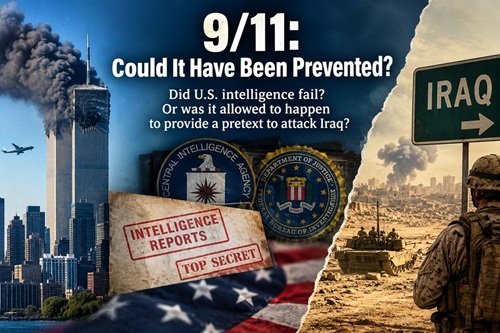 Twenty-five years after September 11, 2001, the central mystery is no longer whether American intelligence had warning of an impending terrorist attack. It did. The harder question is what kind of failure that warning represents. Was 9/11 simply an extraordinary intelligence failure—the result of fragmented agencies, bureaucratic inertia, mistaken assumptions and an inability to imagine what al-Qaeda was planning? Or did officials who possessed warning signs deliberately fail to act? And behind the most controversial version of the theory lies an even darker allegation: was the attack knowingly allowed to happen because it would provide the political opportunity to launch wars, first in Afghanistan and ultimately in Iraq? The evidence supports a devastating indictment of American intelligence and political leadership before 9/11. It does not, however, establish that the attacks were deliberately permitted. The distinction matters. There is a great deal of evidence for incompetence, institutional failure and subsequently opportunistic exploitation of the attacks. There is not comparable evidence that the Bush administration knew the precise plot and intentionally stood aside. The most interesting conclusion lies between the two extremes. The Warnings Were ThereThe idea that 9/11 arrived completely without warning is untenable. American intelligence had been following Osama bin Laden and al-Qaeda for years. By 2001, the threat was no longer theoretical. The congressional Joint Inquiry into 9/11 concluded that intelligence agencies had accumulated substantial information about bin Laden and al-Qaeda and that, during the spring and summer of 2001, there was a significant increase in reporting indicating that bin Laden's organization intended to strike American interests in the very near future. The same investigation found that intelligence agencies had received information for years about the possibility of terrorists using aircraft as weapons. The most famous warning came on August 6, 2001, when President George W. Bush received the Presidential Daily Brief headed "Bin Ladin Determined to Strike in US." It discussed al-Qaeda's longstanding desire to attack inside the United States and mentioned the possibility of hijackings. It is important not to exaggerate this document. It did not say that nineteen hijackers were preparing to seize four aircraft on September 11. It did not give the date, the targets or the operational details. The warning was therefore not a secret copy of the future. But that is precisely what makes the failure so instructive. Intelligence almost never arrives as a completed blueprint. The question is whether apparently disconnected fragments should be assembled into a coherent threat picture. That was where the system failed. The Failure Was One of ConnectionThe Joint Inquiry's conclusion was remarkably blunt: American intelligence possessed pieces of information that, considered collectively, could have substantially increased the chances of discovering and disrupting the plot. Some information was overlooked. Some was not disseminated. Some was not recognized as significant. Other pieces required investigative action that never occurred. Two al-Qaeda operatives, Khalid al-Mihdhar and Nawaf al-Hazmi, are particularly important to this story. The CIA knew significant information about them, including information that should have resulted in them being watchlisted. Yet the information did not effectively reach the FBI in time to permit the kind of domestic investigation that might have followed. This was not primarily a failure to collect information. It was a failure to connect information. The CIA was looking outward. The FBI was looking inward. Neither organization possessed an adequate mechanism for integrating the pieces. Intelligence about foreign terrorists could remain trapped inside the foreign-intelligence system even when those terrorists were physically entering the United States. The result was a peculiar institutional blindness: America had enormous quantities of information but insufficient institutional intelligence. Could the Attack Actually Have Been Stopped?This question needs to be treated more cautiously than it usually is. There were several possible points at which the conspiracy might have been disrupted. The hijackers could potentially have been identified through watchlisting. The FBI might have investigated suspicious individuals inside the United States. Immigration authorities might have scrutinized some of the participants. Airport security might have responded differently. Cockpit doors could have been hardened. Air crews could have been trained to expect suicide hijackings. And once the aircraft were hijacked, a different air-defense posture might conceivably have altered the outcome. But "could have been prevented" does not mean "would certainly have been prevented." The 9/11 Commission emphasized precisely this uncertainty. It concluded that the intelligence community missed opportunities to disrupt the plot, investigate the hijackers, or increase the country's state of alert. But nobody can know whether exploiting those opportunities would actually have stopped the attacks. That distinction is crucial. The evidence establishes missed opportunities, not a demonstrable counterfactual history. The Air Defense FailureThe events of the morning of September 11 reveal another extraordinary institutional problem. Before 9/11, American authorities were accustomed to thinking about hijacked aircraft primarily as hostage situations. The possibility that commercial airliners themselves could be used as giant missiles had been contemplated, but it had not been incorporated effectively into operational procedures. The 9/11 Commission found that FAA and NORAD procedures were fundamentally unsuited to the attack that actually occurred. The military and civilian systems were attempting to improvise a response to a scenario for which they had not adequately prepared. This has sometimes been transformed into the claim that fighter aircraft were deliberately ordered not to intercept the hijacked planes. That is a much stronger claim than the evidence supports. The real story is arguably more disturbing precisely because it is less cinematic: confusion, outdated assumptions, contradictory information, communications failures and a command system that was not designed for four simultaneous suicide hijackings. The system failed spectacularly without requiring anyone to sabotage it. The "Inside Job" HypothesisHere we reach the most controversial question. If officials had so many warnings, why did nothing happen? One possible answer is that they knew more than they admitted and deliberately allowed the attack to proceed. But an investigation has to distinguish between suspicion and evidence. There is no convincing documentary or testimonial evidence establishing that President Bush, Vice President Cheney, the CIA leadership or other senior officials possessed advance knowledge of the specific 9/11 operation and intentionally permitted it to occur. That does not absolve them of responsibility. A president does not need to know the exact date of an attack to be held responsible for failing to respond adequately to a clearly escalating threat. Indeed, the historical record is arguably more damning when interpreted that way. The United States was repeatedly warned that bin Laden wanted to attack America. The government knew al-Qaeda had demonstrated an interest in spectacular attacks. Intelligence agencies knew terrorists had considered aircraft. And by the summer of 2001, the warning level was rising sharply. Yet nobody successfully transformed these warnings into an emergency mobilization capable of disrupting the conspiracy. That is an enormous failure. It simply isn't the same thing as deliberately permitting the attack. The Iraq Question Is DifferentThe strongest part of the "inside job" argument concerns not the origin of 9/11 but what happened afterward. Almost immediately after the attacks, the Bush administration began examining possible Iraqi involvement. The 9/11 Commission records that President Bush wanted officials to investigate whether Saddam Hussein's regime was connected to the attacks. That suspicion was understandable in the chaotic atmosphere immediately following the attacks. But it subsequently became politically consequential. The problem was that the evidence did not establish that Saddam Hussein's Iraq had collaborated with al-Qaeda in carrying out 9/11. The 9/11 Commission found contacts between Iraq and al-Qaeda but did not find evidence that these contacts developed into an operational collaborative relationship for attacks against the United States. The distinction was gradually blurred in public discourse. Americans were repeatedly encouraged to think about Saddam Hussein, al-Qaeda, terrorism and weapons of mass destruction as components of one enormous threat. But these were different propositions requiring different evidence. By 2002-03, the administration was making the case for invading Iraq on several grounds, including weapons of mass destruction and alleged terrorist connections. The weapons of mass destruction were not found. The supposed operational relationship between Saddam Hussein and al-Qaeda did not materialize. And the Senate Intelligence Committee subsequently concluded that the Bush administration had made significant claims about Iraqi intelligence that were unsupported, contradicted or nonexistent. That is a genuine historical scandal. From Intelligence Failure to Political OpportunityThe distinction between causing 9/11 and exploiting 9/11 is therefore essential. There is strong evidence for the second. The Bush administration inherited a pre-existing interest in Saddam Hussein. After 9/11, the political environment changed dramatically. The attacks created an extraordinary sense of national emergency in which military action against perceived enemies became vastly easier to justify. Afghanistan had a direct connection to al-Qaeda because the Taliban regime sheltered bin Laden. Iraq did not have the same evidentiary connection to the attacks. Yet Iraq was nevertheless brought into the post-9/11 narrative. That does not prove that the administration wanted 9/11 to happen. In fact, the sequence of events makes a deliberate-permission theory difficult to sustain: the attacks produced enormous uncertainty, killed thousands of Americans, destabilized the Middle East and created risks that nobody could confidently control. But politicians do not have to create a crisis to exploit one. That is the more defensible—and historically better documented—interpretation. The Counterfactual Nobody Can AnswerSuppose that in July 2001 the CIA and FBI had combined their information properly. Suppose that al-Mihdhar and al-Hazmi had been identified and followed. Suppose that American authorities had realized that several men were participating in a coordinated suicide operation. Suppose that airports had been placed on heightened alert and cockpit security had been strengthened. Would 9/11 have been prevented? Perhaps. Would another attack have occurred? Possibly. Would the conspiracy have been discovered but misinterpreted? Also possible. History gives us no experiment through which to answer these questions. But the inability to prove that prevention was possible does not make the failures irrelevant. Intelligence organizations exist precisely because governments cannot wait until threats become certain. The standard should not be "Did officials possess a complete blueprint?" It should be "Did they respond appropriately to the information they actually possessed?" By that standard, the answer is difficult to defend. The More Plausible ConspiracyThere is a paradox here. The evidence does not support the strongest conspiracy theory—that American leaders knowingly allowed the attacks to happen in order to invade Iraq. But the evidence does support a weaker and historically much more consequential proposition: America suffered a catastrophic intelligence failure, and its political leadership subsequently used the resulting national trauma to pursue policies that went far beyond what the evidence concerning 9/11 justified. That distinction is not semantic. It changes the historical question from "Who secretly planned 9/11?" to "Why did a government that had been warned repeatedly fail to act, and why did it then use the catastrophe to construct a broader geopolitical agenda?" The first question tends to produce speculation. The second produces documents. The Intelligence Community's Own VerdictThe official investigations are particularly important because they did not conclude that nothing could have been done. Quite the opposite. The congressional Joint Inquiry said the intelligence community had failed to capitalize on available information and had missed opportunities to disrupt the plot. The 9/11 Commission subsequently identified profound institutional weaknesses involving the CIA, FBI, FAA, NORAD and the broader structure of national security decision-making. This is not the language of a system that functioned properly. Nor is it necessary to invoke an enormous secret plot to explain the tragedy. Bureaucracies can fail because organizations protect information, agencies compete, analysts make assumptions, leaders discount inconvenient warnings and institutions become prisoners of yesterday's threats. That explanation is less dramatic than an inside job. It is also much better supported by the evidence. What We Should Actually ConcludeTwenty-five years later, the most responsible conclusion is therefore a three-part one. • First, 9/11 was probably preventable in the broad sense that there were multiple missed opportunities to disrupt the conspiracy. The government possessed enough warning information that a more integrated, aggressive response might have uncovered the plot. We cannot know whether it would have succeeded. • Second, U.S. intelligence unquestionably failed. This is not merely a conspiracy-theory allegation. It is the conclusion of the congressional Joint Inquiry and the 9/11 Commission themselves. The failure involved information sharing, threat assessment, watchlisting, interagency cooperation, domestic investigation, aviation security and military preparedness. • Third, there is insufficient evidence that the attacks were deliberately allowed to happen to create a pretext for invading Iraq. The Iraq connection is much better understood as a case of political exploitation: an administration with pre-existing hostility toward Saddam Hussein used the extraordinary post-9/11 atmosphere to construct a case for a war that the available evidence did not justify. That last point should not be softened. The Senate Intelligence Committee itself concluded that the administration presented intelligence in ways that significantly overstated the Iraqi threat. The tragedy of 9/11 therefore does not require a secret mastermind sitting in Washington. The historical record presents something arguably more unsettling: a government that received warnings, failed to connect them, suffered an attack that might conceivably have been disrupted, and then used the resulting catastrophe to embark on a war that had little to do with the actual perpetrators. That is already an extraordinary indictment. And unlike the theory that 9/11 was deliberately permitted, it is an indictment for which the documentary evidence is substantial.
Widget is loading comments...
|