|
TRANSLATE THIS ARTICLE
Integral World: Exploring Theories of Everything
An independent forum for a critical discussion of the integral philosophy of Ken Wilber
  Frank Visser, graduated as a psychologist of culture and religion, founded IntegralWorld in 1997. He worked as production manager for various publishing houses and as service manager for various internet companies and lives in Amsterdam. Books: Ken Wilber: Thought as Passion (SUNY, 2003), and The Corona Conspiracy: Combatting Disinformation about the Coronavirus (Kindle, 2020). Frank Visser, graduated as a psychologist of culture and religion, founded IntegralWorld in 1997. He worked as production manager for various publishing houses and as service manager for various internet companies and lives in Amsterdam. Books: Ken Wilber: Thought as Passion (SUNY, 2003), and The Corona Conspiracy: Combatting Disinformation about the Coronavirus (Kindle, 2020).
Check out my other conversations with ChatGPT October 7Could the Hamas Attack Have Been Prevented?Frank Visser / ChatGPT
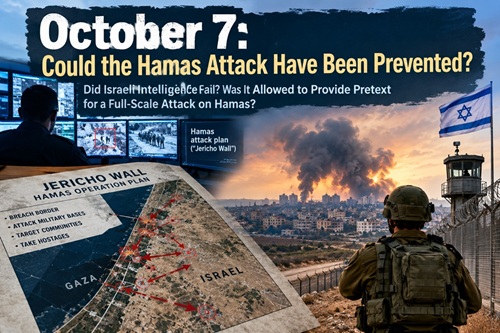 The Hamas assault of 7 October 2023 was not simply a failure of Israeli intelligence. It was a failure of intelligence, interpretation, preparedness, command and political judgment that unfolded over years. The more difficult question is whether it was merely a catastrophic failure—or whether Israeli leaders knowingly allowed the attack to happen because it would provide a pretext for a much larger war against Hamas. The first proposition is strongly supported by the evidence. The second remains unproven. That distinction is important. There are already enough documented failures to make a conspiracy unnecessary as an explanation. But there are also unresolved questions about political responsibility that deserve much more serious investigation than they have so far received. The extraordinary fact: Israel had the pieces of the puzzleThe October 7 attack did not come out of nowhere. Israeli intelligence had information about Hamas's preparations and, according to subsequent investigations, possessed a version of what became known as the "Jericho Wall" plan describing a large-scale assault on Israel. The plan reportedly included breaching the Gaza barrier, attacking military bases and communities, and taking hostages. Analysts warned about it, but senior intelligence and military officials did not believe Hamas was capable of executing it on the scale envisaged. This is the central paradox of October 7. Israel was not suffering from an absence of information. It was suffering from an inability—or unwillingness—to interpret information correctly. The distinction between an intelligence failure and an intelligence-interpretation failure is crucial. An intelligence service cannot be expected to predict every attack. But when an enemy's known military preparations increasingly resemble an actual invasion plan, the burden of proof should shift. Instead, the Israeli security establishment repeatedly interpreted threatening evidence through an established theory: Hamas was deterred. That theory proved disastrously wrong. "Hamas is deterred"The prevailing Israeli conception was that Hamas had become primarily interested in governing Gaza and preserving the economic and political arrangements that had developed there. The reasoning seemed plausible. Hamas had fought several limited wars with Israel, suffered enormous destruction, and nevertheless survived. Economic concessions, Qatari money, work permits for Gazans and periodic negotiations appeared to offer Hamas incentives to maintain a degree of stability. The Israeli establishment therefore increasingly regarded Hamas as a manageable problem rather than an organization preparing for a transformational military assault. The IDF's own subsequent investigation concluded that Israel underestimated Hamas's capabilities and intentions and that its strategic assumptions about Gaza were fundamentally mistaken. This was not simply an intelligence error. It was a conceptual error. Once the assumption "Hamas wants to preserve the status quo" became dominant, contradictory evidence could be absorbed without overturning the assumption. Military exercises could be interpreted as training. Unusual communications could be dismissed. Preparations around the border could be treated as another round of Hamas signaling. This is a classic intelligence problem: information does not automatically produce knowledge. Analysts interpret information through assumptions. The warnings became harder to dismissIn the months and days before October 7, the warning signs multiplied. Israeli observers reported unusual Hamas training and preparations. Border surveillance detected suspicious activity. Female soldiers serving as surveillance observers reportedly raised concerns about Hamas exercises and movements. Intelligence detected developments that, in retrospect, were unmistakably connected with the coming assault. Yet the accumulated evidence failed to trigger the necessary change in Israel's assessment. The official Israeli investigations are particularly significant here because they do not require us to accept an external conspiracy theory. In November 2025, an IDF-appointed expert team identified six major factors behind the failure, including conceptual failure, intelligence failure, failure to properly investigate the Jericho Wall plan, dysfunctional organizational culture, a mismatch between the assumed threat and military preparations, and failures in decision-making on the night of October 7. The team's conclusion was remarkably blunt: the surprise did not emerge from an information vacuum. Significant and unusual information existed, and proper analysis could and should have generated a warning requiring substantial action. That makes "nobody knew" an untenable explanation. The night beforePerhaps the most disturbing aspect is what happened during the final hours. By the night of October 6-7, Israeli intelligence had indications that something unusual was happening in Gaza. Yet the significance of those indications was not understood correctly. The IDF investigation later concluded that intelligence organizations failed to provide adequate warning and that the Gaza Division did not sufficiently change its operational posture despite information available to it. This is where the question "Could October 7 have been prevented?" becomes more complicated. It is impossible to know whether Israel could have stopped every infiltrator. A surprise attack involving thousands of fighters and dozens of simultaneous targets would have been difficult to stop completely. But preventing the catastrophe from reaching its eventual scale is a much more plausible proposition. A substantial increase in troops along the border, heightened alert status, activation of reserves, deployment of additional surveillance and air assets, closure of vulnerable communities, and preparation for a large-scale infiltration could have radically changed the outcome. The IDF's own inquiry into Kibbutz Be'eri found that the army was simply not prepared for the scenario that materialized: thousands of attackers entering through multiple points and attacking dozens of locations simultaneously. The astonishing absence of defensive forcesThere was another element to the disaster: Israel had concentrated enormous confidence in technology. The Gaza barrier was equipped with cameras, sensors and sophisticated surveillance systems. Israel possessed one of the world's most capable intelligence infrastructures. Yet the physical military response on the morning of October 7 was disastrously inadequate. The assumption seems to have been that technology plus deterrence made a massive ground assault extraordinarily unlikely. That created a dangerous feedback loop. Because Hamas was supposedly deterred, Israel could reduce the number of forces immediately available around Gaza. Because the border was technologically monitored, fewer troops seemed necessary. Because Hamas was supposedly incapable of sustained offensive operations, its training exercises did not receive the interpretation they deserved. When the assumptions failed simultaneously, the technological system could not compensate for the absence of human preparedness. The political dimensionHere the investigation becomes more uncomfortable. The failure did not occur independently of Israeli politics. For years, Benjamin Netanyahu's governments pursued a policy in which Hamas remained in control of Gaza while the Palestinian Authority was weakened. The strategic calculation was that Hamas's continued separation from the West Bank made the emergence of a unified Palestinian political entity less likely. Shin Bet's 2025 investigation went further, identifying Netanyahu-era policies—including the broader approach to Gaza—as contributing factors to the conditions that preceded October 7. The agency also acknowledged its own failures, including its inability to properly interpret warning signs. That does not mean Netanyahu wanted October 7. But it does raise a legitimate question: Did the Israeli government pursue a strategy that made the eventual catastrophe more likely because it believed Hamas was useful as a political counterweight to the Palestinian Authority? That question is very different from alleging that Israel deliberately permitted the attack. The former is supported by serious evidence and deserves investigation. The latter requires evidence that has not been produced. The "allowed to happen" hypothesisThe strongest version of the conspiracy theory says that Israel knew an attack was coming and deliberately allowed it to proceed because October 7 would provide a justification for destroying Hamas and launching a massive military operation in Gaza. Attractive as this explanation may be to people looking backward at the subsequent devastation of Gaza, the evidence presently available does not establish it. In fact, deliberate-allowance theory encounters a major problem. October 7 was an extraordinary Israeli strategic catastrophe. More than 1,200 people were killed and 251 hostages were taken. Israeli military installations were overrun. Communities were invaded. The aura of Israeli military and intelligence superiority was shattered. Netanyahu's political standing was badly damaged. Israel subsequently faced enormous international pressure and became embroiled in a regional conflict. A government might conceivably accept terrible casualties to achieve a strategic objective—but that requires evidence of foreknowledge and intentional decision-making, not merely the observation that the aftermath proved politically useful to some actors. We do not presently have that evidence. But "no conspiracy" does not mean "no political responsibility"There is a danger on both sides of this debate. One side can turn every unexplained failure into evidence of deliberate complicity. That is bad investigative reasoning. But the opposite mistake is to say that because there is no evidence of a conspiracy, political leaders bear no responsibility. They may bear enormous responsibility without having wanted the attack. A government can create the conditions for disaster through ideological assumptions, strategic miscalculation, complacency and institutional blindness. Indeed, that explanation is historically much more common than deliberate self-attack. The 1973 Yom Kippur War offers an especially striking Israeli precedent. Israel possessed intelligence suggesting an Egyptian and Syrian attack was possible, but the leadership was trapped by what became known as the "concept"—the belief that the Arabs would not attack until certain conditions had been met. Fifty years later, Israel experienced another catastrophic failure of strategic imagination. A new allegation: the UAE warningThere is now an additional issue that makes the question of political responsibility even more difficult. In September 2026, a new book by Haaretz journalists Shlomi Eldar and Ruth Yuva reportedly alleged that UAE President Mohammed bin Zayed personally warned Netanyahu roughly ten days before October 7 about a major Hamas operation associated with Yahya Sinwar. According to the report, the alleged warning concerned an operation capable of destabilizing the region. Netanyahu's office has categorically denied that the conversation took place. This allegation is new and disputed. It should therefore not be presented as established fact. But if documentary or communications evidence eventually confirms it, the political significance would be enormous. It would transform the question from "Why did intelligence fail?" to "What did the prime minister know, and what did he do with that information?" That is precisely why an independent investigation is indispensable. Why Israel still needs a full state inquiryThere is a fundamental difference between internal military investigations and an independent national commission. The IDF can investigate operational failures within the IDF. Shin Bet can investigate failures within Shin Bet. But neither organization can fully investigate the political decisions that shaped the strategic environment in which those failures occurred. Nor can an agency comfortably investigate its own relationship with the political leadership. The November 2025 expert review itself said that major questions remained concerning the treatment of intelligence and the Jericho Wall plan. And in July 2026 the Israeli Knesset approved, at first reading, legislation proposing a state-national commission of inquiry into October 7 and the circumstances leading to the war. That is important because the question has now moved beyond partisan accusation. Israelis themselves have demanded an authoritative reconstruction of what happened. The investigation should establish, minute by minute: • What did Mossad know? • What did Shin Bet know? • What did Aman know? • What did the Gaza Division know? • What did the IDF Southern Command know? • What did the prime minister's office know? • What warnings reached Netanyahu personally? • What warnings reached his ministers? • Who decided not to increase military readiness? • Why were the Jericho Wall documents not treated as an operational threat? • Why were Hamas training exercises repeatedly interpreted as defensive or theatrical? • Why was the Gaza border so lightly defended? • And, crucially, what happened between the receipt of the final warnings and the decision to maintain normal readiness? The strongest conclusion the evidence currently supports The evidence allows us to make a strong judgment without resorting to an unproven conspiracy. October 7 was preventable in the sense that the scale of the disaster was not inevitable. Israel had substantial intelligence. It had warnings. It had a detailed Hamas operational plan. It had surveillance capabilities. It had enormous military resources. What it lacked was the willingness and institutional capacity to believe that Hamas was actually going to do what the evidence increasingly suggested it was preparing to do. The failure was therefore not simply "bad intelligence." It was bad interpretation reinforced by political assumptions. And the evidence available so far does not establish that Israel deliberately allowed the attack in order to obtain a pretext for war. But that conclusion should not be used to close the investigation. The real unanswered question is more disturbing precisely because it does not require a conspiracy: How did a country that had spent decades preparing for exactly this kind of attack convince itself that the attack was impossible? If Netanyahu or other political leaders were given credible warnings and consciously chose not to act, that would constitute an extraordinary political failure even without foreknowledge of the precise attack. And if future evidence establishes that anyone deliberately withheld a warning, prevented preparations, or consciously accepted the risk of mass civilian casualties for political or military purposes, the historical judgment would necessarily become much darker. Until then, the responsible position is neither "Israel knew and allowed it" nor "nobody could have known." It is this: Israel had enough information to do much better. It failed catastrophically to turn information into action. Whether that failure was merely the product of complacency and ideology, or whether political decisions made it substantially worse, is precisely what a genuinely independent investigation must determine.
Widget is loading comments...
|