|
TRANSLATE THIS ARTICLE
Integral World: Exploring Theories of Everything
An independent forum for a critical discussion of the integral philosophy of Ken Wilber
  Frank Visser, graduated as a psychologist of culture and religion, founded IntegralWorld in 1997. He worked as production manager for various publishing houses and as service manager for various internet companies and lives in Amsterdam. Books: Ken Wilber: Thought as Passion (SUNY, 2003), and The Corona Conspiracy: Combatting Disinformation about the Coronavirus (Kindle, 2020). Frank Visser, graduated as a psychologist of culture and religion, founded IntegralWorld in 1997. He worked as production manager for various publishing houses and as service manager for various internet companies and lives in Amsterdam. Books: Ken Wilber: Thought as Passion (SUNY, 2003), and The Corona Conspiracy: Combatting Disinformation about the Coronavirus (Kindle, 2020).
Check out my other conversations with ChatGPT Nikola Tesla: Genius, Myth, and the Limits of the VisionaryThe man behind the mythFrank Visser / ChatGPT
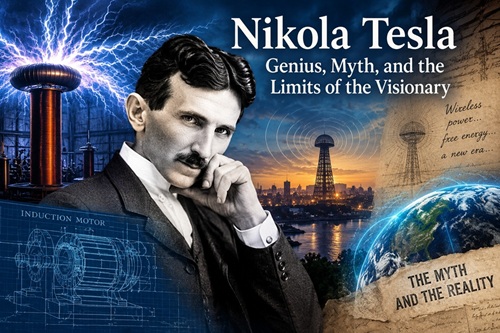 Few inventors have acquired a cultural mythology as powerful as Nikola Tesla. Today he is portrayed not merely as an important pioneer of electrical engineering but as a visionary who was decades ahead of his time, an opponent of corporate greed, a victim of Thomas Edison, and perhaps even a suppressed discoverer of technologies that could have transformed civilization. Tesla has become a secular saint of technological imagination. There is a substantial historical basis for the admiration. Tesla was an extraordinary inventor. His work on alternating current, polyphase electrical systems, induction motors, high-frequency currents, transformers, radio-frequency technology and remote control contributed significantly to the electrification of the modern world. His rotating magnetic field and induction motor were particularly important achievements. The electrical system associated with Tesla and George Westinghouse ultimately helped establish alternating current as the practical basis of large-scale electrical distribution. But precisely because Tesla was genuinely remarkable, there is little need to embellish him. The interesting Tesla is actually more complicated than the mythical one. He was a brilliant and sometimes astonishingly original engineer, but also an increasingly speculative inventor whose later claims were not always supported by experimental evidence. He could be remarkably prescient in some areas and spectacularly wrong in others. He was capable of both rigorous engineering and extravagant speculation. His story therefore offers a useful lesson about the difference between creative genius, scientific knowledge, technological invention and technological prophecy. Tesla's real achievementsTesla's greatest accomplishment was not some mysterious free-energy technology. It was the development of practical electrical machinery and systems based on alternating current. His work on the rotating magnetic field in the 1880s provided the foundation for the induction motor. Unlike the direct-current motors then dominant in some applications, the induction motor could operate without a mechanical commutator and brushes, making it robust and comparatively simple. This was a major engineering achievement. Tesla's polyphase AC system also solved an important practical problem: how to transmit electrical power efficiently over substantial distances. Alternating current could readily be transformed to high voltages for transmission and then reduced to safer voltages for use. The eventual AC electrical grid was therefore not the result of one inventor's isolated breakthrough but of a larger technological development involving Tesla, Westinghouse, engineers, manufacturers and many others. This is an important corrective to the popular Tesla-versus-Edison morality tale. Thomas Edison was not simply the villainous representative of obsolete technology, while Tesla was the heroic representative of the future. Edison's early electrical systems were based on direct current for perfectly understandable engineering reasons. Tesla's AC system had decisive advantages for long-distance distribution. The eventual "War of the Currents" was therefore partly a technological competition and partly a commercial one. Tesla won an important technological battle. But technological history is rarely a morality play. Tesla did not invent electricityOne of the more persistent features of Tesla mythology is the tendency to credit him with almost everything associated with modern electrical technology. He did not invent electricity, electromagnetism, the electric motor, alternating current, radio, wireless communication, or the electrical grid in the simple sense often implied by popular accounts. The nineteenth century had already produced an enormous body of electrical science. Michael Faraday had established electromagnetic induction. James Clerk Maxwell had unified electricity and magnetism mathematically. Heinrich Hertz experimentally demonstrated electromagnetic waves. Many engineers were working simultaneously on generators, motors, transformers, lighting and telecommunications. Tesla's genius consisted in making important combinations and practical implementations of these discoveries. This distinction matters. An inventor does not have to invent the underlying laws of nature in order to make an enormous contribution. Indeed, most great technological achievements are cumulative. They depend upon previous science, engineering traditions, materials, manufacturing capabilities and the work of numerous contemporaries. Tesla's achievement becomes more impressive, not less, when understood in this historical context. The Edison story is more complicated tooTesla's reputation has benefited enormously from the popular contrast between Tesla and Edison: the pure visionary versus the greedy businessman. There is some truth behind the contrast. Tesla was fascinated by ideas and inventions, while Edison operated an enormous industrial research enterprise and was exceptionally skilled at turning inventions into commercial systems. Tesla also suffered financially from some of his arrangements with investors and industrial partners. But Edison was hardly an ignorant technophobe, and Tesla was hardly uninterested in commercial success. Tesla was an entrepreneur himself. He patented inventions, sought investors and attempted to commercialize his technologies. His relationship with George Westinghouse was crucial to the commercial development of his AC system. His later projects repeatedly depended upon attracting wealthy patrons. The more interesting contrast is therefore between two different models of technological innovation. Edison represented the industrialization of invention: laboratories, teams, prototypes, manufacturing and commercialization. Tesla represented the extraordinary individual inventor: intuition, visualization, experimentation and imaginative leaps. Modern technology has overwhelmingly required the first model, although it continues to benefit from individuals capable of the second. The radio questionTesla's later reputation has also been strengthened by claims that he "invented radio" before Guglielmo Marconi. The historical situation is considerably more complicated. Tesla developed important high-frequency electrical circuits and wireless transmission technologies. His patents and experiments were relevant to the development of radio. Other researchers, including Marconi, were simultaneously developing wireless telegraphy. The history cannot reasonably be reduced to the statement that Marconi "stole radio from Tesla." The U.S. Supreme Court's 1943 decision in Marconi Wireless Telegraph Co. v. United States is frequently invoked as proof that Tesla was officially recognized as the inventor of radio. But that decision did not simply declare "Tesla invented radio." Patent validity, prior art and the specific claims at issue were involved. The lesson is familiar: patent disputes are not the same thing as historical judgments about who invented an entire technology. Radio emerged from the cumulative work of Maxwell, Hertz, Branly, Lodge, Tesla, Marconi, Popov and others. Tesla was unquestionably an important contributor. That is already enough. Wardenclyffe and the free-energy mythTesla's Wardenclyffe project has become perhaps the most important symbol of the modern Tesla mythology. The popular story is compelling. Tesla supposedly discovered a way to transmit unlimited free electricity through the Earth and atmosphere. J. P. Morgan, fearing the destruction of the energy industry, allegedly withdrew his funding because there would be no way to meter free electricity. It is a wonderful story. There is, however, little reason to accept it. Tesla's Wardenclyffe Tower was primarily associated with his ambitious plans for wireless communication and wireless transmission of electrical energy. Wireless power transmission is physically real: electromagnetic energy can indeed be transmitted through space. The engineering problem is efficiency, distance, focusing, interference, safety and economics. None of this amounts to the discovery of free energy. Tesla's later ideas increasingly moved beyond what his experimental demonstrations could substantiate. His vision of transmitting enormous amounts of energy globally through the Earth and atmosphere was technologically ambitious, but the claim that he had solved the problem of extracting unlimited usable energy from nature is another matter entirely. There is an especially important distinction here: Wireless energy is not free energy. If energy is transmitted from a source to a receiver, the energy has to come from somewhere. No Tesla coil, resonant circuit or electromagnetic phenomenon changes the first law of thermodynamics. Tesla's admirers sometimes respond that conventional physicists simply failed to understand his revolutionary ideas. But this reverses the burden of proof. If an inventor claims a radically new physical phenomenon, it is the inventor's experiments that must establish the claim. The "free energy" Tesla never demonstratedTesla certainly used language that sounds tantalizing to modern audiences. He spoke about harnessing natural forces and obtaining energy from the environment. He was fascinated by atmospheric electricity, radiant energy and the enormous electrical potential of the Earth. But fascination is not demonstration. Modern Tesla mythology frequently takes an idea he explored, removes the experimental qualifications surrounding it, and turns it into a technological achievement. A speculative possibility becomes a discovery; a proposed experiment becomes a working machine; an ambitious goal becomes a suppressed technology. This is a general mechanism of technological mythology. The same process happens with Leonardo da Vinci, ancient civilizations, Einstein, quantum mechanics and artificial intelligence. A genuine visionary imagines something unusual. Later generations reinterpret that imagination as evidence that the person possessed knowledge that science subsequently "caught up with." Sometimes they did. Usually they did not. Tesla and the earthquake machineTesla also experimented with mechanical oscillators and became associated with claims about an "earthquake machine." Popular accounts often turn this into another example of Tesla's extraordinary ability to manipulate nature. Tesla did build mechanical oscillators capable of producing strong vibrations. He later told dramatic stories about their effects. But this does not establish that he had created a practical earthquake weapon. The basic phenomenon involved mechanical resonance, which was already well understood in physics and engineering. Resonance can produce very large oscillations when a system is driven near its natural frequency. That is an important physical effect, not evidence that Tesla had discovered a secret method for generating earthquakes. Again, the pattern is revealing: a genuine physical phenomenon becomes extraordinary through exaggeration. Tesla and wireless power: visionary but not magicalTesla was nevertheless genuinely visionary in his conception of a world saturated by wireless communication. His ideas about wireless transmission anticipated aspects of a future in which information would travel without physical wires. In this sense he deserves considerable credit as a technological prophet. But even here caution is necessary. Tesla did not foresee the Internet in its modern form. He did not invent smartphones, Wi-Fi or cellular networks. Nor did his experiments establish all the technologies necessary for modern wireless communication. What he did was recognize an important direction in technological development: electromagnetic communication could escape the constraints of wires. That was a profound insight. A good prophecy does not require predicting the exact future. It requires identifying a technological possibility that later becomes important. Tesla's problem with scienceTesla's later career illustrates an important difference between scientific creativity and scientific reliability. Early Tesla was operating close to the engineering frontier. His machines could be built, tested and demonstrated. Their performance could be measured. Other engineers could reproduce them. Industries could adopt them. Later Tesla increasingly made claims that were difficult to substantiate. His writings about cosmic energy, wireless global power transmission, atmospheric electricity and other phenomena sometimes moved from experimentally grounded engineering toward speculative natural philosophy. His confidence remained enormous even when empirical support became weaker. This is where the Tesla myth becomes intellectually interesting. The popular image of Tesla is that of the visionary who trusted his intuition while conventional scientists failed to understand him. But intuition is not a substitute for experimental validation. A brilliant person can be ahead of the evidence. A brilliant person can also be wrong. Indeed, the ability to distinguish those two possibilities is one of the central achievements of modern science. Tesla and the cult of the lone geniusThere is another reason Tesla has become such an attractive modern icon. Our culture loves the lone genius. The lone genius provides a simple story: one extraordinary individual sees the future while the establishment remains blind. The story is emotionally satisfying because it turns scientific and technological history into a battle between imagination and conformity. But modern science and technology rarely work this way. Tesla depended upon Faraday, Maxwell and the broader development of electromagnetism. He depended upon machine shops, materials, financiers, manufacturers and engineers. Westinghouse's industrial organization was crucial to the practical realization of his AC system. The electric grid itself was not "Tesla's invention." It was a gigantic socio-technical system developed through the interaction of many inventions and institutions. This does not diminish Tesla. It puts him in the right place. Tesla's personality and the danger of romanticizing eccentricityTesla was also an unusual personality. He reportedly possessed extraordinary powers of visualization and was capable of mentally constructing and manipulating machines before building them. He had intense personal routines and increasingly eccentric habits in later life. Such characteristics have become part of the mythology. There is a danger here. Eccentricity is frequently interpreted retrospectively as evidence of genius. But unusual behavior does not produce scientific truth. Nor does social isolation demonstrate that someone possesses knowledge that the establishment lacks. The romantic image of the misunderstood genius can actually become anti-intellectual. It encourages the idea that skepticism is evidence of establishment bias and that disagreement with Tesla-like figures proves their originality. Once this principle is accepted, almost any unsupported claim can be protected from criticism. A scientific claim should instead be judged by evidence. Tesla versus EinsteinAn illuminating comparison is Tesla and Albert Einstein. Both became cultural icons. Both were extraordinary thinkers. But their contributions were fundamentally different. Tesla's genius was predominantly technological and experimental. Einstein's most revolutionary contributions were theoretical. Einstein's theories made precise predictions that could be tested independently. General relativity, for example, predicted phenomena that were subsequently investigated experimentally. Tesla's greatest inventions similarly succeeded because they could be constructed and tested. The common feature is therefore not genius, intuition or eccentricity. It is publicly testable achievement. This is an important corrective to the popular tendency to treat "visionary thinking" itself as evidence of truth. What Tesla got wrongA balanced assessment should not merely catalogue Tesla's successes. His failures and errors are equally instructive. He underestimated the difficulty of commercializing some of his ideas. He pursued enormously ambitious wireless-power schemes without establishing their economic viability. Some of his later inventions remained speculative or impractical. His confidence in certain ideas exceeded what his experimental evidence justified. And this is precisely what makes him historically interesting. Tesla was not a prophet whose every prediction eventually came true. He was an inventor with an unusually powerful imagination. Those are not the same thing. The difference matters because an imagination capable of producing revolutionary ideas will inevitably generate many ideas that fail. Innovation requires exploration of possibilities, while science requires elimination of unsupported possibilities. Tesla excelled spectacularly at the first. He was less consistently successful at the second. Tesla's real legacyTesla's enduring legacy therefore does not depend upon free energy, suppressed inventions, secret technologies or claims that he "knew more than modern science." His real legacy is much more impressive. He helped make alternating-current power systems practical. His induction motor became a fundamental component of modern electrical engineering. His work contributed to high-frequency electrical technology and wireless experimentation. He demonstrated the extraordinary possibilities of electromagnetic technology at a time when electricity was still transforming industrial civilization. He was also a superb technological imaginer. Tesla understood that electricity was not merely a new source of illumination. It could become the infrastructure of an entirely new civilization. That vision was correct. What was less reliable was his tendency to extrapolate from technological possibility to technological inevitability. The Tesla paradoxTesla therefore presents us with a paradox. The historical Tesla is simultaneously more impressive and less magical than the popular Tesla. He did not need to have discovered free energy. He did not need to have invented every component of modern wireless technology. He did not need to have been deliberately suppressed by an industrial conspiracy. He was one of the important electrical inventors of the modern era. That is enough. The myth, however, tells us something about ourselves. We continue to be attracted to the idea that somewhere there exists a forgotten genius who possessed the key to a radically different future, only to have been silenced by corporations, governments or conventional science. Tesla has become the patron saint of that fantasy. And perhaps that is the most interesting lesson of all. From invention to mythologyThere is a fundamental difference between saying that Tesla was ahead of his time and saying that Tesla possessed technologies that civilization deliberately refused to adopt. The first statement is historically defensible in several respects. The second requires evidence. Likewise, there is a difference between saying that Tesla had remarkable intuitions about wireless communication and saying that he had solved global wireless energy transmission. There is a difference between resonance and an earthquake weapon, between electromagnetic transmission and free energy, between a patent and a functioning technology. These distinctions are often blurred in popular accounts because the mythology is more exciting than the history. But the historical Tesla needs no mythology. He was an extraordinary inventor working at one of the great technological turning points in human history. He helped transform abstract electromagnetic principles into machines that changed civilization. He possessed a remarkable capacity to visualize technological possibilities before they were commonplace. His failures are part of that story too. The mature view of Tesla is therefore neither debunking nor worship. It is admiration without credulity. Tesla deserves to be remembered as a great inventor—not as a magician who discovered technologies that physics somehow lost. And perhaps the best tribute we can pay him is to apply to his own legacy the principle that his best work embodied: imaginative ideas should ultimately be put to the test.
Widget is loading comments...
|