|
TRANSLATE THIS ARTICLE
Integral World: Exploring Theories of Everything
An independent forum for a critical discussion of the integral philosophy of Ken Wilber
  Frank Visser, graduated as a psychologist of culture and religion, founded IntegralWorld in 1997. He worked as production manager for various publishing houses and as service manager for various internet companies and lives in Amsterdam. Books: Ken Wilber: Thought as Passion (SUNY, 2003), and The Corona Conspiracy: Combatting Disinformation about the Coronavirus (Kindle, 2020). Frank Visser, graduated as a psychologist of culture and religion, founded IntegralWorld in 1997. He worked as production manager for various publishing houses and as service manager for various internet companies and lives in Amsterdam. Books: Ken Wilber: Thought as Passion (SUNY, 2003), and The Corona Conspiracy: Combatting Disinformation about the Coronavirus (Kindle, 2020).
Check out my other conversations with ChatGPT Aristotle, Nietzsche, or Wilber?The Gap Between the Blurb and HistoryFrank Visser / ChatGPT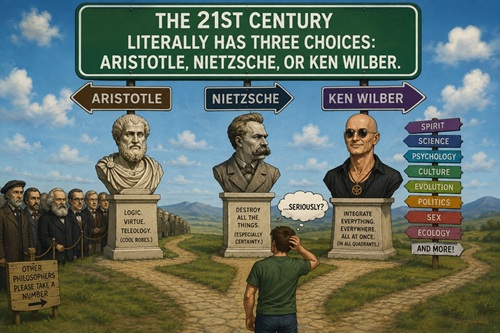 “The twenty-first century literally has three choices: Aristotle, Nietzsche, or Ken Wilber.” — Jack Crittenden, foreword to The Eye of Spirit (1997) There are ambitious blurbs, and then there are blurbs that appear to rewrite intellectual history on the spot. Jack Crittenden's declaration about Ken Wilber belongs to the latter category. “The twenty-first century literally has three choices: Aristotle, Nietzsche, or Ken Wilber.” It is a magnificent sentence. It is also almost certainly one of the most inflated claims ever made about Wilber. The interesting question is not simply whether Crittenden exaggerates. Clearly he does. The more interesting question is what happens when we compare the historical status assigned to Wilber by his admirers with the status he has actually acquired in intellectual life. The contrast is striking. Crittenden presents Wilber as one of three possible destinations of twenty-first-century thought. Actual intellectual history has so far treated him as a highly ambitious, influential and controversial figure on the margins of several academic and intellectual fields—widely read in certain spiritual and integral circles, occasionally engaged by scholars, but hardly comparable in institutional or historical influence to Aristotle or Nietzsche. That gap tells us something important about Wilber's project. The claim is almost comically largeStart with what Crittenden is actually saying. Aristotle is one of the foundational figures of Western philosophy. His work shaped logic, metaphysics, ethics, political philosophy, biology and natural philosophy, and his influence extended across many centuries and intellectual traditions. Nietzsche is one of the defining philosophers of modernity. His critique of morality, religion, metaphysics and European culture became enormously influential across philosophy, literature, psychology, political theory and the humanities. And then there is Ken Wilber. The rhetorical construction is obvious: Aristotle represents one grand intellectual possibility; Nietzsche represents another; Wilber represents the synthesis that the new century must choose. This is not merely praise. It is canonization in advance. The extraordinary thing is that the sentence appeared in the promotion of The Eye of Spirit, a book that presents itself as a comprehensive reconstruction of philosophy, science, psychology, spirituality and cultural history. The publisher itself reproduced Crittenden's endorsement prominently, alongside claims that Wilber was among the most significant thinkers of his time and that his book constituted an “exhaustive exploration” of the history of consciousness. The promotional ecosystem surrounding Wilber thus did not merely say: “Here is an interesting thinker.” It said, in effect: History has arrived at Wilber. That is a very different proposition. But what actually happened?The twenty-first century did not, in fact, organize itself around Ken Wilber. Universities did not reorganize their philosophy departments around AQAL. Psychology did not adopt Wilber's developmental model as its dominant paradigm. Evolutionary biology did not incorporate Wilber's theory of Eros. Philosophy of mind did not begin speaking Wilber's language. Religious studies did not come to regard Integral Theory as the definitive synthesis of Eastern and Western spirituality. Nor did mainstream philosophy discover that there were, after all, only three options. Instead, Wilber developed a substantial following within transpersonal psychology, New Age spirituality, integral studies and associated intellectual networks. His ideas generated books, conferences, institutes, websites, doctoral dissertations and applications in fields ranging from education to leadership and sustainability. That is not nothing. But it is a very different historical phenomenon from becoming the third great philosophical option of the age. The academic reception has been particularly revealing. Scholarly discussions have certainly existed, and there have been serious sympathetic treatments and criticisms. In other words, Wilber has certainly been discussed. But being discussed is not the same as being historically installed. The curious status of “integral” academiaWilber's defenders have understandably objected to the suggestion that Integral Theory has simply been ignored by academia. There have been academic conferences, university programs, dissertations and publications explicitly engaging integral theory. SUNY Press even established a series devoted to Integral Theory. So it would be unfair to portray Wilber as completely unknown in academic circles. But that concession makes the distinction between a developing intellectual movement and a civilization-defining philosophy even more important. The question is not whether there are academics interested in Wilber. There obviously are. The question is whether Wilber occupies anything remotely resembling the historical position of Aristotle or Nietzsche. He does not. And after several decades, that is not a trivial observation. A theory that is supposedly one of the three choices of the twenty-first century should presumably have become difficult for the century's major intellectual institutions to ignore. Instead, Wilber's work has remained largely concentrated in specialized or alternative intellectual communities. Contemporary accounts of his reception explicitly note the continuing gap between Integral Theory and mainstream academia, while also documenting the attempts of integral scholars to establish a more conventional academic presence. This is precisely the sort of distinction that Crittenden's sentence erases. From historical fact to integral mythologyThere is therefore something almost mythological about the statement. It belongs to a genre of integral writing in which Wilber's importance is not merely argued but repeatedly presupposed. Wilber is described as “the Einstein of consciousness research.” His work is presented as the first genuinely comprehensive philosophy. He is said to have created one of the first believable world philosophies. His books are described as the medicine required by the new millennium. And Crittenden places him alongside Aristotle and Nietzsche. The pattern is unmistakable. Wilber is not being introduced into intellectual history. He is being introduced as its next stage. This matters because intellectual status can become self-reinforcing. Once a thinker is repeatedly described as the great synthesizer of his age, later descriptions inherit the claim. The biography becomes part of the theory. The result is a curious feedback loop: Wilber creates a comprehensive theory → admirers describe it as historically unprecedented → that description becomes part of the Wilber narrative → later admirers cite the narrative as evidence of Wilber's historical importance. Eventually, the claim that Wilber is enormously important begins to function as an established fact within the community that already believes it. Outside that community, however, the situation looks rather different. Aristotle and Nietzsche did not need blurbsHere the comparison with Aristotle and Nietzsche becomes unintentionally devastating. Nobody had to tell history that Aristotle was Aristotle. There was no marketing campaign announcing that the next millennium had “three choices: Plato, Aristotle, or Aristotle.” Nietzsche's importance was not established by his publisher commissioning endorsements from sympathetic intellectuals declaring him one of the three possible futures of philosophy. Indeed, Nietzsche's actual historical career was messy, contradictory and initially marginal. His significance emerged through subsequent generations of readers, critics and intellectual movements. That is the crucial distinction. Historical importance is not something a thinker can simply award himself—or have awarded to him by his friends. It is something that happens to a body of work over time. The difference is between declared significance and demonstrated significance. Crittenden gives us the former. History has so far supplied something much more modest for Wilber. Wilber's real achievementNone of this means Wilber is unimportant. Quite the contrary. His actual achievement is interesting enough that it does not require the inflated comparison. Wilber has been remarkably successful at constructing a comprehensive intellectual vocabulary for people who believe that modern science, psychology, spirituality and cultural development need to be understood together. He has also had unusual influence in bringing together ideas that normally occupy separate intellectual compartments. His work attempts to connect developmental psychology with contemplative traditions, systems theory with spirituality, individual consciousness with cultural and social structures. That synthesis has attracted serious scholars as well as enthusiastic practitioners. One early scholarly assessment called attention to both the importance of Wilber's contribution and the controversy surrounding it, while acknowledging his attempt to construct a “world philosophy” integrating science, morals, aesthetics and Eastern and Western traditions. That is a respectable intellectual accomplishment. But it is not Aristotle. And it is not Nietzsche. Nor does it follow that a comprehensive theory is necessarily a better theory. The “ultimate lumper”There is another revealing aspect to Wilber's reception. One of the criticisms of his work is precisely that he integrates too much. Daryl Paulson notes Howard Gardner's characterization of Wilber as the “ultimate lumper”: someone inclined to gather disparate phenomena into a single comprehensive framework. Paulson himself appreciates the attraction of large inclusive models while recognizing the problem. This gets to the heart of the Wilberian project. Wilber's extraordinary breadth is simultaneously his greatest strength and his greatest vulnerability. He reads widely, absorbs enormous numbers of thinkers and places them within an increasingly elaborate architecture. But the fact that Aristotle, Nietzsche, Plotinus, Hegel, Piaget, Kohlberg, Maslow, Buddhism, systems theory and evolutionary biology can all be given a location on an integral map does not demonstrate that the map is correct. It demonstrates that the map is capacious. There is a subtle but important difference. A theory can become so inclusive that almost every disagreement can be translated into a distinction within the theory. At that point, comprehensiveness starts to look suspiciously like immunity from criticism. When critics become “less evolved”The problem becomes especially acute when developmental hierarchy enters the picture. Wilber's framework does not merely classify different perspectives. It often places them within developmental sequences. This creates the possibility that disagreement with integral theory can itself be interpreted developmentally. Perhaps the critic is privileging one quadrant. Perhaps the critic is trapped at an earlier stage. Perhaps the critic has failed to appreciate second-tier consciousness. Perhaps the critic is confusing pre-rational with trans-rational spirituality. This can produce an epistemological asymmetry in which Integral Theory always occupies the more comprehensive position. The critic can be explained. Integral Theory need not be. That is a dangerous structure for any intellectual system. It is also rather different from the situation with Aristotle and Nietzsche. Their theories have been attacked from every direction without the response that the critics simply occupy an inferior developmental level. A philosophical framework should be capable of losing an argument. The irony of the three choicesThis brings us back to Crittenden's sentence. The irony is that the more literally we take it, the less credible it becomes. If “Aristotle, Nietzsche, or Wilber” means that Wilber draws on both systematic metaphysics and Nietzschean critique, then the statement is an amusing shorthand for his synthesis. If it means that Wilber is historically comparable to Aristotle and Nietzsche, it is indefensible at present. And if it means that the twenty-first century actually has only three intellectual choices, it is simply absurd. There is another possibility, of course. Perhaps Crittenden was not making a prediction about intellectual history at all. Perhaps he was making a declaration of faith. Within the integral movement, the sentence makes perfect sense. Outside it, the sentence sounds extraordinary because the evidence needed to support it is missing. The reception gapThe real story of Wilber is therefore much more interesting than the blurb. On one side we have the internal assessment: Wilber is a revolutionary synthesizer, a major philosopher, the Einstein of consciousness, perhaps the thinker who will define the twenty-first century. On the other side we have the external historical record: Wilber is a prominent and unusually ambitious figure in transpersonal and integral circles whose work has attracted a dedicated following, some academic engagement, substantial criticism, and persistent skepticism about its scientific and philosophical claims. Those are not remotely the same thing. And after roughly half a century of Wilber's intellectual career, the discrepancy deserves attention. Perhaps the mainstream has simply failed to recognize the genius. That is possible. But it is also possible that the integral community has systematically overestimated the historical significance of its central thinker. Only history can decide between those possibilities. What the twenty-first century actually hasThe twenty-first century does not have three choices. It has thousands. And this is particularly obvious in the fields Wilber hopes to synthesize. Contemporary philosophy of mind, neuroscience, evolutionary biology, developmental psychology, contemplative science, anthropology and religious studies are not waiting patiently for Wilber's final synthesis. They are producing their own competing explanations. Some of those explanations may eventually be incorporated into an integral framework. Others may demonstrate that parts of the framework are mistaken. That is how intellectual progress normally works. The interesting question is therefore not whether the twenty-first century chooses Aristotle, Nietzsche or Wilber. It is whether Wilber's ideas can survive without the protection of the claim that they are historically inevitable. That would be the real test. If integral theory contains genuinely original insights, those insights will remain valuable even when detached from the mythology surrounding their author. If its developmental psychology is sound, empirical research should strengthen it. If its theory of spirituality is correct, comparative religious studies and contemplative science should increasingly confirm it. If its evolutionary metaphysics is valid, it should survive contact with evolutionary biology. If its synthesis is genuinely superior to competing frameworks, scholars will eventually discover that they cannot do without it. No blurb can accomplish any of these things. A fourth choicePerhaps, then, Crittenden's sentence should be rewritten. The twenty-first century does not literally have three choices. It has a choice between taking Wilber's claims on authority and testing them against the rest of intellectual life. And there is a third possibility that Crittenden forgot: move beyond Wilber altogether. That would not necessarily be a defeat for Wilber. In fact, it might be the highest compliment his work could receive. Aristotle survived because later thinkers did not remain Aristotelians. Nietzsche survived because later thinkers did not simply become Nietzscheans. Their ideas became ingredients in intellectual traditions much larger than themselves. If Wilber is destined to become historically important, the same thing will have to happen to him. His useful distinctions will be retained, his mistakes discarded, his insights appropriated by people who do not regard AQAL as sacred, and his ideas transformed beyond what he himself intended. That would be genuine intellectual influence. Until then, Crittenden's sentence should be read for what it actually is: not a historical verdict, but a piece of integral movement rhetoric. And perhaps that is why it remains such a revealing Wilber quotation. Aristotle and Nietzsche became giants because history made them so. Wilber's admirers announced that he was a giant before history had a chance to vote. The twenty-first century, as it turns out, has been rather less impressed by the blurb.
Widget is loading comments...
|