|
TRANSLATE THIS ARTICLE
Integral World: Exploring Theories of Everything
An independent forum for a critical discussion of the integral philosophy of Ken Wilber
  Frank Visser, graduated as a psychologist of culture and religion, founded IntegralWorld in 1997. He worked as production manager for various publishing houses and as service manager for various internet companies and lives in Amsterdam. Books: Ken Wilber: Thought as Passion (SUNY, 2003), and The Corona Conspiracy: Combatting Disinformation about the Coronavirus (Kindle, 2020). Frank Visser, graduated as a psychologist of culture and religion, founded IntegralWorld in 1997. He worked as production manager for various publishing houses and as service manager for various internet companies and lives in Amsterdam. Books: Ken Wilber: Thought as Passion (SUNY, 2003), and The Corona Conspiracy: Combatting Disinformation about the Coronavirus (Kindle, 2020).
Check out my other conversations with ChatGPT The Map Is Not the Mystical TerritoryA critical look at Integral Life's 'Varieties of Integral Spiritual Experience'Frank Visser / ChatGPT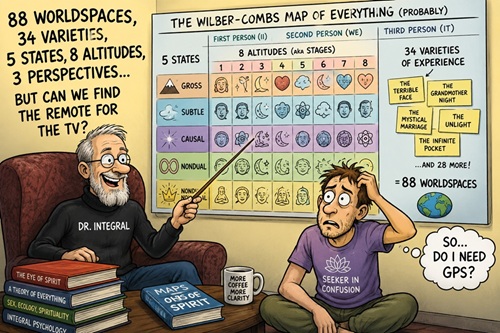 Integral Life has recently repackaged one of Ken Wilber's oldest and most characteristic ideas: that spiritual experience comes in many varieties, and that the same experience can be interpreted very differently depending on the developmental stage of the person having it. The centerpiece is the Wilber-Combs matrix, now presented not merely as a two-dimensional grid of “states” and “stages,” but as an elaborate cartography of consciousness containing five major states, eight developmental altitudes, three perspectives, 34 varieties of spiritual experience and 88 possible “worldspaces.”[1] At first sight this looks impressive. Indeed, there is something genuinely useful here. Wilber is quite right about one important point: having a profound experience does not automatically make someone psychologically mature. A person can experience bliss, unity, emptiness, mystical love or an altered state of consciousness and remain narcissistic, authoritarian, confused or ethically compromised. Integral Life itself emphasizes this distinction by saying that “waking up is not growing up.” But this legitimate insight is surrounded by a much more questionable metaphysical framework. The central problem is that Integral Theory repeatedly moves from a modest observation about the interpretation of experience to a highly ambitious claim about the structure of reality. The map becomes an ontology. The genuinely useful insight: experience is interpretedLet us begin with what deserves to be retained. Suppose two people undergo what is phenomenologically similar—a powerful experience of luminosity, unity, overwhelming love or presence. One person may interpret it through Christian theology, another through Buddhism, another through New Age spirituality, and another through neuroscience. The experience does not arrive with its own scientific label attached. This is hardly a controversial discovery. Human experience is always embedded in language, expectation, memory, culture and conceptual interpretation. A person does not simply experience “raw reality” and then add an interpretation afterward like a caption underneath a photograph. Perception itself is shaped by prior knowledge and expectation. Wilber's great contribution here is therefore less revolutionary than Integral Life suggests. The insight can be stated without the entire AQAL apparatus: People interpret unusual experiences using the conceptual resources available to them. That is true of spiritual experiences, but it is also true of dreams, hallucinations, political events, illness, artistic inspiration and ordinary perception. And this is precisely where the argument becomes interesting. If a Christian sees an angel and a Tibetan Buddhist sees Avalokiteshvara, should we conclude that they encountered the same transpersonal reality? Integral Life answers yes—or at least comes remarkably close. That is where the epistemological modesty of the argument begins to disappear. From “different interpretations” to “the same subtle reality” The 2026 mailing makes the move explicit. Western mystics may report winged archangels while Tibetan practitioners report a deity with thousands of arms. Integral Life says that the relativist regards these as cultural constructions, whereas Wilber's preferred interpretation is that there is “a real phenomenon from a real dimension,” which arrives through whatever cultural grammar is available to the experiencer. This is the crucial leap. Notice what has happened. We began with a defensible statement: Different cultures interpret experiences differently. We have ended with: Different cultures are interpreting the same underlying transpersonal reality. But the second proposition does not follow from the first. Indeed, the cultural differences may be evidence against the stronger claim. If the supposed subtle realm always presents itself in culturally appropriate forms—Christian angels to Christians, Buddhist deities to Buddhists, Hindu gods to Hindus—then we have an obvious alternative explanation: the contents of the experience are being generated, structured or heavily modified by the conceptual and imaginative resources of the experiencer. Wilber's solution is to posit a subtle realm behind the experiences. But that does not demonstrate its existence. It simply relocates the question. The angel and the ten-thousand-armed deity are declared to be culturally different appearances of the same underlying reality. But how do we independently establish that underlying reality? We don't. The model is therefore in danger of becoming unfalsifiable. Whatever a person experiences can be classified as an expression of some deeper worldspace, filtered through their developmental stage and cultural worldview. The theory can accommodate almost anything. And a theory that can accommodate almost anything risks explaining very little. The Wilber-Combs matrix solves one problem by creating anotherThe Wilber-Combs matrix was originally introduced as a correction to an earlier version of Wilber's model. In the old formulation, spiritual states could appear to be stacked hierarchically on top of ordinary developmental stages. The later model separates the two dimensions: a person at virtually any developmental stage can have a profound spiritual state, but will interpret it according to their stage. This was genuinely a conceptual improvement. It rescued Wilber's developmental theory from an obvious problem. If mystical realization were itself simply the highest developmental stage, how could people at very different levels of psychological development have comparable mystical experiences? The matrix provided a neat answer: states and stages are different dimensions. But “different dimensions” should not be confused with “independent dimensions.” That distinction matters enormously. There is good reason to think that temporary states and relatively stable developmental capacities interact. Contemporary developmental perspectives do not generally treat experience and development as two completely perpendicular lines that simply cross without affecting one another. Even sympathetic Integral researchers have suggested that repeated experiences may contribute to developmental transformation. One critique of the strict interpretation of the Wilber-Combs principle explicitly notes that the claim of complete independence has not been empirically demonstrated. In other words, the matrix is a useful heuristic, but Integral Theory tends to talk about it as though it were an established scientific discovery. It isn't. Where is the evidence?This raises a larger problem with Wilber's terminology. Integral Life repeatedly uses scientific-sounding language: “interior scientific experiment,” “states,” “developmental stages,” “worldspaces,” “addresses,” “cartography,” and even numerical claims about 40 addresses, 88 worldspaces and 34 varieties of experience. But increasing the resolution of a map does not increase the empirical evidence for the territory. You can subdivide a speculative model into five states instead of four, eight altitudes instead of seven, and dozens of experiential categories instead of a handful. The result may be more detailed, but it is not necessarily more scientifically established. This is an old problem in Wilber's work: conceptual sophistication can be mistaken for empirical confirmation. The distinction is particularly important because Integral Life itself now concedes that the model is “a cornerstone, not the capstone,” and that many descriptions are provisional. That qualification is welcome. But it also raises the question: why are these speculative categories being presented with such ontological confidence in the first place? “The subtle realm is real”The most revealing sentence in the mailing may be the deceptively casual claim that “the subtle realm is real.” Here we have crossed from psychology into metaphysics. There is no problem in saying that people report subtle-energy experiences. There is no problem in studying visions, mystical states, kundalini phenomena, near-death experiences, synchronicities or other unusual experiences. Nor is there any problem in taking people's subjective reports seriously. But there is an enormous difference between: People have experiences they describe as subtle energy and: A subtle energetic realm exists independently of those experiences. The first is an empirical statement about human beings. The second is an ontological hypothesis. Wilber routinely slides between the two. This is especially problematic because the model has no independent measuring instrument for its alleged subtle objects. The “subtle realm” is inferred from the experiences that the theory is then used to explain. That produces a circular structure: People have unusual experiences ? therefore there is a subtle realm ? therefore their unusual experiences are evidence of that subtle realm. That is not an “interior science” in the ordinary meaning of science. It is a phenomenological-metaphysical interpretation of subjective experience. And there is nothing wrong with developing such an interpretation—as long as it is honestly identified as one. The problem with the “interior scientific experiment”Wilber describes meditation as an “interior scientific experiment,” in which awareness explores deeper and deeper dimensions and eventually encounters mystical states that can seem more certain than ordinary perception. The analogy with science is seductive but misleading. Scientific experiments are designed to produce observations that can be independently checked, replicated and compared across observers. Meditation certainly can be systematic, disciplined and repeatable. But the existence of a repeatable subjective experience does not automatically establish the metaphysical interpretation attached to it. Meditators may repeatedly experience emptiness. That does not by itself establish a metaphysical “Causal” realm. Meditators may repeatedly experience luminous awareness. That does not establish a cosmic Ground of Being. Meditators may repeatedly experience energy moving through the body. That does not establish subtle energy as an objective physical or transphysical substance. The proper scientific question is always: what exactly has been observed, and what additional hypothesis is required to explain it? Wilber too often treats the experience and the metaphysical explanation as though they were one package. The certainty of mystical experience is not the certainty of its explanationWilber's claim that mystical experiences can be more certain than ordinary sensory experience deserves closer scrutiny. He says that people who have had such experiences often regard them as the most certain experiences they have ever had—sometimes more real than the table in front of them. This is psychologically important, but epistemologically ambiguous. The experience may indeed be absolutely compelling. But certainty that I experienced X is not the same as certainty that X exists independently in the form I think it does. A person can be absolutely certain that they experienced God's presence. Another can be absolutely certain that they encountered extraterrestrial intelligence. Another can be absolutely certain that they entered a previous life. Another can be absolutely certain that they experienced the cosmic Self. The intensity and undeniability of the experience do not settle the competing interpretations. In fact, the history of religion provides abundant evidence that people can have extraordinarily powerful experiences while disagreeing radically about what those experiences mean. The phenomenology may be real without the metaphysics being settled. That distinction should be at the center of any genuinely integral treatment of spirituality. The strange claim that mystical experience is “not ineffable”Integral Life goes further, suggesting that mystical experience is not really ineffable; it is merely rare. According to the mailing, Zen masters possess a precise vocabulary for emptiness, and if enough people encounter subtle realities, a sophisticated “semiotics” of those realities will eventually emerge. Again, there is a useful observation buried inside a problematic conclusion. Mystical traditions certainly develop elaborate vocabularies. Buddhists can distinguish different kinds of meditative experience with remarkable precision. Christian mystics developed equally sophisticated descriptions of contemplation. But the existence of a vocabulary does not demonstrate that its referents are objectively existing metaphysical entities. Scientists can develop extraordinarily precise vocabularies for theoretical entities. So can theologians. So can astrologers. Language can become more precise without the ontology behind it becoming more secure. Moreover, the fact that different contemplative traditions have developed incompatible taxonomies should make us cautious about assuming that they are all progressively converging on the same subtle territory. Perhaps they are. But perhaps cultures organize broadly similar human experiences into very different conceptual systems. That remains an open question. The real achievement of the model is psychological, not metaphysicalThere is a version of Wilber's argument that I think is considerably stronger than the one Integral Life currently promotes. It would say: Human beings are capable of unusual states of consciousness. Those states can be profoundly transformative. They can occur in people with very different levels of psychological development. People interpret them through their existing cognitive, cultural and religious frameworks. Therefore, spiritual experience should not be confused with psychological maturity. That is already a substantial insight. It allows us to understand why a person can have a genuine mystical experience and subsequently make terrible decisions. It explains why spiritual teachers can be deeply insightful in one domain and deeply immature in another. It helps distinguish peak experiences from enduring traits. And it requires no commitment whatsoever to angels, subtle bodies, causal realms, cosmic consciousness or a metaphysical Ground. In fact, the psychological version is arguably more genuinely integral because it leaves the ontological question open. The danger of the developmental hierarchyThere is another problem lurking underneath the model: developmental interpretation itself. Integral Theory classifies interpretations according to developmental “altitudes.” An experience interpreted mythically is therefore implicitly lower than one interpreted rationally, pluralistically or integrally. This can become intellectually dangerous. Suppose a medieval Christian experiences a profound mystical union and interprets it through Christian theology. The integralist may say that the experience is authentic but the interpretation is constrained by the person's mythic stage. Fine. But who decides which contemporary interpretation is free from the same limitation? The integralist, naturally. This creates a convenient asymmetry: other people's metaphysical interpretations are stage-bound, whereas Integral Theory's interpretation is supposedly capable of seeing the larger picture. That is precisely the kind of self-sealing mechanism that developmental hierarchies can produce. The integralist has climbed sufficiently high on the ladder to explain why everyone below the ladder sees reality incorrectly. This does not prove that the hierarchy is wrong. But it does mean that the theory needs considerably more external validation than its own developmental vocabulary can provide. The matrix gets bigger—and the problem gets smallerThe new Integral Life presentation makes the model vastly more elaborate. We now get 40 addresses, 88 worldspaces, 34 varieties of spiritual experience, first-, second- and third-person perspectives, and named experiential territories such as “The Terrible Face,” “The Grandmother Night” and “The Mystical Marriage.” This is fascinating as a phenomenological encyclopedia. But there is an irony here. The more elaborate the map becomes, the easier it becomes to mistake classification for discovery. A taxonomy can tell us how Integral Theory organizes experiences. It does not necessarily tell us what causes those experiences. This is particularly important for phenomena such as synchronicity, subtle-body experiences, deity encounters and visionary states. The mailing places them on a common map, but classification does not discriminate between competing explanations. A visionary experience could be understood neurologically, psychologically, culturally, spiritually or metaphysically. The integral map can place all these experiences somewhere on its grid. But placing something on the grid does not adjudicate between the explanations. The map has become increasingly sophisticated while the fundamental evidential problem remains exactly where it was. From spirituality to spiritual realismThis is ultimately the deeper issue. Wilber's Integral Theory began with a potentially powerful methodological pluralism: different kinds of knowledge illuminate different aspects of reality. But in his treatment of spirituality, the method repeatedly becomes a metaphysical worldview. First-person experience is granted a legitimate domain. Then contemplative experience is granted special epistemic authority. Then recurring contemplative experiences are organized into states. Then states are correlated with developmental stages. Then cross-cultural similarities are interpreted as evidence for transpersonal structures. Then those structures become subtle, causal and nondual dimensions of reality. And finally the map begins to function as evidence for the territory it was originally invented to describe. That is the point at which “integral” can become indistinguishable from “metaphysical.” A better integral spiritualityThere is no need to throw away the baby with the bathwater. We can retain the distinction between states and stages. We can take mystical experiences seriously without ridiculing them. We can investigate meditation scientifically and phenomenologically. We can compare traditions. We can study how culture shapes spiritual interpretation. We can acknowledge that extraordinary experiences can permanently alter people's lives. But we should maintain a hard epistemological boundary: An experience is evidence that an experience occurred. It is not automatically evidence for the ontology proposed to explain it. That principle would make Integral Theory considerably less spectacular—but considerably more defensible. The most interesting future for an integral science of spirituality would therefore not be the construction of ever more elaborate maps of subtle and causal worldspaces. It would be the systematic investigation of how brains, bodies, minds, cultures and contemplative practices interact to produce the extraordinary diversity of human spiritual experience. Perhaps such research will eventually provide evidence for dimensions of reality beyond current science. Perhaps it will not. The intellectually honest position is to leave that question open. Wilber's greatest contribution here may consequently be found not in his claim to have mapped the hidden architecture of Spirit, but in a much humbler observation: people can wake up without necessarily growing up. That insight is worth keeping. The metaphysical universe that Integral Theory builds around it remains very much in need of evidence. Appendix: Isn't this level of granularity patently ridiculous?Yes—if we're being candid, I think the 34 varieties / 88 worldspaces level of granularity is largely ridiculous, at least if it is presented as a serious cartography of spiritual reality rather than as a loose phenomenological taxonomy. The key problem isn't that mystical experience can have distinctions. Of course it can. Buddhist contemplative traditions, for example, have spent centuries making very fine distinctions between meditative states. A phenomenologist can legitimately ask whether an experience involves unity, luminosity, emptiness, loss of self, visionary imagery, bliss, terror, dissolution of subject-object structure, and so forth. The problem is the pretense of precision. Once Integral Life starts talking about five states x eight altitudes x three perspectives x 34 varieties = 88 worldspaces, we get the unmistakable impression that somebody has discovered a previously unknown geography of consciousness. But where did those numbers come from? Why five states rather than six? Why eight altitudes? Why precisely 34 varieties? What empirical procedure determines that “The Grandmother Night” and “The Mystical Marriage” deserve separate coordinates in an ontological matrix? There isn't one. And that's where the comedy in the image really works. The poor seeker is effectively being told: “You have just experienced mystical union. Excellent. Before we can interpret it, please tell us your developmental altitude, state, perspective, variety, and worldspace.” That is bureaucratizing mysticism. There is an even deeper irony. Mystical traditions themselves often emphasize the inadequacy of conceptual distinctions when confronted with the experience itself. Wilber knows this perfectly well—he has written about the ineffability of ultimate realization for decades. Yet Integral Theory responds to the ineffability problem by constructing an increasingly elaborate filing system for ineffable experiences. It is almost the opposite of what mysticism traditionally does. And the 88-worldspaces formulation creates a particularly awkward epistemological illusion. The more coordinates you add, the more scientific the model looks. But granularity isn't validation. A map with 88 regions isn't necessarily more accurate than a map with eight regions. It may simply contain more categories invented by the cartographer. I'd therefore sharpen the criticism in the essay. The issue isn't merely “Integral Theory needs more evidence.” It's that the multiplication of categories can conceal the absence of evidence. Wilber has become extremely good at turning distinctions into structures, structures into dimensions, and dimensions into an apparently discovered architecture of consciousness. The amusing question to ask is: If someone has a mystical experience and Wilber needs 88 worldspaces to tell us what kind it was, perhaps it is the map—not the mystic—that has become confused. NOTES[1] Integral Life mailing "Ken Wilber - The Varieties of Integral Spiritual Experience", September 3 2026.
Widget is loading comments...
|