|
TRANSLATE THIS ARTICLE
Integral World: Exploring Theories of Everything
An independent forum for a critical discussion of the integral philosophy of Ken Wilber
  Frank Visser, graduated as a psychologist of culture and religion, founded IntegralWorld in 1997. He worked as production manager for various publishing houses and as service manager for various internet companies and lives in Amsterdam. Books: Ken Wilber: Thought as Passion (SUNY, 2003), and The Corona Conspiracy: Combatting Disinformation about the Coronavirus (Kindle, 2020). Frank Visser, graduated as a psychologist of culture and religion, founded IntegralWorld in 1997. He worked as production manager for various publishing houses and as service manager for various internet companies and lives in Amsterdam. Books: Ken Wilber: Thought as Passion (SUNY, 2003), and The Corona Conspiracy: Combatting Disinformation about the Coronavirus (Kindle, 2020).
Check out my other conversations with ChatGPT The Book That Never ArrivedWhat Happened to Kindred Visions, Ken Wilber's Lost Anthology of Integral Acclaim?Frank Visser / ChatGPT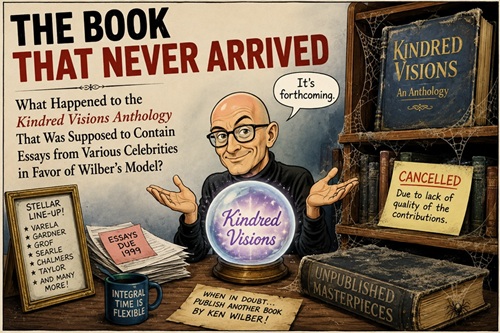 There is a curious footnote in the history of Ken Wilber's integral movement: a book that, for a while, was presented as one of the clearest signs that Wilber's work had entered a new phase of intellectual influence simply disappeared. It was called Kindred Visions. It was supposed to gather essays by an extraordinary constellation of scientists, philosophers, psychologists, spiritual teachers, artists, and cultural figures, many of whom were prominent names in their respective fields. The volume was associated with Shambhala Publications, was being assembled under the editorship of Jack Crittenden and others, and was repeatedly announced as forthcoming around the turn of the millennium. It never appeared. That fact is more interesting than it might initially seem. The story of Kindred Visions is not merely the story of an abandoned publishing project. It offers a revealing glimpse into the difference between being surrounded by distinguished people who find aspects of one's work interesting and having one's theoretical system independently validated by those people. It also illustrates a recurring feature of the Wilber phenomenon: the tendency to treat intellectual proximity, personal endorsement, or participation in an integral project as evidence for the truth or comprehensiveness of Integral Theory itself. The available evidence allows us to reconstruct much of the story, although not every detail of the book's demise. A book designed to demonstrate a movementThe origins of Kindred Visions seem to lie partly in the aftermath of Ken Wilber in Dialogue, the 1998 collection edited by Donald Rothberg and Sean Kelly. That book brought Wilber into dialogue with a range of important figures in transpersonal psychology and related fields. It was a genuine intellectual exchange, including criticism of Wilber's positions. The proposed Kindred Visions project represented something rather different. According to my own earlier account, I was contracted by Shambhala as one of its editors. The projected book was initially expected around 2002 and was intended to contain essays by well-known figures in consciousness studies and spirituality. Wilber himself described the project enthusiastically in A Theory of Everything. There he presented Kindred Visions as a forthcoming Shambhala volume, edited by a team headed by Jack Crittenden, and listed an astonishing roster of contributors. Among the names were Alex Grey, Stanislav Grof, Georg Feuerstein, Larry Dossey, Roger Walsh, Francisco Varela, Ervin Laszlo, Howard Gardner, Robert Kegan, John Searle, Charles Taylor, David Chalmers, Robert Forman, Michael Murphy, Lama Surya Das, Don Beck, Susanne Cook-Greuter and many others.[1] This was quite a list. And that list was itself part of the significance of the project. The book was not simply supposed to be another collection of essays about spirituality. It seemed to promise something much larger: recognition of Wilber by an intellectual and spiritual establishment outside his immediate circle. The implied message was difficult to miss. Here were consciousness researchers, developmental psychologists, philosophers, spiritual teachers and cultural innovators—all apparently converging upon a more integral understanding of reality, with Wilber providing the overarching conceptual framework. In retrospect, this was an extraordinarily ambitious claim. The roster was impressive—but what did it actually prove?The first complication is that the proposed contributors did not constitute a homogeneous intellectual school. The list included people whose theoretical commitments differed substantially, sometimes radically, from Wilber's. Francisco Varela, for example, was an important figure in embodied cognition and neurophenomenology. John Searle was a major analytic philosopher of mind. Howard Gardner was famous for his theory of multiple intelligences. David Chalmers became one of the leading contemporary philosophers of consciousness. Charles Taylor developed a sophisticated philosophical account of modernity and secularization. Stanislav Grof represented psychedelic and transpersonal psychology. Jean Gebser scholar Georg Feuerstein occupied yet another intellectual territory. To place all these people under the heading of "leading integral thinkers" risks making integral so broad that it becomes almost synonymous with "people who reject crude reductionism." And this is precisely where the distinction between convergence and confirmation becomes crucial. Someone can agree with Wilber that consciousness matters without accepting his developmental stage model. Someone can appreciate his attempt to synthesize different traditions without accepting his four-quadrant architecture. Someone can admire his writing without accepting his claims about evolution. Someone can find the notion of "integral" useful without believing that Wilber has produced a comprehensive theory of everything. Yet the rhetoric surrounding Kindred Visions tended to blur these distinctions. Wilber's own description in A Theory of Everything is revealing. He wrote that these people had "contributed" to a more integral and gracious view of the Kosmos, and added that many of the theorists contributing to Kindred Visions had joined him in establishing the Integral Institute. The project therefore existed within a larger institutional strategy. It was not merely a scholarly anthology. It was part of the construction of an integral intellectual movement. Some contributions really did existIt would nevertheless be wrong to conclude that Kindred Visions was entirely imaginary. There is concrete evidence that actual essays were written for the project. One particularly interesting case is Georg Feuerstein. Wilber quoted Feuerstein's essay on Jean Gebser and Wilber's spectrum model as coming from Kindred Visions. The quotation was already being used by Wilber in his debates with Allan Combs, even though the book itself remained unpublished. Another important case is Robert McDermott. In 1999 Wilber invited him to contribute an essay. McDermott eventually submitted a substantial piece on classical American thought and Rudolf Steiner. He later explained that he understood the project to have stalled and subsequently published part of his essay elsewhere. So there really was a manuscript-in-progress. This makes the eventual disappearance more intriguing. The problem was not simply that Wilber announced a book that never existed. There were contributors, commissioned essays, editorial activity and a publisher involved. The project got far enough to become a genuine publishing proposition. And then it stopped. Frank Visser's explanation: the quality problemThe most direct explanation comes from my own later recollection of the project. In a discussion of Wilber's tendency to surround himself with admirers, I wrote that Kindred Visions was supposed to include contributions from scientific and philosophical luminaries reflecting favorably on Wilber's work, but that it was never published, "mostly due to lack of quality of the contributions." That is a striking explanation because it points to a problem deeper than logistics. An anthology of this kind has to work as a book. A famous list of contributors is not enough. Each essay has to be substantial, coherent, relevant to the theme, and sufficiently original to justify publication. And if the editorial premise is that distinguished thinkers are independently confirming or extending a particular theory, the essays need to demonstrate something more than polite appreciation. Perhaps that was precisely where the project encountered difficulties. The contributors may have been impressive individually, but a collection of essays by famous people does not automatically become an intellectual vindication of the theory that brought them together. Indeed, the more prestigious the names, the more obvious the problem becomes. If a philosopher such as Searle contributes an essay that merely touches upon questions compatible with Wilber's concerns, that does not establish Wilber's model. If a developmental psychologist discusses stages of human development, that does not establish Wilber's particular stage scheme. If a consciousness researcher endorses an expanded conception of consciousness, that does not establish Wilber's AQAL architecture. The anthology would have had to demonstrate actual theoretical convergence. That is a much harder task. The Robert McDermott episode is revealingMcDermott's experience provides an unusually revealing glimpse behind the scenes. He had accepted Wilber's invitation in January 1999 and promised an essay connecting classical American thought and Rudolf Steiner with Wilber's thought. After considerable work, he submitted the finished essay in January 2000. He received no acknowledgement from Wilber or the publishers. McDermott understood from colleagues that the book had stalled. This suggests that the project did not collapse overnight. It appears to have entered a prolonged period of editorial uncertainty. And this is important because the chronology tells us something about the transformation of Wilber's career at precisely this moment. The early 2000s were the period in which Wilber was moving from being a highly prolific individual author toward becoming the center of an organized integral movement. The Integral Institute was being established; integral applications were being announced in psychology, medicine, business, ecology, education, politics and other fields; and Wilber's public rhetoric increasingly emphasized the emergence of a new integral culture. Kindred Visions would have been an ideal intellectual showcase for this transformation. Its disappearance therefore left a conspicuous hole. From anthology to institutional movementOne possible reason the book became less important is that the Integral Institute itself superseded it. The proposed anthology and the Institute were closely connected. Wilber explicitly said that many of the theorists associated with Kindred Visions had joined him in establishing the Institute. This changed the function that the anthology was supposed to perform. A book is static. An institution can generate conferences, publications, courses, websites, projects, media appearances and new applications indefinitely. Instead of proving the emergence of integralism through one prestigious volume, Wilber could demonstrate it through an expanding network of people and initiatives. In that sense, Kindred Visions may have become redundant. The movement itself became the anthology. Or, more precisely, the appearance of a movement became more important than the publication of a single book demonstrating its intellectual foundations. The curious fate of the promised celebritiesThere is another important historical detail. Over the years, the list of names associated with Kindred Visions acquired something of a legendary quality. The roster is repeatedly reproduced in secondary literature and in Wilber-related publications. Even years later, descriptions of the project continued to cite people such as Varela, Gardner, Searle, Chalmers, Taylor, Grof and others. But there is a crucial difference between saying: "X contributed to Kindred Visions" and saying: "X endorsed Ken Wilber's Integral Theory." Those propositions are not equivalent. Indeed, the fate of the book makes the distinction particularly important. Because the anthology never appeared, readers cannot easily inspect the essays as a whole and determine how strongly these figures actually endorsed Wilber's model. That creates an epistemic asymmetry. The names survived. The book did not. Consequently, the prestige of the roster could continue circulating independently of the evidence that the finished anthology would actually have contained. The missing book became a kind of evidential ghostThis may be the most fascinating aspect of the entire episode. For years, Kindred Visions functioned rhetorically as a forthcoming book. It could be invoked as evidence that Wilber's ideas were attracting widespread support. The fact that it was forthcoming meant that the claims it was supposed to substantiate could not yet be checked by readers. The anthology consequently acquired the status of an evidential ghost: always on the horizon, never quite available for inspection. Wilber could point toward the remarkable people involved. Supporters could point toward the forthcoming volume. Critics could be told, implicitly or explicitly, that the intellectual world was catching up with Wilber. But the ultimate test—opening the book and reading what these people actually said—never arrived. This is one reason the cancellation matters historically. Had the book appeared and contained genuinely substantial essays by dozens of independent scholars demonstrating the explanatory power of Wilber's framework, it might have been a landmark publication. Had it appeared and contained mostly vague appreciations, that too would have been informative. Had it contained serious disagreements alongside appreciation, it might have been even more valuable. Instead, we have fragments. An unpublished Feuerstein essay here. A McDermott manuscript there. References in Wilber's own books. A formidable list of names. And finally, a bibliographical entry recording that the project was cancelled. Why wasn't it revived?The obvious question is why the anthology was not simply reworked and published later. By the mid-2000s, Wilber's public profile was arguably stronger than it had been when the project began. Integral Institute existed. A Theory of Everything had appeared. Integral applications were proliferating. There was a growing community of practitioners and writers. Yet the anthology remained unpublished. That suggests that the problem was not merely insufficient publicity or a temporary publishing delay. A later bibliographical record explicitly lists Kindred Visions, attributed to Jack Crittenden, Brad Reynolds and Frank Visser, as a two-volume Shambhala project that "has been cancelled." The cancellation therefore appears definitive. And perhaps by then the intellectual landscape had changed. Wilber had moved rapidly from the relatively open field of transpersonal dialogue toward an increasingly elaborate and proprietary version of Integral Theory. The project that might have made sense in 1999 or 2000—"What do leading thinkers think of Wilber?"—was less compelling once the integral movement had become increasingly centered around Wilber's own conceptual vocabulary and institutional network. The irony of the "Kindred" in Kindred VisionsThere is an irony in the title itself. "Kindred Visions" suggests a community of thinkers who arrive independently at related insights. That is a perfectly legitimate intellectual phenomenon. Intellectual movements are often born in precisely this way: different people discover overlapping patterns and eventually recognize their affinities. But there is a danger when kindredness is mistaken for agreement. The thinkers on the proposed roster did not necessarily share Wilber's ontology, epistemology, developmental psychology or evolutionary theory. Many had their own research programs and intellectual genealogies. The stronger interpretation of the anthology would therefore have been: Here are many important thinkers whose work has interesting affinities with certain aspects of Wilber's project. The stronger claim—which the rhetoric around the project sometimes encouraged—was: Here are many distinguished thinkers whose work confirms or participates in Wilber's integral synthesis. The second claim requires considerably more evidence. And Kindred Visions never supplied it. A lost opportunity for genuine intellectual debateThere is, finally, a more charitable way to view the project. Perhaps Kindred Visions should never have been a Festschrift for Wilber at all. It could have been a genuinely important book if it had allowed the contributors to say: "Here is where Wilber is right, here is where he is wrong, here is what he has missed, and here is where his framework might be useful." That would have produced a very different kind of intellectual landmark. In fact, that is precisely what was missing from much of the subsequent integral literature: a sufficiently adversarial engagement between Wilber's model and the strongest alternative theories of consciousness, development, evolution and social theory. My own later suggestion was that a "Contrarian Views" volume would have been far more interesting than another celebration of Wilber. Such a book could have put Wilber alongside his critics rather than merely his admirers. It could have asked whether AQAL actually explains more than competing models; whether Wilber's developmental stages withstand empirical scrutiny; whether his evolutionary metaphysics is scientifically defensible; whether his interpretation of Gebser, Aurobindo and other sources is historically accurate; and whether "integral" functions as a genuine explanatory theory or as a powerful classificatory vocabulary. Those questions remain largely unanswered by the existence of an impressive list of names. The lesson of the vanished anthologySo what happened to Kindred Visions? The safest answer is also the most interesting one. It was a real Shambhala publishing project, associated with Wilber and a substantial group of editors and contributors; essays were actually commissioned and written; Wilber publicly promoted the project and listed an impressive array of intended contributors; but the anthology stalled and was eventually cancelled. The precise internal reasons cannot be reconstructed completely from the surviving public record. But the available testimony points toward editorial and quality problems rather than some dramatic ideological rupture. The project simply failed to become the substantial book that its publicity promised. Its disappearance is therefore more than a publishing curiosity. It illustrates a central problem in the history of Integral Theory: the difference between an expanding circle of people who are sympathetic to integral ideas and independent intellectual validation of Wilber's specific theoretical claims. The proposed anthology was supposed to demonstrate the former and, implicitly, strengthen the case for the latter. But the book never arrived. And that makes Kindred Visions an unusually revealing artifact of the Wilber era. It survives not as a book but as a promise—a promise of intellectual convergence that can no longer be tested in the form in which it was originally advertised. Perhaps that is why the lost anthology remains worth investigating. The most interesting question is no longer "Why wasn't Kindred Visions published?" It is: What would we have discovered if it had been? Provide the full list of contributors to Kindred Visions you summarized from A Theory of EverythingI checked the actual passage in A Theory of Everything rather than relying on my previous summary. Wilber gives the following list of contributors to the then-forthcoming Kindred Visions—Ken Wilber and Other Leading Integral Thinkers. The complete list
Wilber then adds "among many others", so these 44 names constitute the complete named list in the passage, not necessarily the complete list of people who had supposedly contributed to the project.[2] There are a couple of details worth emphasizing for your essay. First, Wilber's wording is quite strong: he says the book was being assembled by a team headed by Jack Crittenden and that it "includes contributions" from these people. He then says that "all of these men and women have contributed, in their own significant ways, to a more integral and gracious view of the Kosmos." Second, the list is considerably more heterogeneous than the phrase "Leading Integral Thinkers" suggests. It includes philosophers such as John Searle, David Chalmers and Charles Taylor, cognitive/developmental scholars such as Howard Gardner and Robert Kegan, consciousness researchers such as Francisco Varela and Max Velmans, spiritual teachers such as Thomas Keating and Lama Surya Das, and cultural figures such as Ed Kowalczyk of Live and Mitchell Kapor. That makes it especially important not to equate being listed as a contributor with endorsing Wilber's Integral Theory as a whole. And there is an intriguing bibliographical twist: the later Integral World bibliography lists the proposed book as J. Crittenden, B. Reynolds & F. Visser, Kindred Visions, 2 vols., Shambhala, and explicitly notes that "this project has been cancelled." So the 44 names above are the list we can actually document from Wilber's 2000 book—not a reconstructed or expanded list from later Integral Institute publicity. NOTES[1] See: Ken Wilber, A Theory of Everything: An Integral Vision for Business, Politics, Science and Spirituality, Shambhala, 2000. Chapter 5, p. 106-107. [2] In "Do Critics Misrepresent My Position?" (2000), Wilber claims to have an even longer list: "Some 80 theorists responded with wonderful essays".
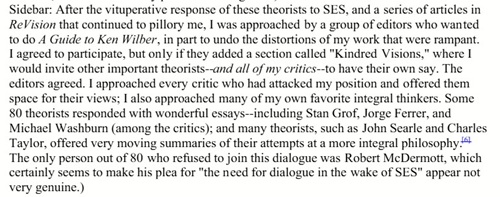 So Kindred Visions was agreed to be a subset of another publication: A Guide to Ken Wilber—which makes the project even more difficult to realize. What is striking is that Wilber mentions that in this anthology "all of my critics" would have their say. The phrase is even italicized! The sneer towards Robert McDermott is also spicy: McDermott later claimed he had submitted an essay. See: McDermott, "Response to Wilber", upon which Wilber replied he never got it: Ken Wilber, "Response to McDermott", www.integralworld.net. Robert McDermott was at the time President Emeritus, Professor, Program in Philosophy, Cosmology and Consciousness of the California Institute of Integral Studies. personal memoryWhen Shambhala contracted me as co-editor of the planned Kindred Visions I asked Wilber if I could read the many contributions that were available at that time. He refused and replied "If you don't like this arrangement, we have to find another way". When the project was turned into two volumes, volume 1 would cover these contributions, and volume 2 would be a summary of Wilber's works (assembled by Brad Reynolds) and of the available criticism (to be assembled by me), making the series a bit uneven. I have never had contact with the main editor Jack Crittenden—so it all remained a mirage. In the end, both me and Brad started to publish one or more book about Wilber and I took care of the critics by offering a platform on Integral World.
Widget is loading comments...
|