|
TRANSLATE THIS ARTICLE
Integral World: Exploring Theories of Everything
An independent forum for a critical discussion of the integral philosophy of Ken Wilber
  Frank Visser, graduated as a psychologist of culture and religion, founded IntegralWorld in 1997. He worked as production manager for various publishing houses and as service manager for various internet companies and lives in Amsterdam. Books: Ken Wilber: Thought as Passion (SUNY, 2003), and The Corona Conspiracy: Combatting Disinformation about the Coronavirus (Kindle, 2020). Frank Visser, graduated as a psychologist of culture and religion, founded IntegralWorld in 1997. He worked as production manager for various publishing houses and as service manager for various internet companies and lives in Amsterdam. Books: Ken Wilber: Thought as Passion (SUNY, 2003), and The Corona Conspiracy: Combatting Disinformation about the Coronavirus (Kindle, 2020).
Check out my other conversations with ChatGPT When 'Liberal' Means Left in America and Right in EuropeFrank Visser / ChatGPT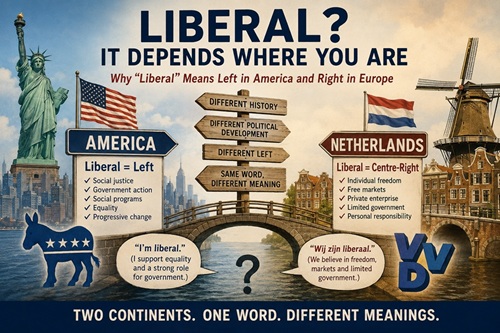 One of the most persistent sources of political confusion in transatlantic discussions is the word liberal. An American who describes herself as liberal will generally be understood as belonging to the political left. A Dutch person hearing the same word is likely to think of liberalisme: individual freedom, free markets, limited government, and parties such as the VVD, which sit firmly on the centre-right. Neither usage is simply wrong. They reflect two different political histories. The paradox becomes even more striking when one realizes that American political language has no exact equivalent of the European left-right spectrum. What Americans call “liberal” is often a position that Europeans would describe as social-liberal, centre-left, or even moderate. And what passes in the United States for a radical left-wing position can still fall well within the European mainstream. The explanation lies partly in the fact that liberalism was originally a movement of the political left in Europe. It subsequently ceased to be the left because something further to its left emerged: socialism. Liberalism began on the leftThe historical meaning of liberal is easiest to understand by going back to the eighteenth and nineteenth centuries. Classical liberalism emerged in opposition to the old European order of monarchy, aristocratic privilege, established churches and inherited status. Liberals demanded constitutional government, civil liberties, freedom of religion, equality before the law, representative institutions and freedom of commerce. In that world, liberals were unmistakably progressive. The great political divide was not between liberals and socialists. Socialism had barely emerged. The main confrontation was between liberal reformers and conservatives defending the ancien r´gime. A nineteenth-century liberal who demanded parliamentary government, secularization, free speech and the abolition of aristocratic privileges was challenging the established social order. “Liberal” therefore meant something much closer to progressive than it does in contemporary European politics. But political categories are relational. Once liberals had achieved many of their original objectives, the political landscape changed. Then socialism arrivedThe industrial revolution produced a new political question that classical liberalism had not adequately answered: what does political freedom mean when enormous inequalities of wealth and power exist? Socialists, social democrats and eventually labour parties pushed the political agenda further. They demanded universal suffrage, trade-union rights, social insurance, public education, redistribution, workers' rights and eventually the welfare state. This produced a remarkable historical displacement. The liberals had originally been the challengers of the conservative establishment. Now the socialists and labour movements became the challengers of the liberal economic order. The political spectrum therefore moved underneath liberalism. What had once been the left became the centre. And eventually, particularly where liberal parties embraced capitalism and private enterprise, liberalism became associated with the centre-right. This is particularly visible in the Netherlands. The Dutch exampleDutch politics makes the transformation almost painfully clear. The VVD—People's Party for Freedom and Democracy—calls itself liberal, and historically that description is entirely appropriate. It emphasizes individual freedom, entrepreneurship, private enterprise, personal responsibility and a relatively restrained state. But by contemporary Dutch standards, the VVD is not a left-wing party. It is generally classified as centre-right or right-wing. Why? Because Dutch political debate has acquired an extensive social-democratic and green vocabulary to the left of classical liberalism. The Labour Party and GroenLinks represent traditions that emerged later than classical liberalism and moved the political debate toward social equality, collective provision and environmental politics. Their contemporary alliance, GroenLinks-PvdA [now merged into PRO], occupies territory to the left of the VVD. So when a Dutch political commentator calls the VVD “liberal,” the word describes its ideological tradition. When that same commentator calls it “right-wing,” the word describes its position relative to contemporary Dutch political alternatives. There is no contradiction. America froze the word in a different placeThe American story is different. The United States was founded during the great age of liberalism. Its political institutions were themselves products of Enlightenment liberal ideas: individual rights, constitutional government, religious freedom, representative government and suspicion of concentrated state power. But America never developed a large socialist or social-democratic political tradition comparable to Western Europe. That difference profoundly affected the meaning of political language. In Europe, the emergence of socialism pushed liberalism toward the centre and eventually the right. In the United States, there was no comparably powerful socialist movement to push liberalism in the same way. Consequently, liberal remained attached to a broad tradition of progressive reform. American liberalism gradually came to mean support for government intervention to achieve social and economic goals: regulation of business, social programs, civil rights, labour protections, environmental regulation and a more expansive welfare state. The New Deal under Franklin D. Roosevelt was particularly important in this transformation. Later, the civil-rights movement and the Great Society expanded the meaning of American liberalism still further. Thus an American can quite naturally say: “I'm a liberal.” And mean: “I support progressive social policies and a substantial role for government in reducing inequality.” A Dutch listener might reasonably respond: “But that sounds like social democracy.” And that is precisely the point. The missing American categoryThe deeper problem is that the American political spectrum is unusually narrow. The Democratic Party is a broad coalition ranging from moderate and economically centrist liberals to progressives who advocate policies that would be associated in Europe with social democracy or the radical left. But the Republican Party occupies most of the territory to its right. There is no major national socialist, social-democratic or green party with the electoral weight such parties have historically possessed in Europe. That creates a peculiar linguistic effect. American political discourse frequently divides the world into “liberal” and “conservative,” as though these were the fundamental alternatives. European politics traditionally has a much more differentiated spectrum: radical left → socialist/social-democratic → green → social-liberal → liberal/conservative → nationalist/right → radical right The exact ordering varies by country, of course. But the important point is that liberal is only one position within a much wider ideological field. The American spectrum is closer to: progressive liberal → liberal/moderate → conservative → nationalist/populist right with the leftmost European positions largely underrepresented at the national electoral level. This is why an American politician can be denounced as “far left” while advocating policies that would not necessarily appear revolutionary to a Dutch social democrat. Bernie Sanders illustrates the problemConsider Bernie Sanders. Sanders describes himself as a democratic socialist, which already makes him unusual in American politics. His proposals for universal healthcare, stronger unions, higher taxation on wealthy Americans, tuition-free public education and a larger welfare state are significantly to the left of the American political mainstream. Yet even Sanders's program is not equivalent to abolishing capitalism or establishing a centrally planned economy. Much of what he advocates resembles policies that have existed for decades in European social democracies. This tells us something important: left and right are not absolute geographical coordinates. They are relational. Sanders is very far left by American standards. By European standards, much of his program would place him somewhere around the democratic-socialist or left-social-democratic end of the mainstream rather than beyond the political system altogether. Why American “liberal” does not mean European liberal This is why translating liberal directly between English-speaking political cultures can be misleading. An American liberal generally means something like: progressive + civil-libertarian + welfare-state oriented + regulated capitalism A European liberal, depending on the country, may mean something closer to: individual freedom + market economy + private enterprise + limited government + civil liberties There is obviously considerable overlap. Both traditions care about individual rights and personal freedom. But they diverged over the question of the economic role of the state. American liberalism absorbed substantial elements of European social reform. European liberalism remained more strongly associated with the classical liberal economic tradition. The same word therefore came to occupy different places on the ideological map. “Liberal democracy” creates another trapThere is an additional complication. The expression liberal democracy does not mean “a democracy governed by American liberals.” It refers to a political system combining democratic elections with liberal constitutional principles: individual rights, rule of law, separation of powers, freedom of expression, minority protections and limits on governmental authority. In this sense, even a conservative European can be a liberal democrat. Indeed, this distinction is essential. Liberalism as a political ideology is not identical to “the left,” and liberal democracy is not synonymous with progressive politics. A conservative defending freedom of speech and constitutional rights is still defending liberal-democratic institutions. A socialist can be a liberal democrat. A green can be a liberal democrat. A conservative can be a liberal democrat. The adjective liberal here refers primarily to a constitutional tradition, not to a position on the contemporary economic left-right spectrum. And then there are the GreensThe rise of green politics adds another layer to the historical story. European Green parties emerged largely after the traditional socialist/social-democratic parties had already established themselves. They introduced another set of issues—environmental limits, climate change, ecological sustainability, nuclear power, participatory democracy and alternative economic models. In countries such as the Netherlands, Greens therefore occupy political territory to the left of conventional economic liberalism. This illustrates the larger historical process beautifully. First there was liberalism versus conservatism. Then came socialism versus liberal capitalism. Then came green politics and new social movements, which challenged both traditional socialism and traditional liberalism. The political centre consequently moved repeatedly. A political position cannot be understood merely by asking what its adherents call themselves. One must ask what alternative positions exist around them. The great illusion of the American left-right debateThis leads to an important conclusion. When an American says, “The Democrats are the left,” this statement is meaningful only within the American political system. When a Dutch person says, “The VVD is right-wing,” that statement is meaningful within the Dutch political system. Neither statement tells us much about where either party would sit on a common international ideological scale. The same problem appears when American commentators describe European politics as “socialist.” A European welfare state may look radically interventionist from the perspective of American laissez-faire traditions while remaining firmly within the framework of a capitalist market economy. Europe has generally combined capitalism with a larger social state. America has generally combined capitalism with a smaller social state. That difference should not be confused with a simple opposition between capitalism and socialism. The irony: America has liberals, but barely a European left There is therefore a delicious historical irony in the phrase “the American left.” The United States certainly has a political left. There are socialists, democratic socialists, progressives, labour activists, greens and other left-wing movements. But they have never occupied the same institutional position as the European left. The American Democratic Party contains much of the territory that in Europe would be divided among liberals, social democrats, greens and parts of the centre-left. The Republican Party, meanwhile, contains conservatives, economic libertarians, national conservatives and increasingly populist-nationalist forces. Consequently, the American political system compresses ideological differences that European multiparty systems display more explicitly. The result is that the word liberal gets asked to perform two contradictory historical jobs. In America it means the progressive alternative to conservatism. In much of continental Europe it means the classical liberal tradition that stands between or to the right of social democracy and the left, while often opposing the traditional conservative right. Both meanings have legitimate historical roots. A final linguistic lessonPolitical labels are not universal units of measurement. They are historical artifacts. “Liberal,” “conservative,” “socialist,” “radical,” “progressive” and even “left” acquire their meaning from the political conflicts in which they developed. European liberalism moved left-to-centre-to-right because socialist and later green movements emerged to its left. American liberalism remained associated with the progressive side of the political spectrum because the United States never developed an equally powerful socialist or social-democratic party tradition. So when an American says “liberal,” a Dutch person should mentally translate it not as VVD'er, but as something closer to progressive or centre-left reformer. And when a Dutch person says “liberaal,” an American should not automatically imagine Bernie Sanders or Alexandria Ocasio-Cortez. The Dutch liberal tradition is much more closely associated with the political philosophy of markets, individual autonomy and limited government. The apparent contradiction disappears once we stop treating political labels as fixed coordinates. American liberalism is left because American politics has historically placed it to the left of conservatism. European liberalism is often centre-right because European politics developed a substantial socialist and green left to its left. The words stayed roughly the same. The political landscape moved underneath them.
Widget is loading comments...
|