|
TRANSLATE THIS ARTICLE
Integral World: Exploring Theories of Everything
An independent forum for a critical discussion of the integral philosophy of Ken Wilber
  Frank Visser, graduated as a psychologist of culture and religion, founded IntegralWorld in 1997. He worked as production manager for various publishing houses and as service manager for various internet companies and lives in Amsterdam. Books: Ken Wilber: Thought as Passion (SUNY, 2003), and The Corona Conspiracy: Combatting Disinformation about the Coronavirus (Kindle, 2020). Frank Visser, graduated as a psychologist of culture and religion, founded IntegralWorld in 1997. He worked as production manager for various publishing houses and as service manager for various internet companies and lives in Amsterdam. Books: Ken Wilber: Thought as Passion (SUNY, 2003), and The Corona Conspiracy: Combatting Disinformation about the Coronavirus (Kindle, 2020).
Check out my other conversations with ChatGPT Wilber's Nine Stages of Pathology and TherapyA Critical AssessmentFrank Visser / ChatGPT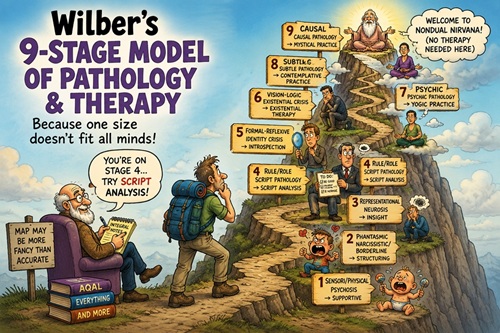 Ken Wilber's early model of psychological pathology and therapy is one of the most ambitious—and least adequately tested—parts of his integral psychology. Long before the familiar AQAL framework, Wilber attempted to construct something resembling a grand clinical map of the human psyche. The basic idea was elegant: human development proceeds through a sequence of increasingly complex structures of consciousness, and each developmental achievement can go wrong in characteristic ways. If development can become pathological at different levels, then psychotherapy should be differentiated accordingly. One should not treat every psychological problem as if it originated from the same developmental failure. In Transformations of Consciousness (1986), written with Jack Engler and Daniel Brown, this idea was developed into a series of developmental “fulcrums.” Wilber eventually organized the spectrum into nine major stages, divided into three broad domains: prepersonal, personal, and transpersonal. Each stage was assigned a characteristic pathology and, correspondingly, a therapeutic or contemplative remedy. This produced a remarkably compact vision of the entire field of psychopathology, from psychosis and borderline disturbances through neurosis and existential crisis to what Wilber called subtle, causal, and ultimate spiritual pathology. The attraction of the model is obvious. Its central intuition remains valuable: different psychological problems may require different kinds of intervention, and spiritual experience should not automatically be interpreted as either pathology or enlightenment. But the moment Wilber turns this useful intuition into a fixed nine-stage developmental architecture, serious scientific and clinical problems emerge. The model is best understood today not as an established scientific theory of psychopathology, but as a speculative metatheoretical framework that contains some useful clinical distinctions embedded within a much larger body of unsupported developmental and metaphysical claims. The Nine-Fold MapThe original scheme is relatively easy to summarize. The first three levels are prepersonal: the sensory or sensoriphysical level, the phantasmic-emotional level, and the representational or conceptual level. They correspond roughly to the earliest differentiation of self from environment, the development of emotional identity, and the emergence of symbolic representation. The characteristic pathologies associated with these levels were, respectively, psychotic disturbance, narcissistic or borderline pathology, and neurosis. The proposed interventions move accordingly from relatively supportive or structuring approaches toward insight-oriented therapy. The next three levels are personal. Rule/role cognition corresponds roughly to the internalization of social norms and roles; formal-reflexive cognition to mature rational and self-reflective functioning; and vision-logic or existential functioning to a more integrative capacity in which previously differentiated perspectives can be brought together. Here the pathologies become less conventionally psychiatric. Script pathology, identity crisis, and existential crisis occupy progressively more “advanced” positions in the developmental sequence. The corresponding treatments include script analysis, introspection, and existential therapy. Finally come the transpersonal stages: psychic, subtle, and causal. These are no longer simply higher forms of ordinary psychological functioning. They introduce Wilber's explicitly spiritual ontology. The psychic level involves forms of expanded or nature-oriented consciousness; the subtle involves archetypal or visionary phenomena; and the causal involves formless awareness and the dissolution of the subject-object distinction. Beyond these lies the ultimate or nondual condition, which Wilber sometimes treats as a culmination beyond the ordinary notion of a developmental stage. The remarkable feature of the model is therefore not merely that it contains nine stages. It attempts to make pathology itself developmental. A person can become stuck, fixated, or distorted at different points in the developmental sequence. The resulting symptom therefore cannot be understood independently of the level at which development has miscarried. This is the conceptual architecture behind Wilber's famous distinction between “pre” and “trans.” The Pre/Trans DistinctionWilber's most influential contribution to this discussion is probably his warning against what he called the pre/trans fallacy. In his 1982 article of that name, he argued that prepersonal and transpersonal experiences can look superficially similar because both can involve diminished rationality, weakened ego boundaries, unusual states of consciousness, or a sense of unity. But they supposedly represent opposite directions of development: one is below the ego, the other beyond it. This is an important clinical warning. A psychotic episode should not automatically be interpreted as a mystical breakthrough. Conversely, an unusual spiritual experience should not automatically be pathologized simply because it violates ordinary assumptions about the self. The distinction is particularly relevant in transpersonal psychotherapy, where unusual experiences may occur in meditation, religious practice, psychedelic states, or spontaneous spiritual crises. But Wilber's formulation contains a hidden problem. He does not merely distinguish two possible interpretations of unusual experience. He embeds the distinction within a very specific developmental metaphysics. “Pre” and “trans” become objectively different structural levels of consciousness, arranged along a developmental ladder. The distinction therefore depends upon the validity of the ladder itself. That is where the argument becomes circular. If one already assumes that development proceeds through prepersonal, personal, and transpersonal structures, then psychosis can be defined as regression or fixation at an earlier level, while mystical consciousness can be defined as transcendence of the personal level. But this does not independently demonstrate that the latter is a higher developmental structure. The classification risks becoming a consequence of the theory rather than evidence for it. Indeed, the pre/trans distinction has never achieved anything like the empirical status of the distinction between, say, psychosis and ordinary functioning. Even within transpersonal psychology, Wilber's formulation has been challenged. Michael Washburn, for example, developed a different account of the relationship between ego and transpersonal experience rather than accepting Wilber's sharply hierarchical separation of pre-egoic and trans-egoic structures. The Problem with Making Pathology Stage-SpecificWilber's strongest clinical intuition is that development matters. His weakest move is to turn that insight into a one-to-one correspondence between developmental stages and psychopathologies. The original chart is extraordinarily neat:
It is an impressive piece of theoretical organization. But psychological disorders do not in reality respect such tidy boundaries. Psychosis, narcissism, borderline personality organization, anxiety, depression, trauma, obsessive-compulsive symptoms, dissociation, and existential distress can coexist in the same person. They can have multiple developmental, biological, interpersonal, cultural, and situational determinants. Modern clinical psychology consequently tends to work with multifactorial models rather than assuming that one developmental “fulcrum” is responsible for a particular class of pathology. Even the concept of a “stage” is more complicated than Wilber's presentation sometimes suggests. Developmental psychology contains legitimate stage models, and researchers have developed formal methods for investigating hierarchical complexity. But a developmental stage must be operationalized, empirically distinguished from adjacent stages, shown to have meaningful sequencing, and tested against alternative explanations. Stage theories have historically faced precisely these methodological challenges. Wilber's nine-stage model does not meet this burden convincingly. From Developmental Psychology to Spiritual MetaphysicsThe problem becomes particularly acute when the model crosses from established developmental psychology into transpersonal territory. The first five stages have recognizable relations to developmental psychology. Wilber draws heavily on figures such as Piaget and other developmental theorists. His model then adds vision-logic and subsequently psychic, subtle, causal, and nondual forms of consciousness. There is nothing inherently illegitimate about proposing such stages. Science frequently begins by proposing phenomena before adequate measurement techniques exist. The problem is the epistemic status Wilber assigns to them. The transpersonal stages are treated not merely as hypotheses about unusual human experiences but as genuine higher structures of consciousness. Here the model moves from psychology toward metaphysics. What would count as evidence that somebody has reached the psychic stage rather than merely experiencing an intense emotional or contemplative state? What independent test distinguishes subtle consciousness from imagination, absorption, dissociation, or culturally conditioned visionary experience? How could causal consciousness be operationally distinguished from a particular interpretation of meditative experience? And what observation could demonstrate that nondual awareness constitutes a developmental structure rather than a recurrent state of consciousness? These questions are not peripheral. They go directly to the scientific status of the model. A later formulation of integral psychology makes an important distinction between states and stages: states are temporary experiences, while stages are relatively enduring structures of development. Wilber calls this the difference between “waking up” and “growing up.” This is conceptually useful. But it also creates an enormous empirical obligation: if spiritual states are to be converted into stable developmental stages, researchers need reliable methods for demonstrating that such structures actually develop, persist, generalize across contexts, and can be independently identified. That evidence remains remarkably thin. The Scientific Problem: A Theory That Is Difficult to FalsifyOne of the sharpest criticisms of integral psychology concerns precisely this issue. A published evaluation of Wilber's integral psychology from a scientific perspective concluded that, despite its considerable conceptual coherence, the theory lacked adequate mechanisms for validation and falsification and therefore did not satisfy ordinary criteria for a scientific theory. That criticism applies with particular force to the pathology model. Consider the flexibility Wilber eventually introduces through the notion of lines of development. A person can be highly developed cognitively while remaining relatively immature morally, emotionally, or interpersonally. This is actually an important corrective to simplistic stage theories. But it also makes the system increasingly difficult to test. If someone behaves badly despite supposedly advanced development, the theory can simply say that another developmental line is lagging behind. If someone has an extraordinary spiritual experience without demonstrating corresponding psychological maturity, the distinction between states and stages can be invoked. If a person appears to regress, one can appeal to temporary identification with a lower level. The model becomes capable of explaining almost anything after the fact. That is a warning sign scientifically. A strong theory should constrain interpretation rather than endlessly accommodate it. Wilber himself and other integral theorists have acknowledged the need for much greater empirical rigor. A later discussion involving Wilber, Susanne Cook-Greuter, and Beena Sharma explicitly emphasized the importance of empirical validation, falsifiability, and rigorous model building within integral and adult-development research. The acknowledgment is welcome, but it also highlights the unresolved problem: the architecture came first; the systematic validation has largely remained to be done. The Clinical Problem: Does the Map Actually Improve Therapy?The practical question is more important than whether the nine-stage model is philosophically elegant. Does knowing that a client supposedly occupies one developmental level actually improve therapeutic outcomes? There is a plausible argument that it could. Therapists routinely adjust their interventions to the capacities and needs of their clients. A highly structured intervention may be appropriate for one person and counterproductive for another. Someone struggling with basic emotional regulation may not benefit from an abstract existential discussion, while a psychologically stable person confronting meaninglessness may not need another round of childhood reconstruction. In this limited sense, Wilber's developmental sensitivity is clinically sensible. This is probably the most defensible practical contribution of the model. But that does not establish the validity of the nine-stage taxonomy. A therapist can recognize developmental differences without accepting Wilber's particular hierarchy. Contemporary psychotherapy already contains many ways of conceptualizing differences in ego strength, attachment, cognitive complexity, personality organization, emotional regulation, trauma history, interpersonal functioning, and meaning-making. The question therefore becomes: what does Wilber's model add that competing clinical frameworks do not? The answer is clearest when spiritual experience is genuinely part of the clinical picture. Here Wilber's framework provides a vocabulary for distinguishing pathological regression from potentially transformative spiritual experience. It encourages therapists to avoid both extremes: reducing every mystical experience to psychopathology and romanticizing every destabilizing experience as enlightenment. That is a useful contribution, even if the nine-stage ontology behind it remains unproven. The Most Problematic Step: “Transpersonal Pathology”The final stages expose the model's greatest conceptual weakness. Wilber proposes not merely that people can become psychologically disturbed while having spiritual experiences, but that there are distinct transpersonal pathologies. This is an intriguing proposition. Mystical experience can certainly be destabilizing. Meditation can sometimes interact badly with pre-existing psychological vulnerabilities. Spiritual practices can become compulsive, dissociative, narcissistic, or grandiose. Religious communities can reinforce delusions of special status. None of that requires a hierarchy of psychic, subtle, and causal structures. Wilber's difficulty is that he wants to interpret these phenomena simultaneously through clinical psychology and a developmental metaphysics of spiritual realization. Once “causal pathology,” for example, becomes a legitimate diagnostic category, the theory has effectively established the reality of the causal level before demonstrating it. The same problem appears in reverse. If someone claims to have attained a superior state of consciousness, the theory has difficulty distinguishing genuine developmental attainment from spiritual inflation. The person can potentially be declared advanced on one line while remaining immature on another. Wilber's later concept of uneven development was intended to solve exactly this problem. His model allows someone to be spiritually advanced while remaining psychologically or morally underdeveloped. But this solution creates a rather uncomfortable possibility: the more complex the model becomes, the harder it becomes to disprove the spiritual status claimed by its practitioners. A guru can be spiritually advanced but psychologically immature. A mystic can be highly developed in one line and primitive in another. A teacher can have an authentic causal realization while displaying prepersonal social behavior. This is theoretically sophisticated. Clinically and scientifically, however, it can become an escape hatch. The Guru ProblemThis point has particular importance in the context of Wilber's broader writings. One of the great advantages of a developmental model should be that it allows us to evaluate the person making spiritual claims rather than merely accepting the claims themselves. Psychological maturity, ethical development, interpersonal competence, and spiritual insight should ideally converge. But Wilber's model makes it possible to separate them. That separation is certainly descriptively realistic: human beings are uneven. But it becomes dangerous when used to protect spiritual authority from ordinary psychological criticism. If extraordinary spiritual realization is granted epistemic priority while ordinary psychological shortcomings are assigned to a different developmental line, the model risks becoming an apologetic device. The very framework that was designed to prevent the romanticization of spiritual experience can therefore end up protecting spiritual exceptionalism. This is one of the deepest paradoxes in Wilber's system. What Remains ValuableA critical assessment should not obscure what is genuinely interesting here. Wilber's nine-stage model contains three ideas that remain worth preserving. The first is that psychological development is not synonymous with symptom reduction. A person can be free of a particular symptom while remaining developmentally limited in other respects. Conversely, a developmental transition can temporarily produce confusion, anxiety, or existential instability without necessarily constituting mental illness. The second is that therapy should be developmentally sensitive. Different psychological organizations may require different interventions. Wilber's attempt to match pathology and therapy is therefore clinically provocative even where his particular correspondences are too rigid. The third is the pre/trans distinction as a warning against category errors. Psychosis and mystical experience can sometimes look superficially alike without being identical. Neither reductionism nor spiritual romanticism is an adequate response to unusual states of consciousness. Wilber was right to insist that this distinction deserves careful attention. Indeed, one sympathetic scholarly assessment has called Wilber's early work on developmental pathology his “finest contribution” to transpersonal psychology, precisely because it organizes a broad range of psychological phenomena and proposes different therapeutic responses. The same assessment nevertheless explicitly notes that this does not establish the model as entirely correct. That is probably the fairest verdict. From Scientific Theory to Heuristic MapThe nine-stage model becomes much more defensible if its status is downgraded. As a scientific theory of psychopathology, it is inadequate. Its stages are insufficiently operationalized, its transpersonal levels are not independently established, its pathology-stage correspondences are too neat, and its flexibility makes decisive falsification difficult. A scientific psychology cannot simply import metaphysical levels of consciousness and then treat the resulting hierarchy as clinically demonstrated. As a metatheoretical map, however, it is considerably more interesting. It asks questions that conventional psychiatry can sometimes neglect: What developmental achievement is implicit in a particular psychological crisis? Can a spiritual experience be both genuine and psychologically destabilizing? Does therapy sometimes need to facilitate development rather than merely eliminate symptoms? Can a person be highly sophisticated in one dimension while remaining remarkably immature in another? Those are good questions even if Wilber's answers are not always convincing. The irony is that Wilber's own ambition ultimately weakens his best insight. He could have offered a modest developmental heuristic: psychological difficulties arise within developmental contexts, and therapy should take those contexts seriously. Instead, he constructed an elaborate ladder extending from infantile sensorimotor functioning through mature rationality to psychic, subtle, causal, and ultimately nondual consciousness. The ladder transformed a useful clinical intuition into a comprehensive theory of human evolution. And that is precisely where the scientific trouble begins. Conclusion: A Brilliant Map Without a Reliable CompassWilber's nine-stage model of pathology and therapy deserves neither dismissal nor acceptance as presented. Its prepersonal-personal-transpersonal distinction represents an imaginative attempt to integrate developmental psychology, psychopathology, psychotherapy, and contemplative traditions into a single framework. Its insistence that different developmental problems may require different therapeutic responses is sensible. Its pre/trans distinction remains a useful warning against both the medicalization of spirituality and the spiritualization of psychopathology. But the model's scientific credentials are much weaker than its conceptual ambition suggests. The prepersonal stages borrow legitimacy from established developmental psychology, while the personal stages stretch familiar developmental ideas into increasingly speculative territory. The transpersonal stages then introduce claims about higher structures of consciousness for which the evidential foundation is substantially weaker. The pathology classifications consequently acquire an appearance of clinical precision that the underlying evidence does not warrant. The central error is therefore not that Wilber proposed stages. Developmental stages can be scientifically investigated. Nor is it that he proposed transpersonal development. Unusual and transformative forms of human experience deserve serious study. The problem is that he moves too quickly from phenomenological possibility to developmental ontology, and from developmental ontology to clinical classification. A more scientifically defensible version of Wilber's project would reverse that sequence. It would begin with empirically observable developmental capacities, independently validated measures of psychological functioning, longitudinal studies, careful differentiation between states and traits, and outcome studies comparing therapeutic interventions. Only then should claims about transpersonal stages be entertained—and they should remain hypotheses rather than axioms. In that form, Wilber's model could become genuinely useful. In its original form, however, the nine-stage pathology model is best regarded as a sophisticated speculative map of the psyche, not a scientifically established map of psychopathology. Its enduring value lies less in the accuracy of its nine levels than in the questions it forces psychology to ask about development, regression, spiritual experience, and the limits of conventional psychiatric categories. Wilber wanted to give psychology a spectrum extending from psychosis to enlightenment. The scientific challenge is to determine whether that spectrum describes a discoverable structure of human development—or whether it is, in the end, an exceptionally elaborate interpretation imposed upon a much messier psychological reality.
Widget is loading comments...
|