|
TRANSLATE THIS ARTICLE
Integral World: Exploring Theories of Everything
An independent forum for a critical discussion of the integral philosophy of Ken Wilber
  Frank Visser, graduated as a psychologist of culture and religion, founded IntegralWorld in 1997. He worked as production manager for various publishing houses and as service manager for various internet companies and lives in Amsterdam. Books: Ken Wilber: Thought as Passion (SUNY, 2003), and The Corona Conspiracy: Combatting Disinformation about the Coronavirus (Kindle, 2020). Frank Visser, graduated as a psychologist of culture and religion, founded IntegralWorld in 1997. He worked as production manager for various publishing houses and as service manager for various internet companies and lives in Amsterdam. Books: Ken Wilber: Thought as Passion (SUNY, 2003), and The Corona Conspiracy: Combatting Disinformation about the Coronavirus (Kindle, 2020).
Check out my other conversations with ChatGPT Ferdinand MagellanThe Explorer Who Circumnavigated the World - AlmostFrank Visser / ChatGPT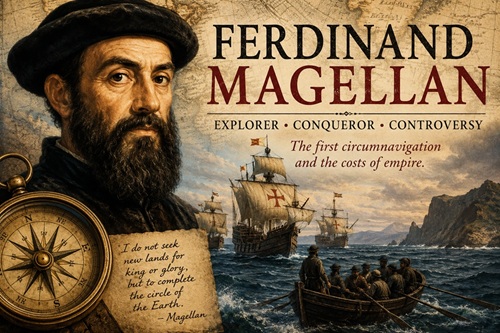 Ferdinand Magellan occupies an almost mythological position in the history of exploration. His name is attached to the first expedition to circumnavigate the globe, to the strait that connects the Atlantic and Pacific oceans, and to a decisive moment in European expansion across the Pacific. He is routinely presented as a heroic navigator who demonstrated, in spectacular fashion, the connectedness of the world. Yet the conventional heroic portrait becomes considerably less convincing when Magellan is viewed in the broader context of sixteenth-century imperialism. He was not simply an intrepid explorer driven by curiosity. He was a Portuguese adventurer working for Spain, a military man, a participant in colonial conquest, a slave trader, and ultimately a commander whose ambition and misjudgments contributed directly to his death. The expedition he launched changed geographical knowledge, but it did so within a deeply exploitative system of conquest. A Portuguese Adventurer in Spanish ServiceMagellan was born around 1480 in Portugal into a family of minor nobility. His early career was shaped less by scientific exploration than by the military and commercial expansion of Portugal. He participated in Portuguese expeditions in Asia and Africa and acquired experience of the Indian Ocean world. These experiences were important because they placed him inside the machinery of European imperial expansion rather than outside it. His break with Portugal was partly political and personal. After disagreements with the Portuguese crown, Magellan sought employment elsewhere. Spain provided the opportunity. He proposed an audacious expedition to reach the lucrative Spice Islands—the Moluccas—by sailing westward. The project depended upon a controversial geographical assumption: that a western route could reach the Asian spice trade while remaining within the sphere assigned to Spain by the Treaty of Tordesillas. This was not exploration for exploration's sake. The objective was commercial and imperial. Spices such as cloves and nutmeg were enormously valuable in Europe, and control of their sources could generate extraordinary profits. Magellan's voyage therefore belongs to the same historical process as the Portuguese and Spanish conquests elsewhere: geographical discovery and imperial expansion were inseparable. The Voyage of 1519Magellan's fleet departed Spain in September 1519 with five ships and roughly 250 men. The expedition faced enormous logistical difficulties almost immediately. Magellan had to deal with hostile weather, shortages, internal dissent and the enormous distances involved. The famous voyage across the Atlantic and down the coast of South America eventually led to the discovery—or, more precisely, the European identification—of the passage now known as the Strait of Magellan. The fleet entered the strait in October 1520 and emerged into the vast ocean Magellan called the Pacific. This achievement deserves its place in history. The Pacific was so immense that the crossing became one of the expedition's greatest ordeals. Magellan had seriously underestimated the distance to Asia. The men endured starvation, disease and dehydration. One account famously describes them eating sawdust and leather in their desperation. The romantic image of the explorer sailing confidently into the unknown therefore conceals an important reality: Magellan's expedition was also an extraordinary exercise in miscalculation. The Pacific was vastly larger than European geographical knowledge had suggested. The voyage succeeded only at terrible human cost. “Discovering” a World That Was Already InhabitedThe language of discovery presents one of the fundamental problems in traditional accounts of Magellan. The lands and waters encountered by the expedition were obviously not unknown to the people who lived there. The Strait of Magellan was part of an existing Indigenous geographical world. The Pacific islands were inhabited by societies with their own histories, political structures, trading networks and cosmologies. When Europeans subsequently described these places as “discovered,” they were using discovery in a specifically European and imperial sense: discovered for European knowledge, European commerce and eventually European possession. This distinction is not merely semantic. It exposes the conceptual framework underlying the Age of Exploration. European powers frequently treated the existence of Indigenous societies as compatible with the legal and political claim that their territories could nevertheless be appropriated. The explorer became the advance agent of empire. Magellan's expedition illustrates this transition particularly clearly. Its ships carried navigational knowledge, weapons, Christianity, commercial ambitions and claims of sovereignty. Exploration was therefore not an innocent precursor to colonization. It was one of colonization's instruments. Magellan and SlaveryPerhaps the most uncomfortable aspect of Magellan's biography is his relationship with slavery. Magellan owned an enslaved Malay man, commonly known as Enrique of Malacca. Enrique had been acquired during Magellan's earlier travels in Southeast Asia and was taken to Europe. He accompanied the expedition and served as an interpreter. Enrique's story complicates the standard narrative in an especially revealing way. Magellan's voyage is often credited with creating the first human circumnavigation of the Earth, but the person who may have been the first individual to complete such a journey was not Magellan. Enrique had already traveled from Southeast Asia westward to Europe with Magellan and then traveled back toward Southeast Asia with the expedition. After Magellan's death, Enrique disappeared from the European record. What is particularly significant is that Magellan's will attempted to secure Enrique's freedom, but the legal circumstances surrounding his status remained contested. Enrique therefore exposes a contradiction at the heart of the expedition. The voyage is celebrated as a triumph of global human mobility while one of its central participants was being transported across the globe as property. Encountering the PhilippinesIn March 1521, Magellan reached the Philippines. His arrival is frequently portrayed as another milestone in geographical discovery. But what happened there demonstrates how quickly exploration could become political intervention. Magellan attempted to establish relationships with local rulers and to bring them into the Spanish sphere. Christianity became part of this process. Some rulers accepted baptism and alliance, while others resisted. Magellan increasingly behaved not merely as an explorer but as an imperial commander. He intervened in local political conflicts and sought to impose Spanish authority. This culminated on April 27, 1521, at the Battle of Mactan. Magellan led a small force against the forces of the local ruler Lapulapu. The Europeans were heavily outnumbered and Magellan was killed. His death has acquired an almost symbolic quality. The explorer who had crossed oceans and navigated one of the world's most formidable maritime passages was brought down not by the vast Pacific but by a local community defending its own political autonomy. Lapulapu has consequently become a national hero in the Philippines, while Magellan represents the beginning of Spanish colonial intrusion. The same event can therefore be remembered in radically different ways depending upon whose historical perspective is adopted. The Irony of the “First Circumnavigation”There is an important historical irony in the common statement that Magellan “circumnavigated the globe.” He did not. Magellan died in the Philippines, approximately halfway through the expedition's eventual journey around the world. The surviving members of the expedition continued westward under the command of Juan Sebastián Elcano. Only one ship, the Victoria, eventually returned to Spain in September 1522, carrying just a small fraction of the original crew. The achievement was therefore properly that of the expedition rather than of Magellan personally. More intriguingly, Enrique may have completed a circuit of the globe, although the precise geography and chronology of his earlier movements make the claim difficult to establish with certainty. If he did so, the conventional European narrative acquires an extraordinary twist: the enslaved Asian interpreter may have accomplished what the celebrated European commander did not. Heroism and HubrisThere is no reason to deny Magellan considerable courage and navigational ability. Leading ships through an unknown passage, crossing the Pacific with inadequate geographical information and maintaining an expedition under extreme conditions were remarkable achievements. But courage should not automatically be confused with wisdom. Magellan's career also demonstrates the dangerous combination of ambition, authority and inadequate knowledge. His decision to intervene at Mactan was strategically questionable. He had little reason to expose himself personally to a land battle against a much larger force. His death was not simply an unfortunate accident; it was connected to his increasingly interventionist approach toward local politics. His career thus contains both exploration and hubris. The explorer who had successfully confronted geographical uncertainty proved less successful at recognizing political and cultural realities on the ground. What the Expedition Actually AchievedThe enduring significance of Magellan's expedition lies less in the personality of Magellan than in what the voyage demonstrated. The expedition provided spectacular empirical evidence of the global scale of the Earth. It established the enormous extent of the Pacific, demonstrated the practical possibility of global maritime circumnavigation and connected European navigation more directly with the maritime worlds of Southeast Asia. It also revealed the extraordinary cost of such undertakings. Of the approximately 250 men who left Spain, only a small group returned. The expedition was therefore both a geographical triumph and a human catastrophe. Moreover, its commercial objective was not immediately successful. The Spanish hoped to challenge Portugal's dominance of the spice trade, but the voyage did not inaugurate a simple Spanish commercial victory. The logistical difficulties of maintaining long-distance Pacific routes were enormous. The expedition's greatest legacy was therefore epistemic rather than immediately economic: it changed what Europeans knew about the planet. The Darker Legacy of ExplorationMagellan's story also raises a larger question about how the Age of Exploration should be remembered. For centuries, European historiography tended to portray explorers as heroic individuals who enlarged humanity's geographical horizons. That interpretation is not entirely false, but it is profoundly incomplete. The geographical enlargement of European knowledge was accompanied by the political and economic enlargement of European empires. The same ship could simultaneously carry a navigator, a cartographer, a missionary, a merchant and an imperial representative. Magellan embodied this combination. He was a skilled navigator and an ambitious adventurer, but also a participant in systems of conquest and slavery. His voyage was intellectually transformative precisely because it was embedded in the violent expansion of European power. This does not require us to dismiss the achievement. On the contrary, it allows us to understand it more accurately. Conclusion: From Hero to Historical FigureFerdinand Magellan is more interesting when stripped of the heroic mythology surrounding him. He did not personally circumnavigate the Earth. He did not discover an empty world. He was not a purely scientific explorer motivated primarily by curiosity. He was a sixteenth-century imperial adventurer whose geographical ambitions were intertwined with commerce, warfare, Christianity, slavery and political power. And yet his achievement remains extraordinary. The expedition he initiated crossed an ocean whose scale Europeans had barely comprehended, connected the Atlantic and Pacific worlds by sea, and eventually completed the first documented circumnavigation of the Earth. It permanently altered European geographical consciousness. The critical lesson is therefore not that Magellan was either a hero or a villain. It is that he was both explorer and imperial agent, navigator and conqueror, visionary and reckless commander. His voyage enlarged humanity's geographical imagination while participating in a process that would profoundly diminish the autonomy of many of the people encountered along the way. That contradiction is precisely what makes Magellan historically important. The first circumnavigation was not simply a story about discovering the world. It was also a story about Europeans beginning to impose themselves upon a world that was already fully inhabited.
Widget is loading comments...
|