|
TRANSLATE THIS ARTICLE
Integral World: Exploring Theories of Everything
An independent forum for a critical discussion of the integral philosophy of Ken Wilber
  Frank Visser, graduated as a psychologist of culture and religion, founded IntegralWorld in 1997. He worked as production manager for various publishing houses and as service manager for various internet companies and lives in Amsterdam. Books: Ken Wilber: Thought as Passion (SUNY, 2003), and The Corona Conspiracy: Combatting Disinformation about the Coronavirus (Kindle, 2020). Frank Visser, graduated as a psychologist of culture and religion, founded IntegralWorld in 1997. He worked as production manager for various publishing houses and as service manager for various internet companies and lives in Amsterdam. Books: Ken Wilber: Thought as Passion (SUNY, 2003), and The Corona Conspiracy: Combatting Disinformation about the Coronavirus (Kindle, 2020).
Check out my other conversations with ChatGPT Kary MullisThe Brilliant Maverick Who Couldn't Stop Challenging ScienceFrank Visser / ChatGPT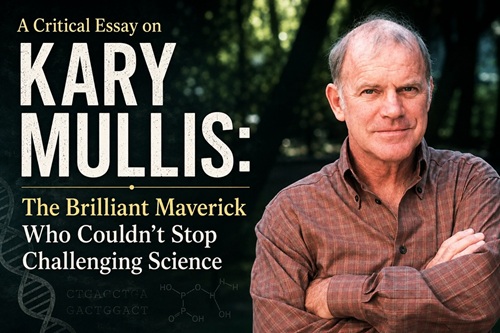 Kary Banks Mullis occupies an unusual place in modern science. He was unquestionably brilliant, undeniably unconventional, and frequently entertaining. In 1993 he received the Nobel Prize in Chemistry, jointly with Michael Smith, for the development of the polymerase chain reaction, or PCR—a technique that transformed molecular biology and became one of the most important laboratory technologies of the modern era. PCR made it possible to amplify tiny quantities of DNA rapidly and repeatedly, turning molecular biology from an investigation constrained by scarcity into one capable of working with astonishingly small biological traces. Yet Mullis's later reputation is considerably more complicated than his Nobel Prize suggests. He became an icon of scientific heterodoxy, presenting himself as a fearless outsider willing to question scientific orthodoxies. He denied that HIV had been established as the cause of AIDS, expressed skepticism about the evidence for human-caused climate change, embraced astrology and various paranormal ideas, and promoted a collection of extraordinary claims that had little evidential support. His life therefore raises an intriguing question: what happens when an extraordinary scientific innovator becomes convinced that his own intellectual independence is itself evidence of intellectual correctness? Mullis is worth taking seriously precisely because the answer is not simply that he was a crank. He was a genuine scientific genius who also provided a powerful demonstration of the limits of genius. The PCR RevolutionMullis's greatest achievement was PCR. Before its development, obtaining enough copies of a particular DNA sequence for analysis could be laborious and technically difficult. PCR provided a remarkably elegant solution. Through repeated cycles of heating, cooling, primer binding, and DNA synthesis, a selected DNA segment could be copied exponentially. The conceptual simplicity of the technique concealed its enormous significance. PCR became indispensable in genetics, forensic science, medical diagnostics, evolutionary biology, biotechnology, and countless other fields. It helped make DNA analysis routine. The ability to amplify genetic material from minuscule samples fundamentally altered what biologists could investigate. Mullis's contribution was sufficiently important that his Nobel Prize was entirely deserved. There is no need to diminish his scientific accomplishment in order to criticize his later views. Indeed, doing so would obscure the more interesting lesson of his career. Mullis demonstrated that revolutionary scientific ideas can sometimes come from people who do not behave like conventional scientists. His imagination, confidence, irreverence, and willingness to ignore disciplinary expectations were arguably assets in developing PCR. But those same characteristics could become liabilities when applied indiscriminately to questions requiring careful evaluation of an enormous body of evidence. This distinction is crucial. The Myth of the Scientific MaverickMullis cultivated the image of the scientific outlaw. His autobiography, Dancing Naked in the Mind Field, presents a personality that is almost deliberately constructed in opposition to academic respectability. He liked the role of the provocateur. He enjoyed making scientists uncomfortable. He distrusted intellectual conformity and was fascinated by possibilities that respectable science regarded as implausible. There is something admirable about this attitude. Science absolutely needs dissenters. Every scientific consensus is provisional, and history contains plenty of examples of ideas initially regarded as absurd that eventually proved correct. Scientific progress depends upon people who are prepared to ask whether the consensus might be wrong. But there is a fundamental misunderstanding lurking here. Being willing to challenge consensus is not the same thing as having good reasons for challenging it. The scientific maverick has a useful social function when skepticism is accompanied by rigorous evidence. Without that second ingredient, however, skepticism easily degenerates into contrarianism. The contrarian defines himself by opposition to the consensus and begins to experience disagreement itself as evidence of independence. Mullis sometimes crossed precisely this line. His reputation therefore illustrates an important distinction between scientific creativity and scientific reliability. A scientist can be exceptionally creative in one domain without possessing exceptional judgment in every other domain. Intellectual brilliance is not a transferable certificate of correctness. The AIDS ControversyThe most consequential example was Mullis's position on HIV and AIDS. He questioned whether HIV had been demonstrated to be the cause of AIDS and became associated with the dissident view promoted most prominently by Peter Duesberg. This was not a minor disagreement over interpretation. The scientific evidence accumulated over decades established an extraordinarily strong causal relationship between HIV infection and AIDS. HIV could be isolated, transmitted, detected, studied experimentally, and linked epidemiologically to the development of immune deficiency. Antiretroviral treatment subsequently provided another powerful line of evidence: suppressing HIV replication dramatically reduces morbidity and mortality from HIV infection. Mullis's skepticism therefore cannot reasonably be treated as a successful scientific challenge to the HIV-AIDS paradigm. The episode is particularly revealing because Mullis was an expert in molecular biology. His expertise gave his dissent an appearance of special authority. But expertise in molecular biology does not automatically validate a conclusion that contradicts the accumulated evidence of virology, epidemiology, immunology, clinical medicine, and infectious-disease research. The episode also exposed a weakness in Mullis's understanding of what scientific evidence actually consists of. Science does not establish causation through one decisive experiment or one spectacular piece of evidence. Strong conclusions normally emerge from the convergence of many independent lines of evidence. A scientific skeptic must therefore ask not merely, "Can I find a problem with this argument?" but "What explanation best accounts for the totality of the evidence?" That is a much harder standard. PCR and the Misuse of a Scientific AuthorityIronically, Mullis's association with PCR also became entangled with arguments that PCR could not establish the presence of a virus in the way it was being used in various controversies. His statements about PCR were subsequently invoked in debates about HIV and, decades later, COVID-19. This illustrates a recurring phenomenon in public discourse: a technically sophisticated statement can be detached from its original context and converted into a sweeping philosophical or political claim. PCR is an amplification technique. It detects particular nucleic-acid sequences under specified experimental conditions. What a PCR result establishes depends upon the assay, primers, controls, sampling procedure, threshold criteria, and the question being asked. It is therefore perfectly legitimate to discuss the limitations of PCR testing. But acknowledging those limitations does not imply that PCR is useless, that positive tests are meaningless, or that the existence of a pathogen has not been established by independent evidence. Mullis himself understood PCR as a powerful molecular technique. The problem arose when statements about the technical limitations of PCR were transformed into broader claims about what PCR could never tell us. That is a familiar pattern in pseudoscientific argument: a legitimate qualification is expanded until it becomes a refutation. Climate Change and the Seduction of UncertaintyMullis also expressed skepticism about anthropogenic climate change. Again, his position is interesting less because it was unusual than because of the rhetorical strategy behind it. Climate science contains uncertainties. Climate models have uncertainties. The precise magnitude of future warming depends upon emissions, feedbacks, aerosols, land-use changes, and other variables. Scientists disagree about particular mechanisms and projections. None of this means that the basic conclusion—that human activities, principally greenhouse-gas emissions, are warming the planet—is equally uncertain. Mullis's skepticism illustrates the danger of confusing uncertainty about how much with uncertainty about whether. Scientific knowledge almost never arrives with mathematical certainty. The relevant question is whether the evidence is sufficiently strong to justify a conclusion. A sophisticated skeptic should therefore distinguish between uncertainty and ignorance. The existence of uncertainty is not evidence that competing hypotheses have equal probability. This is another place where Mullis's contrarian temperament seems to have overwhelmed his scientific judgment. From Skepticism to ParanoiaMullis's intellectual curiosity extended well beyond conventional scientific boundaries. He expressed belief in astrology and recounted an encounter with a glowing, raccoon-like extraterrestrial entity that he interpreted as potentially real. Such claims are fascinating as autobiographical material, but they are not scientific discoveries. There is an important difference between saying, "This strange experience happened to me, and I don't know what caused it," and saying, "Therefore the extraordinary interpretation of the experience deserves belief." The first is epistemic humility. The second is speculation. Mullis sometimes seemed insufficiently interested in this distinction. His willingness to entertain almost any possibility could be intellectually liberating, but without disciplined standards of evidence it also opened the door to almost anything. The paradox is striking. Science requires imagination precisely because reality may turn out to be stranger than our existing theories. But science also requires methodological restraint precisely because human beings are exceptionally good at finding patterns, meanings, and explanations where none exist. Mullis excelled at the first virtue and was less reliable at the second. Genius Is Not a General-Purpose Epistemic SuperpowerPerhaps the deepest lesson of Mullis's career concerns the cult of genius. Because Mullis invented or co-invented a technology of enormous importance, people naturally assumed that his opinions on other scientific questions deserved special consideration. But the Nobel Prize creates no such intellectual entitlement. This is particularly important in an age fascinated by celebrity scientists, billionaire entrepreneurs, dissident intellectuals, and charismatic public thinkers. Expertise is domain-specific. A brilliant physicist can be wrong about biology. A brilliant molecular biologist can be wrong about epidemiology. A brilliant mathematician can be wrong about economics. A Nobel laureate can believe something demonstrably false. This is not an insult to expertise. It is actually a defense of expertise. Science works because knowledge is distributed across communities of specialists who test one another's claims. The strength of modern science lies not in the infallibility of individual scientists but in the capacity of scientific institutions to correct individual errors. Mullis's career is almost a case study in this principle. His greatest achievement was produced by science at its best: ingenious experimentation, technical innovation, reproducibility, refinement, and subsequent adoption by thousands of laboratories. His weakest claims often involved the opposite epistemic pattern: personal intuition, suspicion of consensus, anecdotal experience, and confidence disproportionate to the available evidence. The Romanticization of ContrarianismThere is another reason Mullis remains attractive to contemporary audiences. He fits perfectly into the mythology of the misunderstood genius. The story is compelling. A brilliant outsider challenges the establishment. The establishment dismisses him. He refuses to conform. Eventually history vindicates him. That story is occasionally true. The problem is that it is true often enough to become a dangerous template. For every Galileo there are countless people who were convinced that the scientific establishment was wrong and turned out simply to be wrong. History remembers the successful dissenter and forgets the thousands of unsuccessful ones. This creates a severe selection bias in the mythology of scientific rebellion. The fact that PCR came from an unconventional thinker does not mean that unconventional thinkers are generally more likely to be correct. It means only that unconventional thinking can sometimes generate breakthroughs. There is a profound difference between independence of thought and independence from evidence. Mullis sometimes embodied the first. At his worst, he drifted toward the second. A Brilliant but Cautionary FigureIt would be unfair to reduce Kary Mullis to his controversial opinions. He was not merely a crank who happened to win a Nobel Prize. He was a genuinely important molecular biologist whose invention transformed science and medicine. His irreverence could be refreshing, and his insistence that scientists should remain intellectually adventurous contains a valuable truth. But it would be equally mistaken to treat his Nobel Prize as retroactive validation of his later heterodox beliefs. Mullis's life demonstrates that scientific brilliance and epistemic reliability are different virtues. Creativity can generate revolutionary ideas; evidence determines whether those ideas survive. A person can possess extraordinary scientific imagination while being remarkably poor at judging claims outside the narrow domain in which that imagination has been experimentally disciplined. This makes Mullis more interesting, not less. He was a living contradiction: a scientist whose greatest achievement became part of the foundation of modern empirical biology, while his public persona increasingly challenged the very norms of evidence, consensus, and methodological discipline that made that achievement possible. The proper response is neither hero worship nor dismissal. Mullis deserves admiration for PCR. He deserves credit for reminding scientists that conformity is not a virtue. But his later career should also remind us that contrarianism is not a methodology, skepticism is not evidence, and genius is not a universal solvent for error. The real scientific maverick is not the person who simply refuses to believe what everyone else believes. It is the person who is willing to challenge consensus and then submit the challenge to the same ruthless standards of evidence that everyone else must meet. That is the standard Kary Mullis helped science achieve through PCR—but did not always apply to his own ideas.
Widget is loading comments...
|