|
TRANSLATE THIS ARTICLE
Integral World: Exploring Theories of Everything
An independent forum for a critical discussion of the integral philosophy of Ken Wilber
  Frank Visser, graduated as a psychologist of culture and religion, founded IntegralWorld in 1997. He worked as production manager for various publishing houses and as service manager for various internet companies and lives in Amsterdam. Books: Ken Wilber: Thought as Passion (SUNY, 2003), and The Corona Conspiracy: Combatting Disinformation about the Coronavirus (Kindle, 2020). Frank Visser, graduated as a psychologist of culture and religion, founded IntegralWorld in 1997. He worked as production manager for various publishing houses and as service manager for various internet companies and lives in Amsterdam. Books: Ken Wilber: Thought as Passion (SUNY, 2003), and The Corona Conspiracy: Combatting Disinformation about the Coronavirus (Kindle, 2020).
Check out my other conversations with ChatGPT Raimon PanikkarThe Mystic of Religious Pluralism and the Problem of Saying Yes to EverythingFrank Visser / ChatGPT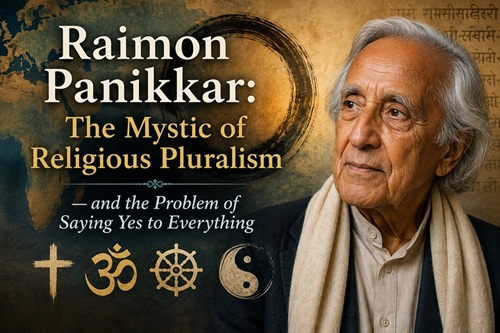 Raimon Panikkar (1918-2010) was one of the most remarkable and intellectually adventurous figures in twentieth-century theology. Born in Barcelona to a Catalan Catholic mother and an Indian Hindu father, he eventually became a Catholic priest, professor of comparative religion, and an influential advocate of interreligious dialogue. He held doctorates in chemistry, philosophy and theology, taught at Harvard and the University of California, Santa Barbara, and developed an extraordinarily wide-ranging intellectual synthesis of Christianity, Hinduism, Buddhism, philosophy, mysticism and intercultural theory. His intellectual biography is almost tailor-made for the pluralistic age. Panikkar famously described his spiritual trajectory by saying that he began as a Christian, discovered that he was a Hindu, and returned as a Buddhist without ceasing to be a Christian. This was not merely a colorful autobiographical statement. It expressed the fundamental principle of his theology: religious traditions should not be regarded as mutually exclusive systems competing for possession of the one religious truth. Rather, they are different historical and cultural expressions of a deeper reality that transcends them all. That vision makes Panikkar an important precursor of contemporary interfaith and intercultural thinking. But it also exposes the central weakness of his project. His desire to overcome religious exclusivism gradually becomes so comprehensive that the distinctive truth claims of the religions themselves begin to disappear. His theology risks transforming religious pluralism from a difficult encounter between competing truth claims into a metaphysical system in which contradiction is ultimately absorbed into harmony. Panikkar is therefore worth taking seriously precisely because his greatest strength and greatest weakness are closely connected. From Christian apologetics to radical pluralismPanikkar's development is particularly revealing. His early work was still recognizably Christian in its approach to other religions. His famous The Unknown Christ of Hinduism, first published in 1964, attempted to interpret Hinduism through a Christian theological framework. The Hindu religious experience could be understood, he argued, in relation to Christ even where Christ was not explicitly recognized. But this position gradually changed. Panikkar moved away from the idea that Christianity provides the privileged framework within which other religions should ultimately be understood. His later work became increasingly concerned with the possibility that Christianity itself might need to be transformed through genuine encounter with Hinduism, Buddhism and other traditions. Recent scholarship describes this trajectory as a movement from a relatively traditional "fulfillment" approach toward an increasingly cosmic and pluralistic theology. This was a profound intellectual shift. The missionary question—"How does Christianity bring the truth to other religions?"—was replaced by a much more radical question: "What happens to truth itself when different religions encounter one another?" Panikkar's answer was that no single tradition possesses the whole of truth. But he did not simply embrace relativism. He wanted to distinguish pluralism from relativism. Truth is plural because reality itself is inexhaustibly rich and cannot be exhausted by any single conceptual or religious perspective. Contemporary scholarship continues to identify this "plurality—but not relativism—of truth" as one of the foundations of his intercultural philosophy. This is one of Panikkar's most attractive ideas. It avoids both religious imperialism and the facile conclusion that all religions are simply "the same." But it raises an awkward question: if no tradition can claim access to truth as such, on what basis can Panikkar make claims about the structure of reality that are supposed to apply to all traditions? That question becomes increasingly important as his philosophy develops. The cosmotheandric visionThe centerpiece of mature Panikkar is his "cosmotheandric" vision. The word combines cosmos, theos and anthropos: world, God and human being. Reality is not fundamentally divided into separate domains called matter, humanity and divinity. These three dimensions constitute an interconnected whole. Panikkar therefore speaks of the "cosmotheandric" structure of reality: the divine, human and cosmic are radically interrelated. His interpretation of the Trinity is correspondingly unconventional. The Trinity is not merely a doctrine about three divine persons. It reveals something about the very structure of being. As one scholarly analysis summarizes his position, for Panikkar "Being is Trinity": reality is an organic whole constituted by divine, cosmic and human dimensions in radical relationality. This is intellectually ambitious and, at first sight, quite beautiful. Panikkar is attempting to overcome a series of dualisms that have deeply influenced Western thought: God versus world, spirit versus matter, subject versus object, religion versus secular life. There is something genuinely valuable here. Panikkar refuses to regard the world as a spiritually irrelevant object sitting outside God, while simultaneously refusing to reduce human beings to isolated egos. His cosmotheandrism anticipates contemporary ecological, relational and systems-oriented philosophies in its insistence that reality consists of interconnected dimensions rather than independent substances. But there is a price. The cosmotheandric vision is presented not merely as a useful metaphor or theological interpretation but as a fundamental description of reality. Panikkar thus moves surprisingly quickly from intercultural dialogue to metaphysics. The comparative theologian becomes a metaphysician. And once that happens, the question becomes unavoidable: why should we believe that reality actually has this triadic structure? The answer cannot simply be that Christianity, Hinduism and Buddhism each contain elements that can be interpreted in this direction. That would be a powerful comparative observation, but it would not establish the metaphysical claim. Panikkar's cosmotheandrism is ultimately an intuition—a sophisticated religious-philosophical intuition, certainly, but an intuition nonetheless. The Trinity transformedPanikkar's reinterpretation of the Trinity illustrates both his creativity and his tendency to stretch Christian categories beyond their traditional meaning. In orthodox Christianity, the Trinity concerns the identity and relations of Father, Son and Holy Spirit within the one God. Panikkar broadens this structure into the divine, human and cosmic dimensions of reality. This gives the doctrine enormous existential scope: the Trinity is no longer primarily something Christians believe about God but a key to understanding the whole of reality. Yet the transformation is substantial. As Anselm Min has pointed out, Panikkar's cosmotheandrism differs significantly from classical Christian Trinitarian doctrine. The danger is that a Christian theological concept becomes a universal metaphysical template. The Trinity becomes so capacious that almost anything can be accommodated within it. This is a recurring problem in Panikkar. His vocabulary is extraordinarily fertile—Christ, Trinity, Spirit, cosmotheandrism, dialogue, mythos, symbol, mystery, radical relativity—but the greater the elasticity of these concepts, the harder it becomes to determine exactly what would count as a contradiction of them. A philosophy that can reconcile almost everything may eventually become incapable of saying that anything is false. Christ without Jesus?The deepest problem appears in Panikkar's Christology. Panikkar increasingly distinguishes "Christ" from the historical Jesus. Christ becomes the symbol or reality through which the finite and infinite are related. In one famous formulation, when he calls this link between finite and infinite "Christ," he does not presuppose its identification with Jesus of Nazareth. This is an extraordinarily consequential move. Christianity traditionally makes an astonishingly particular claim: that God became incarnate in a particular human being, Jesus of Nazareth, at a particular historical moment. Panikkar universalizes Christ beyond this particularity. Christ becomes a cosmic reality that can be encountered outside Christianity and, potentially, outside explicit reference to Jesus. There is an obvious advantage. This allows Panikkar to take Hindu and Buddhist religious experience seriously without treating it merely as an incomplete version of Christianity. Christ can be present wherever the finite and infinite meet. But the theological cost is enormous. If Christ is no longer constitutively identified with Jesus, what exactly remains distinctive about Christianity? This is not merely a conservative Catholic objection. It is a philosophical problem concerning identity. If "Christ" denotes a universal structure of reality that can be found independently of Jesus, then the historical Jesus becomes one manifestation, symbol or expression of a much larger principle. Christianity has thereby ceased to be the exclusive bearer of Christological truth—but it may also have ceased to possess a distinctive Christology. This tension has been extensively identified in the critical literature. A detailed study of Panikkar's Christology concludes that his pluralistic concerns eventually place his understanding of Christ in tension with central principles of traditional Catholic Christology, particularly concerning the relationship between Jesus' humanity and divinity. The criticism is therefore not simply that Panikkar was "too liberal." His project creates a conceptual dilemma: the more universally applicable Christ becomes, the less specifically Christian Christ becomes. Religious dialogue: Panikkar's great contributionIf Panikkar's metaphysics is questionable, his contribution to interreligious dialogue is considerably more convincing. He understood something that many theologians missed: dialogue cannot be reduced to exchanging propositions. If representatives of different religions enter into conversation merely to defend their respective doctrines, they may achieve civility but not genuine understanding. Panikkar therefore advocated what he called "dialogical dialogue." Dialogue should involve persons rather than merely intellectual positions. One must enter into the world of another tradition sufficiently deeply to understand how reality appears from within it. His related concept of "diatopical hermeneutics" seeks to understand conceptual worlds that arise from fundamentally different cultural and religious contexts. This is perhaps Panikkar at his best. He recognizes that understanding another religion requires more than translating vocabulary. "God," "salvation," "self," "world," "liberation" and "spirit" do not necessarily refer to equivalent objects in different traditions. A dialogue between religions therefore requires an encounter between different symbolic universes. This insight remains highly relevant. Yet Panikkar sometimes seems excessively optimistic about what such dialogue can achieve. His method is based on trust in the other and on the possibility of discovering a deeper harmony between traditions. Critics have described his approach as excessively mystical, optimistic and trusting. That criticism deserves attention. Religions do not merely differ because different cultures have given different names to the same underlying reality. They also make mutually incompatible claims. Is the ultimate reality personal or impersonal? Is the self ultimately real or empty? Is there reincarnation? Is there resurrection? Is salvation liberation from individuality or eternal communion with God? Is history linear or cyclic? Is there a creator? These are not merely linguistic misunderstandings. Sometimes two traditions really do disagree. The danger of harmonyThis leads to perhaps the most important criticism of Panikkar: his philosophy can become a metaphysics of reconciliation. He is deeply attracted to the coincidence of opposites, complementarity and relationality. Instead of choosing between alternatives, he looks for a deeper level at which the alternatives can coexist. That is often intellectually productive. But it can also become a way of avoiding falsification. Anselm Min posed the problem particularly sharply in his discussion of Panikkar's "ontological pluralism." He asks whether Panikkar is really a pluralist or a monist in disguise, whether he does justice to the uniqueness of individual religions, and whether he prematurely introduces an eschatological harmony of opposites into a historical world in which oppositions can produce genuine and even violent conflict. This is a devastating question. Panikkar rejects monism because he wants genuine plurality. But his cosmotheandric vision supplies an encompassing unity within which the plurality is integrated. The result can look like pluralism from below and monism from above. Everything is different—but everything belongs to the same deeper reality. That is an elegant philosophical position. But elegance is not evidence. The problem of asymmetryThere is another difficulty. Panikkar's pluralism can appear symmetrical in theory while being asymmetrical in practice. He is especially interested in Christianity, Hinduism and Buddhism because these traditions formed his own intellectual and spiritual world. His comparative work is therefore extraordinarily rich within this triangle. But the resulting "universal" philosophy may actually reflect a particular selection of religious traditions and philosophical categories. This is a familiar problem in comparative religion. The scholar who discovers a common structure among traditions may be discovering something genuinely universal. But he may also be imposing a conceptual grid upon traditions that do not themselves understand their relationship in those terms. Panikkar's own sensitivity to cultural difference makes this irony particularly striking. His theory of dialogue warns against imposing one's categories upon another culture. Yet cosmotheandrism itself can function as precisely such a universal category. Multiple religious belongingPanikkar's personal religious identity was central to his philosophy. His famous description of himself as Christian, Hindu and Buddhist expresses his conviction that religious belonging need not be exclusive. This was radical in the twentieth century and remains provocative today. There is an important distinction, however, between learning deeply from another tradition and actually belonging to it. One can study Buddhism without being Buddhist; one can practice Zen meditation without accepting Buddhist metaphysics; one can find Hindu Vedanta illuminating without accepting its doctrines. Panikkar's notion of multiple belonging challenges this distinction. It can be liberating, but it also risks underestimating the internal coherence of religious traditions. Religions are not collections of spiritual practices that can simply be combined according to individual preference. Their doctrines, rituals, narratives and institutions form interconnected systems. A Christian cannot simply add reincarnation to Christianity without altering Christianity. A Buddhist cannot simply add a creator God without transforming Buddhism. Panikkar understood this intellectually. But his own synthesis sometimes makes the tensions look more easily resolvable than they really are. Panikkar and the perennialist temptationPanikkar should not simply be classified as a perennialist. He is more sophisticated than the familiar claim that "all religions teach the same thing." Indeed, his insistence upon plurality is intended to resist precisely that reduction. Nevertheless, there is a perennialist temptation within his work. The temptation is to say: religions differ on the surface, but at depth they participate in a common mystery. This formulation sounds profound because it is difficult to disagree with it. Religious traditions obviously share certain existential concerns, and mystical experiences across cultures can display striking similarities. But similarity does not establish identity. The fact that Christian mystics, Hindu Vedantins and Buddhist contemplatives report experiences of transcendence does not demonstrate that they encountered the same metaphysical reality. Nor does it demonstrate that their conceptual interpretations are interchangeable. Experience is always interpreted. Panikkar sometimes gives the impression that mystical depth provides access to a level at which doctrinal differences become secondary. But perhaps the opposite is true: mystical experience may be precisely where interpretation becomes most important. Panikkar's epistemological problemThere is therefore a fundamental epistemological problem beneath his entire project. Panikkar is suspicious of claims to possess absolute truth from within a single tradition. Yet he himself makes claims about the nature of truth, reality, religion, dialogue and the structure of being. Where do those claims come from? If they are simply another culturally situated perspective, then Panikkar's cosmotheandric vision cannot claim universal validity. If they are universally valid, however, he appears to have achieved precisely the kind of transcultural insight that his pluralism says no single tradition can monopolize. Perhaps Panikkar would respond that this is a false dilemma: truth can be universal without being exhaustively possessed by any one tradition. That is probably the strongest version of his position. But the problem remains. We still need criteria for distinguishing genuine universal insight from an attractive synthesis produced by one unusually gifted thinker. Panikkar's answer ultimately lies in dialogue, encounter and transformative experience. That is spiritually appealing. It is not quite the same thing as philosophical demonstration. A pioneer who sometimes wanted too muchPanikkar's achievement should nevertheless not be underestimated. He belonged to a generation in which Christianity was still often treated as the normative religious framework against which other traditions were evaluated. He helped move comparative theology toward something much more genuinely dialogical. His work anticipated contemporary discussions of religious pluralism, intercultural philosophy, multiple belonging and the relational character of identity. Scholars today continue to find his epistemology and intercultural hermeneutics productive. He also possessed a rare intellectual generosity. He did not approach Hinduism or Buddhism merely as exotic objects for Christian theology. He allowed them to challenge Christianity itself. That is a major virtue. But intellectual generosity can become intellectual indiscrimination. Panikkar sometimes seems unwilling to allow reality to remain genuinely fractured, unresolved and contradictory. He wants the traditions to meet, but he also wants their encounter to disclose a deeper unity. He wants Christianity to learn from Hinduism and Buddhism, but he also wants their differences to reveal complementary dimensions of a single reality. The result is an extraordinary intellectual architecture—but one whose foundations are much less secure than its elegance suggests. The legacyThe most fruitful way to read Panikkar today may therefore be neither as a prophet who solved religious pluralism nor as a theologian who simply abandoned Christianity. He is better understood as a brilliant explorer of a problem that has no easy solution. How can religious traditions meet without one dominating the others? How can we take radically different spiritual worldviews seriously without collapsing them into relativism? How can Christianity remain genuinely Christian while acknowledging that religious experience cannot be monopolized by Christianity? Panikkar's answer was dialogue, pluralism, radical relationality and cosmotheandrism. His weakness was that the proposed solution sometimes becomes more certain than the evidence permits. His pluralism can slide toward an overarching metaphysical unity; his Christology can become so universal that Jesus becomes less distinctive; his dialogical optimism can underestimate genuine contradiction; and his cosmotheandric vision can appear to solve at the metaphysical level precisely the differences that remain unresolved at the historical and doctrinal level. Perhaps Panikkar's most enduring contribution is therefore methodological rather than metaphysical. He taught that the other religion should not merely be studied from outside. It should be encountered from within. He taught that dialogue requires vulnerability, not just tolerance. And he understood that one's own religious identity can be transformed through genuine encounter with another tradition. Those are substantial achievements. But we need not accept the further conclusion that all religious differences are ultimately reconciled within a cosmotheandric unity. We can retain Panikkar's extraordinary lesson about dialogue while remaining skeptical about his metaphysics. Indeed, there may be a deeper irony here. Panikkar's most valuable legacy may survive precisely if we stop trying to turn it into a comprehensive theory of reality. His greatest insight was not that all differences disappear at the deepest level. It was that we should learn to live, think and converse seriously while they remain.
Widget is loading comments...
|