|
TRANSLATE THIS ARTICLE
Integral World: Exploring Theories of Everything
An independent forum for a critical discussion of the integral philosophy of Ken Wilber
  Frank Visser, graduated as a psychologist of culture and religion, founded IntegralWorld in 1997. He worked as production manager for various publishing houses and as service manager for various internet companies and lives in Amsterdam. Books: Ken Wilber: Thought as Passion (SUNY, 2003), and The Corona Conspiracy: Combatting Disinformation about the Coronavirus (Kindle, 2020). Frank Visser, graduated as a psychologist of culture and religion, founded IntegralWorld in 1997. He worked as production manager for various publishing houses and as service manager for various internet companies and lives in Amsterdam. Books: Ken Wilber: Thought as Passion (SUNY, 2003), and The Corona Conspiracy: Combatting Disinformation about the Coronavirus (Kindle, 2020).
Check out my other conversations with ChatGPT Harold Saxton Burr and the Electric Blueprint of LifeHow a pioneering bioelectrician turned a real biological phenomenon into an overextended theory of organismic formFrank Visser / ChatGPT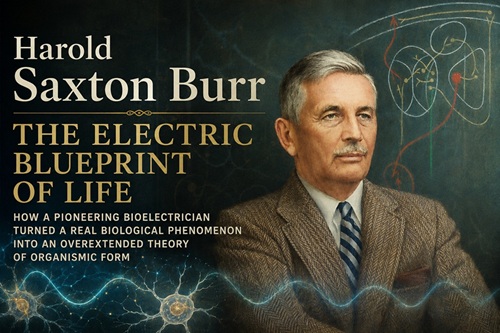 Harold Saxton Burr occupies an intriguing position in the history of twentieth-century biology. He was neither a crank working outside science nor a conventional reductionist comfortably ensconced within it. For decades he was a professor of anatomy at Yale University, publishing experimental work on embryology, neuroanatomy, cancer, ovulation and the electrical properties of living organisms. He devised instruments for measuring tiny electrical potentials in biological systems at a time when such measurements were technically difficult. His work therefore deserves to be taken seriously. But Burr's later reputation presents a problem. He has become something of a patron saint for contemporary “biofield” theories, energy medicine and various forms of biological holism. His famous concept of the L-field, or “field of life,” is frequently invoked as though modern science has vindicated his claim that an invisible electromagnetic blueprint organizes the body. That conclusion is much harder to sustain. The most interesting way to understand Burr is therefore neither to dismiss him as pseudoscience nor to celebrate him as a prophet vindicated by twenty-first-century biology. His career illustrates something more subtle: how an important empirical discovery can become attached to a much larger philosophical interpretation that the evidence does not necessarily warrant. The genuine discovery: living things are electricalBurr's starting point was not absurd. Quite the opposite. Living organisms really are electrical systems. The nervous system operates through electrical potentials. Cell membranes maintain voltage differences. Ion channels generate currents. Developing tissues display endogenous electrical fields. Wounds generate electrical signals, and electrical activity can influence cellular migration, proliferation and differentiation. Modern developmental biology has established that bioelectric signals can participate in regulating large-scale patterns of growth and regeneration. Burr's contribution was to take this phenomenon seriously at a time when biological research was increasingly dominated by chemical and mechanical explanations. His early work included studies of developing salamanders and embryonic tissues. In 1932 he proposed an “electro-dynamic theory of development,” and in 1935, together with philosopher Filmer S. C. Northrop, he published The Electro-Dynamic Theory of Life. This was an intellectually ambitious proposal. Biology, Burr argued, should not think exclusively in terms of molecules and cells. The organism also has electrical organization at the level of the whole. There was something important in this challenge. Burr was asking a question that remains scientifically legitimate: how do local cellular processes become coordinated into the large-scale architecture of an organism? A collection of cells does not spontaneously explain a body plan. A developing embryo somehow produces ordered structures, axes and organs. Regenerating organisms can reconstruct missing parts. And the individual molecules in a body are constantly being replaced without the organism losing its overall identity. These are genuine problems of biological organization. Burr's mistake was not necessarily asking these questions. It was the increasing confidence with which he moved from the existence of bioelectric phenomena to a comprehensive theory about what those phenomena mean. From electrical gradients to the L-fieldBurr called the hypothesized organizing field the L-field. He regarded it as something like an electromagnetic blueprint of the organism. The metaphor was powerful. Imagine an organism as a pattern of iron filings surrounding a magnet. The individual filings may be removed and replaced, but the magnetic field maintains the pattern. Burr thought something comparable might happen in living organisms. The material components continually change, yet the overall form remains remarkably stable. Perhaps the field provides the organizing pattern. This was a striking inversion of conventional biological thinking. Instead of saying that the organism's structure is simply the consequence of the properties and interactions of its constituent parts, Burr suggested that the larger-scale field might constrain and organize those parts. There is an important insight here. Modern biology has indeed become considerably more comfortable with systems-level causation, feedback, collective dynamics and bioelectric patterning than mid-century molecular reductionism often was. Contemporary researchers such as Michael Levin, for example, investigate how bioelectric states can regulate developmental and regenerative patterning. Burr's work has consequently received renewed historical attention. Levin has argued that Burr's emphasis on bioelectric gradients as prepatterns for morphogenesis anticipated important developments in modern biology. But there is a crucial distinction between saying that bioelectric states participate causally in morphogenesis and saying that an organism possesses a single, unified electromagnetic blueprint that controls its development. Those propositions are not equivalent. The danger of the “field” metaphor“Field” is one of the most seductive words in science. It has enormous explanatory power in physics. Gravitational, electromagnetic and quantum fields are mathematically defined entities with precisely specified relationships to measurable quantities. But when the word migrates into biology, psychology or spirituality, it can easily become a metaphor masquerading as an explanation. Burr sometimes came perilously close to this. The existence of voltage gradients around or within an organism is not controversial. The difficult question is what those gradients do. Are they merely consequences of cellular activity? Are they signals? Do they provide positional information? Do they causally constrain development? How are they generated? How do cells detect them? How are they integrated with genes, proteins, mechanical forces, chemical gradients and cell-cell communication? Those are empirical questions. But the statement that “the L-field organizes the organism” can become circular. We observe organized development and an electrical pattern; we then call the electrical pattern the organizing field. The organization has been renamed rather than explained. This is a recurrent problem in holistic biology. The language of organization can easily be mistaken for a mechanism of organization. Burr against reductionismBurr's philosophical ambitions were much greater than his experimental work. In The Nature of Man and the Meaning of Existence (1962), he explicitly attacked materialist philosophy. His later books, including Blueprint for Immortality (1972) and The Fields of Life (1973), presented the L-field as a fundamental feature of living systems. Yale's archival description of his papers summarizes the mature position succinctly: Burr regarded the electrodynamic field as a “blueprint” for life. Here Burr crossed from experimental biology into metaphysics. He was dissatisfied with the idea that life could ultimately be understood through physics and chemistry alone. He saw the organism as an integrated whole and believed that biological order pointed toward something deeper than material mechanism. The philosophical intuition is understandable. But it is important not to confuse an objection to naive reductionism with an argument against physical explanation. Modern biology itself has moved far beyond the crude picture that Burr opposed. Contemporary systems biology, developmental biology and network science routinely study emergent properties, feedback loops, hierarchical organization and multiscale causation. None of this requires an immaterial organizing field. The alternative to reductionism is not necessarily vitalism. That is the point Burr's legacy makes especially clear. Where Burr was ahead of his timeIt would nevertheless be unfair to treat Burr simply as a failed vitalist. Some of his intuitions were genuinely prescient. Developmental biology today recognizes that electrical states can carry information. Cells can alter their behavior in response to voltage differences, and bioelectric networks can participate in pattern formation and regeneration. Researchers are investigating how tissues maintain anatomical targets and how bioelectric signaling interacts with molecular pathways.[1] This gives Burr's work a fascinating afterlife. The contemporary revival of developmental bioelectricity does not demonstrate that his complete L-field theory was correct. Rather, it shows that one component of the problem he identified was real and scientifically productive. This distinction matters enormously. Science frequently progresses by rescuing a good question from a bad theory. The history of science is full of examples in which an investigator correctly notices an anomaly or neglected phenomenon but explains it through a framework that later proves inadequate. The enduring contribution lies in the phenomenon and the question, not necessarily in the original explanatory architecture. Burr may belong to this category. Cancer, ovulation and the temptation of predictionBurr also extended his electrical investigations into pathology and physiology. He studied electrical correlates of tumors and reported differences between cancer-resistant and cancer-susceptible mice. He investigated wounds and the electrical properties of ovulation. His work on ovulation even attracted considerable public attention in the 1930s; Time reported Burr's claim that his technique could determine the timing of human ovulation. Again, the distinction between correlation and explanation becomes critical. A physiological state can alter the electrical properties of tissue without those electrical properties being the fundamental cause of the physiological state. And even if an electrical measurement reliably precedes a disease or physiological event, that does not automatically mean the field is the “blueprint” controlling what follows. Prediction and causation are different achievements. This is particularly important because Burr's later writings tended to broaden the significance of his measurements. The more ambitious the theory became, the more the electrical field was asked to explain: development, health, disease, behavior and even the persistence of individual identity. The field became a universal explanatory principle. And universal explanatory principles should make us nervous. The moon, trees and cosmic rhythmsThe most speculative phase of Burr's research involved environmental influences on biological electrical activity. His long-term measurements of trees led him to suggest relationships between their electrical behavior and diurnal, lunar and annual cycles. Yale's archive confirms that much of his surviving research material concerns the electrodynamic fields of trees. This is where Burr's scientific imagination becomes particularly difficult to separate from his metaphysical worldview. There is nothing inherently implausible about organisms responding to environmental cycles. Circadian biology is firmly established. Organisms respond to light, temperature, seasons, gravitational and geophysical conditions in various ways. But establishing a specific electromagnetic coupling requires much more than finding correlations in long-term measurements. Large datasets are full of rhythms. Biological organisms are rhythmic. The environment is rhythmic. The Earth is rhythmic. The Moon is rhythmic. The challenge is to determine which correlations represent genuine causal relationships and which are statistical coincidences, indirect effects or artifacts of measurement. Burr's interpretation often ran ahead of that methodological caution. The problem of technological authorityThere is another interesting feature of Burr's story. His experiments possessed the aura of technological sophistication. He developed microvoltmeters and pioneered difficult measurements of weak biological electrical potentials. His technical ingenuity was real. A later review of his work emphasizes precisely how demanding these measurements were with the technology available to him. But sophisticated instruments do not automatically produce sophisticated explanations. This is an important lesson for the contemporary “biofield” movement, which often invokes Burr's instruments as evidence that invisible life energies have been scientifically established. They have not. Measuring a voltage is not the same as measuring a mysterious life force. A voltage is a physical quantity. Its biological origin, physiological function and causal significance must be established independently. Calling it a “biofield” does not add explanatory power unless the field is mathematically and experimentally characterized. Burr's genuine measurements therefore cannot simply be imported wholesale into energy medicine or spiritual theories. Burr's unexpected relevance to contemporary biologyIronically, Burr's strongest legacy may be found precisely where his admirers sometimes look least. We do not need to accept his metaphysical L-field to appreciate the biological significance of bioelectricity. Modern developmental bioelectricity provides a much more disciplined version of the question Burr was asking. Researchers investigate membrane potentials, ion channels, gap junctions, electrical gradients and bioelectric networks and ask how these participate in the regulation of anatomical form. The work is experimental, mechanistic and increasingly connected to molecular biology. That is a much stronger scientific position than simply declaring that “life is an electromagnetic field.” The difference is methodological. The contemporary researcher asks: • What electrical state exists? • How is it generated? • What cells detect it? • What molecular pathways respond? • Can manipulating it alter development? • Can the result be reproduced? • What predictions follow? Burr sometimes asked these questions, but his later philosophy increasingly encouraged a different kind of reasoning: Since the organism is organized, and since an electrical field is associated with it, perhaps the field is the organizing principle of life. That is an intellectually attractive hypothesis. It is not, by itself, a demonstrated conclusion. The ghost of vitalismBurr's deepest problem was therefore philosophical. He wanted to escape the dead-end of mechanism. But he never fully demonstrated what should replace it. His L-field became a modernized form of an old biological idea: form is not reducible to matter because some organizing principle must stand behind matter. In earlier generations this organizing principle might be called the vital force, entelechy or formative principle. Burr gave it an electrical vocabulary. That was scientifically more respectable because electrical potentials are measurable. But the philosophical move remained similar. The danger is subtle. Once an empirical phenomenon is elevated into a metaphysical principle, every unexplained feature of life can be attributed to it. The field explains development because it organizes development; it explains organismic unity because it is the field of the organism; it explains health because deviations in the field precede disease. At that point the theory becomes difficult to falsify. And a theory that can explain everything may predict very little. A better verdict on BurrHarold Saxton Burr deserves neither the status of forgotten crank nor that of prophetic genius vindicated by modern science. He was something more interesting: a serious scientist who identified an important phenomenon and then drew conclusions from it that became increasingly difficult to justify. His experimental work belongs to the history of bioelectricity. His insistence that biological organization cannot be understood solely by staring at isolated molecular components anticipated questions that contemporary developmental biology continues to explore. Modern work on bioelectric signaling gives his central intuition a measure of retrospective significance. But the modern evidence does not establish the grand metaphysical L-field of Blueprint for Immortality. Nor does it validate the broader claims sometimes attached to Burr's name concerning cosmic energies, disease prediction, consciousness or a universal electromagnetic blueprint of life. The irony is that Burr does not need to have been completely right to have been important. His real achievement was to insist that biology has an electrical dimension that deserves explanation. His mistake was to turn that dimension into an explanation of biology as a whole. And perhaps that is the most useful lesson of the Burr episode. Holism becomes scientifically productive when it generates new variables, measurements, mechanisms and predictions. It becomes speculative when “wholeness,” “field,” “information” or “organization” merely gives a new name to what we do not yet understand. Burr stood on that boundary. On one side was a genuinely fruitful science of bioelectricity. On the other was the alluring dream of an invisible blueprint behind life. The first has survived. Whether the second ever existed is precisely what Burr's evidence failed to establish. NOTES[1] Michael Levin, "Reprogramming cells and tissue patterning via bioelectrical pathways: molecular mechanisms and biomedical opportunities", Wiley, 29 July 2013.
Widget is loading comments...
|