|
TRANSLATE THIS ARTICLE
Integral World: Exploring Theories of Everything
An independent forum for a critical discussion of the integral philosophy of Ken Wilber
  Frank Visser, graduated as a psychologist of culture and religion, founded IntegralWorld in 1997. He worked as production manager for various publishing houses and as service manager for various internet companies and lives in Amsterdam. Books: Ken Wilber: Thought as Passion (SUNY, 2003), and The Corona Conspiracy: Combatting Disinformation about the Coronavirus (Kindle, 2020). Frank Visser, graduated as a psychologist of culture and religion, founded IntegralWorld in 1997. He worked as production manager for various publishing houses and as service manager for various internet companies and lives in Amsterdam. Books: Ken Wilber: Thought as Passion (SUNY, 2003), and The Corona Conspiracy: Combatting Disinformation about the Coronavirus (Kindle, 2020).
Check out my other conversations with ChatGPT Joe Firmage, Ken Wilber, and the Long Shadow of Integral FinancingFrank Visser / ChatGPT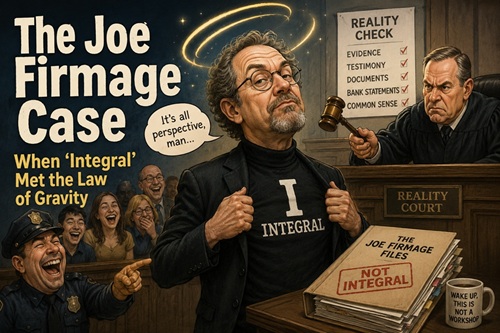 When I wrote about Joe Firmage last year, the central question was still hanging in the air: how much of the extraordinary investment story surrounding Firmage's alleged breakthrough propulsion technology was merely the fantasy of a charismatic entrepreneur, and how much of it implicated people from Ken Wilber's Integral circle? A year later, the most important update is surprisingly simple: the case is not over. The lawsuit brought by Max Marmer and other investors remains active in the U.S. District Court for the District of Utah. A recent account of the docket reports an amended scheduling order entered in July 2026, with discovery now scheduled to run into October 2026 and motions due in November. In other words, the trial and final judicial determination that I anticipated in my earlier article did not materialize in 2025 or early 2026. That changes the status of the story, but not its significance. Indeed, with another year of distance, the Firmage affair looks less like an eccentric footnote in Integral history and more like a revealing stress test of the movement's claims about consciousness, discernment, ethics and human development. The basic storyThe underlying lawsuit, Marmer et al. v. Firmage et al., Case No. 2:23-cv-00580-JCB, was filed in August 2023 in Utah. The plaintiffs include Max Marmer and several other investors. The defendants include Joe Firmage, Robert A. Richards, Kenneth E. Wilber, Colin Bigelow, Integral Initiatives LLC and a number of companies and individuals associated with Firmage's project. The case is classified as a securities-fraud action. The plaintiffs' central allegation is devastating if eventually established: Firmage and associates allegedly solicited approximately $25 million by claiming that a revolutionary propulsion project was on the verge of receiving enormous U.S. government contracts. Investors were allegedly told that a $200 million Department of Defense contract had already been signed, but that money had to be advanced to bridge the project until government funds became available. The complaint describes a particularly important episode. Firmage and Richards allegedly told investor Max Marmer in 2022 that the Biden administration had offered two large government contracts, including a $200 million Defense Department contract. They allegedly said the contracts were already signed but could not be shown because they were classified. Investors were then invited to contribute toward a $1 million escrow payment supposedly necessary to secure intellectual-property rights and unlock the government money. That is not merely an implausible business proposition. If the allegations are proven, it is the classic architecture of an advance-fee investment fraud: the promised enormous payoff is always just around the corner, while some immediate payment is required to unlock it. And the plaintiffs allege something even more serious: that earlier investors were recruited into bringing in new investors in order to recover their own losses. The complaint explicitly characterizes the arrangement as a Ponzi scheme. The Integral connection is not incidentalThis is where the story becomes particularly relevant to the history of Integral Theory. Joe Firmage was not some random outsider who happened to encounter a few integralists. He was present at the very beginning of the Integral Institute project. The official history of the Integral Institute still describes how, in 1997, philanthropists approached Wilber about creating an organization devoted to integral approaches to complex problems. Firmage participated in the meetings and subsequently donated $1 million in cash. The Integral Institute says explicitly that this donation formally launched the organization. That historical connection matters because it establishes something beyond mere social acquaintance. Firmage was one of the financial patrons who helped make the institutional Wilber project possible. And the relationship did not simply disappear. The 2023 complaint alleges that Richards, Wilber and Bigelow were involved with Firmage's Lab Project for years. More significantly, the plaintiffs allege that agreements existed whereby members of what the complaint calls the "Integral Initiative Parties" would receive commissions or other compensation for recruiting new investors, partly to recover their own earlier losses. The complaint says that these arrangements effectively perpetuated the alleged Ponzi scheme. That is the allegation that deserves the greatest attention. Not because it proves Wilber's guilt—it does not—but because it changes the question. The issue is no longer simply: "Did Ken Wilber personally believe Joe Firmage's extraordinary technological claims?" It becomes: "What was the nature of Wilber's financial relationship with Firmage's investment operation, what did he know, and what did he do with that knowledge?" Those are much more consequential questions. What Wilber's lawyers actually saidIt is important not to confuse an accusation with an established fact. Wilber and the other "Wilber Defendants" filed an answer in May 2024. They broadly denied the allegations and asserted a long list of affirmative defenses. They denied, among other things, misleading investors, misusing investment funds, exploiting their position in the Integral community, and participating in deceptive conduct concerning Firmage's technology. They also argued that Marmer had dealt directly with Firmage and Richards and had been informed about the risks of the proposed investment. This is legally important. The defense is not an admission disguised as a denial. Nor does the plaintiffs' complaint establish that Wilber knowingly participated in fraud. The court has not finally adjudicated the competing versions of events. So the responsible formulation remains: Wilber was named as a defendant and has denied the allegations. The plaintiffs allege that he and associated Integral entities participated in an investment scheme connected with Firmage. Those allegations remain contested. That distinction should be maintained even in a strongly critical essay. But there is another distinction that is equally important. A legal defense is not the same thing as a satisfactory public explanation. The problem with "I deny everything"One of the striking features of the Wilber defendants' answer is how frequently it relies on categorical denials, assertions that allegations do not pertain to them, or claims of insufficient information. That may be entirely normal litigation strategy. Lawyers are not hired to write philosophical autobiographies. They are hired to protect their clients' legal interests. But there is an enormous difference between asking what must be established in court and asking what an intellectual community reasonably deserves to know. The first question is: Can the plaintiffs prove the elements of their claims against Wilber? The second is: What exactly happened between Wilber, Richards, Firmage and the various Integral entities? The second question cannot be answered merely by pointing to the first. This is especially true because the Integral movement has historically presented itself as an unusually sophisticated approach to human development, ethics and the integration of multiple perspectives. If that rhetoric means anything, financial relationships should be subjected to more transparency, not less. The $200 million fantasyPerhaps the most revealing part of the story concerns the alleged government contract. The idea that a secret $200 million Department of Defense contract existed, that the contract had already been signed, that nobody could see it because it was classified, and that private investors nevertheless needed to supply money to unlock it should have triggered enormous skepticism. The complaint alleges that Firmage and Richards made precisely these claims. It also alleges that they produced fake checks and bank statements to reassure investors that the government money existed. In one particularly disturbing allegation, this happened in connection with Terry Patten, a well-known member of the Integral community who later died in 2021. This is where the affair intersects with a much broader problem in Integral culture. Wilber's intellectual system has always placed considerable emphasis on developmental levels, epistemic sophistication and the ability to distinguish more adequate from less adequate perspectives. Yet extraordinary claims demand extraordinary verification. A claim about a revolutionary propulsion technology capable of overturning fundamental assumptions in physics is not something one should accept because an impressive person says it is true. It requires independent experimental replication, competent peer review, transparent documentation and, above all, demonstrable results. That is the ordinary scientific standard. It does not become less important because the people involved are spiritually ambitious, technologically visionary or members of an integral network. Firmage's extraordinary career makes the story even strangerThe irony is that Firmage's earlier history was already a warning. He had been a genuine Silicon Valley success story. But he subsequently became associated with UFOs, exotic physics, extraterrestrial experiences, anti-gravity and grandiose technological claims. His 1990s writings mixed physics, spirituality, cosmology and speculative ideas in ways that should have made a scientifically trained observer cautious. The trajectory is remarkably consistent with what came later. Today Firmage's own website presents him as a "Technology Architect," "Prophetic Scientist" and "World Visionary," and features an extensive collection of writings claiming fundamental advances in physics, chemistry, cosmology and the structure of matter. It includes titles such as Architecture of the Atom and Periodic Table of Elements, Geometric Atom, Law of Reciprofluxion, Cosmogeneology and Towards the Completion of Physics. Whatever one thinks of those claims, they demonstrate that the grandiosity did not end with the Lab Project. The question therefore becomes not simply why Firmage could make such claims, but why intelligent, experienced people continued to place confidence in him. The real tragedy: victims recruiting victimsThis may be the most psychologically interesting aspect of the entire case. Suppose an investor has already lost a substantial amount of money in an enterprise. The rational response would normally be to stop, reassess and perhaps accept the loss. But if the investor is told that the project is about to receive $200 million, everything changes. The previous loss becomes temporary. The investment has not failed. It is merely waiting for the promised breakthrough. And if bringing in another investor produces compensation that helps recover one's own loss, the psychological and financial incentives become even more dangerous. The victim now has a reason to become a recruiter. This is why Ponzi schemes are so destructive to communities. They do not merely transfer money. They transform relationships of trust into mechanisms for transmitting risk. The very person who reassures you may genuinely believe the story—or may have a financial reason to keep believing it. That is precisely why independent verification matters. And then there is Ken WilberHere we arrive at the most uncomfortable part of the story. Ken Wilber's significance in this affair is not necessarily that he personally invented, promoted or operated Firmage's alleged scheme. The publicly available record does not establish that. His significance is that trust in Wilber's Integral network appears to have been one of the social assets surrounding the investment operation. The complaint explicitly alleges that the relationship between plaintiffs and defendants was based in substantial part on their shared affiliation with the Integral Theory community. It says that this relationship caused investors to relax the care and vigilance they otherwise might have exercised. That is a profound allegation. A philosophical community can create social capital. People recognize one another as members of the same intellectual or spiritual tribe. They assume common values. They assume that someone recommended by a trusted teacher has already been vetted. This is precisely where charisma becomes economically consequential. Wilber did not have to tell someone, "Invest your money in Firmage." His name, his network, and his institutional relationships could potentially perform a subtler function: they could lower the perceived risk of the people around him. That is why the ethical question cannot be reduced to whether Wilber personally signed a fraudulent document. The Integral Institute's founding ironyThere is an almost perfect historical irony here. The Integral Institute began with a million-dollar contribution from Joe Firmage. The official history still acknowledges this. Twenty-five years later, people from the same broad Integral milieu allegedly became involved in an investment operation centered on Firmage's extraordinary claims. The institution that was supposed to advance a more comprehensive understanding of reality therefore acquired one of its earliest financial patrons whose later career became increasingly entangled with extraordinary claims about reality. That does not prove causation. But it is difficult to imagine a more revealing historical coincidence. It raises an old question about the Integral project itself: What happens when an intellectual system that prizes synthesis becomes insufficiently demanding about discrimination? Integration without discrimination is not wisdom. It is accumulation. The science problemThe propulsion claims deserve independent scrutiny because they reveal another weakness in the Integral culture: a tendency to move very quickly from scientific terminology to metaphysical significance. Firmage's alleged propulsion technology invoked advanced physics and extraordinary possibilities. But physics is not a vocabulary one can simply borrow to make an extraordinary idea sound sophisticated. Terms such as quantum mechanics, zero-point energy, Casimir effects, inertial frames or electromagnetic fields have precise mathematical and experimental meanings. A functioning propulsion technology must ultimately produce measurable forces under controlled conditions. It cannot be established by charisma, patents, classified-contract stories, impressive prototypes or philosophical speculation. And a patent is not scientific validation. Indeed, Firmage's earlier inertial-drive patent is no longer active; the patent status is abandoned. That does not by itself prove fraud. But it certainly does not constitute evidence that revolutionary propulsion technology had been demonstrated. The evidential burden remains where it has always been: show the effect, reproduce it, measure it, publish the methodology, and let independent researchers try to break it. What has changed since my original investigation?Quite a lot—and simultaneously, not enough. The biggest change is that the case has lasted much longer than expected. The expectation in my original article was that a jury might resolve the dispute in late 2025 or early 2026. Instead, the case remains active, with discovery now extending into late 2026. The second change is that Firmage himself continues to present a grand scientific vision. His current website contains a remarkable volume of new material on physics, cosmology, chemistry and a supposed "New Renaissance." That is significant because it suggests that the underlying worldview has not simply disappeared with the investment controversy. The third change is perhaps more subtle. The passage of time has made the central question less about whether Firmage was eccentric. We already know he was. The question is why people with access to money, scientific expertise, institutional experience and a supposedly sophisticated developmental philosophy could become entangled with his claims. The deeper Integral lessonThis is ultimately not just a story about Joe Firmage. It is a story about epistemic trust. Every intellectual or spiritual community creates hierarchies of credibility. Some people become trusted teachers. Others become insiders. Some acquire reputations as scientists, entrepreneurs, visionaries or spiritual authorities. Once that happens, information does not travel neutrally. If someone tells you that a revolutionary technology exists, you may ask for evidence. If a trusted member of your community tells you that a revolutionary technology exists—and that other trusted people have already invested—you may ask fewer questions. That is the danger. The most sophisticated scam does not necessarily require the most sophisticated deception. It requires the right social environment. And Integral culture, like every other charismatic intellectual movement, is not immune to that problem. Integral financing—or integral failure?My original article ended with a deliberately provocative question: was this "Integral Financing"? A year later I would put the point somewhat differently. The scandal is not simply that someone allegedly tried to turn an Integral network into an investment pipeline. The deeper scandal would be if a movement devoted to human development failed to develop adequate mechanisms for protecting its own members from precisely this kind of manipulation. Financial sophistication is part of psychological maturity. Scientific literacy is part of intellectual maturity. Knowing when to say "I don't know" is part of spiritual maturity. And refusing to invest money in an extraordinary technology until independent experts have verified it is not cynicism. It is basic adult judgment. We still need the evidenceIt would be premature—and legally irresponsible—to declare Ken Wilber guilty of participating knowingly in Firmage's alleged fraud. The plaintiffs have made serious allegations. Wilber and the other Wilber defendants have denied them. The court has not yet issued a final determination on the merits. The case remains active. But the opposite conclusion would be equally premature. The fact that Wilber denies wrongdoing does not make the questions disappear. • What were the financial agreements? • What did Wilber know about Firmage's project? • When did he know it? • What did he believe about the alleged government contracts? • Did he personally encourage anyone to invest? • Did he or Integral Initiatives receive commissions or other compensation? • What happened to the money? • And perhaps most importantly: why did people who trusted Wilber become willing to take extraordinary financial risks in a project built around extraordinary scientific claims? Those questions deserve answers independent of whatever technical verdict a court eventually reaches. The final ironyThere is something almost painfully appropriate about the Firmage affair appearing in the history of Integral Theory. Wilber's philosophy promises a framework capable of integrating science, spirituality, psychology, culture and economics into a more comprehensive understanding of reality. Firmage offered something that sounded superficially similar: a grand synthesis of physics, consciousness, spirituality, extraterrestrials, cosmology and technological revolution. But there is a crucial difference between integrating knowledge and integrating claims. The former requires discrimination. The latter merely requires imagination. That distinction may be the most important lesson of the whole affair. If the court eventually establishes that Firmage operated a fraudulent investment scheme, the obvious villain will be Firmage. But the more interesting intellectual question will remain: why did his story travel so far, and why did it travel so effectively through an Integral network? And if the court ultimately clears Wilber and his associates of legal liability, that still will not settle the philosophical question. Because an integral community should aspire to something higher than merely avoiding conviction. It should aspire to being difficult to fool. That is the standard by which the Firmage affair should ultimately be judged. And on that standard, the story is not finished.
Widget is loading comments...
|