|
TRANSLATE THIS ARTICLE
Integral World: Exploring Theories of Everything
An independent forum for a critical discussion of the integral philosophy of Ken Wilber
  Frank Visser, graduated as a psychologist of culture and religion, founded IntegralWorld in 1997. He worked as production manager for various publishing houses and as service manager for various internet companies and lives in Amsterdam. Books: Ken Wilber: Thought as Passion (SUNY, 2003), and The Corona Conspiracy: Combatting Disinformation about the Coronavirus (Kindle, 2020). Frank Visser, graduated as a psychologist of culture and religion, founded IntegralWorld in 1997. He worked as production manager for various publishing houses and as service manager for various internet companies and lives in Amsterdam. Books: Ken Wilber: Thought as Passion (SUNY, 2003), and The Corona Conspiracy: Combatting Disinformation about the Coronavirus (Kindle, 2020).
Check out my other conversations with ChatGPT Wilber's Four DrivesA Critical Assessment from the Standpoint of Contemporary PsychologyFrank Visser / ChatGPT
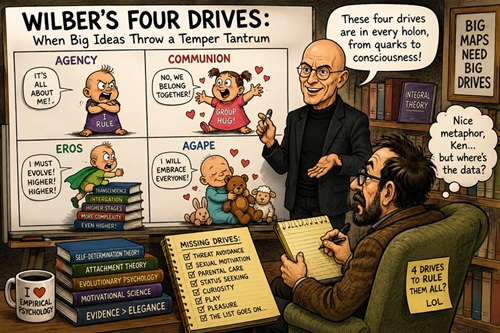
Ken Wilber's theory of the four basic drives is one of the more psychologically suggestive elements of his Integral Theory. It is also one of the places where his characteristic tendency to move from useful metaphor to sweeping ontological claim becomes particularly visible. Wilber proposes that every “holon”—something that is simultaneously a whole in itself and a part of a larger whole—possesses four fundamental drives: agency, communion, Eros, and Agape. Agency is the tendency to preserve oneself as a distinct whole; communion is the tendency to participate in larger wholes. Eros is the drive toward higher-order organization or transcendence, while Agape is the complementary tendency of the higher to embrace and include the lower. Wilber therefore presents these not merely as human motives but as fundamental characteristics of reality, operating “all the way up, all the way down.” In his more recent formulations he continues to describe Agency and Communion as horizontal forces and Eros and Agape as vertical forces. There is an important insight buried inside this scheme. But contemporary psychology suggests that the four-drive model becomes much less convincing when it is presented as a scientific theory of human motivation. Agency and communion have genuine precedents in personality psychology. Eros and Agape, by contrast, are much harder to translate into empirically defensible motivational constructs. And the attempt to combine all four into a single universal “drivology” conflates several very different levels of explanation: biological regulation, psychological motivation, interpersonal behavior, personality structure, development, and metaphysics. The result is an elegant philosophical schema that is considerably less successful as psychology. The Four DrivesWilber's terminology is easiest to understand if we first strip away its metaphysical vocabulary. Agency means maintaining one's identity, autonomy, boundaries, competence and integrity. A human being needs to be capable of saying “I,” of resisting intrusion, pursuing goals, protecting resources and exercising control over circumstances. Communion represents the complementary tendency to belong, cooperate, attach and participate in something larger than oneself. Human beings are profoundly social organisms. We form families, friendships, partnerships, communities and institutions. Eros represents movement toward greater complexity, integration, wholeness or transcendence. In Wilber's evolutionary philosophy, this is not simply a human aspiration. It is one of the forces supposedly responsible for the emergence of increasingly complex levels of organization. Agape is the complementary movement of inclusion or embrace: the higher-order whole incorporates and cares for its constituent parts. In psychological language, it comes closest to love, nurturance, care and identification with others. Wilber thus obtains a striking four-quadrant arrangement: Agency: “I must remain a whole.” Communion: “I must belong to a larger whole.” Eros: “I must become a greater whole.” Agape: “I must embrace the wholes that constitute me.” The symmetry is attractive. The problem is that psychological reality does not have to be symmetrical merely because a conceptual model is. Where Wilber Is Onto Something: Agency and CommunionThe strongest part of the theory is undoubtedly the distinction between agency and communion. This is not an invention of Integral Theory. Agency and communion have a substantial history in personality and interpersonal psychology. Contemporary interpersonal models frequently organize social behavior around dimensions corresponding to agency and communion. Agency concerns influence, autonomy, mastery and differentiation; communion concerns affiliation, intimacy, cooperation and connection. This makes Wilber's intuition quite defensible at the psychological level. Indeed, one could remove virtually all of the Integral metaphysics and retain a useful psychological proposition: Human beings must simultaneously negotiate the problem of being an individual and the problem of belonging to others. That tension is fundamental to human development. Too much agency can produce domination, narcissistic self-sufficiency, interpersonal distance or exploitative behavior. Too much communion can produce dependency, submissiveness, enmeshment or loss of self-definition. But this is precisely where contemporary psychology also exposes a problem in Wilber's formulation. Agency and communion are better understood as dimensions of functioning than as two mysterious “forces” pushing human beings from inside. Psychologists can operationalize agency and communion through measures of traits, motives, interpersonal behavior, values and relationship patterns. Their empirical relationships can be investigated. They can be associated with personality dimensions and psychopathology. They can be examined cross-culturally. Wilber's formulation does something different. He takes a useful descriptive distinction and turns it into an ontological principle supposedly operating throughout the universe. That additional step is not supplied by the psychological evidence. Self-Determination Theory Is a More Empirical AlternativeThe comparison with Self-Determination Theory (SDT) is particularly revealing. Developed principally by Richard Ryan and Edward Deci, SDT has become one of contemporary psychology's major frameworks for understanding motivation, personality development and well-being. Its three basic psychological needs are autonomy, competence and relatedness. The resemblance to Wilber's agency/communion distinction is immediately apparent. Autonomy overlaps substantially with agency. Relatedness overlaps substantially with communion. Competence adds something Wilber's two horizontal drives do not capture adequately: the human need to experience oneself as effective and capable. That third dimension is not trivial. Imagine a person who has strong agency and strong communion but feels completely incompetent. Such a person may be autonomous and socially connected while nevertheless experiencing profound frustration because they cannot accomplish what matters to them. Conversely, someone can be highly competent but socially isolated. Someone else can be deeply connected but lack autonomy. Contemporary psychology therefore has good reason to resist reducing psychological functioning to a simple agency-versus-communion polarity. SDT is also methodologically different from Wilber's drivology. Its constructs have been operationalized and subjected to thousands of empirical investigations. Research has examined how autonomy, competence and relatedness relate to motivation, internalization, performance, psychological health and well-being across different settings and cultures. The contrast is instructive. Wilber asks, in effect, “What are the fundamental forces of existence?” SDT asks, “What psychological needs can we measure, and what happens when they are satisfied or frustrated?” The second question is considerably more modest—and considerably more scientifically productive. Agency and Communion Are Not Necessarily OppositesThere is another problem with Wilber's geometrical symmetry. His four drives are presented as complementary polarities: Agency ↔ Communion Eros ↔ Agape But psychological evidence does not require these dimensions to be opposites. A person can be highly agentic and highly communal. A successful parent, for example, may be autonomous, assertive and competent while simultaneously being extraordinarily caring and connected. A good leader can exercise authority while cultivating cooperation. A scientist can pursue an intensely individual intellectual project while being deeply committed to a scientific community. Contemporary personality research consequently treats agency and communion as dimensions that can vary independently to considerable degrees. The interpersonal circumplex, for example, uses agency and communion as fundamental dimensions for organizing interpersonal functioning rather than treating them as mutually exclusive drives. This is an important distinction. Wilber's model is essentially dialectical: two forces pull in opposite directions and healthy functioning requires their integration. Contemporary psychology is more comfortable with multidimensionality: several partially independent motivational systems can operate simultaneously. That is a less aesthetically satisfying picture, but human beings are not obliged to conform to aesthetically satisfying diagrams. The Missing MotivesThe inadequacy of a four-drive psychology becomes even clearer when we ask what it leaves out. Where is threat avoidance? Where is attachment? Where is sexual motivation? Where is parental care? Where is status seeking? Where is curiosity? Where is achievement? Where is play? Where is punishment avoidance? Where is pleasure seeking? Where is emotion regulation? Where is uncertainty reduction? Where is the desire for meaning? There is no obvious place for all of these in Wilber's four categories without stretching the categories until they become almost infinitely elastic. Evolutionary motivational psychology provides a useful counterexample. Researchers have proposed multiple distinct motivational systems involving self-protection, disease avoidance, affiliation, status, mate acquisition, mate retention and parental care, among others. These systems have different psychological signatures and can be activated under different circumstances. Status motivation is particularly awkward for Wilber's model. The desire for status has been argued on empirical grounds to constitute a fundamental human motive involving respect, admiration and voluntary deference from others. One could certainly say that status seeking is a form of agency. But that does not explain it; it merely redescribes it. Likewise, parental care could be placed under communion or Agape. But again, doing so does not demonstrate that parental care is generated by some underlying “Agape drive.” It simply classifies an existing phenomenon under Wilber's preferred vocabulary. This is a recurring problem with very broad psychological categories: if every motivation can be assigned retrospectively to one of four drives, the theory becomes difficult to falsify. The Problem of ErosThe greatest difficulty is Eros. In Wilber's system, Eros is not simply sexual desire. It is the drive toward higher-order organization, greater complexity, greater wholeness and ultimately higher stages of consciousness. At the psychological level, there are indeed human tendencies toward exploration, mastery, learning, creativity, achievement and self-expansion. People often want to become more capable versions of themselves. But it does not follow that these phenomena constitute one fundamental drive toward “higher” existence. Achievement motivation, curiosity, intrinsic motivation, competence motivation, exploration and personal growth can have different antecedents and psychological functions. Contemporary motivation research investigates these separately rather than assuming that they are manifestations of one vertical evolutionary force. Research on achievement motivation, for example, examines beliefs, values, goals, identity, intrinsic and extrinsic motivation, emotion and developmental processes. Wilber therefore takes a genuine phenomenon—human beings often strive toward growth—and embeds it in a much stronger claim: reality itself contains an intrinsic tendency toward increasing complexity and consciousness. That is no longer a psychological hypothesis. It is metaphysics. The Problem of AgapeAgape creates a similar problem from the opposite direction. At the human level, the phenomena Wilber associates with Agape—love, nurturance, compassion, care, acceptance and inclusion—are perfectly legitimate subjects of psychological investigation. But these phenomena have multiple psychological foundations. Attachment theory, empathy research, prosocial motivation, parental investment, moral psychology and social bonding all provide different explanatory frameworks. They do not require a universal cosmic principle of “the higher embracing the lower.” The distinction becomes especially problematic when Wilber applies Agape to nonhuman systems. A human parent can care for a child. A cell can regulate its internal environment. A multicellular organism can incorporate cells into a larger organism. But saying that the organism “embraces” its cells in the same sense that a parent embraces a child is metaphorical anthropomorphism. The biological system does not need a psychological motive called Agape to explain its organization. The Holon ProblemThis exposes perhaps the deepest conceptual problem in the four-drive theory. Wilber moves seamlessly between different ontological levels. A molecule is said to possess agency and communion. A cell possesses them. An organism possesses them. A human being possesses them. A society possesses them. But these things do not possess properties in the same sense. A molecule has physical and chemical dynamics. A cell has biochemical regulatory mechanisms. An organism has nervous, endocrine, immune and behavioral systems. A human being has subjective experience, language, autobiographical memory and culturally mediated goals. A society has institutions, norms, collective representations and distributed cognition. Calling all of these “holons” makes the analogy possible, but it does not establish equivalence. The danger is what philosophers of science would recognize as a level-of-analysis error: because two systems exhibit superficially similar patterns, they are assumed to be generated by the same underlying principle. A molecule does not need a motivation to preserve itself. Natural selection does not require molecules to “want” anything. A cell membrane maintains gradients because of physical and biochemical processes. An organism protects itself through evolved regulatory and behavioral systems. Human beings, by contrast, really do have motivations represented in neural systems and experienced phenomenologically. The same vocabulary can therefore obscure rather than clarify the causal differences between levels. Wilber's Four Drives Are Better Seen as a Taxonomy of MetaphorsThis does not make the four drives worthless. Quite the contrary: as a phenomenological and philosophical taxonomy, they are surprisingly powerful. Agency captures something about self-maintenance and autonomy. Communion captures attachment and belonging. Eros captures aspiration, exploration and self-expansion. Agape captures care, inclusion and prosociality. Taken this way, the model resembles a philosophical map of recurrent dimensions of human life. The difficulty begins when Wilber treats the map as a causal theory. There is a crucial difference between saying: “Human beings repeatedly display these four broad patterns.” and saying: “These four forces are fundamental drives built into reality itself.” The first is a potentially useful psychological generalization. The second requires evidence of an entirely different order. The Four Drives and AttachmentAttachment theory also complicates the picture. Human beings possess powerful systems regulating proximity, security and social bonding. Under threat, attachment behavior can become especially salient. Secure attachment does not simply mean communion, however. Healthy attachment simultaneously permits exploration and autonomy. This is psychologically interesting because it undermines the simplistic opposition between agency and communion. The secure individual can move away from the attachment figure to explore the environment and return when necessary for security. Autonomy and relatedness therefore cooperate rather than merely compete. This is strikingly compatible with contemporary developmental psychology and much less compatible with a picture in which two fundamental drives are constantly pulling against one another. The mature psychological achievement is not necessarily to balance two cosmic forces. It may instead involve developing regulatory systems capable of flexibly coordinating multiple needs according to context. Context Matters More Than Wilber's Drivology AllowsAnother major weakness is insufficient attention to situational variability. Human motivation is highly context-sensitive. The same person may display extraordinary agency at work, intense communion with friends, strong avoidance behavior when threatened, competitive status seeking in one environment and nurturing parental behavior in another. Modern motivational psychology therefore emphasizes dynamic interactions between person, environment, goals, affect and social context. Self-Determination Theory, for example, explicitly investigates how environments support or thwart autonomy, competence and relatedness. This is an important methodological difference. Wilber's language tends to make motivation sound like something emitted by the individual or holon. Contemporary psychology increasingly asks what the person is trying to accomplish, what situation they are in, what social contingencies operate, what developmental history they have, what physiological state they occupy, and which motivational systems are currently activated. The latter approach is less elegant but more explanatory. The Evolutionary Argument Is Particularly VulnerableWilber's four drives become most controversial when they are used to explain evolution. He effectively proposes that evolution contains an intrinsic vertical impulse toward increasing complexity, culminating in increasingly complex forms of consciousness. His recent formulations explicitly connect Eros with self-organization and the emergence of higher-order wholes. But self-organization is not equivalent to evolutionary progress. Complex structures can emerge through ordinary physical and biological processes without implying a universal tendency toward higher consciousness. Evolution also produces simplification, loss, extinction, specialization, parasitism and regression. Natural selection does not contain a universal requirement that organisms become more complex. There is therefore a hidden normative term in Wilber's Eros: “higher.” Higher according to what criterion? More complex? More integrated? More conscious? More morally developed? More capable? More inclusive? These properties can come apart. A highly complex organism is not automatically morally superior. A cognitively sophisticated human being can behave atrociously. A simpler organism can be extraordinarily well adapted to its environment. Consequently, the move from “complexity increases under some evolutionary conditions” to “evolution is driven upward by Eros” is not licensed by psychology, biology or complexity science. It is a philosophical interpretation of evolution. What Contemporary Psychology Can SalvageInterestingly, the four drives can be reconstructed into a much more defensible psychological model if their metaphysical ambitions are removed. Agency can become autonomy, self-efficacy, mastery and self-regulation. Communion can become relatedness, attachment, affiliation and prosocial motivation. Eros can become exploration, growth, curiosity, achievement and self-expansion. Agape can become caregiving, compassion, empathy and prosocial concern. This reconstructed model would no longer claim that these are four universal forces operating in every holon. Instead, it would treat them as clusters of human motives and psychological processes that sometimes interact, sometimes conflict and sometimes reinforce one another. That version would be considerably closer to contemporary psychology. And it would also be more interesting scientifically, because it could actually generate empirical questions. Does autonomy predict well-being independently of relatedness? Under what conditions does achievement motivation become maladaptive? When does self-expansion promote psychological health and when does it produce grandiosity? How does caregiving interact with attachment style? How do agency and communion relate to personality traits? How do these motives vary across cultures? These are questions psychology can investigate. “Does the universe contain an Eros driving all holons toward higher consciousness?” is a fundamentally different kind of question. From Four Drives to Multiple Motivational SystemsThe deepest lesson is therefore methodological. Wilber's four-drive model has the aesthetic appeal of a grand unified theory. Contemporary psychology has largely moved in the opposite direction. Rather than searching for four ultimate motives, researchers distinguish multiple motivational systems, psychological needs, personality dimensions, goals, values and regulatory processes. Some are relatively stable; others are highly context-dependent. Some interact hierarchically; others operate in parallel. This does not mean that contemporary psychology has discovered the final list of human motives. It has not. Indeed, the continuing development of motivational science demonstrates how difficult it is to reduce human motivation to a small number of principles. Contemporary Self-Determination Theory itself has expanded substantially beyond its original formulation into a broader metatheoretical framework encompassing multiple subtheories of motivation, internalization, personality, goals, relationships and well-being. That intellectual history provides an important contrast with Wilber. Psychology's progress has generally come through differentiation, operationalization and empirical testing. Wilber's progress has generally come through conceptual integration. These are not the same enterprise. Conclusion: A Beautiful Map, Not a Scientific DrivologyWilber's four drives remain one of the more elegant components of Integral Theory because they capture a genuine tension in human existence. We want to be ourselves and to belong. We want to preserve what we are and to become something more. We want independence and connection, self-development and care. Those tensions are real. But the psychological validity of the four-drive model decreases as its scope increases. Agency and communion have substantial support as organizing dimensions within personality and interpersonal psychology. Contemporary psychology can therefore recognize a real insight here. Eros and Agape are more problematic. They can be interpreted as useful umbrella terms for growth, exploration, self-expansion, caregiving and compassion, but there is little justification for treating them as fundamental psychological forces. And there is even less justification for projecting them downward onto molecules and upward into cosmic evolution. The central mistake is therefore not that Wilber's four drives are completely wrong. It is that he asks them to do far too much work. They are plausible as metaphors. They are interesting as philosophical categories. Agency and communion are recognizable psychological dimensions. But they are not established as four basic human drives, and certainly not as four fundamental forces of the cosmos. Contemporary psychology offers a more complicated picture: human motivation emerges from interacting needs, evolved motivational systems, attachment processes, personality traits, learned goals, cultural values, situational demands and regulatory mechanisms. That messier picture lacks Wilber's beautiful symmetry. It has one considerable advantage, however. It can be tested. And that is ultimately the point at which Wilber's “drivology” stops being psychology and becomes Integral metaphysics.
Widget is loading comments...
|