|
TRANSLATE THIS ARTICLE
Integral World: Exploring Theories of Everything
An independent forum for a critical discussion of the integral philosophy of Ken Wilber
  Frank Visser, graduated as a psychologist of culture and religion, founded IntegralWorld in 1997. He worked as production manager for various publishing houses and as service manager for various internet companies and lives in Amsterdam. Books: Ken Wilber: Thought as Passion (SUNY, 2003), and The Corona Conspiracy: Combatting Disinformation about the Coronavirus (Kindle, 2020). Frank Visser, graduated as a psychologist of culture and religion, founded IntegralWorld in 1997. He worked as production manager for various publishing houses and as service manager for various internet companies and lives in Amsterdam. Books: Ken Wilber: Thought as Passion (SUNY, 2003), and The Corona Conspiracy: Combatting Disinformation about the Coronavirus (Kindle, 2020).
Check out my other conversations with ChatGPT The Liability of Wilber's RhetoricWhen Metaphysics Speaks Too Loudly About ScienceFrank Visser / ChatGPT
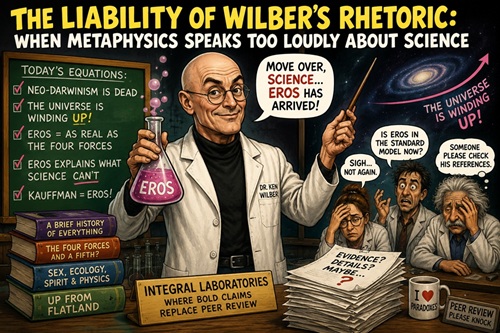
Ken Wilber has always been a rhetorically gifted writer. One of the attractions of his work is precisely the confidence with which he connects psychology, spirituality, philosophy, evolutionary theory, physics, and cosmology. He rarely sounds tentative. He wants the reader to see the larger picture, and he writes as though the pieces of that picture fit together with remarkable clarity. That rhetorical confidence, however, becomes a serious liability when Wilber speaks about science. The problem is not merely that some of his scientific claims are controversial, outdated, or overstated. Science is full of controversy, and theoretical understanding inevitably changes. The deeper problem is rhetorical: Wilber repeatedly formulates complex scientific questions in categorical, sweeping language that makes his own position appear obvious while making competing positions appear foolish, obsolete, or intellectually naive. This is especially consequential because the rhetorical force of these statements often does the philosophical work that the scientific argument itself does not accomplish. A provocative scientific claim is made; a large metaphysical conclusion is then attached to it; and the reader is invited to regard the latter as vindicated by the former. The pattern can be summarized rather simply: scientific complication → rhetorical exaggeration → metaphysical conclusion. That is where Wilber's rhetoric becomes a liability. “Absolutely nobody believes this anymore”Consider one of Wilber's most striking formulations in A Brief History of Everything: “The neo-Darwinian explanation of natural selection—absolutely nobody believes this anymore.” This is an extraordinary statement. The problem is not simply whether Wilber was technically correct about some particular version of neo-Darwinism. The problem is the phrase “absolutely nobody.” Scientific theories do not normally disappear because a philosopher declares them obsolete. Moreover, contemporary evolutionary biology has never been identical to the nineteenth-century Darwinian theory of natural selection. Evolutionary biology has expanded enormously through genetics, population biology, molecular biology, developmental biology, ecology, genomics, evo-devo, and other fields. There is therefore a perfectly legitimate and interesting story to tell: evolutionary theory has developed considerably beyond Darwin's original formulation. But that is not what Wilber's rhetoric communicates. A much more responsible formulation would have been: Evolutionary theory has expanded greatly since Darwin. Natural selection remains central, but contemporary evolutionary biology incorporates many additional mechanisms and constraints. Let's explore these developments. That statement would actually open a fascinating discussion. Instead, Wilber creates a false intellectual drama. The old theory is supposedly dead. Something else must therefore be added. And that “something else” quickly becomes Eros—Spirit-in-action, the intrinsic drive of the Kosmos toward greater complexity, consciousness, and depth. The rhetorical shortcut is important. If neo-Darwinism is presented as something that “absolutely nobody believes anymore,” then Wilber does not have to demonstrate that Eros is required by evolutionary biology. The scientific theory has already been rhetorically disqualified. But the scientific question is precisely whether such a disqualification is warranted. Evolution is not “winding up” instead of “winding down”A similar problem occurs in Wilber's treatment of entropy. Wilber has repeatedly emphasized the apparent tension between the second law of thermodynamics and the emergence of increasingly complex structures in the universe. His rhetorical formulation is memorable: “The universe is not winding down, that is ridiculous. It is winding UP!” This is excellent rhetoric. It is also scientifically misleading if taken literally. The second law does not say that everything in the universe must become progressively simpler. It concerns the statistical behavior of entropy in thermodynamic systems. Open systems can develop and maintain local order and complexity while exporting entropy into their surroundings. Stars, planets, chemical systems, living organisms, ecosystems, and technological societies can all exhibit increasing organization without violating thermodynamics. Indeed, the interesting scientific question is not whether complexity somehow defeats entropy. It is how complexity emerges within a universe governed by thermodynamic constraints. Wilber could have made this much more interesting by saying: There is an intriguing paradox here: local pockets of complexity can flourish in a universe governed by increasing entropy, and these complex structures can themselves contribute to greater entropy production. That formulation leads naturally toward fascinating work in nonequilibrium thermodynamics, self-organization, dissipative structures, and the thermodynamics of life. Instead, “winding down” versus “winding up” turns a sophisticated physical problem into a cosmic metaphor. The metaphor is rhetorically powerful. But metaphor is not explanation. Eros is not a fifth fundamental forceWilber's rhetoric becomes even more problematic when he compares Eros to the fundamental forces of physics: “Eros or the drive towards complexity is as real as the four fundamental forces of physics.” This is precisely the sort of statement that invites confusion. Gravity, electromagnetism, the strong nuclear interaction, and the weak nuclear interaction are physical interactions characterized by mathematical theories, empirical consequences, and extraordinarily successful experimental predictions. Eros is not another physical interaction. Wilber presumably does not literally mean that physicists should search for an “Eros field” alongside the electromagnetic field. His concept is much broader and more metaphysical. But saying that Eros is “as real as” the fundamental forces blurs an essential distinction between ontological speculation and physical theory. A more defensible formulation would have been: Eros is obviously not a physical force in the sense in which gravity or electromagnetism is a force. I am using the term as a philosophical shorthand for the tendency toward increasing complexity, organization, and interiority that I see across evolution. That would still be controversial. But at least the category mistake would be avoided. And once the distinction is made, an important question immediately appears: if Eros is merely a philosophical interpretation of patterns observed in evolution, why call it a force at all? That is exactly the question Wilber's rhetoric tends to obscure. “The best explanation for what science cannot explain”Perhaps the most revealing formulation is Wilber's claim that: “Eros offers the best explanation for what science so unsuccessfully tries to explain.” Here the rhetorical structure becomes almost circular. First, science is portrayed as unable to explain some major feature of reality—presumably the emergence of complexity, consciousness, or evolutionary novelty. Then Eros is introduced as the explanation. But what exactly does Eros explain? If Eros simply means “the tendency toward greater complexity,” then saying that Eros explains complexity can amount to little more than redescribing the phenomenon. Complexity occurs because Eros drives complexity. Why does Eros drive complexity? Because Eros is the drive toward complexity. This is not yet a scientific explanation. It may be a metaphysical interpretation, a philosophical hypothesis, or a poetic description of the directionality Wilber perceives in evolution. But calling it an explanation risks confusing explanation with labeling. Wilber could have avoided this problem by saying: I am not proposing Eros as a scientific explanation of evolutionary processes. It is a broad metaphysical placeholder for the remarkable tendency toward organization, complexity, and interiority that I believe deserves philosophical interpretation. That would actually make his position much more difficult to dismiss. The price, however, would be giving up some of the rhetorical authority borrowed from science. The Kauffman problemStuart Kauffman provides perhaps the clearest example of how this borrowing can occur. Wilber invokes Kauffman's work on self-organization as evidence that natural selection is insufficient. He then associates self-organization with Eros. The resulting argument looks something like this: Natural selection is insufficient → Kauffman says self-organization matters → therefore Eros is scientifically required. But that conclusion does not follow. Kauffman is a naturalistic scientist. His arguments about self-organization, spontaneous order, autocatalytic systems, and the origins of biological complexity do not constitute an endorsement of Wilber's metaphysical Eros. One can accept that self-organization contributes to biological evolution without accepting any cosmic principle of Spirit-in-action. Indeed, this distinction is crucial. The question “Does natural selection explain everything?” is a scientific question. The question “Does the universe possess an intrinsic evolutionary drive toward greater depth and consciousness?” is a metaphysical question. They should not be conflated. A more accurate representation of Kauffman's position would be: I am well aware that Kauffman is a naturalist who accepts evolutionary theory and natural selection. His work nevertheless points to an interesting source of order and variation that cannot simply be reduced to selection itself: self-organization. That would preserve the genuinely interesting insight without turning Kauffman into an unwitting witness for Integral metaphysics. The rhetorical asymmetryThis reveals a broader characteristic of Wilber's writing. When discussing his own position, Wilber tends to use expansive, suggestive, synthetic language. When discussing positions he wants to overcome, he often compresses them into formulations that make them appear simplistic. Neo-Darwinism becomes “natural selection explains everything.” Thermodynamics becomes “everything is winding down.” Materialism becomes “flatland.” Reductionism becomes “everything is merely matter.” Then Wilber introduces a richer alternative: Eros, Spirit, consciousness, interiority, depth, holarchy. The rhetorical effect is extremely effective. It is also intellectually dangerous. The opposing position is often not represented in the strongest form in which its contemporary advocates would recognize it. Instead, a simplified version is constructed, defeated, and replaced by Wilber's more expansive vocabulary. This creates the impression that the scientific worldview has already reached an explanatory dead end and that Integral metaphysics naturally occupies the territory left behind. But contemporary science is considerably more complicated than this rhetorical opposition suggests. Evolutionary biology is not simply “Darwinism.” Thermodynamics is not simply a doctrine of cosmic decay. Complexity science does not automatically imply metaphysical vitalism. Self-organization does not require Spirit. Emergence does not necessarily imply consciousness at the foundations of matter. Each of these fields contains genuine mysteries and open questions. But an open question is not evidence for a particular metaphysical answer. The danger of the rhetorical “therefore”This is ultimately the central liability of Wilber's rhetoric. He frequently moves from a legitimate observation to a much stronger conclusion without sufficiently marking the transition. Evolution contains genuine novelty. Therefore: there must be Eros. Complexity increases locally. Therefore: the universe is winding up. Self-organization occurs. Therefore: natural selection is insufficient and Eros is required. Science cannot yet fully explain consciousness. Therefore: interiority must be fundamental. These conclusions may be philosophically interesting. But the “therefore” requires an argument of its own. Wilber sometimes treats the existence of an explanatory gap as though it were evidence for his preferred metaphysical explanation. It is not. An explanatory gap establishes that something remains to be explained. It does not establish what the explanation is. This distinction is especially important in discussions of consciousness and evolution. The fact that science has unanswered questions does not mean that a particular metaphysical theory has thereby been confirmed. Wilber's strongest case is actually weaker than his rhetoricIronically, Wilber does not need the stronger claims. There is a much more defensible version of his project. One can argue that evolution displays recurrent tendencies toward greater complexity, integration, differentiation, cooperation, hierarchical organization, and increasingly elaborate forms of information processing. One can ask whether these tendencies deserve a philosophical interpretation beyond the language of mechanism and selection. One can explore self-organization, emergence, developmental constraints, niche construction, major evolutionary transitions, complexity theory, thermodynamics, and the evolution of cognition. And one can ask whether “interiority” is an important dimension of reality that is poorly represented by a purely third-person vocabulary. These are legitimate philosophical questions. But none of them requires saying that “absolutely nobody” believes in neo-Darwinian explanations, that the universe is “winding up,” that Eros is as real as a fundamental force, or that Eros provides the explanation for everything science cannot explain. The more modest formulation is actually more intellectually interesting. It would allow Wilber to participate in an interdisciplinary conversation rather than constantly positioning himself as the person who has seen what conventional science has failed to see. From rhetoric to epistemologyThere is therefore an epistemological issue underneath the rhetorical one. Wilber frequently speaks in the register of scientific authority while making claims that belong to metaphysics. This produces what might be called scientistic rhetoric without scientistic methodology. He borrows the prestige of science—evolution, thermodynamics, complexity theory, physics, neuroscience—but does not subject his metaphysical concepts to the same standards of operationalization, mathematical formulation, empirical testing, and falsifiability. There is nothing inherently wrong with metaphysics. But metaphysics should be presented as metaphysics. If Eros is a metaphysical interpretation of evolutionary directionality, say so. If interiority is a philosophical proposal about the ontology of consciousness, say so. If the Kosmos is being interpreted as intrinsically developmental, say so. The moment these ideas are presented as though they have the epistemic status of a physical force or an established scientific explanation, the argument becomes vulnerable. And unnecessarily so. The cost of overstatementThere is also a practical cost. Wilber's extravagant scientific rhetoric makes it much easier for scientifically literate readers to dismiss his larger philosophical project. A reader who knows evolutionary biology encounters “absolutely nobody believes this anymore.” A physicist encounters “the universe is winding up.” A complexity scientist encounters Eros being presented as the answer to self-organization. The immediate reaction is likely to be: If this is how he understands my field, why should I trust his conclusions about anything else? That is unfortunate because some of Wilber's genuinely interesting philosophical questions deserve better treatment. His rhetoric effectively creates unnecessary enemies. He does not merely challenge conventional scientific interpretations; he frequently caricatures them first. Could Wilber have written differently?Absolutely. Imagine replacing the rhetoric with something like this: Evolutionary theory has undergone enormous development since Darwin. Natural selection remains indispensable, but contemporary biology also investigates self-organization, developmental constraints, cooperation, niche construction, and other sources of evolutionary structure. Or: The second law of thermodynamics does not prohibit local increases in complexity. The interesting question is how complex dissipative structures emerge and persist within an entropic universe. Or: I use “Eros” as a philosophical term for the apparent directionality toward greater complexity, integration, and interiority. I do not mean it as a physical force. Or: Kauffman's work on self-organization is scientifically important, but it does not by itself establish my metaphysical interpretation. It does, however, challenge overly simple accounts of evolutionary order. Notice what happens. The statements become less spectacular. But the argument becomes considerably stronger. There is no need to pretend that science has collapsed in order to introduce a metaphysical perspective. Need I go on?Yes—but perhaps not because there are infinitely many examples. The important point has already been established. Wilber's problem is not that he asks large questions. It is not even that he proposes a metaphysics of Eros, Spirit, interiority, or developmental directionality. Those are legitimate philosophical subjects. The problem is that he too often presents those metaphysical ideas through rhetorically inflated descriptions of science. He turns scientific complexity into scientific failure, scientific uncertainty into metaphysical opportunity, and metaphysical speculation into something that sounds suspiciously like scientific explanation. That is a liability. And it is particularly unnecessary because Wilber's most interesting contribution does not depend on it. He could simply say: science has discovered extraordinary mechanisms and patterns, but I want to interpret their larger significance philosophically. That would be a respectable project. Instead, his rhetoric too often says something closer to: science has got this wrong, everybody knows it, and my metaphysics explains what science cannot. The first position invites dialogue. The second invites fact-checking. And once the rhetoric is subjected to fact-checking, the metaphysical edifice built upon it can begin to look considerably less secure than Wilber's prose suggests. The irony is that Wilber's rhetoric is strongest precisely where his argument is weakest. The sweeping declaration, the dramatic contrast, the triumphant “therefore”—these make his worldview memorable. But they also make it vulnerable. A more cautious Wilber would probably have been less spectacular. He might also have been much more convincing.
Widget is loading comments...
|