|
TRANSLATE THIS ARTICLE
Integral World: Exploring Theories of Everything
An independent forum for a critical discussion of the integral philosophy of Ken Wilber
  Frank Visser, graduated as a psychologist of culture and religion, founded IntegralWorld in 1997. He worked as production manager for various publishing houses and as service manager for various internet companies and lives in Amsterdam. Books: Ken Wilber: Thought as Passion (SUNY, 2003), and The Corona Conspiracy: Combatting Disinformation about the Coronavirus (Kindle, 2020). Frank Visser, graduated as a psychologist of culture and religion, founded IntegralWorld in 1997. He worked as production manager for various publishing houses and as service manager for various internet companies and lives in Amsterdam. Books: Ken Wilber: Thought as Passion (SUNY, 2003), and The Corona Conspiracy: Combatting Disinformation about the Coronavirus (Kindle, 2020).
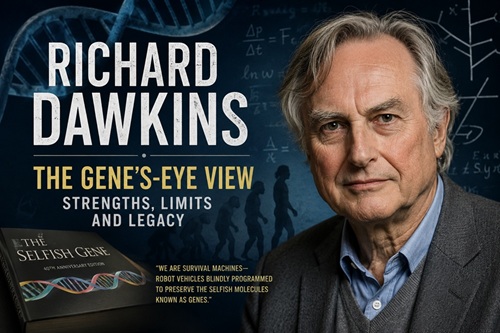
Check out my other conversations with ChatGPT Richard Dawkins and the Limits of the Gene's-Eye ViewFrank Visser / ChatGPT
Richard Dawkins occupies a peculiar position in modern intellectual life. He is at once one of the most influential evolutionary biologists of the twentieth century, one of the most gifted popularizers of science, and one of the most controversial public atheists of the modern era. His books have shaped how millions of people think about evolution, genes, religion and human nature. Yet the very clarity and force that made Dawkins such a successful communicator have also created a recurring problem: he often presents one particularly powerful perspective on evolution as though it were the perspective from which evolution itself must ultimately be understood. That distinction matters. Dawkins has done much to clarify evolutionary thinking. But he has also contributed to a tendency to reduce the extraordinary complexity of biological evolution to a single explanatory principle: genes are the fundamental units of selection, organisms are their temporary vehicles, and apparently purposive features of life can ultimately be understood as consequences of differential genetic replication. As a metaphor and theoretical perspective, this is enormously illuminating. As a complete philosophy of biology, it is much less convincing. The revolution of The Selfish GeneDawkins's reputation rests above all on The Selfish Gene, published in 1976. The book was brilliantly timed. The Modern Synthesis had established natural selection as the central mechanism of evolution, while molecular biology had made the gene increasingly tangible as the bearer of hereditary information. Dawkins took the emerging gene-centered perspective and turned it into an extraordinarily memorable conceptual framework. The provocative phrase "selfish gene" was never meant literally. Genes do not possess desires, intentions or consciousness. "Selfishness" was a metaphor for differential replication. A gene that causes effects increasing the probability that copies of itself will survive and reproduce will tend to become more common. From this perspective, organisms can be understood as vehicles constructed by natural selection because they enable genes to persist and reproduce. This way of thinking solved several genuine problems. It provided an elegant account of apparently altruistic behavior. Why, for example, should an animal risk itself for relatives? The answer is that relatives carry copies of many of the same genes. Helping a sibling survive can therefore promote the propagation of genes shared with that sibling. Inclusive fitness and kin selection supplied a rigorous framework for understanding such phenomena. Dawkins also made a crucial conceptual point about evolutionary explanation: the fact that selection operates on organisms does not necessarily mean that the ultimate beneficiary of selection is best understood at the organismic level. Natural selection can be analyzed in terms of replicators and their differential persistence. The gene-centered perspective therefore offered a powerful antidote to vague talk about "the species wanting to survive" or "nature designing organisms for the good of the ecosystem." This was real intellectual progress. The trouble begins when a useful perspective becomes an ontological doctrine. Is the gene really the "unit" of evolution?The central ambiguity in Dawkins's argument concerns the status of the gene. In one sense, the claim is almost uncontroversial: hereditary information is transmitted through genetic material, and natural selection changes the frequencies of genetic variants in populations. But in another sense, the gene-centered view can sound as if genes are the primary actors in evolution while organisms, development and environments are secondary consequences. That stronger claim is much harder to defend. Genes do not reproduce themselves in isolation. They operate within extraordinarily elaborate developmental systems. A gene is embedded in a genome, a cell, an organism, a population and an ecological environment. Its effects depend upon interactions with other genes, regulatory networks, cellular machinery, developmental history and environmental circumstances. There is therefore an important difference between saying that genes are replicators and saying that genes are independent evolutionary agents. The former is illuminating. The latter can become misleading. A gene does not "know" which organism contains it. It does not construct an organism by itself. It does not determine a phenotype in isolation. A gene participates in a developmental process whose outcome depends on thousands of interacting variables. This does not refute Dawkins's theory. Rather, it places it in its proper context. The gene-centered perspective describes an important causal level of evolutionary organization. It does not necessarily establish that all other levels are merely epiphenomenal. The organism is not just a survival machineDawkins's famous characterization of organisms as "survival machines" is rhetorically brilliant. But it can encourage a distorted picture of biology. An organism is not simply a container constructed by genes. It is an active, self-maintaining system. It regulates its internal environment, responds to external conditions, modifies its behavior, develops through time and participates in ecological relationships. Its capacities can alter the selective environment in which its genes operate. This is where twentieth- and twenty-first-century biology has become considerably more complicated than the simplified gene-centered picture suggests. Developmental biology has shown that phenotypic outcomes emerge from interactions between genes and developmental systems. Evo-devo has demonstrated that changes in developmental architecture can profoundly affect evolutionary trajectories. Systems biology emphasizes networks and interactions rather than isolated genetic causes. Niche construction theory emphasizes that organisms themselves modify environments, thereby changing the selection pressures subsequently acting on themselves and their descendants. None of this makes genes irrelevant. Quite the opposite. It shows that genes operate within a hierarchy of causal relationships. The genome is not a blueprint in the simple sense. It is more like a highly structured set of resources whose effects depend upon cellular and developmental context. Dawkins himself has sometimes acknowledged this complexity. His later work is considerably more sophisticated than the caricature of "genes determine everything" sometimes attributed to him. But the popular image of Dawkins remains strongly associated with the gene-as-master-programmer metaphor. And that metaphor is precisely what contemporary biology has increasingly taught us to treat with caution. The organism as an evolutionary participantThere is another problem with the strict gene-centered imagination: organisms are not passive objects upon which selection operates. Consider an animal that chooses a habitat, constructs a nest, modifies its surroundings, learns a behavior or cooperates with other organisms. These activities can alter the selective environment. Beavers provide an obvious example. Their genes influence their capacity to build dams, but the dams then transform the environment in ways that influence the survival and reproduction of the beavers. Causation therefore runs in multiple directions. Genes influence organisms. Organisms modify environments. Environments influence organisms. Organisms interact with other organisms. Development feeds back into evolutionary possibilities. Evolution is consequently not a one-way process in which genes dictate organisms and organisms simply reproduce genes. This is one reason why the increasingly popular language of "extended evolutionary synthesis" has attracted attention. Its advocates emphasize developmental plasticity, niche construction, cultural inheritance, epigenetic processes and other phenomena that complicate the classical Modern Synthesis. One need not accept every claim made under the banner of the Extended Evolutionary Synthesis to recognize the underlying point: evolutionary biology has become pluralistic. The gene-centered view remains powerful, but it no longer looks like the whole story. Dawkins and the illusion of genetic omnipotenceThe most serious philosophical danger in Dawkins's popular writing is therefore not genetic determinism in its crude form. Dawkins is far too sophisticated a biologist for that. The danger is subtler: the repeated use of genetic language can encourage readers to interpret biological phenomena as though genes were the primary explanatory objects in every case. This becomes especially problematic when discussing human behavior. Human beings inherit genes, certainly. But they also inherit languages, institutions, technologies, traditions, norms and symbolic systems. Human development takes place within cultural environments of extraordinary complexity. These environments are not merely external decorations placed around a genetically determined organism. They become part of the developmental conditions under which human beings actually exist. Dawkins recognized this himself when he introduced the concept of the meme. The meme was intended as a cultural analogue of the gene: a unit of cultural transmission capable of copying itself, varying and undergoing selection. The idea was extraordinarily influential. It helped establish a vocabulary for thinking about cultural evolution and later became the source of the internet meaning of "meme." But the analogy is much less secure than the original theory. Genes have a relatively well-defined material basis and a complex but identifiable mechanism of replication. Memes do not have an equivalent status. A tune, religious doctrine, slogan, scientific idea or fashion does not reproduce itself in quite the same way as a DNA sequence. Cultural transmission is deeply dependent on psychology, language, institutions and social learning. The meme concept therefore risks importing the gene-centered logic into a domain in which it fits less comfortably. Culture is not simply another population of selfish replicators. The strange fate of the "selfish gene"There is an irony here. Dawkins intended the selfish-gene metaphor to undermine anthropomorphic explanations of nature. Evolution does not "try" to produce progress, perfection or the good of the species. Natural selection has no foresight. It has no purpose. It simply produces statistical consequences from differential reproduction. Yet the metaphor itself became anthropomorphic. Genes began to be described as "selfish," "ruthless," "cooperative," "manipulative" and even "immortal." Dawkins always knew these were metaphors. But metaphors have lives of their own. For a popular audience, it is surprisingly easy to move from "a selfish gene is a useful way of describing differential replication" to "genes are the real actors and organisms exist for their benefit." The first statement is a scientific model. The second is a philosophical interpretation. Confusing the two is one of the recurring weaknesses of Dawkins's popular presentation. Evolution has no direction—but does it have history?Dawkins has also been one of the strongest opponents of the idea that evolution has an intrinsic direction toward greater complexity, intelligence or consciousness. On this point, he is largely right. Evolution has no known cosmic destination. Natural selection does not foresee humanity. There is no guarantee that evolution will produce intelligence, technology or civilization. The history of life contains enormous amounts of contingency, extinction and dead ends. But rejecting cosmic purpose does not require reducing evolution to a simple gene-selection narrative. There is an important distinction between teleology and historical directionality. Evolution may have no predetermined goal while still displaying recurring tendencies produced by constraints, feedbacks and physical conditions. Certain evolutionary solutions repeatedly arise because organisms face recurring problems. Eyes, flight, streamlined bodies, echolocation and complex nervous systems have evolved independently more than once. This does not mean evolution is "progressive" in a grand metaphysical sense. It means that evolutionary possibility is constrained. Dawkins's polemic against cosmic progress sometimes comes close to treating every suggestion of directionality as disguised creationism. That is unnecessarily restrictive. One can reject divine purpose while still investigating why evolution repeatedly generates particular forms of complexity. Dawkins and religionDawkins's second great public identity is that of an atheist polemicist. The God Delusion transformed him from a prominent evolutionary biologist into one of the most recognizable representatives of the New Atheism. His basic argument is straightforward. The existence of God is an empirical claim, and there is insufficient evidence for it. Religion often makes factual claims about the universe that conflict with scientific understanding. Natural selection provides a powerful explanation for apparent design without requiring a designer. Religious institutions can produce harmful social and political consequences. Therefore, Dawkins argues, we should be considerably less deferential toward religious belief. Much of this is perfectly reasonable. But Dawkins sometimes moves too quickly from criticism of particular religious claims to sweeping conclusions about religion itself. The existence of bad theology does not demonstrate that all religious experience is intellectually worthless. The fact that evolution explains biological complexity does not by itself settle metaphysical questions about why there is something rather than nothing, whether consciousness has irreducible features, or whether moral truths can be objectively grounded. Nor does explaining why people believe in God explain whether God exists. This is an important logical distinction. A belief can have evolutionary, psychological or sociological origins and nevertheless be true. Explaining the genealogy of a belief does not automatically establish its falsity. Dawkins is at his strongest when he is doing evolutionary biology. He becomes considerably less compelling when he treats evolutionary explanations as though they automatically settle philosophical questions that lie beyond evolutionary biology. The God hypothesis and the limits of scienceDawkins's famous formulation of religion as a hypothesis invites scientific investigation. But here again the argument encounters a difficulty. Science can investigate claims about the empirical consequences of religious beliefs. It can study the evolutionary origins of religion, the psychology of religious experience, the social organization of religious communities and the historical development of religious traditions. But "God exists" is not necessarily equivalent to a scientific hypothesis in the same sense as "this virus causes this disease." A supernatural being that leaves no empirically detectable consequences would be scientifically inaccessible. That does not make the claim true. But neither does it make it scientifically falsifiable in the ordinary sense. Dawkins occasionally treats this distinction too casually. His atheism is therefore stronger as a philosophical position of evidential skepticism than as a scientific deduction from evolutionary biology. There is no scientific experiment called "evolution" whose result is "therefore God does not exist." That conclusion requires additional philosophical premises. The problem of human exceptionalismDawkins has been admirably resistant to human exceptionalism in evolutionary thinking. Human beings are animals, and our species is the product of the same evolutionary processes that produced every other species. This is an important corrective to the idea that humans stand completely outside nature. But there is an opposite danger. Human beings have created language, mathematics, science, literature, music, law, moral systems and institutions capable of accumulating information across generations. Cultural evolution has become enormously powerful. Once symbolic culture reaches sufficient complexity, the relationship between genes and culture becomes reciprocal. Human beings are therefore not merely gene vehicles in any practically adequate description of human life. Our genes made culture possible, but culture subsequently transformed the selective environment in which our genes operate. This does not refute the gene-centered view. It reveals its incompleteness when applied to the human world. Dawkins the polemicistPerhaps the most interesting tension in Dawkins's career lies between his scientific achievements and his rhetorical style. He is an exceptionally effective writer. He has a gift for finding simple formulations that illuminate difficult ideas. But the same talent can encourage an adversarial style in which complicated intellectual disputes are organized around sharp binaries: science versus religion, reason versus faith, evolution versus creationism. Such contrasts are useful rhetorically but not always philosophically. There are religious thinkers who accept evolution. There are scientists who reject simplistic forms of scientism. There are philosophers who are neither creationists nor reductionists. There are evolutionary biologists who accept natural selection while disagreeing about the appropriate level or unit of evolutionary explanation. The intellectual landscape is more complicated than Dawkins's polemical battles sometimes suggest. This matters because Dawkins is not merely describing science. He is defending a worldview. And that worldview contains propositions that cannot themselves simply be read off the results of evolutionary biology. The deepest lesson of DawkinsDawkins's greatest contribution may ultimately be methodological rather than metaphysical. He taught generations of readers to ask a devastatingly useful question: What mechanism could produce this apparent design without anyone designing it? That question transformed public understanding of evolution. It remains one of the great intellectual achievements of modern biology. But another question must follow it: At what level is the mechanism operating, and what other causal levels are involved? Here the picture becomes richer. Genes matter. Organisms matter. Development matters. Environments matter. Populations matter. Ecological interactions matter. Culture matters. History matters. None of these levels needs to be elevated into an exclusive master principle. The temptation to search for the single "real" level of explanation is itself a philosophical inheritance from reductionism. Biology is increasingly revealing a world of nested causal systems in which higher-level organization can be real without violating lower-level mechanisms. The organism does not have to compete with the gene for ontological supremacy. The gene can be a genuine replicator without being the sole protagonist of evolution. Beyond DawkinsRichard Dawkins deserves neither the reverence of his admirers nor the dismissal of his critics. He remains one of the great popular expositors of evolutionary biology. His demolition of naive creationism, his insistence on naturalistic explanations, his defense of intellectual skepticism and his ability to communicate difficult evolutionary concepts have had enormous cultural importance. But Dawkins's explanatory revolution also needs to be historicized. The gene-centered perspective emerged from a particular moment in twentieth-century biology. It was a powerful correction to group-selectionist and vaguely teleological thinking. Yet biology did not stop developing in 1976. Developmental biology, genomics, systems biology, epigenetics, ecological theory, niche construction and cultural evolution have complicated the picture. The result is not the overthrow of Darwinism, nor the return of Lamarckism, nor the triumph of some mystical "holism." It is something more interesting. Evolutionary theory can remain thoroughly naturalistic while becoming less reductionistic. That is perhaps the most important correction to Dawkins. We do not need to choose between genes and organisms, between mechanism and emergence, or between Darwinism and complexity. We can recognize that evolutionary reality is structured at multiple levels and that causation runs both upward and downward through these levels. Dawkins taught us to see the gene. The next intellectual task is to see the system in which the gene exists. And that may be the point at which the great explanatory power of the selfish-gene metaphor reaches its natural limit.
Widget is loading comments...
|