|
TRANSLATE THIS ARTICLE
Integral World: Exploring Theories of Everything
An independent forum for a critical discussion of the integral philosophy of Ken Wilber
  Frank Visser, graduated as a psychologist of culture and religion, founded IntegralWorld in 1997. He worked as production manager for various publishing houses and as service manager for various internet companies and lives in Amsterdam. Books: Ken Wilber: Thought as Passion (SUNY, 2003), and The Corona Conspiracy: Combatting Disinformation about the Coronavirus (Kindle, 2020). Frank Visser, graduated as a psychologist of culture and religion, founded IntegralWorld in 1997. He worked as production manager for various publishing houses and as service manager for various internet companies and lives in Amsterdam. Books: Ken Wilber: Thought as Passion (SUNY, 2003), and The Corona Conspiracy: Combatting Disinformation about the Coronavirus (Kindle, 2020).
Check out my other conversations with ChatGPT Denis Noble and the Gene-Centric Straw ManA Critical Assessment of Systems Biology's Rebel PhysiologistFrank Visser / ChatGPT
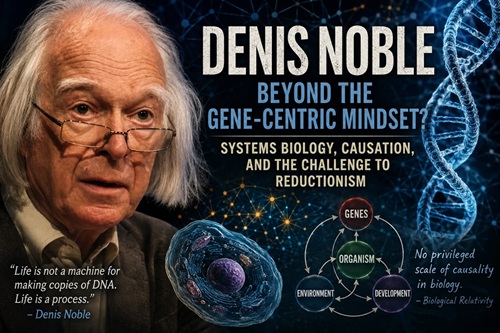
Denis Noble occupies an unusual position in contemporary biology. He is not an outsider attacking biology from the margins, nor a philosopher speculating about organisms without having worked with them. He is an eminent physiologist whose career has been deeply empirical and mathematical. His pioneering work on models of cardiac electrophysiology helped lay foundations for modern computational physiology, and his later work in systems biology has made him one of the most articulate critics of genetic reductionism. His 2006 book The Music of Life popularized the idea that organisms cannot adequately be understood by treating genes as little master controllers. More recently, Noble has developed what he calls “biological relativity,” arguing that there is no privileged level of causation in biology. There is much to admire here. Noble is right that an organism is not a bag of genes, that genes do not operate in isolation, that developmental and physiological contexts matter, that feedback is ubiquitous, and that causation in living systems is distributed across interacting levels. He is also right to criticize the loose metaphors that have sometimes accompanied molecular biology: genes are not miniature homunculi, they do not literally “want” anything, and DNA is not a complete computer program containing a pre-written organism waiting to be executed. But Noble's critique becomes much less convincing when he moves from these important points to the larger claim that contemporary evolutionary biology is fundamentally trapped in a “gene-centric impasse.” His strongest insights are often directed against a caricature of gene-centered biology rather than against the most sophisticated versions of evolutionary theory. His systems perspective is valuable; his attempt to turn it into a replacement for evolutionary explanation is considerably more problematic. The legitimate target: genetic reductionismNoble's most persuasive argument concerns the relationship between genes and phenotypes. A mutation can have a dramatic phenotypic effect, but that does not mean that the gene constitutes an autonomous causal explanation of the phenotype. Biological systems contain enormous amounts of buffering, feedback, redundancy and interaction. The same genome can give rise to radically different cell types, and the behavior of a gene depends upon the cellular environment in which it operates. This is hardly controversial today. Indeed, it is one of the major lessons of modern molecular and developmental biology. Noble is particularly effective when he distinguishes between a “differential” view of genetics and an “integral” view. In the differential approach, one changes a gene and observes what happens to the phenotype. But biological systems can compensate for genetic perturbations. A knockout may have surprisingly little effect because other pathways compensate for it. Conversely, a small genetic alteration can have enormous effects when it occurs at a critical point in a network. Noble therefore argues that understanding causation requires studying the entire physiological system rather than treating the genome as an isolated causal machine. That is an important methodological lesson. The problem begins when Noble treats this lesson as if it overturns the central explanatory achievements of genetics. It does not. A gene is not a little dictator—and evolutionary biologists know thisNoble repeatedly attacks the idea that genes are “dictators” of organisms. He invokes Barbara McClintock's description of the genome as a sensitive “organ of the cell” rather than its dictator. This is a useful metaphorical correction. But it risks creating a false choice: either genes dictate organisms or genes are merely passive participants in a much larger system. Modern biology has long operated between these extremes. Genes are not autonomous agents. But neither are they merely interchangeable components in a dynamically symmetric causal network. DNA has distinctive causal properties because it is an exceptionally stable medium of hereditary information. The fact that its expression is regulated by cellular and organismic processes does not abolish that special evolutionary role. This distinction matters enormously. A thermostat does not “dictate” the temperature of a room, because its operation depends upon an entire feedback system. Yet it would be absurd to conclude that the thermostat therefore has no special causal role in regulating temperature. Likewise, the genome does not determine phenotype in isolation, but that does not make its role causally equivalent to every other component of the organism. Noble's “biological relativity” emphasizes that causation can operate at multiple levels. That is reasonable. But multiple causation does not entail causal equivalence. And this is where Noble's rhetoric occasionally outruns his argument. Biological relativity: illuminating principle or inflated metaphor?Noble proposes that there is “no privileged scale of causality” in biology. His 2013 formulation explicitly presents biological relativity as a way of avoiding the assumption that genetic causes are automatically primary. As a warning against simplistic reductionism, this is excellent. As a general metaphysical principle, however, it becomes much harder to defend. Different biological questions legitimately privilege different levels of explanation. If the question is how a heart generates an action potential, electrophysiological and cellular mechanisms are indispensable. If the question is why a particular allele increased in frequency in a population, population genetics becomes indispensable. If the question is why a protein folds in a particular way, molecular structure matters. If the question is why an organism has a particular ecological distribution, population and ecological processes matter. There is no universal “correct level.” But that does not mean there are no privileged levels relative to particular questions. Causation in biology is not a democratic parliament in which every level has exactly one vote. The danger of systems thinking is that “everything interacts with everything” can become a profound-sounding statement that explains very little. The scientific challenge is not merely to establish that levels interact. It is to determine which causal relationships are quantitatively important under specified conditions. Ironically, Noble's own physiological work demonstrates this. His computational models do not merely celebrate multilevel interaction. They specify mechanisms, parameters, equations and experimentally testable relationships. Systems biology becomes scientifically powerful precisely when it moves beyond the philosophical assertion of interconnectedness and quantifies particular causal interactions. That is a lesson Noble's philosophical critics should take seriously—and one Noble himself sometimes seems to underplay when he generalizes from physiology to evolutionary theory. The “selfish gene” is an especially weak targetNoble's criticism of Richard Dawkins is rhetorically effective but conceptually less decisive than he suggests. He argues that the “selfish gene” concept is not physiologically testable because selfishness cannot be treated as an intrinsic property of a nucleotide sequence independently of its frequency and evolutionary success. But this largely misses what the metaphor was intended to accomplish. The selfish-gene framework does not require genes literally to possess psychological selfishness. It identifies the gene as a useful unit of evolutionary accounting: hereditary variants that increase their own representation in subsequent generations tend to become more common. The “selfishness” is metaphorical shorthand for differential propagation. Whether the metaphor is pedagogically desirable is debatable. Whether it is a physiological hypothesis is almost beside the point. Noble sometimes seems to criticize Dawkins as if Dawkins had claimed that individual genes are autonomous physiological agents. But evolutionary explanations and physiological explanations answer different questions. A gene can be causally embedded in an enormously complicated physiological network while simultaneously being a useful unit of evolutionary selection. There is no contradiction. Indeed, the distinction between physiological causation and evolutionary selection is precisely what prevents much of the debate from becoming confused. Asking what causes a phenotype in an organism is not the same question as asking why a hereditary variant has increased in frequency in a population. Noble is strongest when discussing the first question. He becomes much less convincing when he treats his answer to the first as though it invalidated approaches to the second. The central dogma is another case of conceptual overreachNoble has repeatedly argued that the central dogma of molecular biology is an incomplete representation of causation because biological systems contain feedback and multiscale interactions. His 2026 paper with Richard Bourret goes even further, arguing that the central dogma neglects multiscale properties and contributes to a “gene-centric impasse.” There is an important point here, but the terminology needs care. The central dogma does not say that DNA is the only cause of phenotype. It is fundamentally a statement about certain permitted routes of sequence information transfer. Regulatory feedback, epigenetic states, protein interactions, cellular signaling and physiological processes do not automatically contradict it. This distinction has been emphasized for decades, yet Noble sometimes writes as though rejecting the idea of a one-way genetic program amounts to rejecting the central dogma itself. That is unnecessary. One can accept the central dogma while completely rejecting genetic determinism. Indeed, this is what much of contemporary molecular biology does. The genome is not a blueprint in the simplistic sense. Gene expression is conditional. Regulatory networks are extensive. Epigenetic mechanisms matter. RNA molecules can have regulatory and catalytic functions. Development is dynamically interactive. Cellular states influence gene expression, and environmental signals can alter developmental trajectories. None of these observations requires abandoning molecular genetics. They require making molecular genetics more sophisticated. Downward causation is real—but not necessarily revolutionaryNoble's concept of downward causation is similarly valuable but easily misunderstood. An organism can constrain the behavior of its parts. A cell's regulatory environment affects gene expression. Tissue-level signals influence cellular behavior. Neural and hormonal states affect molecular processes. Environmental conditions influence developmental pathways. But the existence of downward causation does not imply that higher-level causation somehow bypasses lower-level mechanisms. Suppose an organism experiences starvation. The physiological state triggers hormonal changes, which alter cellular signaling, which changes transcription, which changes protein production and metabolism. One can describe this as downward causation. But the causal chain is still instantiated in molecular and physical processes. The important philosophical question is therefore not whether downward causation exists. It clearly does in some meaningful senses. The question is what kind of causal novelty it represents. Noble sometimes seems to want downward causation to do more philosophical work than the evidence warrants. A higher-level constraint can be causally indispensable without being ontologically independent of the mechanisms that implement it. This is the familiar distinction between levels of description and levels of physical realization. A traffic jam is real. It has causes and consequences. But traffic-jam dynamics do not require a new fundamental force of nature. Likewise, organism-level organization is real without necessarily implying a new causal ontology. The evolutionary problemThe deepest weakness in Noble's position appears when he attacks “neo-Darwinism” itself. Noble explicitly argued in 2011 that the Modern Synthesis is incomplete and needs extension. That is a defensible position. Evolutionary biology has indeed expanded substantially beyond the version of the Modern Synthesis assembled in the mid-twentieth century. Developmental biology, genomics, evo-devo, symbiosis, horizontal gene transfer, epigenetic inheritance, niche construction and other fields have enriched evolutionary theory. But “evolutionary theory is incomplete” is not the same as “gene-centered evolutionary theory is fundamentally misguided.” The former is almost certainly true. The latter requires much stronger evidence. The irony is that Noble's own list of alternatives—symbiogenesis, horizontal gene transfer, non-genetic inheritance and developmental processes—does not abolish evolutionary theory. These phenomena become evolutionary phenomena precisely because they affect variation, inheritance, fitness and population change. Evolutionary biology has proved remarkably capable of incorporating mechanisms that were poorly understood by the architects of the Modern Synthesis. The history of science here is therefore rather different from Noble's revolutionary narrative. Genetics did not discover the genome and then become obsolete. Rather, genetics became increasingly sophisticated as biologists discovered that genes operate inside complex developmental and ecological systems. The synthesis is being extended, not discarded. The genome project and the “gene-centric impasse”Noble's critique becomes particularly provocative when he links gene-centric thinking to the disappointing medical returns from genomics. His 2026 work argues that genomic association scores cannot by themselves establish causation and that the failure of genomics to deliver the expected cures for common diseases demonstrates the need for physiological analysis at relevant levels of organization. There is considerable truth here. Genome-wide association studies often identify statistical associations rather than straightforward causal mechanisms. Complex diseases are influenced by many variants, environmental factors, developmental history and physiological networks. Knowing that a variant is associated with a disease does not automatically tell us how to treat the disease. But Noble's argument risks confusing the failure of a particular research strategy to meet inflated expectations with the failure of genetics as such. The Human Genome Project did not make the organism transparent. It was never reasonable to expect a complete genome sequence to function as a medical instruction manual. The disappointment was partly the result of exaggerated promises made by some genomic enthusiasts. But genetics has hardly become medically irrelevant. Cancer genetics, Mendelian disease, pharmacogenomics, infectious disease susceptibility, molecular diagnostics and gene-based therapies all demonstrate otherwise. The more appropriate conclusion is that genomic information must be integrated with physiology, development, environment and clinical context. That is almost exactly what systems biology proposes. The choice, therefore, is not between “genes” and “systems.” The future lies in understanding genes as components of systems. Noble's great achievement—and his great temptationThere is an interesting tension at the heart of Noble's work. His scientific achievement is precisely that he demonstrates the insufficiency of simplistic reductionism without rejecting reductionist knowledge itself. His computational physiology depends on knowing molecular mechanisms while placing them into larger networks. His work therefore embodies a pluralistic science. His rhetoric, however, sometimes suggests a more radical revolution: replace gene-centered thinking with organism-centered thinking; replace genetic determinism with biological relativity; replace the central dogma with multilevel causation. The first formulation of each contrast is illuminating. The second can become misleading. Genes are not organisms. But organisms cannot be understood without genes. Genes do not determine phenotypes in isolation. But genetic differences can produce highly reproducible phenotypic differences. Physiology cannot be reduced to molecular genetics. But physiological mechanisms are ultimately implemented through molecular interactions. Higher levels constrain lower levels. But this does not make lower-level mechanisms causally irrelevant. Evolutionary theory needs more than the Modern Synthesis. But that does not mean that natural selection, inheritance and population genetics have become obsolete. The real lesson of systems biology is therefore less dramatic—and more scientifically interesting—than Noble's polemical presentation sometimes suggests. From reductionism to integrationNoble deserves credit for helping to shift the biological conversation away from the crude idea that the genome is a complete “program of life.” His insistence on networks, feedback, multiscale organization and physiological context is entirely compatible with the direction in which much of twenty-first-century biology has already moved. A useful formulation would therefore be: genes are neither dictators nor bystanders. They are components of extraordinarily complex causal systems. Their effects depend upon cellular context, developmental history, regulatory architecture and environment. At the same time, their capacity to preserve heritable sequence information gives them an evolutionary significance that cannot simply be relativized away. This is where Noble's metaphor of biological relativity should perhaps be interpreted modestly. There is no single level from which all biological phenomena can be explained. But that does not imply that all levels are equivalent, nor that molecular genetics is merely one optional vocabulary among many. Scientific explanation is inherently pluralistic. The physiology of a heartbeat, the development of an embryo, the inheritance of a mutation and the evolution of a population are different explanatory problems. They intersect, but they should not be collapsed into one another. Noble's systems biology is at its best when it reminds us of this. It is at its weakest when its critique of reductionism becomes a critique of evolutionary genetics itself. Conclusion: the rebel who is right for the wrong reasonDenis Noble is an important corrective to genetic triumphalism. His central insight—that biological causation is distributed, reciprocal and multilevel—is both defensible and valuable. His physiological work gives this claim considerably more substance than the vague holism traditionally associated with systems thinking. But Noble sometimes turns a methodological correction into an ontological revolution. The fact that genes are not autonomous causes does not make genes causally unimportant. The fact that phenotypes emerge from networks does not make evolutionary genetics obsolete. The fact that organisms influence gene expression does not invalidate molecular causation. And the failure of genomics to produce simple cures for complex diseases does not demonstrate the failure of genetics; it demonstrates the complexity of the systems genetics was trying to understand. The most productive reading of Noble is therefore not as the man who finally defeated gene-centered biology, but as the physiologist who exposed one of its most persistent exaggerations. That is already a considerable achievement. The irony is that Noble's strongest argument does not require overthrowing evolutionary biology at all. It requires completing it. Biology does not need to choose between the gene and the organism. It needs an account of how genes, cells, tissues, organisms, populations and environments form dynamically coupled systems across time. That is not the end of Darwinism. It is what a mature Darwinian biology looks like.
Widget is loading comments...
|