|
TRANSLATE THIS ARTICLE
Integral World: Exploring Theories of Everything
An independent forum for a critical discussion of the integral philosophy of Ken Wilber
  Frank Visser, graduated as a psychologist of culture and religion, founded IntegralWorld in 1997. He worked as production manager for various publishing houses and as service manager for various internet companies and lives in Amsterdam. Books: Ken Wilber: Thought as Passion (SUNY, 2003), and The Corona Conspiracy: Combatting Disinformation about the Coronavirus (Kindle, 2020). Frank Visser, graduated as a psychologist of culture and religion, founded IntegralWorld in 1997. He worked as production manager for various publishing houses and as service manager for various internet companies and lives in Amsterdam. Books: Ken Wilber: Thought as Passion (SUNY, 2003), and The Corona Conspiracy: Combatting Disinformation about the Coronavirus (Kindle, 2020).
Check out my other conversations with ChatGPT Donald Trump and the WorldThe Politics of DisruptionFrank Visser / ChatGPT
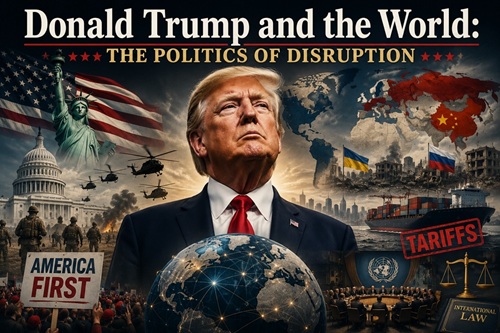
Donald Trump is difficult to assess because he is simultaneously a politician, a political movement, a governing style, and a symptom of a much larger transformation in the international system. To reduce him to the familiar categories of “right-wing populist,” “isolationist,” or even “authoritarian” is therefore insufficient. Trump is certainly all of these things to varying degrees, but his historical significance lies elsewhere: he is one of the principal agents through whom the post-Cold War international order is being dismantled and renegotiated. That does not mean that Trump single-handedly created the crisis of the liberal international order. The system he inherited was already under considerable strain. The Iraq War damaged American credibility, the financial crisis undermined confidence in Western economic leadership, China became a formidable strategic competitor, Russia rejected important aspects of the post-Cold War settlement, and Western democracies experienced growing inequality and political polarization. Trump did not invent these problems. He recognized them, amplified them, and converted them into a political program. His second presidency has made the consequences considerably more consequential. By August 2026, Trump's foreign policy is no longer merely a provocative alternative to conventional American diplomacy. It represents a sustained attempt to redefine America's relationship with allies, adversaries, international institutions, trade, military power and the very idea of a rules-based international order. The result is neither classical isolationism nor straightforward American imperialism. It is something more contradictory: an aggressively transactional form of nationalism that is prepared to use American economic and military power while becoming increasingly skeptical of the alliances and institutions through which that power was traditionally exercised. Trump is not an isolationistOne of the most persistent misunderstandings of Trump is to describe him simply as an isolationist. The label is understandable. “America First” suggests withdrawal from international affairs, and Trump has repeatedly criticized the wars, alliances and international commitments of previous administrations. Yet his actual behavior points in almost the opposite direction. He has not withdrawn America from the world. He has sought to make American power more unilateral, more transactional and less constrained by traditional diplomatic conventions. The distinction is important. An isolationist says: let us stay out of the world. Trump's approach is closer to: let us enter the world on our own terms. This helps explain the otherwise puzzling combination of rhetoric and behavior. A president who criticizes foreign intervention can simultaneously threaten military action against Iran, deploy American power in the Caribbean, pressure NATO allies, impose sweeping tariffs, intervene in Ukraine and Gaza, and challenge international institutions. The Council on Foreign Relations has aptly described the emerging policy as a new form of “American internationalism with Trumpian characteristics,” rather than conventional isolationism. Trump's worldview is therefore better understood as transactional realism, although even that description requires qualification. Classical realists tend to think in terms of national interests, power balances and strategic constraints. Trump frequently substitutes personal relationships, bargaining leverage and immediate political advantage for systematic strategy. He wants the United States to be powerful, but he does not necessarily believe that American power should be embedded in a stable international architecture. That is the revolutionary element. The great bargain with America's alliesFor seventy-five years, American power rested on a remarkable bargain. The United States provided security guarantees and global leadership; its allies accepted American strategic primacy and participated in a network of institutions and alliances that benefited both sides. Trump has questioned that bargain at its foundation. His complaints about NATO burden-sharing are not entirely irrational. European countries have depended heavily on American military capabilities for decades, and Trump's pressure has contributed to substantially higher European defense commitments. It would therefore be simplistic to argue that everything Trump has done to NATO is destructive. But the method matters. An alliance is not merely a financial transaction. It depends upon confidence that commitments will survive changes in political mood. When an American president repeatedly suggests that security guarantees are conditional upon immediate compliance with American demands, allies naturally begin to ask whether they can safely depend upon Washington. That question is already being asked in Europe. German and European strategic analysts increasingly argue that the old assumption of an American security guarantee can no longer be taken for granted. Trump may consequently achieve something his critics and supporters alike have underestimated: he may accelerate European strategic autonomy. Ironically, this could eventually produce one of two very different outcomes. Europe could become a stronger military and geopolitical actor within a renewed transatlantic alliance. Or Europe could gradually construct a security architecture that assumes the United States will no longer be a reliable partner. The first outcome would make Europe stronger. The second would represent one of the greatest geopolitical consequences of Trump's presidency. Ukraine exposes the limits of the dealmakerTrump's self-image as the supreme negotiator has always been central to his political identity. He believes that wars persist because previous leaders lack the courage, ruthlessness or bargaining skill to force the parties toward a deal. Ukraine has provided a severe test of that theory. Trump promised an extraordinarily rapid end to the war. Yet by 2026 the conflict remains unresolved. Negotiations have repeatedly encountered the fundamental contradiction at its heart: Russia wants territorial and strategic concessions that Ukraine considers unacceptable, while Ukraine demands security guarantees that Moscow rejects and that Washington has been reluctant to provide without conditions. This illustrates a fundamental weakness in Trump's conception of international politics. Not every conflict is a real-estate negotiation. A deal requires not merely a sufficiently powerful negotiator but an overlap between the interests of the parties. If that overlap does not exist, threats and personal persuasion can produce temporary concessions, but they cannot manufacture a durable settlement. Trump's approach nevertheless has had an important consequence. It has forced Europeans to confront the possibility that the United States will not indefinitely underwrite European security. European countries have consequently begun increasing defense spending and preparing for a greater role in Ukraine's future security architecture. Here again Trump is simultaneously weakening and stimulating the Western alliance. That ambiguity is characteristic of his presidency. Gaza and the Middle East: peace through coercion?The Middle East presents an even more complicated picture. Trump's supporters can legitimately point to his willingness to become directly involved in conflicts that other presidents struggled to resolve. His administration has promoted a substantial Gaza reconstruction and political plan and has pursued negotiations involving Hamas and Israel. In July 2026, Trump announced a tentative agreement concerning Hamas's disarmament, although major obstacles remained. But Trump's Middle Eastern policy also demonstrates the danger of confusing dramatic intervention with successful diplomacy. The same administration has been involved in an escalating confrontation with Iran. By August 2026, the conflict had become a serious strategic and economic problem, contributing to higher energy prices and growing political pressure at home. Reuters described the administration as facing unresolved crises in Iran, Ukraine and Gaza while its promised foreign-policy breakthroughs remained elusive. The contradiction is striking. Trump presents himself as the president who will stop endless wars, yet his willingness to employ overwhelming coercive power can generate precisely the kind of open-ended geopolitical entanglements he claims to oppose. This does not make Trump uniquely hypocritical. American presidents across the political spectrum have discovered that military power is easier to deploy than to control. But Trump's personal style magnifies the problem because he tends to present escalation as evidence of strength and compromise as evidence of weakness—until, of course, he suddenly declares the resulting compromise a historic victory. The tariff weaponPerhaps nowhere is Trump's transformation of American power clearer than in trade. For decades, American economic leadership was based substantially on promoting an increasingly integrated global economy. Trump regards trade differently. He sees tariffs not merely as instruments of economic policy but as weapons of negotiation and instruments of national power. This is a major conceptual shift. Trump's tariffs can sometimes produce concessions. They can protect particular industries. They can force other countries to negotiate. They can also expose vulnerabilities in countries that have become excessively dependent upon particular markets. But tariffs are not cost-free coercion. Much of the economic burden ultimately falls upon consumers and businesses within the imposing country. Moreover, once tariffs become a routine instrument of foreign policy, other countries have incentives to retaliate, diversify supply chains and reduce their dependence upon the United States. Trump's recent tariff confrontations—including his temporary suspension of planned 50 percent tariffs on Canadian imports while negotiations continued—illustrate his preferred method: announce an extreme demand, create uncertainty, negotiate intensely, and then present the resulting compromise as a victory. It is politically effective. Whether it constitutes a coherent long-term economic strategy is much less certain. Trump and the decline of American soft powerThere is another dimension that is harder to quantify but potentially more important: legitimacy. American power has never rested solely upon aircraft carriers, dollars and nuclear weapons. It has also depended upon the willingness of other countries to believe that American leadership is broadly compatible with their own interests. Trump has weakened that assumption. A 2026 Pew survey found that confidence in Trump was low across much of the world, with a median of only 23 percent of respondents in 36 countries expressing confidence in him. One should not confuse popularity with geopolitical power. A president does not need to be loved abroad to be effective. But persistent distrust matters when Washington asks allies to accept sacrifices, join sanctions, support military operations or defend American-led institutions. The problem becomes particularly acute when American policy appears inconsistent. Trump has simultaneously demanded respect for national sovereignty while threatening territorial acquisitions; criticized international institutions while using American economic power to shape them; criticized foreign wars while launching or escalating military operations; and attacked globalization while seeking advantageous trade arrangements around the world. From Trump's perspective these contradictions may not be contradictions at all. Each policy is judged according to whether it advances American leverage. The problem is that international systems require expectations that extend beyond the next transaction. The ICC and the rules-based orderThe confrontation with the International Criminal Court illustrates the deeper institutional stakes. The United States has always had an ambivalent relationship with the ICC. Successive administrations have supported some of its objectives while resisting its jurisdiction over American citizens. Trump's administration, however, has taken a particularly confrontational approach, including sanctions against senior ICC officials. The immediate political issue concerns the court's actions involving Israeli and Russian leaders. But the larger question is whether powerful states will accept any meaningful principle of legal accountability when international law becomes inconvenient. This is where criticism of Trump should move beyond partisan politics. If international law is valid only when it constrains America's enemies, it is not really international law. Conversely, if international courts exercise unlimited jurisdiction without regard to sovereignty or due process, they can themselves become politically controversial. The proper debate is therefore not “Trump versus the ICC.” It is about whether the international community can develop institutions whose legitimacy is sufficiently broad that powerful states cannot simply opt out whenever the rules become uncomfortable. Trump's instinct is fundamentally skeptical of such constraints. That instinct is not uniquely American. China, Russia and other major powers have their own objections to aspects of the Western international order. But Trump's United States possesses extraordinary structural power, so his rejection of international constraints has consequences far beyond the United States itself. Trump and the rise of a post-liberal worldIt would nevertheless be a mistake to interpret Trump solely as a destroyer. Something important is being revealed by the success of Trumpism: many of the assumptions underlying the postwar Western order had become politically fragile before Trump arrived. Large sections of Western populations no longer believe that globalization automatically produces broadly shared prosperity. They distrust political elites. They resent immigration. They believe that national sovereignty has been weakened by international institutions. They are skeptical of military interventions undertaken in the name of democracy. They increasingly reject the idea that liberal internationalism should take precedence over domestic interests. Trump did not invent this revolt. He gave it a face. And he discovered how effectively contemporary media reward political performance. Trump's genius—or pathology, depending on one's perspective—is his understanding that politics is increasingly mediated through attention. Outrage, spectacle, personal conflict and dramatic reversals are not accidental features of Trumpism. They are its operating system. This makes Trump unusually consequential in the age of social media. He is not merely a politician communicating through the media. He is a politician whose political identity has become inseparable from the media environment itself. Trump and authoritarianismThe authoritarian question cannot simply be dismissed. Trump's hostility toward institutional constraints, his personalization of political loyalty, his attacks on independent institutions and his willingness to portray opponents as illegitimate all raise serious concerns about democratic norms. Yet calling Trump simply a dictator is analytically unhelpful. The United States remains a highly pluralistic political system containing courts, states, Congress, civil society, opposition media and elections. Trump's power is substantial but not unlimited. Indeed, recent reporting shows that courts and Congress have at times constrained his initiatives. The more interesting question is therefore not whether Trump has abolished American democracy. He has not. It is whether he is changing what Americans expect democracy to mean. Trump's conception is strongly majoritarian and personal. If “the people” elected him, he argues, resistance to his agenda can be represented as resistance to the democratic will itself. That is a dangerous proposition because liberal democracy rests upon two principles that can conflict: majority rule and institutional constraint. Elections determine who governs, but they do not grant unlimited authority. The struggle over that distinction may ultimately prove more historically important than any individual Trump policy. China is the larger strategic questionBehind almost every discussion of Trump lies a much larger geopolitical transformation: the emergence of a world in which American primacy is no longer uncontested. China is the central long-term challenge. Trump's trade policy, technological restrictions and pressure on allies are partly responses to this reality. But his transactional treatment of allies can also undermine the coalition that Washington needs if it wants to compete effectively with Beijing. This produces perhaps the central paradox of Trumpism. China thinks in decades. Trump thinks in deals. China builds institutions, infrastructure, supply chains and technological capacity. Trump seeks leverage. Both approaches have strengths. Trump's unpredictability can make him difficult to counter. His willingness to use economic coercion may force concessions that a more cautious administration would never obtain. But unpredictability is not the same thing as strategy. A successful grand strategy requires continuity. It requires allies to know what the United States will defend, competitors to know what it will not tolerate, and markets to know roughly what rules will govern tomorrow. Trump's great strength—his unpredictability—is therefore also one of his greatest weaknesses. What Trump has changedThe most consequential thing about Trump may ultimately not be any particular treaty, tariff or military operation. It is the change in expectations. Europe now has stronger reasons to prepare for American unreliability. Other countries have stronger incentives to diversify away from American economic dependence. Governments are reconsidering the assumption that Washington will consistently support the institutions it helped create. Allies are learning that American commitments can become bargaining chips. Adversaries are learning that American power remains formidable but that political patience may be limited. In that sense Trump is accelerating the transition from a unipolar world toward a more fragmented multipolar order. But it would be wrong to attribute the entire transition to him. The relative rise of China, Russia's challenge to European security, the growing importance of India and the Global South, technological competition and the weakening of Western consensus would have occurred with or without Donald Trump. Trump is better understood as an accelerator. He takes existing contradictions and pushes them toward crisis. The paradox of TrumpThis produces a final paradox. Trump wants to make America great again by making American power more sovereign, more autonomous and less constrained by international institutions. Yet American greatness historically depended in part upon the extraordinary network of alliances and institutions that Washington constructed after 1945. Trump sees those institutions as burdens. His critics see them as the foundation of American leadership. Both positions contain part of the truth. The postwar order was never as altruistic as its rhetoric suggested. The United States built it partly because doing so served American interests. NATO contained the Soviet Union. Bretton Woods and the dollar system reinforced American economic power. International institutions often reflected the distribution of power after 1945 rather than some neutral conception of global justice. Trump is therefore right about one important thing: international politics has always involved power. Where he may be wrong is in assuming that power is maximized by treating every relationship as a transaction. Alliances create capabilities that cannot be purchased at the negotiating table. Trust is a strategic asset. Predictability has value. Institutions reduce transaction costs. Soft power can accomplish things that military threats cannot. The United States did not become the world's most influential power merely because it was rich and militarily strong. It became powerful because much of the world was willing to organize itself around American leadership. Trump is testing how much of that willingness remains. Conclusion: Trump as symptom, accelerator and architectDonald Trump should therefore neither be dismissed as a clown nor elevated into a geopolitical mastermind. He is something more historically interesting. He is a symptom of the exhaustion of the post-Cold War consensus, an accelerator of the transition toward a more competitive international system, and increasingly an architect of the emerging order. His greatest achievement may be to have made previously unthinkable questions politically unavoidable. • Should Europe depend upon America for its security indefinitely? • Should China be contained, accommodated or confronted? • Should globalization continue on its previous terms? • Should international institutions constrain great powers? • How much sovereignty should states surrender to international rules? • What should America actually be responsible for beyond its borders? These questions existed before Trump. They will survive him. That is why the historical importance of Donald Trump does not ultimately depend upon whether he succeeds or fails in any single negotiation. His deeper significance lies in the fact that he has exposed the fragility of a world order that many people had assumed was permanent. The danger is that destroying an old order is considerably easier than constructing a new one. Trump is exceptionally good at disruption. The unanswered question is whether disruption can become strategy—and whether the world that emerges from the disruption will be more stable, more democratic and more peaceful, or merely more fragmented, transactional and dangerous. As of 2026, the evidence does not yet justify a confident answer. What it does justify is the conclusion that Trump's role in world politics is no longer marginal or episodic. He has become one of the central forces shaping the transition from the American-led order of the late twentieth century to whatever comes next.
Widget is loading comments...
|