|
TRANSLATE THIS ARTICLE
Integral World: Exploring Theories of Everything
An independent forum for a critical discussion of the integral philosophy of Ken Wilber
  Frank Visser, graduated as a psychologist of culture and religion, founded IntegralWorld in 1997. He worked as production manager for various publishing houses and as service manager for various internet companies and lives in Amsterdam. Books: Ken Wilber: Thought as Passion (SUNY, 2003), and The Corona Conspiracy: Combatting Disinformation about the Coronavirus (Kindle, 2020). Frank Visser, graduated as a psychologist of culture and religion, founded IntegralWorld in 1997. He worked as production manager for various publishing houses and as service manager for various internet companies and lives in Amsterdam. Books: Ken Wilber: Thought as Passion (SUNY, 2003), and The Corona Conspiracy: Combatting Disinformation about the Coronavirus (Kindle, 2020).
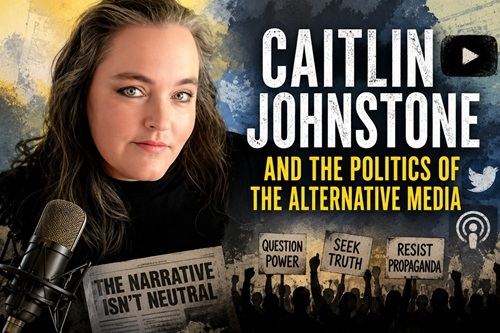
Check out my other conversations with ChatGPT Caitlin JohnstoneAnd the Politics of the Alternative MediaFrank Visser / ChatGPT
Caitlin Johnstone occupies an unusual position in the contemporary political-media landscape. She is too radical, too openly anti-establishment, and too suspicious of Western foreign policy to fit comfortably within mainstream journalism. Yet she is also too consistently aligned with a particular interpretation of world politics to be described simply as an independent journalist who happens to question official narratives. Her work belongs to a recognizable ecosystem of anti-imperialist, anti-war, anti-establishment media in which skepticism toward Western power is the organizing principle. That makes Johnstone interesting for reasons that go beyond the individual claims she makes. She represents a transformation in political journalism itself: the migration of political commentary away from newspapers, television and professional newsrooms toward personality-driven newsletters, Substack pages, podcasts, social media and reader-supported websites. Her importance lies partly in what she says, but also in the kind of media figure she has become. She is best understood neither as a conventional journalist nor as a mere propagandist. She is an ideological commentator, polemicist and media entrepreneur whose principal subject is the production of political narratives. Her great strength is her willingness to question the assumptions built into Western political discourse. Her great weakness is that her suspicion of one propaganda system can itself become a highly selective worldview, in which almost everything the United States and its allies say is treated as suspect while counter-narratives receive insufficient scrutiny. A journalist who decided not to become oneJohnstone's personal history is unusually relevant to understanding her eventual position. She was born in Melbourne in 1974 and has described growing up in Australia during the 1970s and 1980s, a period she associates with a distinctly anti-establishment political culture. She has recalled the Australian values of “giving everyone a fair go” and “keeping the bastards honest,” and has connected her own distrust of authority to that political environment. These are, of course, Johnstone's own retrospective interpretations of her childhood rather than neutral biographical facts, but they help explain the political sensibility she later brought to her writing. More concretely, Johnstone actually trained as a journalist. She graduated with distinction from the Royal Melbourne Institute of Technology in 2003. Yet she says that her experience during her training convinced her that conventional journalism would not allow her to do what she regarded as genuine investigative work. She recalls a two-week internship at Channel 10's Eyewitness News in which she noticed that the stories being selected closely resembled those appearing on Australia's other major television networks. She came to believe that much of television journalism consisted of reproducing established news priorities rather than independently discovering what was important. By the time she graduated, she says, she had already decided against pursuing a conventional newsroom career. Instead, she did corporate work, became involved in environmental activism, raised children and ran an eco-blog. According to her own account, it was only with the rise of internet-based, reader-funded journalism that she eventually found a medium through which she could practice journalism on her own terms. She began attracting a wider audience in 2016, initially through political commentary surrounding Bernie Sanders and the treatment of the progressive movement by the Democratic establishment and mainstream media. This is an important part of the Johnstone story because it complicates the usual description of her as an “alternative journalist.” She is not simply someone without journalistic training who discovered politics on the internet. She is a trained journalist who decided that the professional media system was fundamentally incompatible with the kind of journalism she wanted to practice. Her subsequent career can therefore be interpreted as a kind of rebellion against the profession that trained her. That also helps explain both the power and the danger of her worldview. If one becomes convinced early that the institutional media system systematically filters out uncomfortable truths, it becomes natural to treat independence from that system as an epistemic virtue. But independence from a flawed institution does not automatically produce reliable knowledge. The alternative journalist still has to develop mechanisms for checking sources, correcting errors and resisting confirmation bias. Johnstone's career is therefore an interesting case study in what happens when a journalist rejects the traditional gatekeepers and constructs her own. The journalist as dissidentJohnstone began attracting wider attention during the 2010s, particularly through her aggressive criticism of Western foreign policy, American interventionism and the mainstream media. Her writing is deliberately confrontational. She does not present herself as a neutral observer standing above political conflict. She writes as someone who believes that Western societies systematically misunderstand their own role in the world. This is crucial to understanding her appeal. The conventional journalist is supposed to ask: What happened? Who says it happened? What evidence supports the claim? What do competing sources say? How reliable are they? Johnstone frequently begins somewhere else: Who benefits from our believing this particular story? That is not an illegitimate question. Indeed, it is an essential question in political journalism. Governments routinely manipulate information. Intelligence agencies selectively release information. Military organizations conduct information operations. Newspapers depend on official sources. Politicians cultivate journalists who will reproduce their preferred narratives. Corporate ownership and advertising can influence media institutions. During wartime, the boundaries between journalism and national propaganda can become extraordinarily porous. Johnstone has made this problem her central theme. Her repeated phrase "Narrative Matrix" captures her basic conception of politics: citizens inhabit an informational environment constructed by powerful institutions, and political domination therefore involves not merely controlling territory or resources but controlling the stories through which reality is interpreted. Her writing repeatedly returns to propaganda, censorship, media ownership, intelligence agencies, NATO, Israel, American foreign policy and what she calls the "US-centralized empire." There is a valuable insight here. Modern power really does operate through narratives. The mistake would be to conclude that every dominant narrative is therefore false, or that the opposite of a mainstream narrative is automatically closer to the truth. That is where Johnstone's method becomes problematic. From anti-imperialism to epistemic contrarianismJohnstone's political home is best described as radical anti-imperialism. She is profoundly hostile to American global power and to the foreign-policy establishment surrounding it. She is equally hostile to the liberal media institutions that she believes normalize American power. On Ukraine, for example, she has repeatedly argued that Western media presented an artificially simplified morality play in which Russia was simply evil and Ukraine simply heroic. In a 2022 article she characterized the Western narrative as portraying Putin as an irrational Hitler-like aggressor while treating American involvement as intrinsically benevolent. There is an important criticism buried inside this argument. Western reporting during wars can indeed become highly nationalized. Governments become major sources of information; journalists often operate within the assumptions of their own societies; enemy claims receive disproportionate skepticism; and emotionally powerful narratives can crowd out uncertainty. But Johnstone frequently moves from this defensible observation to a much stronger proposition: that the Western narrative is essentially propaganda while the counter-narrative is substantially closer to reality. That is a very different claim. The danger is what might be called epistemic inversion. If mainstream sources are presumed guilty until proven innocent, while sources hostile to the West receive the benefit of the doubt, skepticism ceases to be symmetrical. It becomes an ideology of source selection. This is particularly visible in her treatment of Russia and Ukraine. Critics have documented instances in which Johnstone relied upon Russian state media or sources closely associated with Russian information networks. One detailed 2022 critique in CounterPunch examined her sourcing on Ukraine and argued that several of the links she used ultimately led back to Russian state or pro-Russian sources. This does not prove that Johnstone is a Russian agent, nor does it establish that her arguments are false. Those are much stronger conclusions than the evidence warrants. Indeed, Johnstone herself has explicitly denied being paid by or connected to Russia and explained that Russian media sometimes republish her work without her solicitation. The more interesting criticism is methodological. A journalist can be completely sincere and still reproduce the information priorities of one side of a geopolitical conflict. That distinction matters. The "Russia apologism" problemJohnstone's critics often accuse her of being a Russian propagandist or apologist. Some of these accusations are intellectually lazy. Disagreeing with American foreign policy does not make somebody pro-Russian, and opposing NATO expansion does not imply support for Vladimir Putin. Indeed, one of the legitimate services performed by Johnstone's journalism has been to remind Western readers that criticism of American power is not equivalent to endorsement of its adversaries. But the reverse error is equally serious. Criticizing American imperialism does not make Russian imperialism disappear. Johnstone sometimes writes as though identifying American responsibility for a geopolitical crisis constitutes the central explanatory task. This can produce an asymmetry in which Russian actions become reactions to Western provocation rather than independent decisions requiring their own moral and strategic analysis. Ukraine provides the clearest example. NATO expansion, the post-2014 political transformation of Ukraine, Western support for Kyiv, and the failure of diplomacy are all legitimate subjects of investigation. They do not, however, exhaust the explanation of Russia's invasion. A serious analysis has to accommodate Russian agency, Russian nationalism, Russian imperial ambitions, Ukrainian political agency, European security concerns and the enormous diversity of Ukrainian opinion. Otherwise the Ukrainian population becomes strangely invisible. One of the sharpest criticisms of Johnstone's 2022 writing was precisely that describing Ukraine primarily as a "US client state" risked reducing Ukrainians themselves to geopolitical objects rather than political actors. That is an important criticism because anti-imperialism can itself become paternalistic. The people living in countries caught between great powers are not merely chess pieces moved by Washington, Moscow, Beijing or Brussels. They have political preferences of their own. Her strongest case: the media itselfIronically, Johnstone is most persuasive when she stops trying to explain everything through geopolitics and concentrates on journalism. Her criticism of the media has considerable merit. The history of modern warfare contains endless examples of journalists reproducing official claims that later turned out to be false or highly misleading. Iraq's weapons of mass destruction are the obvious recent example. Vietnam, Libya, Syria, Afghanistan and numerous intelligence controversies demonstrate that governments routinely construct narratives designed to secure public support for policy. Johnstone is therefore right to insist that journalists should treat official claims skeptically. She is also right that "propaganda" should not be understood as something produced exclusively by authoritarian states. Democratic societies have propaganda too. The difference is often institutional rather than metaphysical: Western propaganda is usually produced through a decentralized ecosystem of government briefings, think tanks, intelligence leaks, expert networks, media organizations, advocacy groups and political communication rather than through a single ministry of information. This insight is one reason her writing resonates with people who have become disillusioned with mainstream media. The irony is that Johnstone sometimes constructs precisely the kind of simplified narrative she accuses mainstream journalism of constructing. Instead of "Russia is evil and America is good," the story becomes "America is the empire and its media manufacture consent." Once that framework has been established, almost every new event can be interpreted through it. That is intellectually seductive. It is also dangerous. The rhetorical machineJohnstone's writing style is unusually well adapted to the social-media environment. Her sentences are short. Her arguments are compressed. Her headlines are provocative. She frequently uses sarcasm, profanity, ridicule and deliberately exaggerated formulations. She writes less like an academic than like an insurgent pamphleteer. This is not accidental. Her work belongs to the same broader transformation that has produced figures such as Glenn Greenwald, Matt Taibbi, Chris Hedges, Aaron Maté and a large ecosystem of independent Substack writers and podcasters. These figures differ enormously politically, but they share one important characteristic: they increasingly operate outside the traditional institutional boundaries of journalism. Johnstone has taken this model particularly far. Her website explicitly describes her work as reader-supported, and she publishes books, newsletters and a magazine while making her material freely available for republication. This is simultaneously her strength and her weakness. Because she does not have an editor sitting between herself and publication, she can pursue subjects that mainstream outlets might avoid. But the same independence removes many of the institutional mechanisms that are supposed to constrain journalists: editorial review, fact-checking, legal scrutiny, source verification and professional standards. The independent journalist gains freedom at precisely the moment when professional safeguards disappear. That trade-off is central to understanding the alternative media. Gaza and the consolidation of her worldviewHer writing on Israel and Gaza has further clarified her political position. Johnstone has become an uncompromising critic of Israel, American support for Israel, Donald Trump and the Western media's coverage of the conflict. In 2025 she argued that Trump had effectively assumed responsibility for the continuation of the devastation in Gaza and accused Western media of helping normalize it. Whatever one thinks of the precise language, this is an area where the mainstream media landscape itself has changed dramatically. Gaza exposed deep disagreements over the adequacy of conventional journalistic frameworks, particularly concerning proportionality, civilian casualties, occupation, international law and the relationship between Israeli and Palestinian narratives. Johnstone's willingness to foreground Palestinian suffering has consequently brought her into a much larger political current. Her writing on Gaza is not an isolated obsession: it fits her longstanding argument that Western institutions systematically minimize the violence inflicted by states aligned with Washington while emphasizing the crimes of their adversaries. But again, her polemical method creates problems. Her language can become so absolute that distinctions disappear: between Israel and Jews, between Israeli civilians and the Israeli state, between Hamas and Palestinians, between legitimate criticism and conspiracy theory, and between different degrees and forms of responsibility. A political writer who wants to expose propaganda has an especially high obligation to avoid replacing one simplification with another. The strange overlap with the populist rightOne of the most fascinating features of Johnstone's position is that some of her arguments overlap rhetorically with parts of the political right. Her hostility toward mainstream journalism, intelligence agencies, censorship, NATO, the Washington establishment and "the establishment" can occasionally sound surprisingly similar to populist or libertarian-right critiques. But the political conclusions are usually very different. Johnstone is not simply a right-wing populist. Her politics remain rooted in anti-imperialist left traditions, with strong concern for Palestinians, refugees, marginalized groups and economic and political inequality. Her own biographical material emphasizes her earlier concern with Aboriginal rights, refugees and police brutality. The overlap instead reflects something broader: the fragmentation of the old left-right political spectrum. A person can simultaneously be economically left-wing, socially progressive, anti-war, anti-establishment, deeply suspicious of intelligence agencies and hostile to liberal institutions. Another person can share the same institutional distrust while being economically libertarian, socially conservative and nationalist. They may therefore consume some of the same media while reaching radically different conclusions. Johnstone inhabits this strange borderland. The paradox of the alternative mediaThere is a deeper paradox here. Johnstone's entire project is based on escaping the "narrative matrix." Yet every alternative-media ecosystem develops its own narrative matrix. Its participants read the same websites. They circulate the same journalists. They distrust the same institutions. They recognize the same villains. They develop their own vocabulary. They discover that the mainstream media is "finally admitting" something they have supposedly known all along. At that point the dissident media can become just as predictable as the establishment media. The problem is not that its conclusions are necessarily wrong. The problem is that its selection mechanism becomes predictable. If Washington says X, the alternative journalist instinctively looks for not-X. If CNN reports X, the task becomes finding the hidden context that undermines X. If the Pentagon announces something, skepticism is warranted; if Moscow announces something, context is sometimes supplied first and skepticism later. That is not genuine contrarianism. It is inverse establishment thinking. A genuinely independent journalist should be capable of surprising both sides. That means sometimes saying the American government is lying, sometimes saying Russia is lying, sometimes saying Israel is lying, sometimes saying Hamas is lying, sometimes saying Western journalists are wrong, and sometimes saying the alternative media is wrong. The real test of independence is not whether one opposes the establishment. It is whether one can oppose one's own side. Johnstone's importanceNone of this makes Caitlin Johnstone irrelevant. Quite the opposite. She is important precisely because she illustrates a major structural change in contemporary journalism. The old media system had a relatively small number of institutional gatekeepers. The new system has millions of potential publishers and a rapidly expanding ecosystem of newsletters, podcasts, YouTube channels, Substacks and independent websites. Political authority has consequently become much more decentralized. This is liberating, but it also produces epistemic fragmentation. Johnstone is one of the more recognizable personalities within that fragmentation. Her role is not primarily to provide neutral news. It is to provide a counter-narrative. She tells readers that the stories supplied by powerful Western institutions are incomplete, self-serving and frequently deceptive. That message has genuine democratic value. But a counter-narrative is not automatically a better narrative. The central intellectual task is therefore not to choose between "mainstream propaganda" and "alternative propaganda." It is to develop methods capable of detecting distortion in both. The final ironyThere is an irony at the heart of Caitlin Johnstone's journalism. She is most valuable when she makes readers uncomfortable about beliefs they have accepted too easily. She is least valuable when she makes readers comfortable with beliefs they have accepted too easily. The first is skepticism. The second is tribalism. Her writing frequently performs the first function, but her most committed readers can sometimes turn it into the second. Once the reader has learned that CNN, the BBC, The New York Times and Western governments can manipulate information, it is tempting to conclude that the sources opposing those institutions must therefore be more trustworthy. They are not. The correct conclusion is considerably more demanding: every source is potentially fallible, every institution has incentives, every government has propaganda, every movement has blind spots, and every political tribe is capable of believing convenient stories. Johnstone has done a great deal to expose the blind spots of Western liberal journalism. Her blind spot is the possibility that anti-imperialist journalism can acquire blind spots of its own. That makes her neither a fraud nor an oracle. She is something more interesting: a highly effective product of the new fragmented media environment, where journalism, political activism, polemic, personal branding and ideological community increasingly overlap. Her work should therefore be read neither as authoritative reporting nor dismissed as "Russian propaganda." It is better approached as militant counter-journalism: a sustained attempt to reverse the perspective of the Western establishment and make imperial power visible from the other side. That reversal is sometimes illuminating. But a mirror is not a window. And the political-media landscape of the twenty-first century desperately needs journalists who can do more than reverse the dominant narrative. It needs journalists who can test narratives—including their own—against evidence, uncertainty, competing explanations and inconvenient facts. That is the standard by which Caitlin Johnstone, like everyone else in the increasingly crowded world of independent political media, should ultimately be judged.
Widget is loading comments...
|