|
TRANSLATE THIS ARTICLE
Integral World: Exploring Theories of Everything
An independent forum for a critical discussion of the integral philosophy of Ken Wilber
  Frank Visser, graduated as a psychologist of culture and religion, founded IntegralWorld in 1997. He worked as production manager for various publishing houses and as service manager for various internet companies and lives in Amsterdam. Books: Ken Wilber: Thought as Passion (SUNY, 2003), and The Corona Conspiracy: Combatting Disinformation about the Coronavirus (Kindle, 2020). Frank Visser, graduated as a psychologist of culture and religion, founded IntegralWorld in 1997. He worked as production manager for various publishing houses and as service manager for various internet companies and lives in Amsterdam. Books: Ken Wilber: Thought as Passion (SUNY, 2003), and The Corona Conspiracy: Combatting Disinformation about the Coronavirus (Kindle, 2020).
Check out my other conversations with ChatGPT Between Immortality and ResurrectionThe Unresolved Tension at the Heart of Christian EschatologyFrank Visser / ChatGPT
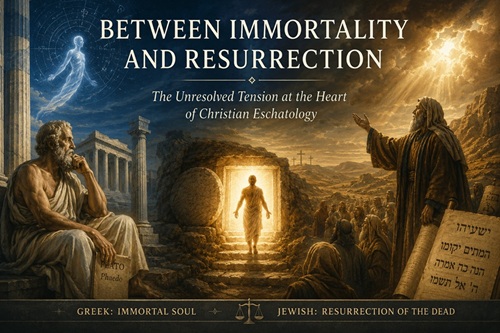
Christianity has never had an entirely comfortable answer to one of the most basic questions about human existence: what happens to us when we die? The conventional Christian answer sounds straightforward. We die, our souls continue to exist, and at the end of history God resurrects the dead. But this apparently coherent formula conceals a deep historical tension. Is eternal life something we already possess because the soul is inherently immortal? Or is immortality something God must give us through resurrection? Do we go to heaven immediately after death, or do we remain dead until the resurrection? Is salvation ultimately the escape of the soul from the body, or the restoration and transformation of embodied existence? These are not merely theological technicalities. They reflect two rather different visions of what a human being is. One has roots in the Jewish biblical and apocalyptic tradition: the human person is an embodied creature, death is an enemy, and God's final victory consists in raising the dead. The other belongs much more comfortably to the philosophical world of ancient Greece: the true self is the soul, the body is temporary, and death can liberate the soul into a higher mode of existence. Christianity inherited both languages. It never completely reconciled them. The Jewish background: death is not liberationThe starting point of Christian eschatology is not Plato but Judaism. Yet even this statement needs qualification. Ancient Judaism did not possess a single, uniform doctrine of the afterlife. The Hebrew Bible is surprisingly reticent about life after death. Its dominant horizon is this-worldly: blessing, offspring, land, covenant and communal survival. Sheol, the realm of the dead, is generally portrayed as a shadowy condition rather than as the heavenly destiny familiar from later Christianity. The decisive development came much later, particularly during the Second Temple period. Under the pressures of persecution, martyrdom and apocalyptic expectation, ideas of resurrection and final judgment became increasingly prominent. By the time of Jesus, resurrection was an important Jewish belief, although it was by no means universally accepted. The Sadducees, for example, rejected resurrection. This historical development matters because Christian resurrection theology makes sense primarily against this Jewish background. The central Jewish idea was not that human beings possess an indestructible metaphysical substance called a "soul." Rather, God could restore life to the dead. Resurrection therefore meant that death itself would ultimately be defeated. This is the logic visible in Paul's famous argument in 1 Corinthians 15. Christ is not merely someone whose soul survived death. Christ was raised. And his resurrection is presented as the "first fruits" of the resurrection of others. If there is no resurrection of the dead, Paul argues, then Christian faith itself collapses. This is an astonishingly bodily conception of salvation. Paul does not say that death is ultimately harmless because the real person was never the body in the first place. Quite the opposite: death is an enemy precisely because it destroys embodied human existence. The Christian hope is therefore not simply survival after death but resurrection from death. N. T. Wright has emphasized this distinction, while also warning against the simplistic formula that "Jews believed in resurrection and Greeks believed in immortality." Second Temple Judaism contained a spectrum of positions, including resurrection, disembodied existence and other forms of postmortem hope. The Greco-Roman world was equally diverse. Nevertheless, the broad contrast remains historically significant: Christian resurrection emerged within a Jewish apocalyptic framework rather than simply being another version of Greek belief in the immortal soul. The Greek alternative: the soul survivesGreek philosophy introduced Christianity to a very different way of conceptualizing death. In Platonic philosophy, the soul can be understood as fundamentally different from the body. The body belongs to the changing material world; the soul is capable of participating in a higher and more permanent reality. Death can therefore be interpreted not merely as an evil to be reversed but as the separation of the soul from the body. This radically changes the meaning of salvation. If the essential human being is the soul, then bodily resurrection can begin to look almost unnecessary. Why reconstruct the body when the soul has already escaped it? The philosophical problem became particularly acute because Christianity entered the intellectual world of the Hellenistic Mediterranean. Christian thinkers had to explain resurrection to audiences who could find the idea of dead bodies returning to life absurd, crude or philosophically inferior. Pagan critics such as Celsus ridiculed the idea of bodily resurrection. Christian theologians therefore increasingly employed philosophical concepts of soul, substance, incorporeality and immortality. The result was not the simple replacement of resurrection by immortality. Instead, Christianity constructed a remarkable hybrid. The Christian compromiseThe hybrid eventually became something like this: The body dies, but the immortal soul survives. The soul enters an intermediate state, often described as heaven or another postmortem condition. At the end of history, God resurrects the dead and reunites soul and body. The resurrected body is transformed and incorruptible. This solution allows Christianity to preserve both traditions. It retains the Jewish resurrection while incorporating the Greek conviction that the soul can survive bodily death. But conceptually, the compromise is unstable. If the soul is already enjoying eternal life in heaven, what exactly is gained by resurrection? If the person is already fully alive with God after death, the resurrection can begin to look like a theological appendix. Conversely, if resurrection is genuinely necessary for the fulfillment of human existence, then the idea that the soul is already living its essential life apart from the body becomes difficult to reconcile with the biblical conception of the human being. Nancey Murphy has described precisely this historical development. According to her analysis, early Christianity emphasized bodily resurrection, while Christian thinkers increasingly adopted Greek philosophical anthropology. By Augustine's time, body-soul dualism and the immortality of the soul had become firmly established within Christian theology. The result was a hybrid doctrine in which the soul survives death before eventually being reunited with a resurrected body. The compromise solved one problem by creating another. Augustine and the triumph of the immortal soulAugustine was particularly important in giving Western Christianity a philosophical anthropology capable of integrating Christian doctrine with Platonism. For Augustine, the soul was not simply a temporary function of the body. It had a distinctive spiritual status and could survive bodily death. Yet Augustine did not abandon resurrection. Christianity continued to teach that the final destiny of the human person involved resurrection. This produced the familiar Christian sequence: death → survival of the soul → judgment/intermediate state → resurrection → final destiny. The crucial point is that this sequence contains two different conceptions of personal identity. The first says that "I" can survive without my body. The second says that "I" am restored through the resurrection of my body. Christianity simply learned to say both. The medieval synthesis made this seem less problematic because "body" and "soul" could be treated as distinct but complementary components of a single human being. The soul survives temporarily without the body, but the complete human being requires their reunion. The result is intellectually sophisticated, but it is also quite different from the popular Christian picture of "going to heaven when you die." The curious disappearance of resurrectionOne of the ironies of Christian history is that resurrection remained doctrinally indispensable while becoming psychologically secondary. The Apostles' Creed says, "I believe in the resurrection of the body." The Nicene tradition likewise affirms resurrection and "the life of the world to come." Yet ordinary Christian imagination has overwhelmingly focused on heaven. Funeral sermons often speak of the deceased as having "gone to be with the Lord." Christian art depicts souls ascending into heaven. Popular spirituality imagines salvation as departure from this world into another. The resurrection therefore becomes something that happens later, after the important event has apparently already occurred. This produces one of the strangest structures in Christian eschatology: Christianity officially insists that resurrection is essential, while Christian popular culture frequently treats the immortal soul as though resurrection were optional. The Catholic Church provides a particularly clear example of the compromise. Its Catechism explicitly teaches both that the soul is immortal and that the body will be resurrected. After death, body and soul are separated; the body decays while the immortal soul awaits reunion with it in the resurrection. There is therefore no ambiguity about the official position. The problem is conceptual rather than doctrinal: why is the soul's temporary disembodied existence not already the fulfillment of salvation? Protestantism did not eliminate the problemThe Reformation challenged many medieval doctrines, but it did not fundamentally resolve this particular tension. Luther and Calvin retained belief in resurrection while continuing to affirm some form of conscious existence after death. Protestant traditions consequently inherited much of the same dual structure. Evangelical Christianity often intensifies the popular emphasis on immediate postmortem destiny: the believer "goes to heaven" after death, while the resurrection remains a future event. Some modern Protestant theologians, however, have deliberately reversed this emphasis. They argue that resurrection rather than disembodied immortality is the genuinely Christian doctrine and that the popular concept of heaven owes more to Greek philosophical assumptions than many Christians realize. This has produced something of a theological rehabilitation of resurrection in contemporary Christianity. The twentieth-century challengeModernity introduced a new problem. Scientific materialism made both immortality and resurrection difficult to conceptualize. If consciousness depends upon the brain, what exactly survives death? And if the body decomposes, what could it mean for the same individual to be resurrected? The old body-soul distinction consequently came under pressure from both science and philosophy. Some theologians responded by abandoning literal bodily resurrection in favor of symbolic or existential interpretations. Resurrection could mean the victory of God's purposes, the transformation of human existence, or the continuing significance of Jesus rather than the reanimation of corpses. Others went in the opposite direction and insisted that Christianity stands or falls with an actual resurrection. Between these extremes emerged attempts to formulate resurrection without requiring a crude "reassembly" of biological matter. Paul's phrase "spiritual body" in 1 Corinthians 15 became particularly important here. A resurrected body need not mean the ordinary mortal body simply being reconstructed. It can mean transformed embodiment. This distinction is significant because resurrection is not necessarily equivalent to resuscitation. Resuscitation means that a dead organism returns to its previous biological condition. Resurrection, in the Christian theological sense, means transformation into an incorruptible mode of embodied existence. Contemporary Christianity: several models coexistToday there is no single Christian understanding of the afterlife. Traditional Catholic and Orthodox Christianity retains the full synthesis: the soul survives death, judgment occurs, and the dead will ultimately be resurrected. Catholic teaching explicitly maintains both doctrines. Many conservative Protestants similarly combine immediate heavenly existence with a future bodily resurrection. Some contemporary theologians, however, regard this as an unfortunate historical compromise. They argue that Christianity should recover its original emphasis on resurrection rather than immortality. Nancey Murphy is one example of this approach, explicitly advocating a return to an understanding of human beings as unified embodied creatures rather than essentially divided into body and soul. Others have gone further and rejected the idea of an independently existing soul altogether. On this view, God remembers, recreates or resurrects the person. Personal continuity depends not upon an immortal substance but upon divine action. This position has an interesting philosophical consequence: resurrection becomes conceptually more important precisely because immortality has been abandoned. The human being does not naturally survive death. God must overcome death. The deeper philosophical issueThe disagreement is ultimately not about what happens "after death." It is about what a human being is. The immortal-soul model says, in effect, that my body is not identical with my deepest self. I can lose my body and nevertheless remain myself. The resurrection model says something quite different: embodied existence belongs constitutively to human identity. God does not save me from embodiment; God saves embodiment from death. The distinction also affects the Christian attitude toward the material world. If salvation means escape from embodiment, then earthly existence can easily become a temporary waiting room. Matter is something we eventually leave behind. If salvation means resurrection and the renewal of creation, then the material world becomes part of God's ultimate project. Creation is not discarded but redeemed. This is one reason contemporary theologians who emphasize resurrection sometimes connect it with ecological and social concerns. If Christian hope concerns the renewal of embodied creation rather than escape from it, then the physical world acquires theological significance. Was Christianity really a synthesis?It would therefore be misleading to say simply that Christianity began with Jewish resurrection and later imported Greek immortality. The historical reality was messier. Second Temple Judaism itself contained diverse views of the afterlife, including forms of disembodied existence. Greek and Roman thought was equally heterogeneous. Early Christianity emerged in precisely this culturally mixed environment. Its thinkers did not simply choose between "Jewish" and "Greek" options; they experimented with ways of making resurrection, soul, heaven, judgment and eternal life mutually intelligible. But something genuinely happened in the process. The Christian tradition gradually came to inhabit two different conceptual worlds. One says that death is the enemy and resurrection is God's final victory over it. The other says that the essential person can survive death because the soul is immortal. The two ideas can coexist institutionally. They are much harder to reconcile philosophically. And perhaps that is why Christian eschatology has remained so remarkably elastic. It can speak the language of resurrection to preserve its biblical and creedal identity while speaking the language of immortal souls to satisfy the intuitive desire that the person we love is already somewhere, alive and conscious. The awkward compromiseThe historical irony is that the doctrine of the immortal soul may actually weaken the very doctrine of resurrection Christianity officially regards as central. If death does not really destroy the person, resurrection is no longer the decisive victory over death. If the soul continues happily in heaven, the resurrection of the body becomes a later enhancement rather than the restoration of something genuinely lost. The Jewish-Christian proclamation was more radical than that. It was not: "You will survive because you possess an immortal soul." It was closer to: "Death does not have the final word because God will raise the dead." That difference is easy to overlook because centuries of Christian theology have placed the two propositions side by side. But historically they come from different intellectual trajectories. One begins with the conviction that human beings are embodied creatures whom death destroys and whom God can restore. The other begins with the conviction that the deepest human reality is capable of surviving the destruction of the body. Christianity never completely chose between them. Instead, it constructed one of the most enduring theological compromises in Western history: the soul goes on living, but the body will eventually rise; heaven is already our destination, but resurrection remains our ultimate hope; the person can exist without the body, but cannot finally be complete without it. That compromise has served Christianity remarkably well. Whether it has ever been philosophically coherent is another question. Appendix: From Immortality to Resurrection—Revisiting My Early TreatmentThe preceding essay raises a historical and conceptual problem that I had already encountered, in a very different intellectual context, more than four decades ago. In Seven Spheres, originally self-published in Dutch in 1982 as Occult Wereldbeeld and republished in 1995, I attempted to map different conceptions of human nature onto different conceptions of life after death. Looking back at those chapters today, it is striking how directly they anticipated the question addressed here: is the human being essentially an embodied organism, an immortal soul, or something more complicated? My early analysis began with a useful observation: ideas about the afterlife are inseparable from ideas about what a human being is. If the human being is simply the physical body, death is the end unless God resurrects the person. If the human being consists of body plus an immaterial soul, survival after death becomes conceptually possible. And if human nature consists of several layers or "vehicles" of consciousness, then still more elaborate accounts of postmortem existence become possible. I explicitly argued that increasing complexity in one's anthropology tends to produce a corresponding complexity in one's conception of the afterlife. That framework led me to distinguish what I called the "simple" and "twofold" views of human nature. The first identifies the human being with the physical organism; the second, represented philosophically by Plato and later by Descartes, distinguishes body from soul. In the Platonic conception, the soul belongs to a higher and more enduring order than the body, making survival after death almost a natural consequence of anthropology. I was already aware, therefore, of precisely the tension discussed in the main essay. Once an immortal soul is introduced, resurrection ceases to be the only possible solution to death. Indeed, the question becomes why resurrection should be necessary at all. If the essential person survives bodily death, then the destruction of the body has not destroyed the person in the first place. The three models of immortalityChapter 4 of Seven Spheres made this tension explicit. I presented three broad models of the afterlife: resurrection, survival, and what Anthony Flew called the "shadow-man" or intermediate-body conception. In the first, God resurrects the person at the end of history. In the second, the immortal soul survives immediately after death. In the third, consciousness survives through some kind of subtle or intermediate body. This classification allowed me to identify something that remains historically important: Christianity contains both the resurrection model and the survival model. The resurrection model has its roots in Jewish apocalypticism and the expectation of the renewal of the world. The survival model is much more congenial to the Greek philosophical distinction between body and soul. I observed that the early Christian expectation was strongly eschatological. Christ was expected to return, the existing order would be overturned, the dead would be raised, and judgment would follow. But as the Second Coming failed to occur, a practical theological problem emerged: what happened to Christians who died in the meantime? The solution was an increasingly elaborate doctrine of individual judgment and an intermediate afterlife, alongside the continuing expectation of a final resurrection. I wrote rather bluntly at the time that "for these contradictions a solution has never been found." That judgment still seems substantially correct. The historical development can therefore be understood not simply as a theological evolution but as the superimposition of two anthropologies. The Jewish-Christian conception says: the dead will be raised. The Greek conception says: the soul survives. Christianity eventually learned to say both. Where my earlier analysis was particularly perceptiveThe strongest part of the early analysis, in retrospect, was the insistence that we should examine the anthropology underneath eschatology. That point is still indispensable. The question "What happens after death?" cannot be answered independently of the question "What is a human being?" A materialist, a Thomist, a Platonist, a Buddhist, a Theosophist and a contemporary Christian resurrection theologian may all use the word "person" while meaning radically different things by it. I therefore think the basic methodological insight of Seven Spheres deserves to be retained: eschatological doctrines should not be compared in isolation. They are consequences of deeper assumptions about embodiment, consciousness, identity and the relation between the visible and invisible worlds. But this is also where my earlier work became problematic. Where I would now be much more criticalIn Seven Spheres, I moved rather quickly from identifying alternative models to treating the Theosophical model as a possible superior synthesis. I proposed a sevenfold conception of human nature involving physical, vital, emotional, mental and spiritual levels, culminating in the monad or higher Self. In that framework, death becomes a process of withdrawing successively from different bodies or vehicles, while the afterlife unfolds through astral and mental spheres. The model is internally elaborate. It is also remarkably well suited to reconciling apparently conflicting traditions. The physical body dies, but consciousness does not simply float free as an immaterial Cartesian soul. Instead, different aspects of the person supposedly operate through different levels of embodiment. Theosophy could therefore offer something between crude material resurrection and disembodied immortality. I was attracted to this third possibility. In Chapter 4 I explicitly argued that the "third option" of an astral or subtle body deserved serious consideration, and eventually concluded that I would personally prefer to abandon the traditional doctrine of bodily resurrection in favor of such a model. I also regarded clairvoyant observation, spiritualism, near-death experiences and related phenomena as potentially relevant empirical evidence for postmortem survival. That is precisely the point at which my present assessment would diverge most sharply from my younger self. The historical analysis remains interesting; the evidential conclusion does not follow. The problem of turning metaphysical architecture into evidenceThe Theosophical system has an impressive explanatory symmetry. Body, astral body, mental body, causal body and higher spiritual principles correspond to successive spheres of existence. The process of dying becomes the reverse of incarnation: one sheds one vehicle after another and moves into progressively subtler domains. My early text describes this in considerable detail, including the idea that the astral plane contains the deceased, non-human entities and thought-forms, while higher planes correspond to increasingly spiritual states of consciousness. But explanatory elegance is not evidence. This is an important distinction that is much clearer to me now. A metaphysical system can organize a large number of experiences without thereby establishing the ontological reality of the entities it postulates. The fact that near-death experiences, apparitions, mediumistic experiences or mystical states can be interpreted within a subtle-body framework does not demonstrate that astral bodies or astral planes actually exist. My younger argument sometimes moved too easily from "this model explains these experiences" to "this model therefore describes reality." That is precisely the sort of inference that a critical history of religion should resist. The irony of the third wayThere is nevertheless something valuable in the old Theosophical proposal. It reveals that the traditional choice between immortality and resurrection is not exhaustive. The twofold Greek model gives us body and immortal soul. The Jewish-Christian resurrection model gives us death followed by divine restoration. A third model introduces intermediate forms of embodiment. This idea has a long history, and my earlier discussion connected it to traditions ranging from ancient cultures and Neoplatonism to Indian thought and certain Christian speculations about intermediate states. The historical lesson is therefore broader than the Christian controversy itself. Human cultures have repeatedly found it difficult to imagine consciousness without some form of embodiment. The supposedly simple opposition between "material body" and "immaterial soul" may itself be an abstraction. Even Platonism developed increasingly elaborate accounts of the soul's relationship to different levels of reality, while later esoteric traditions populated the space between physical embodiment and pure spirit with increasingly subtle forms of corporeality. This makes the Christian compromise more intelligible. Perhaps Christianity never really had to choose between "body" and "soul." It inherited a much richer and more confused collection of ideas about what survives death. From Theosophy back to ChristianitySeen from today's perspective, the most interesting feature of my early work is therefore not the Theosophical cosmology itself but the question it forced into the open. What exactly does "resurrection" mean if the person already survives death? What exactly does "immortality" mean if the person requires embodiment? And what exactly is the "person" whose survival or resurrection we are discussing? These questions remain unresolved. Contemporary Christian theology has produced sophisticated answers, but it has not eliminated the underlying tension. Some theologians attempt to recover a strongly biblical conception of resurrection and reject the independent immortality of the soul. Others retain conscious existence after death while also affirming a future resurrection. Still others reinterpret resurrection in a more existential, symbolic or metaphysical fashion. My early work belongs to yet another tradition: the attempt to construct a layered anthropology in which death is not a single event but a transition through multiple levels of embodiment. Historically, this is fascinating. Epistemically, it requires much more caution than I exercised at the time. What remains from Seven SpheresI would therefore retain three things from my early treatment. First, the insistence that eschatology depends upon anthropology. Second, the recognition that "immortality" and "resurrection" are not simply interchangeable words for the same hope. They embody different conceptions of personal identity and embodiment. And third, the historical recognition that Christianity contains an unresolved mixture of Jewish resurrection theology and Greek philosophical ideas about the soul. What I would no longer accept without qualification is the leap from this conceptual analysis to the factual existence of a Theosophical hierarchy of astral, mental, causal and spiritual worlds. The sevenfold model may be an ingenious metaphysical map, but a map is not evidence that the territory exists. That distinction is especially important because my present critique of Christian eschatology turns out to converge with something my younger self already sensed: the doctrine of the afterlife cannot be separated from the model of the human being that generates it. The difference is that I would now add a further question that Seven Spheres did not press hard enough: what evidence warrants the model in the first place? That is where historical reconstruction must give way to philosophical criticism and empirical investigation. And perhaps this is the most interesting continuity between the early and the present work. The questions have changed surprisingly little. What has changed is my willingness to distinguish a compelling metaphysical possibility from an established fact.
Widget is loading comments...
|