|
TRANSLATE THIS ARTICLE
Integral World: Exploring Theories of Everything
An independent forum for a critical discussion of the integral philosophy of Ken Wilber
  Frank Visser, graduated as a psychologist of culture and religion, founded IntegralWorld in 1997. He worked as production manager for various publishing houses and as service manager for various internet companies and lives in Amsterdam. Books: Ken Wilber: Thought as Passion (SUNY, 2003), and The Corona Conspiracy: Combatting Disinformation about the Coronavirus (Kindle, 2020). Frank Visser, graduated as a psychologist of culture and religion, founded IntegralWorld in 1997. He worked as production manager for various publishing houses and as service manager for various internet companies and lives in Amsterdam. Books: Ken Wilber: Thought as Passion (SUNY, 2003), and The Corona Conspiracy: Combatting Disinformation about the Coronavirus (Kindle, 2020).
Check out my other conversations with ChatGPT The "Regressive Left"When Progressivism Becomes IlliberalFrank Visser / ChatGPT
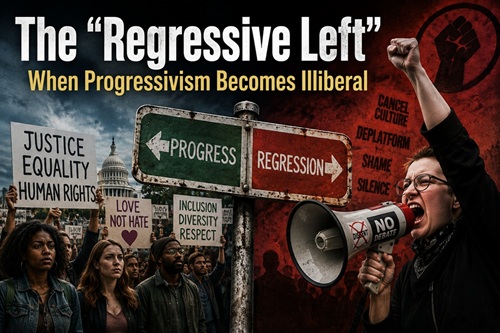 The expression “regressive Left” has become a familiar weapon in contemporary political debate. It is normally used to describe people who identify with progressive or left-liberal politics but, in the name of tolerance, multiculturalism, anti-racism or social justice, end up defending attitudes and institutions that are themselves illiberal. The phrase is deliberately paradoxical: how can a political movement dedicated to progress become regressive? There is a real phenomenon behind the polemical label. But the label is also frequently abused. It can become a convenient way for conservatives and right-wing populists to dismiss the entire political Left as hypocritical, authoritarian or culturally destructive. A serious analysis therefore has to distinguish between legitimate criticism of illiberal tendencies within progressive politics and the caricature of the Left as a whole. The central problem is not that the Left has become “too progressive.” It is that some forms of progressive politics have allowed the pursuit of equality and protection from discrimination to collide with other liberal principles—freedom of speech, intellectual openness, universalism, secularism and individual autonomy. When that happens, progressivism can indeed become internally contradictory. Where did the “regressive Left” come from?The expression acquired much of its contemporary meaning through the British Muslim reformer Maajid Nawaz, who used it to criticize Western liberals whom he believed were excessively accommodating toward Islamism. The term became more widely known through discussions involving figures such as Sam Harris, Richard Dawkins and Bill Maher. Its original target was therefore relatively specific: Western progressives who were so concerned about appearing Islamophobic that they hesitated to criticize authoritarian or Islamist ideas. That criticism touches upon a genuine liberal dilemma. Liberalism traditionally means that individuals should be free to practice their religion, express their opinions and organize their lives as they choose, provided they respect the equal rights of others. But liberalism does not require liberals to regard every belief system as equally compatible with liberal democracy. A woman should be free to wear a headscarf. That is a straightforward matter of religious liberty. But if someone argues that women should be legally compelled to wear it, the principle changes. Similarly, Muslims should have exactly the same civil rights as everybody else. But that does not mean that an Islamist political movement demanding religious government should receive immunity from criticism merely because its adherents belong to a minority religion. The distinction is crucial: protecting people from discrimination is not the same thing as protecting ideas from criticism. The paradox of toleranceOne intellectual source of the debate is Karl Popper's famous “paradox of tolerance.” A liberal society cannot necessarily remain tolerant toward movements whose objective is to abolish tolerance itself. This principle, however, is easily misused. Almost every political opponent can be described as “intolerant” by someone. The mere fact that an ideology is unpleasant, conservative, religious or culturally alien does not make it an existential threat to liberalism. The proper question is therefore not whether somebody holds an illiberal opinion. Liberal societies contain many illiberal opinions. The question is whether individuals or organizations seek to impose those opinions coercively upon others. That distinction is often lost in contemporary culture-war arguments. When solidarity becomes tribalismOne of the more troubling tendencies associated with the “regressive Left” is the transformation of solidarity into tribalism. Traditional left-wing universalism begins with the proposition that human beings possess equal moral worth regardless of race, religion, sex or nationality. The contemporary identity-oriented Left sometimes reverses this logic. Individuals are increasingly interpreted through collective categories: white, Black, Muslim, Jewish, immigrant, colonizer, oppressed, privileged. Such categories can be sociologically useful. Race, class, gender and nationality clearly influence people's experiences and opportunities. The problem begins when group membership becomes a moral classification. The result can be a strange inversion of the old anti-racist principle. Instead of saying, “Judge people as individuals rather than according to their group,” one begins to assume that individuals inherit different moral positions because of the groups to which they belong. This is not necessarily progressive. It can reproduce precisely the kind of essentialist thinking that earlier generations of liberals and socialists tried to overcome. A white individual may be privileged in one context and disadvantaged in another. A Muslim woman may simultaneously experience religious discrimination, sexism and economic disadvantage. A wealthy member of a historically marginalized group may possess enormous social power. Human beings occupy multiple social positions simultaneously. Reducing this complexity to a simple oppressor/oppressed binary is intellectually regressive because it replaces analysis with moral categorization. The problem with “lived experience”Another important feature of contemporary progressive discourse is the elevation of “lived experience.” Personal experience deserves respect. If somebody tells us that they have experienced racism, sexism or discrimination, the appropriate response is not to dismiss their testimony. But experience is not automatically an argument about causation. Someone can accurately report what happened to them while being mistaken about why it happened. Individual experience cannot by itself establish a general sociological proposition. Science exists partly because human beings are extraordinarily bad at generalizing from personal experience. We see patterns where none exist, underestimate alternative explanations and selectively remember evidence that confirms our existing beliefs. Consequently, the progressive commitment to listening to marginalized voices can become epistemically problematic if “lived experience” is treated as a privileged source of truth rather than one form of evidence among others. There is an important difference between saying, “You should listen to people describing discrimination,” and saying, “Their interpretation of the causes of discrimination cannot be questioned.” The first is empathy. The second can become dogma. The collision with scienceThis becomes particularly serious when political commitments begin determining empirical conclusions. A progressive movement committed to equality has every reason to oppose scientific racism and pseudoscience. But the correct response to bad science is not politically motivated censorship. It is better science. Scientific propositions cannot become true or false according to whether their social consequences are considered desirable. That principle cuts both ways. Conservatives cannot reject climate science because its implications are politically inconvenient. Progressives cannot reject uncomfortable findings about human psychology, biology, sex differences, intelligence or evolutionary behavior simply because they might be misused politically. There is a fundamental distinction between an empirical proposition and its political interpretation. Suppose a study discovered a biological difference between two populations. That would not automatically establish a hierarchy of human worth. Conversely, discovering that a difference is socially constructed would not automatically establish that every disparity is caused by discrimination. The proper scientific response is investigation, replication, criticism and methodological scrutiny—not ideological permission slips. There is evidence that extreme political attitudes can occur on both sides of the political spectrum, including forms of authoritarian political correctness as well as right-wing identitarianism. Research examining these tendencies explicitly warns against treating authoritarianism as the exclusive property of either the Left or the Right. Cancel culture and the shrinking of disagreementThe most visible manifestation of these tensions may be the contemporary controversy surrounding “cancel culture.” There is nothing inherently wrong with criticism. People who make offensive statements can be criticized, challenged and even socially rejected. Employers and institutions also have legitimate interests in determining whom they employ or invite. The problem arises when criticism becomes an organized demand that certain ideas, speakers or researchers must not merely be challenged but prevented from being heard. This is particularly dangerous in universities. The university is supposed to be an institutionalized environment for disagreement. Its purpose is not to guarantee that students encounter only morally approved opinions. It is precisely because difficult, offensive or unpopular claims exist that intellectual institutions need argument, evidence and criticism. A student who encounters a bad argument is not necessarily harmed by it. They may instead learn how to dismantle it. There is a profound difference between intellectual censorship and intellectual refutation. The former says: “You must not hear this.” The latter says: “You may hear it, but here is why it is wrong.” The second is almost always the stronger intellectual strategy. A 2020 academic analysis of the “regressive Left” specifically identified restrictions on speech and academic inquiry as one of the tendencies associated with the phenomenon, although its broader characterization of the movement is itself open to criticism. But the Right has its own versionHere the critique of the “regressive Left” must become symmetrical. It is tempting to imagine that authoritarianism is a specifically left-wing disease. History makes such a conclusion impossible. The Right has its own forms of intellectual conformity, censorship and tribalism. Religious fundamentalism can demand obedience to sacred authority. Nationalism can suppress criticism of the nation. Populism can portray journalists, academics and scientists as enemies of “the people.” Racial nationalism can turn group identity into political destiny. The modern far Right has developed its own identitarian politics, conspiracy theories and hostility toward established institutions. Research examining political extremism has consequently found authoritarian tendencies associated with both extremes rather than with the Left alone. Indeed, there is an important symmetry here. The regressive Left can say: “You are privileged, therefore your argument is suspect.” The regressive Right can say: “You are an outsider, therefore your argument is suspect.” Both replace argument with identity. Both can transform politics into a struggle between morally pure tribes. Both can become hostile to intellectual pluralism. The danger of weaponizing the termThere is therefore another problem with the phrase “regressive Left”: it is too easy to use. Once the term becomes a generalized insult, virtually any progressive position can be declared “regressive.” Support for immigration becomes “regressive.” Opposition to racism becomes “regressive.” Feminism becomes “regressive.” Concern about colonialism becomes “regressive.” This destroys the analytical value of the concept. A useful criticism must specify what exactly is regressive. • Is the claim empirically false? • Is it logically contradictory? • Does it violate freedom of speech? • Does it excuse authoritarianism? • Does it apply double standards? • Does it essentialize human beings according to group identity? • Does it reject evidence because the conclusion is politically inconvenient? These are substantive criticisms. Calling somebody “regressive” without answering such questions is merely political name-calling. There is also a particularly ironic phenomenon in which critics of progressive identity politics themselves become obsessed with identity politics. They spend so much time talking about “the Left” that they create the very political monolith they claim to oppose. The Left is not a single intellectual organism. Social democrats, democratic socialists, Marxists, anarchists, liberals, Greens, feminists, labor activists and identity-oriented progressives can disagree profoundly with one another. There is no single “regressive Left.” There are regressive tendencies within the Left. That is a much more defensible proposition. The deeper issue: liberalism versus illiberalismPerhaps the most useful way to understand the controversy is not Left versus Right but liberalism versus illiberalism. Liberalism contains several principles that can come into tension: equality, individual liberty, freedom of expression, freedom of religion, pluralism and democratic government. Progressive politics emphasizes equality. Conservative politics traditionally emphasizes order, continuity and social cohesion. Neither side possesses an automatic monopoly on liberalism. A progressive can become illiberal by demanding ideological conformity in the name of equality. A conservative can become illiberal by demanding conformity in the name of tradition, religion or national identity. The fundamental political question is therefore not: “Is this Left or Right?” It is: “What happens to individual freedom, equality before the law, freedom of inquiry and democratic pluralism if this principle is taken seriously?” That question is much harder to answer—and much more useful. A liberal Left is possibleThe Left does not need to abandon its historical commitments in order to escape its regressive tendencies. • It can defend minorities without romanticizing minority cultures. • It can oppose racism without reducing individuals to racial categories. • It can defend Muslims against discrimination while criticizing Islamism. • It can defend transgender people from violence and discrimination while permitting legitimate disagreement about policy and biology. • It can oppose colonialism without turning Western civilization into a uniquely malignant historical phenomenon. • It can defend social equality without pretending that every unequal outcome is evidence of discrimination. • It can take lived experience seriously without treating experience as infallible. • And it can defend marginalized people while simultaneously defending freedom of speech for people whose opinions it finds repugnant. Indeed, this combination is not a retreat from progressive politics. It is arguably its mature form. The real meaning of progressThe word “progressive” should ultimately mean more than belonging to the culturally fashionable side of a political divide. Progress means being willing to revise one's beliefs. That requires intellectual humility. A genuinely progressive movement should therefore be able to say: “We were wrong.” It should be capable of recognizing that yesterday's progressive certainty can become tomorrow's dogma. It should be willing to examine evidence that challenges its preferred narrative. And it should be suspicious of any political movement that claims a monopoly on moral virtue. The deepest danger of the “regressive Left” is therefore not that it is left-wing. It is that, in some manifestations, it abandons one of the most important achievements of modern liberalism: the idea that no political tribe, however virtuous it considers itself, is entitled to immunity from criticism. But the opposite danger is equally real. The phrase “regressive Left” can itself become a tribal weapon, allowing conservatives to dismiss legitimate struggles against racism, inequality and discrimination without engaging their substance. The answer is not to choose between the Left and the Right. It is to defend the liberal principles that both sides are capable of betraying. That means universal human rights rather than competing group hierarchies; free inquiry rather than ideological conformity; evidence rather than political convenience; individual dignity rather than collective essentialism; and argument rather than censorship. The genuinely progressive position may therefore be less glamorous than either side's culture-war rhetoric suggests. It is simply the willingness to keep moving forward—including when the evidence forces us to change direction.
Widget is loading comments...
|