|
TRANSLATE THIS ARTICLE
Integral World: Exploring Theories of Everything
An independent forum for a critical discussion of the integral philosophy of Ken Wilber
  Frank Visser, graduated as a psychologist of culture and religion, founded IntegralWorld in 1997. He worked as production manager for various publishing houses and as service manager for various internet companies and lives in Amsterdam. Books: Ken Wilber: Thought as Passion (SUNY, 2003), and The Corona Conspiracy: Combatting Disinformation about the Coronavirus (Kindle, 2020). Frank Visser, graduated as a psychologist of culture and religion, founded IntegralWorld in 1997. He worked as production manager for various publishing houses and as service manager for various internet companies and lives in Amsterdam. Books: Ken Wilber: Thought as Passion (SUNY, 2003), and The Corona Conspiracy: Combatting Disinformation about the Coronavirus (Kindle, 2020).
Check out my other conversations with ChatGPT Time's Second ArrowDoes Evolution Really Need a New Law of Nature?Frank Visser / ChatGPT
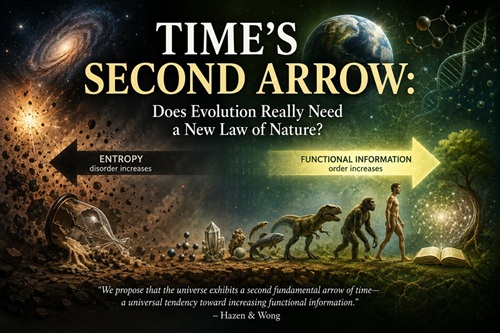
Robert M. Hazen and Michael L. Wong's Time's Second Arrow: Evolution, Order, and a New Law of Nature (2026) is an ambitious little book with a very large claim. The authors propose that science has overlooked a fundamental law governing the universe: alongside the familiar thermodynamic arrow of increasing entropy, there is a second arrow of time pointing toward increasing “functional information.” Evolution, they argue, is therefore not merely a biological phenomenon. It is a universal process operating across atoms, molecules, minerals, planets, organisms, and perhaps even knowledge itself. That is an exciting proposition. It is also one that deserves considerably more scrutiny than the rhetoric of a “new law of nature” might suggest. Published by W. W. Norton in February 2026, the 192-page book develops an argument that Hazen and Wong had already presented in a 2023 PNAS paper, where they explicitly proposed a “law of increasing functional information.” The book therefore does not introduce an entirely unexpected idea. Rather, it expands a research program into a broad philosophical and scientific narrative about evolution, information, complexity and the directionality of time. The central question is whether this really amounts to a new fundamental law—or whether the authors have identified an important pattern that can already be understood through evolutionary theory, statistical mechanics, thermodynamics, information theory and the physics of nonequilibrium systems. The puzzle: order in an entropic universeThe starting point is familiar. The second law of thermodynamics gives us the best-known physical arrow of time. In an isolated system, entropy tends to increase. Eggs break but do not spontaneously unscramble; stars burn through their fuel; organized energy gradients dissipate. Yet the universe also contains an extraordinary increase in organization. Hydrogen and helium became stars. Stars produced heavier elements. Planets produced increasingly diverse minerals. Chemistry produced enormously complicated molecules. Biological evolution generated cells, organisms, nervous systems and ecosystems. Hazen and Wong ask a legitimate question: if entropy describes an important aspect of temporal change, does it provide a complete description of the evolution of complexity and functionality? Their answer is no. They propose a second arrow: the “law of increasing functional information.” In their formulation, an evolving system consists of many interacting components capable of generating many configurations, with those configurations subjected to selection according to function. Under those circumstances, functional information increases. This is the conceptual heart of the book. And it is worth emphasizing that there is something genuinely interesting here. Functional information is not simply “complexity”One of the strengths of the proposal is that Hazen and Wong do not merely announce that “complexity increases.” That would be hopelessly vague. They use the more specific concept of functional information, originally developed in work associated with Jack Szostak. Functional information measures how rare functional configurations are within a space of possible configurations. If only a tiny fraction of possible molecular sequences performs a particular function, finding such a sequence represents a large amount of functional information. Mathematically, the quantity can be expressed in bits as the negative logarithm of the fraction of configurations achieving a specified degree of function. This gives the argument a quantitative foundation that many popular discussions of “complexity” lack. It also explains why the authors prefer the term functional information rather than simply information. Shannon information, algorithmic information and thermodynamic entropy are different concepts, and conflating them would be a serious mistake. Hazen and Wong largely avoid that elementary confusion. The problem comes later. From Darwinian evolution to “evolution everywhere”The authors' most provocative move is to generalize evolutionary language far beyond biology. Biological evolution clearly involves variation, differential persistence and reproduction, and selection. But Hazen and Wong argue that analogous processes can be found throughout nature. Minerals provide their favorite example. The early universe contained relatively few chemical elements and consequently relatively few mineral species. Stellar nucleosynthesis, planetary differentiation, geological processes, atmospheric chemistry and biological activity subsequently generated an enormous diversity of minerals. Hazen has spent much of his career documenting this phenomenon as “mineral evolution.” The authors see the same general pattern elsewhere. Configurations are generated, some persist because they are stable or otherwise functional, and those successful configurations become part of the subsequent state of the system. Their proposal therefore treats Darwinian evolution as one particularly important instance of a much broader evolutionary principle. There is a useful insight here, but also a danger. Calling all these processes “evolution” can illuminate structural similarities while simultaneously obscuring crucial differences. Stars do not reproduce. Minerals do not inherit genomes. Atoms are not populations of competing individuals. Nuclear reactions do not constitute natural selection in the Darwinian sense merely because stable nuclei persist while unstable ones disappear. The question is therefore not whether these systems exhibit change, selection-like filtering or increasing diversity. They plainly can. The question is whether they instantiate the same causal principle. That requires considerably more than an interesting analogy. Selection is doing most of the workThis is where the proposed law becomes less revolutionary than its presentation suggests. The authors' own formulation requires three conditions: a system must contain numerous interacting components; there must be mechanisms capable of generating many configurations; and those configurations must undergo selection for function. But notice what has happened. The law does not simply say that nature produces increasing functional information. It says that functional information increases under conditions in which variation, selection and function are already present. That makes the proposal scientifically interesting, but it also raises a fundamental question: is this a new law explaining selection, or is it a general description of what selection does? In Darwinian evolution, selection automatically enriches populations for variants that perform better under particular environmental conditions. If functional information is defined in terms of the rarity of configurations achieving a specified function, then selection concentrating a population in functional regions of configuration space will naturally increase that measure. The authors are therefore on much firmer ground when saying: “Selection can produce increasing functional information.” They are on much shakier ground when turning this into: “Nature obeys a new fundamental law of increasing functional information.” Those are not equivalent claims. The second law is not actually in troubleThe book's title risks creating a misleading impression that thermodynamics has left us with a profound explanatory gap. It has not. The second law does not state that every subsystem must become progressively disordered. It concerns entropy in appropriate thermodynamic systems and constraints. Local decreases in entropy are entirely compatible with an overall increase in entropy when energy and matter are exchanged with the surroundings. A refrigerator produces local order by exporting entropy to its environment. Earth receives a continual flow of relatively low-entropy energy from the Sun and radiates higher-entropy infrared energy back into space. That energy flow permits enormous amounts of local organization without violating thermodynamics. Biological evolution is no exception. Natural selection does not somehow defeat entropy. Organisms are dissipative structures operating far from thermodynamic equilibrium. They maintain and elaborate organization by consuming free energy and exporting entropy. Consequently, there is no contradiction that requires a second thermodynamic arrow to repair it. Hazen and Wong themselves acknowledge this. Their claim is not that the proposed law replaces the second law or contradicts it. Rather, they argue that increasing functional information is independent of entropy and cannot be derived from the second law. That is a much more defensible proposition. But it also weakens the dramatic framing. If the second law already permits local order, complexity and organization, then the existence of biological and geological complexity does not demonstrate that a missing physical law must exist. Description is not explanationThis is perhaps the central weakness of the book. Suppose we observe that successful configurations become more prevalent under selection. We can quantify their functional information. We can then observe that functional information increases through evolutionary history. What have we explained? We have provided an elegant description of the trajectory. But a scientific law normally does more than rename an observed regularity. Newton's laws do not merely tell us that planets move in regular orbits; they specify quantitative relationships that allow us to calculate what those orbits will be. Thermodynamics does not merely say that systems change; it constrains which transformations are possible and provides quantities that can be calculated. The proposed law currently has a different character. Its formulation is essentially conditional: if a system has many configurations, generates variants, and subjects them to selection for function, then its functional information increases. But this is close to what we would expect selection to accomplish by definition. The more interesting scientific question is therefore not whether functional information increases under selection. It is whether the proposed law makes novel, quantitative predictions that competing theories cannot make. That is where the proposal remains unproven. “Function” is the difficult wordThere is another problem hidden in plain sight. What exactly is a function? For a biological enzyme, the question can be reasonably well defined. One can specify catalytic activity, reaction rate, binding affinity or another measurable property. But once the concept is generalized to minerals, atmospheres, stars or entire planetary systems, the definition becomes much less obvious. A mineral that survives because it is thermodynamically stable has a very different relationship to “function” than an enzyme that catalyzes a reaction. A star does not have a function in the biological sense. Nor does a stable atomic nucleus. The authors attempt to broaden “function” so that it includes persistence and other forms of successful interaction with an environment. That makes the framework more general. But generality comes at a price: the broader the definition, the easier it becomes to classify almost any persistent configuration as functional. This creates a potential circularity. A configuration persists because it has some property that enables persistence. We call that property a function. We then say that selection for function explains why the configuration persists. The explanatory gain can become very small. Evolution without foresightThe language of “selection for function” also needs careful handling because it can sound teleological. There is no problem in biology with saying that an eye has the function of detecting light. Biological functions can be understood historically: the trait was retained because variants possessing it contributed to reproductive success. But applying “selection for function” to cosmological evolution can encourage a subtly different interpretation. The universe is not obviously selecting configurations because it wants greater complexity. There is no cosmic target. This distinction matters enormously. Darwinian evolution is not driven by an intrinsic tendency toward complexity. Evolution can produce simplification, loss, extinction, parasitism, specialization and enormous amounts of evolutionary stasis. Selection favors whatever happens to work under particular conditions. Sometimes that generates greater complexity. Sometimes it does the opposite. The same qualification should apply to mineral and chemical evolution. A tendency for some configurations to persist because they are stable is not equivalent to a universal drive toward complexity. The arrow of time may be the wrong metaphorThe most provocative concept in the book may also be the least convincing: the “second arrow of time.” An arrow of time refers to a temporal asymmetry. The thermodynamic arrow is fundamental because microscopic physical laws are, under ordinary circumstances, compatible with time reversal while macroscopic thermodynamic behavior is not. But increasing functional information does not appear to constitute an independent temporal asymmetry in the same sense. Consider evolution. Given a particular evolutionary system, its history can be reconstructed as a sequence of changing populations and environments. But the fact that functional information increased does not itself tell us that the reverse process is physically forbidden in the way that macroscopic entropy decrease is extraordinarily improbable. The evolutionary asymmetry arises because selection, reproduction, environmental conditions, historical contingency and information storage create a particular causal structure. That may be profound. But it is not obviously a second fundamental arrow of time. Indeed, one reader's criticism captures the difficulty nicely: why does this constitute a second arrow rather than two processes coexisting within the same thermodynamic arrow? That question is currently unanswered by the slogan alone. The mineral example is both brilliant and revealingThe mineral argument deserves special attention because it shows both the power and the limitation of Hazen and Wong's approach. The diversity of minerals has increased enormously through cosmic and planetary history. That is a genuine empirical phenomenon, and Hazen's work has made mineral evolution a fascinating field. But increasing diversity does not automatically mean increasing functional information. More kinds of things existing is not necessarily equivalent to a universal increase in function. The authors need to demonstrate that the quantitative information measure is increasing in a way that is not simply built into the selection framework. That requires carefully specified configuration spaces, fitness or function criteria, and empirical measurements across time. This is precisely why the authors' discussion of testing the law is so important. Their 2024 work on mineral evolution explicitly treats mineral evolution as a quantitative test case for the proposal. That is the direction in which the project should develop: away from grand analogies and toward hard quantitative tests. This is not creationism—and that distinction mattersThere is another reason to approach the book carefully. A universal principle of increasing complexity can easily be appropriated by teleological or creationist interpretations. If the universe appears to contain an intrinsic tendency toward increasing organization, one can be tempted to interpret this as evidence of cosmic purpose or design. But nothing in the existence of evolutionary regularities establishes a cosmic designer. Indeed, the Darwinian achievement was precisely to show how sophisticated functional organization can emerge without foresight. Hazen and Wong's proposal does not require God, intelligent design or a cosmic mind. The authors are proposing a naturalistic mechanism involving configuration spaces, selection and persistence. That should be kept firmly separate from metaphysical claims about purpose. If anything, the strongest version of their proposal would be one that explains increasing organization without introducing teleology. Where the book is genuinely importantDespite these criticisms, Time's Second Arrow should not be dismissed. Its real achievement may be less dramatic than its subtitle suggests, but potentially more valuable. The authors are trying to identify a common formal structure underlying processes that are usually studied separately. Evolutionary biology, mineralogy, chemistry, planetary science and astrobiology are often treated as different domains. Hazen and Wong ask whether there is a deeper mathematical language capable of describing the emergence and persistence of functional configurations across all of them. That is a worthwhile research program. Their emphasis on functional information is especially promising because it offers something more precise than the notoriously slippery concept of “complexity.” Their three conditions—many configurations, generation of novelty, and selection—also provide a useful framework for comparing biological and non-biological systems. The question is whether this framework eventually becomes predictive. That is the decisive test. The Assembly Theory problemThere is also an obvious neighboring research program that the book needs to be distinguished from: Assembly Theory. Assembly Theory, associated particularly with Lee Cronin and collaborators, likewise attempts to identify a general framework for distinguishing historically produced complexity from arbitrary physical complexity. It emphasizes the number of steps required to construct an object and the role of selection and historical assembly. The overlap is substantial enough that readers have already noticed it. Some early reviews explicitly remark on similarities between the two approaches. That does not invalidate either theory. But it raises an important scientific question: what does the law of increasing functional information predict that Assembly Theory does not, and vice versa? The answer cannot simply be that both theories describe complexity in different language. A genuinely new law should earn its status by generating distinctive empirical consequences. A promising hypothesis, not yet a new lawThe most reasonable verdict on Time's Second Arrow is therefore neither enthusiastic acceptance nor dismissal. Hazen and Wong have identified a real and interesting pattern: systems containing many possible configurations can, under mechanisms of variation and selection, accumulate configurations with increasingly rare and useful properties. Expressing that pattern through functional information provides a potentially powerful bridge between evolutionary biology and other sciences. But the leap from this observation to a new fundamental law of nature has not yet been demonstrated. The crucial distinction is between a law and a law-like generalization. The former should constrain nature in a way that produces testable predictions independently of our definitions. The latter can be an extremely useful conceptual framework without possessing that status. At present, the law of increasing functional information looks more like the second. The authors themselves understand that testing is essential. Their earlier scientific paper explicitly presents the proposal as a potential natural law and calls for examining its implications across evolving systems. The book's scientific importance will therefore ultimately depend not on how persuasive its narrative is, but on what happens when other researchers try to break the proposed law. • Can they find evolving systems satisfying the three conditions in which functional information does not increase? • Can functional information be measured independently of the evolutionary outcome? • Can the theory predict rates, limits or trajectories of evolution? • Can it explain phenomena that existing evolutionary and nonequilibrium theories cannot? • Can it distinguish itself quantitatively from Assembly Theory, statistical mechanics and other approaches to complexity? Those are the questions that matter. The real second arrow may be scientificThere is an irony here. The most valuable “second arrow” in Time's Second Arrow may not be a second arrow of time at all. It may be a second direction in our understanding of evolution. Darwin showed that biological adaptation could arise without foresight. Hazen and Wong are asking whether the same general logic of variation, selection and persistence can illuminate processes outside biology. That is a bold and legitimate question. But the scientific temptation to turn a fruitful analogy into a universal law should be resisted. Nature does not become more intelligible merely because we give a recurring pattern a grand name. The proposal becomes genuinely revolutionary only when “increasing functional information” does explanatory work that existing theories cannot do. Until then, Time's Second Arrow is best read not as the announcement of a discovered law comparable to thermodynamics, but as an ambitious research manifesto: an invitation to investigate whether evolution is indeed a more universal phenomenon than Darwin's original biological domain. That is already an important idea. Whether it deserves to be called a new law of nature is, appropriately enough, something that only nature can decide. How does this compare to Wilber's solution to the puzzle of order?The comparison is actually very revealing, because Hazen and Wong are addressing almost exactly the problem that has long motivated Wilber's concept of Eros: how can a universe governed by physical laws that include entropy nevertheless produce increasing organization, complexity, novelty, and eventually consciousness? The crucial difference is that Hazen and Wong try to answer the question scientifically, whereas Wilber answers it metaphysically. Hazen and Wong explicitly frame their proposal as a “second arrow of time”: alongside entropy, there is an apparently opposing historical trend toward increasing functional information. Their proposed mechanism is selection operating on a large space of possible configurations. The book therefore calls evolution a universal phenomenon, extending beyond biological evolution into atomic, chemical, mineral and physical processes. Wilber's answer is Eros. In Wilber's evolutionary cosmology, Eros is an intrinsic “self-transcending drive” in the Kosmos. Matter does not merely rearrange itself according to local physical laws; reality has an inherent tendency toward greater differentiation-and-integration, complexity, consciousness and interiority. Wilber explicitly describes this as an “intrinsic force” in the unfolding of the Kosmos. That produces a striking parallel: Wilber: the universe “winds up” as well as “winds down.”
Wilber: evolution is driven by Eros.
Wilber: increasing order points toward a deeper evolutionary trajectory.
The difference is therefore not primarily about the phenomenon being noticed. It is about what is required to explain it. Wilber's solution: put directionality into reality itselfWilber's move is ontological. He thinks the directionality of evolution cannot be adequately explained by ordinary Darwinian mechanisms. If evolution repeatedly produces novelty, increasing complexity and eventually higher forms of consciousness, then there must be something intrinsic to the Kosmos that accounts for this upward movement. He calls that something Eros. This is why Wilber repeatedly appeals to phenomena such as self-organization, dissipative structures, Prigogine, Kauffman and Whitehead's “creative advance into novelty.” He sees them as evidence that the universe possesses a built-in tendency toward greater organization. The problem is that Eros can become an explanatory placeholder rather than an explanation. If the universe produces increasing complexity, Wilber says: Eros. Why does Eros produce complexity? Because Eros is the intrinsic drive toward greater complexity. That is dangerously close to redescribing the phenomenon in metaphysical language. Hazen and Wong make almost the opposite moveHazen and Wong begin with something that looks remarkably like Wilber's observation, but instead of inserting a cosmic drive they ask what happens when you have variation, a large configuration space and selection. Their key concept is “functional information.” It is not simply complexity. It concerns the rarity of configurations that achieve a specified function. Their proposal is that when systems can generate many configurations and selection favors functional ones, functional information can accumulate. The authors explicitly present this as a natural process operating across multiple domains. This is important because it potentially removes the need for Eros. You don't need the universe to want greater organization. You need a universe in which enormous configuration spaces exist, physical processes generate variants, and some configurations persist preferentially because they work better under particular conditions. In that sense, Hazen and Wong provide precisely the kind of middle ground that has often been missing from Wilber's discussion: neither crude reductionism nor cosmic teleology. But there is an interesting ironyHazen and Wong may actually strengthen one part of Wilber's argument while weakening another. They strengthen Wilber's empirical intuition that something important happens between the simple early universe and the extraordinary organization we see today. Wilber has long objected to the picture in which the universe is simply “running down” toward heat death. Hazen and Wong make a scientifically respectable version of that objection. Their whole project begins with the observation that increasing entropy does not exhaust the story of cosmic history. But they weaken Wilber's explanation. The fact that order, complexity and functionality increase does not necessarily imply a cosmic Eros. It may instead be an emergent consequence of selection operating in an enormous space of possibilities. That is a major distinction. The really interesting comparison: Eros versus selectionOne could almost reconstruct the debate as follows. Wilber asks: “Why does evolution have a direction toward greater complexity and consciousness?” His answer: “Because Eros is intrinsic to the Kosmos.” Hazen and Wong ask: “Why do evolving systems accumulate increasingly functional configurations?” Their answer: “Because selection operating over configuration space produces a ratchet of functional information.” The second answer is much less ambitious metaphysically. And that is precisely its advantage. It does not tell us that the universe has a purpose. It does not require consciousness to be present at the beginning of the universe. It does not require a future attractor toward which evolution is moving. It does not require Spirit-in-action. It attempts to explain the appearance of directionality through ordinary natural processes. This is very close to Darwin's great achievement: explaining apparent purpose without invoking purpose. But Hazen and Wong have not completely escaped Wilber's problemHere is where I would be more critical of Hazen and Wong than my previous review perhaps was. Their “law” may have a structural resemblance to Eros. Both are attempts to explain the extraordinary historical asymmetry between what the universe could have produced and what it actually produces. Both focus on the accumulation of novelty and organization. Both generalize evolutionary processes beyond biology. Both reject the idea that the second law of thermodynamics tells the whole story. And both see evolutionary history as possessing a kind of directionality. The difference is that Wilber interprets that directionality as an intrinsic tendency of reality, while Hazen and Wong interpret it as the statistical and historical consequence of selection. That distinction is enormous scientifically—but it also means Hazen and Wong face a question remarkably similar to Wilber's: Why should selection produce an apparently directional ratchet of increasing functional information in the first place? If the answer is simply “because selection preferentially retains functional configurations,” critics can ask whether the proposed law is doing more than mathematically characterizing what selection does. This is precisely the issue I raised in the review: the proposed law risks becoming descriptive rather than explanatory. And here Wilber unexpectedly has a point. He is explicitly asking for an explanation of the directionality itself. His mistake is to jump from that legitimate question to Eros as an ontological answer. The deepest difference: teleologyThis is where the two theories finally separate. Wilber's Eros has an unmistakably teleological flavor. Although he insists that Eros is not an external God or conscious designer, it is still an intrinsic tendency toward higher organization, consciousness and integration. In his terminology, holons “transcend and include,” producing an evolutionary trajectory toward greater wholeness. Hazen and Wong's proposal is explicitly compatible with blind natural processes. There is no cosmic intention. No future goal is pulling evolution forward. No Spirit is trying to realize itself. No universe “knows” that consciousness is coming. Selection simply preserves some possibilities rather than others. This makes Hazen and Wong much closer to Darwin than to Wilber. And it is precisely why their proposal is potentially so interesting for the Integral debate. Hazen and Wong could be called a naturalized ErosIf I were putting the comparison in the strongest possible form, I would say this: Hazen and Wong are proposing something that looks superficially like a naturalized version of Wilber's Eros—but without Eros. They retain the empirical phenomenon that attracted Wilber: the universe does not merely decay; it generates increasing organization, novelty and functionality. They retain a form of cosmic evolution. They retain directionality. But they attempt to derive that directionality from selection and information rather than from a metaphysical principle of self-transcendence. This is very close to the criticism you have been developing for years against Wilber's evolutionary metaphysics. Wilber correctly notices that “something is happening” that cannot be captured by the simplistic slogan “entropy increases.” But instead of looking harder at the mechanisms producing complexity, he turns the observed trend into a cosmic principle. Hazen and Wong are trying to do the reverse. They take the apparent cosmic principle and ask whether it can be decomposed into ordinary processes. And there is one final ironyIf Hazen and Wong's proposal eventually succeeds as a genuinely predictive law, it could become one of the strongest scientific challenges to Wilber's Eros. Not because it would prove Wilber wrong directly, but because it would make Eros explanatorily redundant. That is the crucial distinction between “Eros is needed to explain evolution” and “evolution exhibits a robust tendency that Wilber called Eros.” The first is a metaphysical claim. The second could turn out to be an empirical observation. And Time's Second Arrow is potentially interesting precisely because it attempts to move the discussion from the first category into the second. In fact, the most fruitful Integral-world question may now be: If Hazen and Wong can explain the evolutionary ratchet through selection and functional information, what explanatory work is left for Wilber's Eros? My provisional answer would be: quite a lot philosophically, perhaps—but very little scientifically. That would make Time's Second Arrow a fascinating book to place next to Wilber's evolutionary writings, because it may represent something like the scientific answer to the question Wilber has been asking for decades: How can the universe appear to “wind up” without having to posit a cosmic force that makes it wind up? NOTEEarlier this year I published Grok's review of this book: The Second Arrow of Time, Evolution, Entropy and the Naturalization of Wilber's Eros, April 2026
Widget is loading comments...
|