|
TRANSLATE THIS ARTICLE
Integral World: Exploring Theories of Everything
An independent forum for a critical discussion of the integral philosophy of Ken Wilber
  Frank Visser, graduated as a psychologist of culture and religion, founded IntegralWorld in 1997. He worked as production manager for various publishing houses and as service manager for various internet companies and lives in Amsterdam. Books: Ken Wilber: Thought as Passion (SUNY, 2003), and The Corona Conspiracy: Combatting Disinformation about the Coronavirus (Kindle, 2020). Frank Visser, graduated as a psychologist of culture and religion, founded IntegralWorld in 1997. He worked as production manager for various publishing houses and as service manager for various internet companies and lives in Amsterdam. Books: Ken Wilber: Thought as Passion (SUNY, 2003), and The Corona Conspiracy: Combatting Disinformation about the Coronavirus (Kindle, 2020).
Check out my other conversations with ChatGPT The Ground of BeingOr the Ground of Our Own Being?Frank Visser / ChatGPT
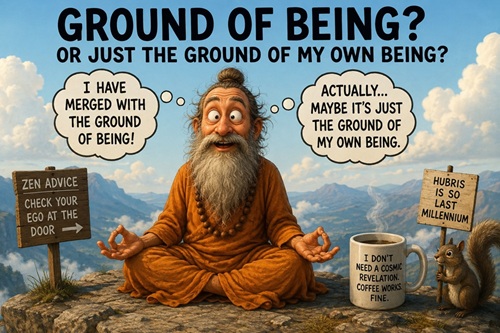
The Mystic's Most Dangerous LeapMystics across cultures have reported experiences in which the ordinary distinction between self and world seems to disappear. There may be a profound sense of unity, timelessness, boundlessness, presence, or absolute reality. The experience can feel more real than ordinary consciousness. Some mystics describe it as an encounter with God; others as Brahman, the Tao, the Absolute, pure consciousness, emptiness, or—as modern philosophical and theological language often puts it—the “Ground of Being.” The experience itself is difficult to dispute. Something happens. It can be extraordinarily powerful, transformative, and psychologically consequential. The more controversial question is what the experience tells us about reality. Here a subtle but consequential leap often occurs. The mystic experiences something that feels like the ultimate ground of reality and concludes that he or she has encountered the ultimate ground of reality. But there is another interpretation that requires considerably fewer metaphysical assumptions: perhaps the mystic has encountered the ground of his or her own being. That is not a dismissal of mystical experience. Quite the contrary. It may be a way of taking the experience more seriously while making fewer claims about what lies beyond it. Experience Is Not the Same as InterpretationThere is an important distinction between phenomenology and metaphysics. Phenomenologically, a person may experience the dissolution of the ordinary boundary between self and world. The sense of being a separate individual may become extremely attenuated or temporarily disappear. There may be an overwhelming impression of unity or of consciousness without an identifiable object. Metaphysically, however, one can then ask: what does this experience demonstrate? That second question does not have an obvious answer. If I experience an overwhelming sense of unity, the experience establishes—at least for me—that I have experienced an overwhelming sense of unity. It does not automatically establish that the universe itself is literally One, that consciousness is fundamental to the cosmos, or that I have accessed some transpersonal metaphysical reality. The distinction is familiar in other areas of human experience. A dream can be completely real as an experience without the events represented in the dream having occurred in the external world. An optical illusion is a genuine perceptual event without the perceived object necessarily being what it appears to be. The point is not that mystical experiences are “illusions.” That conclusion would go well beyond the evidence. The point is that the phenomenological certainty of an experience should not be confused with metaphysical certainty about its interpretation. This distinction becomes especially important when mystical experience is transformed into a comprehensive worldview. What Does “Ground of Being” Actually Mean?The language itself encourages the confusion. “Ground of Being” sounds as though one has discovered something underneath or behind ordinary reality. In theological philosophy, particularly in Paul Tillich, the phrase has a more sophisticated meaning: God is not simply another entity within the universe but the ontological ground that makes existence possible. Ken Wilber frequently moves in a similar direction. His descriptions of nondual realization, Spirit, Kosmos and the ultimate ground of reality encourage the idea that certain extraordinary states of consciousness provide privileged access to the deepest structure of existence. But there is an intriguing alternative reading. What if the “ground” encountered in mystical consciousness is not the ontological foundation of the cosmos but the phenomenological foundation of the subject? In ordinary consciousness, we experience ourselves as a particular person: with a name, biography, memories, intentions, emotions and social identity. Beneath this narrative self there are more fundamental layers of bodily sensation, perception, affect, attention and consciousness. If some of the higher-level structures of selfhood become quiet, what remains can feel extraordinarily fundamental. From the inside, this can quite reasonably be experienced as “ground.” But ground of what? Perhaps ground of experience. That is a much more modest claim than “ground of Being,” but it may actually fit the experience better. The Brain Has Something to Say About ItModern neuroscience does not possess a “mystical experience center” in the brain. The evidence points instead to interactions among multiple neural systems. An early fMRI study of Carmelite nuns instructed to recall their mystical state of union with God found changes involving medial prefrontal, anterior cingulate, insular, temporal and parietal regions, among others. The important finding was not that one particular “God spot” had been discovered, but that mystical experience involved a distributed network of brain processes. This makes intuitive sense. Mystical experience simultaneously involves perception, emotion, bodily awareness, attention, memory, self-representation and meaning. There is no reason to expect such a complex phenomenon to reside in one small brain region. One particularly interesting candidate is the brain's default mode network (DMN). This distributed network includes medial frontal, temporal and parietal association areas and is involved in functions such as autobiographical memory, imagining the future, social cognition and forms of internally oriented thought. In other words, some of the machinery involved in constructing and maintaining our ordinary personal perspective is precisely the machinery that becomes interesting when that perspective changes. The Self Is a Construction—and It Can Become QuietNeuroscience increasingly treats the ordinary sense of self not as a single thing located somewhere in the brain, but as a dynamic achievement of multiple interacting systems. Neuroimaging research has consistently implicated cortical midline structures in self-referential processing—the processes through which experiences, thoughts and perceptions are related to “me.” This does not mean that the self is unreal. It means that the self we ordinarily experience is constructed through ongoing neural activity. And constructed does not mean imaginary. A city is constructed. A language is constructed. A personality is constructed. Yet all are real in the appropriate sense. The same applies to the self. This gives us an intriguing way of understanding mystical states. If the ordinary machinery supporting autobiographical and self-referential processing is substantially altered, the familiar boundaries of the self can weaken. The result may be experienced not as “my brain is processing information differently” but as “I have discovered what consciousness really is.” That difference is crucial. Ego Dissolution Is Not the Discovery of Cosmic ConsciousnessMeditation and psychedelic experiences provide particularly interesting evidence here. Both can produce profound changes in self-consciousness, including what researchers call “ego dissolution.” Research comparing psychedelic and meditative states has specifically examined the disruption of ordinary self-experience and its neural correlates. Classic psychedelics such as psilocybin and LSD can reliably produce experiences that participants describe as mystical, including unity, transcendence and diminished self-boundaries. These experiences can also have lasting psychological consequences. This presents a fascinating philosophical problem. Suppose the experience of losing one's ordinary ego is interpreted as discovering universal consciousness. Why should that interpretation automatically follow? The neurological evidence is equally compatible with a more cautious formulation: the brain's normal mechanisms for constructing a bounded individual perspective have temporarily been reorganized. The resulting consciousness may feel infinite because the usual cognitive boundaries that define “me” have become less prominent. That is profoundly interesting. But infinity experienced from within is not necessarily the same thing as infinity existing outside the experiencer. The Predictive BrainPredictive-processing theories make the issue even more interesting. On contemporary models, the brain does not simply passively receive an objective world. It continuously constructs models of the world and of the organism within it, integrating sensory information with expectations, memories and prior beliefs. A major review of the neurocognitive basis of religious and spiritual experience has proposed predictive processing as a framework connecting several phenomena, including religious visions, ecstatic experiences, self-transcendence and supernatural beliefs. This does not mean that the brain simply “makes up God.” That would be an equally crude metaphysical conclusion in the opposite direction. Rather, it means that every human experience of reality is mediated by biological systems that construct an experienced world. The mystic therefore cannot step outside mediation and inspect reality “as it really is.” The mystical state is itself an event occurring within an embodied nervous system. This is precisely why the distinction between experience and interpretation matters. The Strange Case of the Brain InjuryOne of the more provocative pieces of evidence comes from neurological patients. A 2016 study of Vietnam veterans with penetrating traumatic brain injuries found that lesions involving frontal and temporal regions were associated with increased mystical experience. Particularly striking was the finding that damage involving the dorsolateral prefrontal cortex was associated with greater reported mysticism. The authors interpreted this as evidence that executive functioning normally contributes to the down-regulation of mystical experiences. This does not mean that mysticism is brain damage. It does, however, undermine the simple picture in which mystical experience is necessarily the result of the brain accessing a higher metaphysical reality. Alter the brain, and the propensity for extraordinary religious experience can change. That observation should make us cautious about treating the contents of such experiences as straightforward revelations about the external universe. Even the “Presence” Can Be ConstructedNeuroscience has also demonstrated how readily the sense of self can be manipulated. Out-of-body experiences, for example, involve alterations in the normal integration of bodily position, visual perspective and self-location. Research has linked such experiences to neural systems involved in multisensory integration, particularly around the temporoparietal junction. This is significant because the experience can be extraordinarily convincing. A person can feel that “I” am somewhere other than where my body actually is. The lesson is not that subjective experience is worthless. It is that subjective conviction is not a reliable guarantee of the metaphysical interpretation attached to an experience. The brain can generate a remarkably compelling sense of presence, absence, unity, disembodiment and transcendence. Consequently, the question “What did the mystic experience?” and the question “What exists beyond the experience?” must be kept separate. The Mountain, the Cave and the LaboratoryThere is another intriguing lesson from the history of mystical experience: radically different circumstances can produce surprisingly similar phenomenology. Mystical and revelation experiences have been associated with meditation, sensory deprivation, extreme environments, sleep disruption, epilepsy, psychedelics and other altered states. Researchers have even explored how high-altitude hypoxia and changes involving temporoparietal and prefrontal systems might contribute to unusual experiences historically associated with mountains and revelations. This does not reduce Moses, Meister Eckhart, Ramana Maharshi or a contemporary meditator to a neurological mechanism. It does suggest that human brains have multiple routes into states characterized by transcendence, presence, unity and altered selfhood. The laboratory has therefore become an unexpected partner to comparative mysticism. Instead of asking only what different traditions say their experiences mean, neuroscience can ask what different experiences have in common at the level of cognition and brain dynamics. That is a potentially revolutionary shift. From Cosmic Revelation to First-Person DiscoveryPerhaps the most interesting possibility is therefore neither reductionism nor supernaturalism. The reductionist says: “It is only the brain.” The mystic may say: “It is the ultimate reality.” Both formulations risk jumping beyond what the evidence establishes. A third position is available: “It is an extraordinary transformation in the way consciousness experiences itself, produced by the interaction of brain, body, mind, attention, culture and circumstance. What it ultimately tells us about reality remains an open question.” This position does not diminish mystical experience. It relocates its significance. The mystic may indeed have discovered something profound—but perhaps the first discovery concerns the depth and plasticity of human consciousness itself. The “ground” may be the point at which the familiar narrative construction of the person becomes transparent and more basic processes of consciousness become experientially accessible. That is already astonishing. The Humility PrincipleThere is also an ethical advantage to this interpretation. If I believe that I have encountered the Ground of Being itself, I can easily conclude that my subsequent beliefs possess an authority unavailable to ordinary people. My experience becomes revelation. My interpretation becomes metaphysics. And my metaphysics can become doctrine. This is where mystical insight can turn into spiritual hubris. The history of religion contains countless examples of people who claimed privileged access to ultimate truth. The problem is not necessarily that their experiences were insincere. They may have been among the most sincere experiences of their lives. The problem is the inference from: “I experienced something extraordinarily deep” to: “Therefore I know what ultimate reality is.” The second statement simply does not follow from the first. Interpreting mystical experience as contact with the “ground of one's own being” introduces a useful epistemic humility. It preserves the profundity of the experience while acknowledging the limitations of the experiencer. It says: this may be as deep as human consciousness can go. It does not say: therefore I have seen behind the curtain of the universe. What About Wilber?This distinction poses a particularly interesting challenge to Ken Wilber's integral framework. Wilber is right to insist that states of consciousness matter. He is also right that contemplative traditions should not be dismissed merely because their experiences are difficult to accommodate within conventional scientific models. But the move from contemplative phenomenology to an ontology of Spirit requires additional philosophical argument. A person may experience nonduality. That does not by itself establish metaphysical nonduality. A person may experience timelessness. That does not establish that ultimate reality is timeless. A person may experience pure consciousness. That does not establish that consciousness is the fundamental substance of the universe. And a person may experience what seems like the ground of Being without thereby establishing that he or she has encountered the ground of Being. This is precisely where an integral approach should become more—not less—scientifically sophisticated. The scientific study of mystical experience does not have to destroy the mystery. It can help us distinguish the mystery of consciousness from the stories we tell about its ultimate metaphysical meaning. The Ground Beneath the GroundThere is perhaps an irony here. The mystic traditionally seeks to transcend the limited ego and discover something more fundamental. Neuroscience may encourage us to take that quest in a different direction—not outward toward a cosmic metaphysical substance, but inward toward the architecture of experience itself. Beneath the autobiographical self lies a complex network of processes. Beneath the narrative ego lies embodiment. Beneath conceptual thought lies perception, affect, attention and interoception. And beneath our ordinary sense of being a separate individual lies an even deeper mystery: why should any of these processes be accompanied by subjective experience at all? That question remains open. Indeed, neuroscience may ultimately make mystical experience more fascinating, not less. It reveals that the apparently solid structure of the self is surprisingly malleable. It shows that the brain can generate radically different modes of selfhood. It demonstrates that experiences of unity, transcendence and presence have identifiable biological correlates without thereby explaining away their subjective significance. The mystic may therefore have touched a genuine “ground.” But perhaps the safest formulation is that the mystic has touched the ground of his or her own being—the deepest level of human experience currently accessible to that person. Whether that ground is also the Ground of Being is a further metaphysical hypothesis. And that distinction may be exactly what protects mystical experience from becoming mystical hubris. The experience can remain profound. The mystery can remain intact. Only the claim to possess the universe's final explanation has been surrendered. Appendix: From Metaphysical Realms to Experiential PhenomenaThe same epistemic caution applies to some of the familiar vocabulary of contemporary spirituality, particularly terms such as “subtle,” “causal,” and “nondual.” In integral discourse, these words are often presented as if they designate distinct ontological domains or levels of reality. A more defensible interpretation is that they describe recurring features of human experience. “Subtle,” for example, need not refer to an objectively existing subtle realm populated by energies, entities or higher-dimensional structures. It can simply designate a class of experiences that differ from ordinary waking perception: vivid imagery, visionary experiences, dream states, altered bodily sensations, unusual affective states, intuitive impressions, or experiences of presence. These phenomena are real as experiences without requiring us to posit a separate subtle universe behind them. The same applies to the “causal” domain. In Wilber's usage, causal consciousness is associated with deep formless awareness, often encountered in dreamless sleep, profound meditation or other states in which ordinary mental contents recede dramatically. Rather than treating “the causal” as a metaphysical layer of the Kosmos, we could understand it as a phenomenological category: experiences characterized by an attenuation of perceptual and conceptual content, a profound sense of stillness, or awareness without clearly differentiated objects. “Nondual” is perhaps the clearest case. Nonduality need not be the name of an ultimate cosmic condition. It can describe a particular transformation in the structure of experience in which the usual subject-object distinction becomes attenuated or disappears. There is no longer an experienced observer standing over against an experienced world. Everything may appear as one seamless field of experience—or, more radically, the distinction between “experience” and “experiencer” may itself become difficult to sustain. That is already extraordinary. We do not need to turn it into a metaphysical geography. This phenomenological interpretation also helps explain why similar experiences can occur within radically different religious traditions. A Buddhist may interpret a nondual experience through the language of emptiness; an Advaita Vedantist may interpret it as realization of Brahman; a Christian contemplative may describe union with God; a secular meditator may describe the disappearance of the boundary between self and world. The phenomenology may overlap considerably while the metaphysical interpretations differ dramatically. This raises an important question: which comes first, the experience or the conceptual framework through which it is understood? The answer is probably both. Human beings never encounter experience in a completely culture-free conceptual vacuum. Expectations, practices, vocabulary and prior beliefs can influence attention and interpretation. Contemporary research on predictive processing makes such interactions increasingly plausible: perception itself is not simply the passive reception of information but involves the brain's ongoing construction and updating of models. This does not mean that religious traditions merely manufacture their experiences. It means that experience and interpretation are intertwined. Consequently, integral terminology might be made considerably more precise by treating “subtle,” “causal” and “nondual” as phenomenological descriptors rather than ontological claims. Instead of saying, “The practitioner has entered the subtle realm,” we could say, “The practitioner is experiencing a visionary or otherwise altered mode of consciousness.” Instead of saying, “The practitioner has entered the causal domain,” we could say, “The practitioner is experiencing a profound reduction of differentiated mental content.” Instead of saying, “The practitioner has realized the Nondual,” we could say, “The practitioner is experiencing a temporary or sustained attenuation of subject-object differentiation.” This may sound like a loss of spiritual grandeur. In fact, it accomplishes the opposite. It gives us a more precise vocabulary for describing what actually happens. And there is an important philosophical advantage. Once these terms are treated as descriptions of phenomena rather than names for metaphysical territories, they become available for comparative investigation. Neuroscience, psychology, phenomenology and contemplative studies can investigate them without first having to accept the cosmology of the tradition that supplied the terminology. The resulting picture is potentially much richer than the traditional hierarchy. Instead of a ladder of increasingly “real” worlds—gross, subtle, causal, nondual—we get a multidimensional landscape of possible human experiences. Some concern sensory and imaginal content; others concern bodily awareness; others involve emotion, cognition, self-reference or the structure of consciousness itself. There is no requirement that these dimensions form a single cosmic hierarchy. This also fits the central argument of the main essay. If the mystic's “Ground of Being” can plausibly be understood as the deepest ground of his or her own experience, then the vocabulary used to describe mystical states should likewise be anchored in what can actually be experienced. The crucial distinction is therefore not between “spiritual” and “scientific” language. It is between phenomenological language and premature ontology. We can preserve the words. We can preserve the experiences. We can even preserve the mystery. What we should be more cautious about is turning the map into a territory—and then claiming that the person who has mastered the map has thereby discovered the architecture of the universe.
Widget is loading comments...
|