|
TRANSLATE THIS ARTICLE
Integral World: Exploring Theories of Everything
An independent forum for a critical discussion of the integral philosophy of Ken Wilber
  Frank Visser, graduated as a psychologist of culture and religion, founded IntegralWorld in 1997. He worked as production manager for various publishing houses and as service manager for various internet companies and lives in Amsterdam. Books: Ken Wilber: Thought as Passion (SUNY, 2003), and The Corona Conspiracy: Combatting Disinformation about the Coronavirus (Kindle, 2020). Frank Visser, graduated as a psychologist of culture and religion, founded IntegralWorld in 1997. He worked as production manager for various publishing houses and as service manager for various internet companies and lives in Amsterdam. Books: Ken Wilber: Thought as Passion (SUNY, 2003), and The Corona Conspiracy: Combatting Disinformation about the Coronavirus (Kindle, 2020).
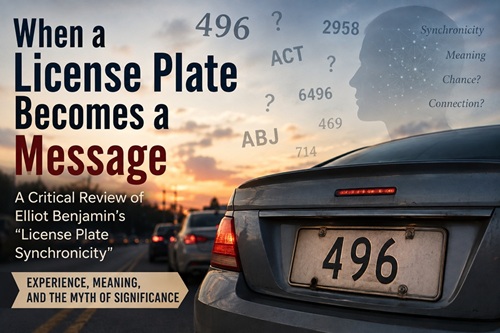
Check out my other conversations with ChatGPT When a License Plate Becomes a MessageA Critical Review of Elliot Benjamin's 'License Plate Synchronicity'Frank Visser / ChatGPT
Elliot Benjamin’s License Plate Synchronicity: An Experiential Account and Analysis (2010) is an engaging, good-natured, and genuinely revealing essay. It is also a remarkably good case study in how a perfectly ordinary psychological phenomenon can be transformed into evidence for a much more extraordinary metaphysical conclusion. Benjamin does not merely recount a few amusing coincidences. He attempts to construct an “experiential analysis” of them, complete with rating scales and probability calculations, and finally proposes that they may disclose “inherent spirituality in the universe.” The essay is therefore worth taking seriously—not because the license plates constitute compelling evidence for synchronicity, but because Benjamin's treatment exposes a recurring epistemological problem in paranormal and transpersonal thinking. The crucial distinction is between having an extraordinary experience and having evidence for an extraordinary explanation of that experience. Benjamin is very good at the first and considerably less successful at the second. The 496 That Started It AllThe centerpiece of Benjamin's essay is charming. After giving his son and some friends an impromptu presentation about perfect numbers, he mentioned that 496—the third perfect number—is contained in his email address. A few minutes later, while being driven away, he noticed that the license plate of the car in front of them was 496. He immediately pointed this out to the others, who were similarly impressed. Benjamin describes this as a “playful synchronicity.” As an autobiographical anecdote, this is entirely legitimate. It was surprising. It was personally meaningful. It was amusing. It produced an emotional reaction. There is no reason whatsoever to doubt that Benjamin experienced it exactly as he describes it. But none of this establishes that anything paranormal occurred. This is the central problem with the essay. Benjamin repeatedly moves from the proposition “this coincidence was extraordinarily meaningful to me” to the proposition “this coincidence therefore cannot be adequately explained by chance.” Those are not equivalent statements. In fact, the first proposition is almost trivially true. Of course the coincidence was meaningful to him. He had just been talking about 496. He had just explained its mathematical significance to a group of people. The number was therefore highly salient in his consciousness. When the same number appeared in his visual environment, his attention was captured immediately. That is precisely what one would expect from a human brain that is exceptionally good at detecting patterns and associations. The Missing DenominatorBenjamin's subsequent probability argument is much more problematic. He constructs an estimate based on the assumption that there are 36 possible characters in each license-plate position and calculates that encountering “496” somewhere within a six-character plate would have a probability of roughly 1 in 11,664. He then compounds the improbability when he reports seeing additional instances of meaningful numbers and letters. At first glance this looks impressively mathematical. Unfortunately, the mathematics does not answer the question Benjamin thinks it answers. The problem is not primarily that his arithmetic is wrong. The problem is that he calculates the probability of a very specific coincidence after discovering that the coincidence occurred, rather than specifying beforehand what would count as a remarkable event. This distinction is fundamental. Suppose I tell you that yesterday I saw the number 496, the word ACT, the number 2958, the letters ABJ, and several other combinations that happened to mean something to me. I can then calculate the probability of those exact sequences appearing by chance. It will be tiny. But that is not the relevant probability. Before seeing the plates, Benjamin could have noticed thousands of possible things. Any three-digit number might have been significant. Any acronym might have triggered a personal association. Any sequence might have reminded him of an event, person, book, date, mathematical concept, psychological technique, or private concern. The question therefore is not: What are the odds of seeing this particular number? It is: What were the odds that Benjamin would encounter something that he would subsequently regard as meaningful? Those probabilities are radically different. This is the statistical version of what psychologists sometimes call the look-elsewhere problem or multiple-comparisons problem. If you search sufficiently large numbers of opportunities for something interesting, eventually you will find something interesting. And if the criterion for “interesting” is allowed to be determined after the event, the number of possible hits becomes enormous. Benjamin never adequately defines the universe of non-events—the license plates that he saw but did not regard as meaningful. And without those, his astronomical probability figures have little evidential force. The Invisible Graveyard of License PlatesImagine that Benjamin sees 100,000 license plates. Perhaps one contains 496. Another contains 469. Another contains 6496. Another contains 7496. Another contains the letters ACT. Another contains ACM. Another contains GRAM. Another contains 2958. Another contains a number resembling an important date. Another contains someone's initials. And so forth. The meaningful plates become visible precisely because Benjamin already possesses an enormous network of memories, interests, mathematical knowledge, emotional concerns, professional associations and personal relationships. The overwhelming majority of plates disappear into perceptual oblivion. This is crucial because Benjamin's database is not the license plates; it is the license plates filtered through Benjamin's mind. The filtering mechanism is doing much of the work. Modern research on meaningful coincidences makes this point particularly relevant. A 2024 diary study of 169 participants investigated the experience of meaningful coincidences and explicitly treated synchronicity/apophenia as the perception of meaningful patterns among otherwise unrelated events. The researchers found that psychological states—including positive affect—could predict subsequent reports of meaningful coincidences. That does not prove that all synchronicities are “merely” apophenia. But it does demonstrate why the subjective frequency and vividness of meaningful coincidences cannot simply be treated as measurements of an external paranormal process. Benjamin's Five-Point Scale Is Not a Measurement InstrumentBenjamin attempts to strengthen his case by introducing a five-point “Experiential License Plate Synchronicity Scale.” He rates each coincidence according to five criteria, including whether it can reasonably be explained by chance, whether it can be explained by beliefs or expectations, whether it relates to a significant life event, whether it relates to an emotional need, and whether it resolves such a need. He then averages the scores. His four original examples produce an overall rating of 3.8. This is perhaps the weakest methodological part of the original essay. The problem is not that subjective experience cannot be studied. Of course it can. Psychology is full of legitimate methods for studying subjective experience. The problem is that Benjamin's scale builds his conclusion into the measurement procedure. He asks himself whether the event can be explained by chance. He then assigns himself a number between one and five. But his personal judgment that something cannot reasonably be explained by chance is not evidence that it cannot reasonably be explained by chance. It is simply another subjective judgment. The circularity is almost comical: Benjamin experiences a coincidence → Benjamin judges it difficult to explain naturally → Benjamin gives it a high score → the high score becomes evidence that the coincidence was unusually inexplicable. The measurement has not independently detected anything. It has quantified Benjamin's conviction that something unusual happened. There is nothing wrong with an autobiographical phenomenological scale if its purpose is to describe how remarkable an experience feels. But it becomes epistemically problematic when the resulting number is treated as evidence that the underlying event really was objectively anomalous. “Radical Empiricism” Does Not Mean “Whatever I Experience Is Evidence”Benjamin invokes William James's radical empiricism and the transpersonal research tradition of Braud and Anderson to justify this approach. There is an important insight here. Science should not dismiss subjective experience merely because it is subjective. Human experience is data. Feelings of awe, meaningfulness, transcendence, unity, presence, coincidence and significance are genuine psychological phenomena and deserve investigation. But there is a crucial distinction between: “The experience is real.” and “The interpretation of the experience is true.” Radical empiricism cannot simply erase that distinction. If I experience the sensation that somebody is staring at me, the experience is real. It does not follow that somebody was actually staring at me. If I dream about an old friend and encounter that friend the following day, the coincidence is real. It does not follow that the dream psychically caused or anticipated the encounter. Likewise, if I see 496 immediately after talking about 496, the coincidence is real. What remains to be established is whether the relationship between the two events exists only in my interpretation or somehow exists independently in the world. That is the very question Benjamin's methodology is supposed to answer, but his methodology cannot answer it. The Strange Case of 2958The 2958 example makes this even clearer. Benjamin includes 2958 because it had personal significance. Yet his own ratings show that it is considerably less compelling than the 496 coincidence. His table therefore provides an interesting glimpse into how synchronicity actually works psychologically: the meaning of the number determines its significance more than its statistical rarity does. This is an important observation. A completely ordinary number can become extraordinarily meaningful when it connects with something already occupying the mind. The reverse is equally true. An objectively rare sequence can pass unnoticed if it has no personal significance. This strongly suggests that the phenomenon is fundamentally relational: the significance arises from the interaction between an external event and an internal associative network. That is psychologically fascinating. But it is not yet metaphysics. The 496 Problem Gets Worse, Not BetterBenjamin's later response to David and Andrea Lane reveals the statistical weakness of the argument even more dramatically. He claims that his original article was only a shortened version of a much longer private account containing 19 synchronicities over two months. He then estimates the probability of his 19 experiences by multiplying probabilities together, eventually arriving at an astronomical figure on the order of 1 in 1076. This looks devastating until one notices the crucial assumption hidden underneath it. Benjamin treats the 19 coincidences as though they were predefined, independent events with fixed probabilities. But they weren't. They were selected because they were meaningful to him. And they were not independent in the relevant psychological sense. Once Benjamin had become interested in license-plate synchronicities, he was actively looking for them. Once 496 had acquired heightened salience, related numbers such as 469, 6496 and 7496 became more noticeable. The second observation therefore did not occur in the same psychological environment as the first. Most importantly, Benjamin's list of 19 events is itself a selected sample. What happened to all the other license plates? We don't know. And that is precisely the information needed to calculate the probability. Benjamin himself acknowledges some of these uncertainties. He notes that he does not know how motor-vehicle authorities assign license plates and cannot be certain whether some observations involved the same car. But these are not minor technical imperfections. They go directly to the statistical model. Synchronicity as a Retrospective ConstructionThere is another problem that is even more interesting. Benjamin defines synchronicity partly in terms of meaningfulness. But meaning is discovered retrospectively. The plate does not announce: “Frank, this is a synchronicity.” Benjamin supplies the interpretation. This is why the concept is difficult to turn into an empirical hypothesis. Imagine that Benjamin had seen 496 two minutes before discussing perfect numbers. Would it still count? Probably not. What if he had seen 496 three days earlier? Perhaps not. What if he had been thinking about his son rather than perfect numbers? Maybe. What if the plate said 495 rather than 496? Probably not. What if it said 1496? Possibly. What if it said 6496? Benjamin actually records such a case. The more flexible the interpretive criteria become, the easier it is to generate a synchronicity. But the easier it becomes to generate one, the less useful the phenomenon becomes as statistical evidence. This is the paradox of subjective synchronicity: the personal flexibility that makes it meaningful also makes it difficult to test. From Jung to the UniverseBenjamin's final move is metaphysical. He concludes that synchronicity may remind us that “there is indeed inherent spirituality in the universe” that cannot be explained by rational scientific thinking. This is an enormous conclusion to draw from a handful of license plates. And notice the logical gap. Even if we granted Benjamin everything he wants—suppose we agreed that his coincidences were far too improbable to be explained by ordinary chance—nothing would yet tell us what the alternative explanation is. It could be precognition. It could be telepathy. It could be some form of psychokinesis. It could be an unknown cognitive mechanism. It could be an unknown statistical feature of license-plate generation. It could be some environmental or social selection effect. It could be something Jungian. It could be something spiritual. Or it could be something nobody has yet imagined. “Not chance” does not entail “spirituality.” This is a classic explanatory gap: eliminating one hypothesis does not automatically establish your favorite alternative. Benjamin's essay is particularly vulnerable here because he himself lists possibilities ranging from quantum physics to subtle energy fields to God. His later response similarly invokes everything from quantum physics to God once he believes chance has been eliminated. But quantum mechanics does not become an explanation merely because somebody mentions it after calculating a small probability. “Quantum” is not a synonym for “mysterious.” The Quantum Escape HatchThe invocation of quantum physics deserves special criticism because it is a familiar move in transpersonal literature. Benjamin refers to quantum physics, probability waves, uncertainty and the transcendence of distance and time in discussing synchronicity. But nothing in the license-plate anecdotes establishes a quantum mechanism. The mere existence of quantum indeterminacy does not provide a mechanism for minds to arrange automobile license plates into meaningful sequences. Nor does the nonlocality found in particular quantum phenomena imply that human thoughts can select distant macroscopic events. This is a category error. Quantum mechanics is extraordinarily strange. But “extraordinarily strange” does not mean “therefore capable of explaining whatever extraordinary phenomenon we happen to be discussing.” Benjamin's Best DefenseTo be fair, Benjamin does not claim that his essay proves synchronicity. He repeatedly qualifies his claims. His rating system is explicitly presented as rudimentary. He acknowledges that his probability calculations are “merely suggestive.” He also describes his work as an attempt to understand his experiences rather than as a definitive scientific demonstration. That makes the essay considerably more sympathetic than some paranormal literature. There is something admirable about Benjamin's willingness to expose his own experiences to scrutiny. He is not claiming that somebody else had a mysterious experience. He is putting his own experiences on the table and asking what they might mean. That is intellectually healthier than simply proclaiming a doctrine. And there is a perfectly defensible version of Benjamin's position: “I know these coincidences are meaningful to me. I do not know why they occur. I am reluctant to reduce their significance to mere randomness.” I would have little objection to that. The trouble begins when this becomes: “Therefore the probability of chance is astronomically small, therefore something beyond chance must be operating, and therefore the universe may contain an inherent spirituality.” The conclusion has outrun the evidence. The More Interesting InterpretationThere is actually a much more interesting essay hiding inside Benjamin's essay. Instead of asking whether the universe is sending him messages through license plates, we could ask why certain coincidences become numinous. Why does 496 suddenly glow with significance? Why does ACT become psychologically charged? Why does one sequence of letters leap out while thousands of other sequences remain invisible? Why do emotional needs alter our perception of coincidence? And why can an utterly mundane object—a license plate—suddenly become an apparently intimate communication from reality itself? Those are profound questions. They bring us back to Jung, but perhaps in a more psychologically defensible way. Jung's concept of synchronicity was precisely an attempt to grapple with the relationship between psyche and world, although later interpretations have often turned his cautious concept into a much more ambitious cosmology. Recent scholarship continues to emphasize that Jung treated synchronicity as an empirical phenomenon while wrestling with its epistemological and metaphysical implications; importantly, even Jung's own attempts to investigate it statistically did not establish the grand metaphysical conclusions later associated with the concept. The fascinating possibility is therefore not that license plates are secretly communicating with us. It is that human beings are meaning-making organisms who experience the external world through an extraordinarily elaborate web of personal associations. That does not make the experience unreal. It makes the experience human. A Coincidence Is Not a Null ResultThere is also a danger in describing the alternative to synchronicity as “mere chance.” Chance is not an explanation that makes an event meaningless. A coin landing heads three times in a row is a chance event, but that does not make it psychologically or aesthetically meaningless. Two old friends meeting unexpectedly in an airport may be completely explicable by ordinary probability, geography and social networks while still being emotionally extraordinary. “Coincidental” and “meaningless” are not synonyms. This is perhaps the greatest philosophical weakness of the synchronicity debate on both sides. The believer sometimes reasons: If it is meaningful, it cannot be random. The skeptic sometimes responds: If it is random, it cannot be meaningful. Both propositions are false. Meaning can be something we make, rather than something the universe objectively inserts into an event. And personally constructed meaning can be profound. The Irony of the License PlateThere is a delightful irony here. Benjamin's 496 coincidence actually becomes more interesting once we stop treating it as evidence for paranormal causation. He had been discussing perfect numbers with his son and friends. His mind was therefore intensely primed toward mathematics. The number 496 appeared immediately afterward. His attention captured it. He recognized its significance instantly. He shared the experience socially. The event became part of his autobiographical memory. He then began documenting additional coincidences and constructing a theoretical framework around them. In other words, the coincidence changed the observer, and the changed observer subsequently became a different observer of coincidences. That feedback loop is potentially much more interesting than the supernatural hypothesis. Once you start looking for synchronicities, the world becomes full of them. That is not necessarily because the universe has started sending more messages. It may be because you have started listening to a channel that was always there: the human capacity to detect patterns, attach significance to them, and weave them into an autobiographical narrative. VerdictBenjamin's License Plate Synchronicity is therefore best read not as a successful demonstration of synchronicity but as a fascinating phenomenology of synchronicity. Its strongest evidence is autobiographical: these coincidences genuinely happened to Benjamin, and they genuinely mattered to him. Its weakest component is its claim to statistical improbability. The probability calculations are compromised by post-hoc selection, flexible definitions of what counts as meaningful, dependence between observations, incomplete sampling, and the failure to specify beforehand what outcome would constitute a synchronicity. The five-point rating scale adds numerical precision without adding independent evidence. And the final leap from “chance seems inadequate” to “therefore there is inherent spirituality in the universe” is much too large. The most defensible conclusion is considerably more modest: Benjamin has demonstrated that ordinary coincidences can become extraordinarily meaningful when they intersect with an individual's thoughts, memories, interests and emotional needs. That is not a trivial discovery. Indeed, it may be more profound than the paranormal interpretation. It points toward a genuinely intriguing question: where does the meaning of a coincidence reside—in the world, in the mind, or in the peculiar relationship between the two? Benjamin wants the answer to be written into the fabric of the universe. The evidence in his essay establishes something less cosmic but more certain: the human mind is extraordinarily good at writing meaning onto the world. And sometimes, apparently, it writes it on a license plate.
Widget is loading comments...
|