|
TRANSLATE THIS ARTICLE
Integral World: Exploring Theories of Everything
An independent forum for a critical discussion of the integral philosophy of Ken Wilber
  Frank Visser, graduated as a psychologist of culture and religion, founded IntegralWorld in 1997. He worked as production manager for various publishing houses and as service manager for various internet companies and lives in Amsterdam. Books: Ken Wilber: Thought as Passion (SUNY, 2003), and The Corona Conspiracy: Combatting Disinformation about the Coronavirus (Kindle, 2020). Frank Visser, graduated as a psychologist of culture and religion, founded IntegralWorld in 1997. He worked as production manager for various publishing houses and as service manager for various internet companies and lives in Amsterdam. Books: Ken Wilber: Thought as Passion (SUNY, 2003), and The Corona Conspiracy: Combatting Disinformation about the Coronavirus (Kindle, 2020).
Check out my other conversations with ChatGPT The Random Number Generator MirageHow Statistical Noise Became Evidence for PsiFrank Visser / ChatGPT
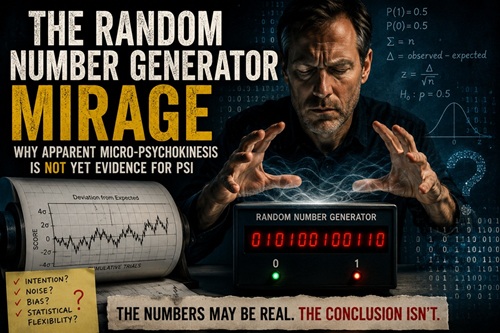
There is something almost irresistibly seductive about a random-number generator. It sits on a laboratory bench, indifferent to human hopes, beliefs, intentions and metaphysical commitments, producing its endless stream of zeros and ones. There are no cards to peek at, no hidden pictures to guess, no ambiguous dreams to interpret, no medium claiming to communicate with the dead. There is simply a machine generating random events. And then someone sits in front of it and tries to make the machine behave differently. Not visibly differently, of course. Nobody expects the machine to jump across the table. The alleged effect is much more modest: perhaps the generator produces 50.0001 percent ones rather than precisely 50 percent. Nothing dramatic happens. Nothing that anyone could see with the naked eye. Only statistics, after millions of trials, supposedly reveal the influence of consciousness. Welcome to the peculiar world of micro-psychokinesis, or micro-PK, where the paranormal has been reduced to a decimal place. The idea has become one of the more respectable-looking forms of parapsychology because it seems to have escaped the weaknesses of traditional psychic research. There is no sensory leakage, because there is supposedly nothing to sense. There is no target that can be guessed. There is no subjective judging of whether a person's response resembles a hidden photograph. Instead, there is a physical machine producing objectively measurable data. That is precisely what makes the argument interesting. It is also what makes the logical leap at its heart so easy to overlook. A statistical anomaly is not the same thing as psychokinesis. And a statistical anomaly certainly is not a theory of consciousness. The Machine That Became a Metaphysical WitnessThe basic experiment is remarkably simple. A random-number generator produces binary events. Under the null hypothesis, each event has an equal probability of being a zero or a one. A participant is instructed to concentrate on producing more ones, or perhaps more zeros. The resulting output is then compared with the statistical expectation. If the participant's intention is associated with a deviation from chance, the deviation becomes the evidence. There is nothing inherently unreasonable about such an experiment. In fact, it is one of the better ways in which a paranormal hypothesis could be formulated. Rather than relying on anecdotes or subjective impressions, the investigator is making a quantitative prediction about an observable physical process. The trouble begins when the result is interpreted. Suppose the machine produces a statistically unusual sequence. What has actually been established? We know that the sequence was unusual relative to the statistical model being employed. We do not yet know why it was unusual. Perhaps the random-number generator was imperfect. Perhaps some physical variable influenced the device. Perhaps the data-processing procedure introduced a bias. Perhaps the statistical model was inadequate. Perhaps the result was a chance fluctuation. Perhaps an unnoticed experimental variable was involved. Perhaps the anomaly is genuine and represents some previously unknown physical phenomenon. And perhaps, eventually, it turns out that human intention really can influence physical systems. That last possibility cannot simply be ruled out in advance. But neither can it be inserted into the argument merely because the investigator happens to find the statistical result intriguing. Yet this is where the rhetoric of psi research often becomes slippery. The anomaly becomes an "effect." The effect becomes "micro-PK." Micro-PK then becomes evidence that consciousness is not reducible to the brain. And from there the argument can quickly migrate into a much larger metaphysical territory involving nonlocal consciousness, subtle dimensions, spiritual evolution and the inadequacy of materialism. A small statistical deviation has somehow become a witness for an entire cosmology. That is quite a burden to place on a zero and a one. The PEAR ExperimentThe most famous chapter in this story is the Princeton Engineering Anomalies Research laboratory, founded by Robert Jahn at Princeton University. For nearly three decades, PEAR investigated whether human intention could influence physical systems, including random-event generators. The importance of PEAR lies partly in the fact that it attempted to turn parapsychology into an engineering discipline. Instead of séances, paranormal anecdotes and spontaneous experiences, Jahn and his colleagues constructed machines and accumulated enormous quantities of data. Participants were asked to influence the output of the generators in predetermined directions. The reported effects were extremely small, but over enormous numbers of trials the researchers argued that the deviations accumulated into a statistically significant pattern. This was a clever move. If the paranormal exists, why not measure it? But there is a danger in confusing the precision of the measurement with the certainty of the interpretation. A highly sophisticated instrument can produce extremely precise measurements of something that has been misunderstood. PEAR's results have remained controversial precisely because the effect sizes were so small and the theoretical implications so large. The statistical deviations were treated as evidence for an anomalous interaction between intention and physical systems. But the further claim—that this interaction was evidence for a nonmaterial causal power of consciousness—required another inferential step. And then another. And another. The history of psi is full of these inferential escalators. An unusual result becomes an anomalous result. An anomalous result becomes psi. Psi becomes evidence for the irreducibility of consciousness. Consciousness then becomes the foundation of a metaphysical picture of reality. The original experiment may have been modest. The conclusions are anything but. The Seductive Authority of StatisticsThere is a psychological reason why RNG experiments have been so successful as a vehicle for paranormal claims. Numbers look objective. If someone says, "I feel that my consciousness influenced the machine," we naturally remain skeptical. But if the same person says that the experiment produced a z-score of 3.2, or that the probability of obtaining the observed result under the null hypothesis was one in several thousand, the claim suddenly sounds scientific. The mathematics is real. The rhetorical conclusion may not be. A p-value tells us how surprising the observed data would be under a specified null model. It does not tell us the probability that psi exists. It does not tell us that consciousness caused the deviation. And it does not tell us that all other explanations have been eliminated. This distinction is particularly important in fields where investigators are searching for very small effects. Imagine running thousands of statistical tests. Some will produce unusual results. That is not evidence that the universe has a supernatural preference for the variables that happened to achieve significance. It is what happens when enough opportunities for significance are created. And the possibilities in an experimental program can be enormous. Researchers can examine different participants, different machines, different time periods, different experimental conditions and different statistical measures. They can investigate whether effects are stronger among believers, among skeptics, among particular individuals, under particular environmental conditions or at particular stages of an experiment. None of these investigations is necessarily dishonest. Each may appear perfectly reasonable after the fact. But when enough analytical possibilities exist, the distinction between discovering an effect and discovering an interesting-looking pattern becomes increasingly difficult to maintain. This is one reason modern science has become so interested in preregistration and independent replication. The question is not simply whether an impressive result can be obtained. The question is whether it can be predicted before it is observed. That is a much harder test. The Quantum AlibiThe use of quantum random-number generators adds another layer of fascination. Quantum mechanics really does contain processes whose outcomes are fundamentally probabilistic according to the standard interpretation. This makes quantum systems excellent sources of randomness. But an extraordinary misunderstanding often creeps into popular discussions of the subject. Quantum mechanics is strange, therefore consciousness can influence quantum events. This does not follow. Quantum theory does not say that consciousness gets to choose among quantum outcomes. It does not say that human intention can reach into a random process and bias it. It does not provide a scientific loophole through which every paranormal hypothesis can enter. The fact that quantum mechanics violates classical intuitions does not mean that anything goes. Indeed, the opposite is closer to the truth. Quantum mechanics is among the most precisely tested theories in the history of science. Its weirdness is not a license for metaphysical improvisation. It is a highly constrained mathematical framework that makes extraordinarily accurate predictions. Calling an RNG "quantum" therefore does not transform it into a consciousness detector. It simply tells us something about the physical source of its randomness. The rest of the argument still has to be made. The Tiny Effect ProblemOne of the most peculiar features of micro-PK research is that the tiny size of the alleged effect is sometimes treated almost as a virtue. Of course the effect is tiny, the argument goes. Consciousness does not simply shove matter around. It operates subtly, at the margins of physical probability. Only sophisticated statistical analysis can reveal its influence. Perhaps. But there is an equally plausible methodological interpretation. The smaller the claimed effect, the more difficult it becomes to distinguish it from everything else that might be going on. Every physical device contains noise. Every electronic system has tolerances. Every laboratory has environmental fluctuations. Every measurement system contains assumptions. Every data-processing pipeline contains choices. If the claimed influence of consciousness is extraordinarily small, then all these factors have to be controlled with extraordinary care. A tiny effect is therefore not automatically impressive. It is potentially fragile. And if the effect disappears when experimental conditions are changed, or when independent researchers repeat the procedure, then the smallness of the original effect may have been telling us something important after all. Perhaps it was not a new force. Perhaps it was simply a small artifact. The File Drawer ProblemThen there is the old problem of publication bias. Suppose a hundred laboratories conduct RNG experiments. Ninety-five obtain results that are perfectly compatible with chance. Five obtain unusual positive results. Which studies are most likely to attract attention? The five positive ones. They are interesting. They generate papers. They generate discussion. They become candidates for meta-analysis. The ninety-five boring studies may never become visible. This is the notorious file-drawer problem, and it is not unique to parapsychology. Psychology, medicine and many other sciences have struggled with it. But in psi research it is particularly important because the alleged effects are so small. A field can accumulate an impressive literature without necessarily accumulating an equally impressive body of independent evidence. The response from parapsychology has often been that the cumulative statistical evidence is too large to dismiss as chance. But this can become circular. If the published literature contains a disproportionate number of positive studies, a meta-analysis can confirm precisely the bias that produced the literature in the first place. The larger the published database becomes, the more impressive the cumulative effect can appear. Yet the missing studies remain missing. A mountain of published evidence does not automatically tell us the size of the invisible mountain of unpublished evidence underneath it. When Anomaly Becomes OntologyThis is where the RNG debate becomes especially relevant to Integral Theory. The attraction of psi to integral thinkers is understandable. If consciousness can exert a causal influence on physical systems, then the familiar materialist picture of consciousness as nothing more than a product of neural processes becomes less convincing. That would be philosophically significant. But even if RNG experiments eventually establish a genuine anomalous effect, they would not by themselves establish the integral worldview. They would establish an anomaly. Perhaps the anomaly would force us to rethink the relationship between consciousness and matter. That would certainly be important. But there would still be an enormous distance between that conclusion and the claim that reality consists of evolving levels of consciousness, that consciousness is fundamentally primary, that spiritual development follows a hierarchical trajectory, or that some particular integral model has correctly mapped the Kosmos. This is where integral discourse can sometimes become too eager to recruit empirical anomalies into an existing metaphysical framework. The argument can become: Materialism cannot explain psi. Therefore consciousness is fundamental. Therefore spiritual realities are real. Therefore the integral map is vindicated. But the first premise would need to be extraordinarily secure before the rest of the chain could even begin. And the first premise is precisely what remains in dispute. An unexplained result is not necessarily evidence for the explanation we find most philosophically attractive. It is simply unexplained. That is a much more uncomfortable position. It is also a much more scientific one. The Replication TrapUltimately, the question is brutally simple: can independent researchers reproduce the effect? Not merely the original investigators. Not laboratories that share their theoretical commitments. Not researchers who already believe that psi exists. Independent researchers. The distinction matters because experimental psychology has repeatedly demonstrated how difficult it can be to reproduce surprising findings. Expectations, subtle methodological differences, analytical choices and statistical flexibility can all influence outcomes. Psi research faces the same problem, but with an additional complication. When a replication fails, it can always be argued that the conditions were somehow inappropriate. Perhaps the experimenters were skeptical. Perhaps the participants lacked motivation. Perhaps the laboratory environment was psychologically hostile. Perhaps the machine was unsuitable. Perhaps the experiment was too formal. Perhaps the effect is inherently unstable. Any one of these possibilities might conceivably be true. But collectively they create a serious scientific problem. If successful psi requires precisely the right combination of participant, experimenter, machine, psychological state, environmental atmosphere and experimental protocol, then demonstrating its existence becomes almost impossible independently of the researchers' own judgments about what constitutes a "good" psi experiment. The hypothesis begins to acquire an escape hatch for every failed prediction. And that is dangerous territory. A scientific theory should not merely explain successful experiments. It should expose itself to failure. What Would Actually Convince a Skeptic?The answer is not complicated. Conduct a large preregistered experiment across multiple laboratories. Specify the statistical analysis in advance. Characterize the random-number generators independently. Fix the stopping rule. Blind the analysis. Publish the raw data. Include unsuccessful sessions. Allow skeptics and believers to participate in the design. Then repeat the entire experiment independently. If a small but unmistakable deviation appears again and again, under conditions in which ordinary methodological explanations have been systematically eliminated, the scientific community should take notice. At that point, the argument would become genuinely fascinating. Perhaps consciousness really can influence physical probability. Perhaps there is a previously unknown interaction between mind and matter. Perhaps our current conception of causation is incomplete. Perhaps something much stranger is happening. The point is not to prevent such conclusions. The point is to earn them. That distinction is important because skepticism is sometimes caricatured as a refusal to consider extraordinary possibilities. Genuine skepticism is almost the opposite. It is a refusal to claim that an extraordinary possibility has been demonstrated before the evidence warrants it. If psi is real, skepticism should ultimately help it. A genuine effect does not need sympathetic statistics forever. It needs replication. A genuine effect does not need metaphysical rhetoric. It needs independent measurement. A genuine effect does not need believers to protect it from skeptics. It needs to survive skeptics. That is the standard by which every revolutionary scientific claim has eventually succeeded. The Random Number Generator as Rorschach TestPerhaps the deepest irony of the RNG debate is that the machine has become something of a Rorschach test for the investigators themselves. The skeptic sees a statistical anomaly and asks what went wrong. The believer sees the same anomaly and asks what new force has been discovered. The materialist sees a problem to be explained within physics. The idealist sees a crack in materialism. The integral theorist sees an opening through which consciousness can be restored to the center of the Kosmos. But the machine itself says none of these things. It merely produces numbers. That is why the distinction between data and interpretation matters so much. The data may eventually force us to revise our worldview. But we should not revise the data to fit our worldview. This is particularly important for an integral approach to knowledge. If Integral Theory is supposed to overcome the limitations of narrow materialism, it should not replace one dogmatism with another. It should be capable of holding empirical uncertainty without immediately converting every anomaly into spiritual confirmation. Otherwise "integral" becomes merely another word for believing that reality agrees with us. The Paranormal Needs Less Metaphysics and More ScienceThe original attraction of random-number generators was that they seemed to offer parapsychology an escape from the anecdotal and the subjective. They promised a machine that could settle the matter. But the machine has not settled it. Instead, it has generated a vast and fascinating argument about statistics, experimental design, publication bias, replication and the interpretation of anomalous results. That is already worthwhile. Perhaps there is something genuinely strange in the data. Perhaps there isn't. The point is that we should resist the temptation to answer the question prematurely. The distance between "something unusual happened" and "consciousness influenced a quantum system" is enormous. The distance between that claim and "consciousness is fundamental to the Kosmos" is larger still. And the distance between that conclusion and a fully developed spiritual-evolutionary worldview is positively astronomical. The RNG cannot carry us across those distances. At most, it can give us a place to start asking questions. That may be less exciting than declaring victory for psi. But it is considerably more intellectually honest. Perhaps consciousness really does possess powers that contemporary science has failed to recognize. If so, the discovery would be extraordinary. But extraordinary discoveries should eventually become ordinary facts. They should survive hostile laboratories, skeptical investigators, preregistered protocols, failed replications and attempts to disprove them. Until then, the random-number generator remains what it has always been: a machine producing random events—and, unfortunately for the paranormal imagination, a machine onto which human beings can project an extraordinary amount of meaning. The numbers may be real. The deviations may even be real. But the leap from deviation to psi, from psi to consciousness, and from consciousness to metaphysics is still a leap. And no amount of decimal places can make that leap disappear.
Widget is loading comments...
|