|
TRANSLATE THIS ARTICLE
Integral World: Exploring Theories of Everything
An independent forum for a critical discussion of the integral philosophy of Ken Wilber
  Frank Visser, graduated as a psychologist of culture and religion, founded IntegralWorld in 1997. He worked as production manager for various publishing houses and as service manager for various internet companies and lives in Amsterdam. Books: Ken Wilber: Thought as Passion (SUNY, 2003), and The Corona Conspiracy: Combatting Disinformation about the Coronavirus (Kindle, 2020). Frank Visser, graduated as a psychologist of culture and religion, founded IntegralWorld in 1997. He worked as production manager for various publishing houses and as service manager for various internet companies and lives in Amsterdam. Books: Ken Wilber: Thought as Passion (SUNY, 2003), and The Corona Conspiracy: Combatting Disinformation about the Coronavirus (Kindle, 2020).
Check out my other conversations with ChatGPT Wilber and the Problem of Evolutionary ContingencyFrank Visser / ChatGPT
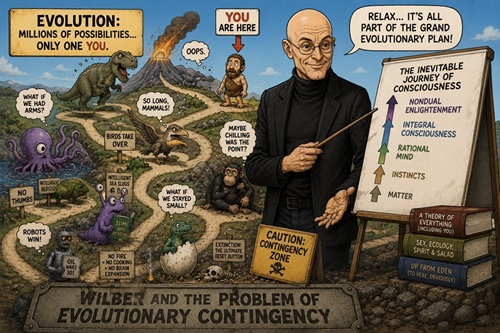
Ken Wilber's evolutionary philosophy has always possessed a distinctly teleological character. Evolution, in his account, is not merely a process of mutation, natural selection, ecological interaction and historical contingency. It is also the unfolding of a deeper developmental tendency toward greater complexity, consciousness, interiority and integration. This vision gives his philosophy much of its grandeur: matter becomes life, life becomes mind, mind becomes self-awareness, and self-awareness ultimately awakens to the nondual ground from which the entire evolutionary drama has emerged. The difficulty is that evolutionary contingency sits rather awkwardly within this narrative. The more seriously we take the role of accident, extinction and historical chance, the more difficult it becomes to sustain the claim that evolution possesses an intrinsic direction. Wilber does acknowledge contingency, but he tends to relegate it to the level of detail while preserving an overarching evolutionary trajectory. The question is whether that distinction can actually survive what modern evolutionary biology has taught us. Contingency at the surface—or at the foundation?It would be unfair to portray Wilber as someone who denies chance altogether. Throughout his work he recognizes variation, environmental influence, historical circumstance and the existence of multiple evolutionary pathways. His argument is more sophisticated than simple determinism. Chance, he suggests, operates within a larger developmental movement. Evolution may not determine exactly which species appears or precisely how history unfolds, but its overall tendency remains one of increasing differentiation, integration, complexity and interior depth. This distinction is crucial because it shifts the teleological claim away from particular organisms and toward the trajectory of evolution itself. Wilber is not saying that Homo sapiens had to evolve exactly as it did. He is saying that something recognizably like greater consciousness was always the deeper destination of the evolutionary process. The details may vary, but the arrow supposedly remains fixed. The problem is that evolutionary contingency does not merely alter the details. It calls the arrow itself into question. What if history had unfolded differently?Consider the asteroid that struck Earth sixty-six million years ago. Its impact transformed the biosphere and opened ecological opportunities that mammals later exploited. Had it missed the planet, dinosaurs might well have remained the dominant terrestrial vertebrates for tens of millions of additional years. Mammals would still have evolved, ecosystems would still have changed, and evolution would certainly have continued. But why should we assume that anything resembling Wilber's sequence toward greater interiority and consciousness would necessarily have emerged? There is no empirical basis for assigning a predetermined developmental destination to these counterfactual histories. Another lineage might have become ecologically dominant. Intelligence might have evolved in a radically different form—or not at all. The point is not that humans were impossible, but that they were never guaranteed. Once we genuinely entertain alternative evolutionary histories, Wilber's developmental arrow begins to look much less like a discovery and much more like a retrospective interpretation of the one history that actually occurred. Historical sequence is not evolutionary purposeThis exposes a deeper philosophical confusion between sequence and purpose. Looking backward from the present, it is perfectly true that matter preceded life, life preceded nervous systems, nervous systems preceded reflective consciousness, and consciousness eventually produced philosophy and science. That historical ordering is undeniable. The mistake comes when the sequence is transformed into evidence that earlier stages existed for the sake of later ones. Imagine reconstructing the history of architecture by beginning with Gothic cathedrals. One could arrange earlier buildings as progressive steps toward Gothic architecture, but that would not mean Roman houses or medieval churches were striving to produce cathedrals. They simply happened to precede them historically. Evolution presents the same temptation. Once human consciousness exists, it becomes easy to reinterpret billions of years of biological history as preparation for our arrival. Darwin's revolution consisted precisely in rejecting this mode of explanation. Earlier organisms do not exist in order to produce later ones. They exist because they survived and reproduced under particular historical conditions. Historical dependence is real; historical intention is not. Complexity does not imply progressWilber often reinforces his evolutionary narrative by appealing to increasing complexity. There is no doubt that evolution has produced astonishingly elaborate organisms, nervous systems and ecosystems. Yet complexity is not synonymous with progress, nor does it increase universally. Parasites routinely lose genes and structures that have become unnecessary. Cave animals lose eyes. Entire lineages become simpler because simplification is advantageous within their ecological niche. Meanwhile bacteria, despite their relative simplicity, remain among the most successful organisms in Earth's history. This creates a fundamental problem for any universal developmental metric. Complexity increases in some dimensions while decreasing in others. A genome may become larger without producing a more sophisticated organism. Behavioral flexibility may increase while anatomical complexity declines. Ecological specialization may represent either elaboration or reduction depending on the context. There is simply no single scalar quantity called “evolutionary complexity” that marches steadily upward. Consequently, Wilber's hierarchy risks becoming selective. Organisms that fit the narrative of increasing consciousness are emphasized, while equally successful examples of simplification become anomalies to be explained away. But they are not anomalies at all. They are ordinary products of evolution. Extinction is not a footnoteThe greatest challenge to teleology may not be complexity but extinction. More than ninety-nine percent of all species that have ever lived are gone. Evolutionary history is therefore less like a triumphant ascent than an enormous cemetery of abandoned experiments. Entire branches of the tree of life disappeared, often through sheer environmental contingency rather than developmental failure. A teleological philosophy can always reinterpret extinction as part of a larger unfolding. One lineage disappears so another can emerge; catastrophe becomes preparation; failure becomes hidden progress. But this flexibility comes at a cost. If every conceivable outcome can be absorbed into the same narrative of increasing depth, then the narrative loses explanatory discrimination. Extinction ceases to count against the theory because it has already been redefined as serving it. Darwinian evolution requires no such reinterpretation. Extinction is neither failure nor success; it is simply what happens when populations cease to reproduce successfully under changing conditions. That explanation may seem less emotionally satisfying, but it has the virtue of not imposing meaning where the evidence does not require it. Gould's challenge to inevitabilityNo modern thinker articulated this challenge more forcefully than Stephen Jay Gould. His famous thought experiment invited us to imagine rewinding the tape of life and allowing evolution to unfold again from an earlier point. Gould's conclusion was that the further back we rewind, the more opportunities there are for small differences to cascade into radically different futures. Tiny contingencies accumulate until the entire subsequent history diverges. Wilber's philosophy implicitly rejects this conclusion. He can allow different species, different cultures and different historical pathways, but the overall destination remains recognizably similar. Gould's vision is more radical. There may be no destination at all—only branching histories shaped by contingency, constraint and ecological interaction. Importantly, Gould did not claim that evolution is pure randomness. Physical laws, developmental constraints and natural selection all impose structure on evolutionary possibilities. The question is whether those constraints amount to a cosmic developmental direction. Gould thought they did not. Wilber thinks they do. Convergence helps Wilber—but not enoughWilber's strongest empirical ally is convergent evolution. Eyes evolved repeatedly, as did flight, echolocation, complex sociality and sophisticated nervous systems. Such repeated innovations suggest that evolution is not an unrestricted lottery. Similar ecological problems often generate remarkably similar biological solutions. This is an important point, and it genuinely weakens simplistic accounts of evolution as mere chance. Yet convergence demonstrates constraint rather than purpose. The repeated evolution of eyes tells us that vision is an effective solution to recurrent environmental challenges. It does not tell us that the universe wanted eyes. Likewise, the repeated emergence of large brains shows that complex information processing can be advantageous under certain conditions; it does not establish that evolution possesses an intrinsic longing for self-awareness. Convergence therefore supports evolutionary regularity without supporting cosmic teleology. It narrows the landscape of possibilities without identifying a predetermined destination within that landscape. The problem of intelligenceThe emergence of intelligence makes Wilber's argument especially tempting. Conscious beings capable of reflecting upon evolution do seem qualitatively different from bacteria or trilobites. It is understandable to see this as the culmination of a developmental process. Yet the empirical evidence is surprisingly thin. Earth has produced only one technological civilization. Several lineages evolved impressive cognition, but none approached the cumulative symbolic culture of Homo sapiens. One successful experiment is not enough to demonstrate inevitability. We simply do not know whether human-like intelligence is a common evolutionary attractor or an extraordinarily improbable historical accident. If anything, contingency counsels humility. Had hominins disappeared during one of the many climatic fluctuations of the Pleistocene, or had another lineage survived where ours did not, the Earth might still contain abundant life without producing mathematics, symphonies or evolutionary philosophy. Intelligence may be remarkable precisely because it was never guaranteed. Wilber's hierarchy compounds the difficultyThe challenge becomes even greater when Wilber extends biological evolution into a hierarchy of psychological and spiritual stages. Even if biology displayed a robust tendency toward greater cognitive complexity, it would not follow that cultures are evolving toward pluralism, integral consciousness or nondual realization. These are distinct processes governed by different mechanisms. Biological evolution occurs across populations through heredity and selection. Psychological development unfolds within individuals through maturation and learning. Cultural evolution operates through language, institutions and cumulative knowledge. Spiritual development, whatever one's view of it, belongs to yet another domain of inquiry. There may be fascinating interactions among these levels, but they cannot simply be stacked into a single universal ladder without independent evidence that they truly constitute one developmental process. Wilber's synthesis is philosophically elegant because it unifies these domains. Its weakness is that elegance is not itself evidence of causal unity. The lesson of contingencyPerhaps the deepest lesson of evolutionary contingency is that emergence becomes more impressive once teleology is removed. If Homo sapiens was not inevitable, then consciousness is not diminished by contingency; it is enriched by it. Our existence becomes the outcome of billions of years of experimentation, extinction and historical accident rather than the fulfillment of a cosmic script. This does not make evolution meaningless. It simply relocates meaning. Instead of discovering purpose embedded within biology itself, we discover extraordinary creativity arising from lawful processes operating without foresight. Variation, inheritance, selection, development, ecology and chance are sufficient to produce organisms capable of asking philosophical questions. That achievement requires no hidden evolutionary manager. Wilber's greatest insight may therefore lie not in his teleology but in his appreciation of emergence. Reality genuinely does generate new levels of organization whose properties cannot be reduced to their constituent parts. Chemistry gives rise to life, life gives rise to cognition, and cognition gives rise to culture. These transitions are astonishing enough without assuming that they were cosmically destined. The real disagreement is therefore surprisingly narrow. Wilber interprets emergence as evidence of an intrinsic evolutionary direction toward Spirit. Evolutionary contingency suggests a more modest conclusion: emergence is real, complexity is remarkable, consciousness is extraordinary—but none of these achievements requires the universe to have been heading toward them all along. That is, perhaps, the most profound implication of modern evolutionary biology. The grandeur of life lies not in fulfilling a predetermined plan, but in the fact that no such plan was ever required.
Widget is loading comments...
|