|
TRANSLATE THIS ARTICLE
Integral World: Exploring Theories of Everything
An independent forum for a critical discussion of the integral philosophy of Ken Wilber
  Frank Visser, graduated as a psychologist of culture and religion, founded IntegralWorld in 1997. He worked as production manager for various publishing houses and as service manager for various internet companies and lives in Amsterdam. Books: Ken Wilber: Thought as Passion (SUNY, 2003), and The Corona Conspiracy: Combatting Disinformation about the Coronavirus (Kindle, 2020). Frank Visser, graduated as a psychologist of culture and religion, founded IntegralWorld in 1997. He worked as production manager for various publishing houses and as service manager for various internet companies and lives in Amsterdam. Books: Ken Wilber: Thought as Passion (SUNY, 2003), and The Corona Conspiracy: Combatting Disinformation about the Coronavirus (Kindle, 2020).
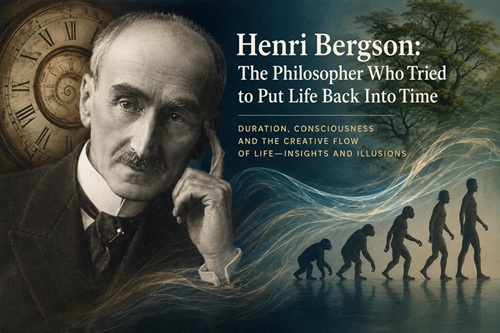
Check out my other conversations with ChatGPT Henri BergsonThe Philosopher Who Tried to Put Life Back Into TimeFrank Visser / ChatGPT
Henri Bergson occupies an unusual position in the history of modern philosophy. At the beginning of the twentieth century he became one of Europe's most celebrated intellectuals, winning the Nobel Prize in Literature in 1927 and attracting audiences far beyond academic philosophy. His central complaint was deceptively simple: modern science, in its attempt to explain reality, had become too good at turning living processes into static representations. Something essential, Bergson argued, disappears when we translate lived time, consciousness and life into spatial diagrams, measurable quantities and mechanical descriptions. There is much to admire in this diagnosis. Bergson understood, remarkably early, that an explanation of a phenomenon is not necessarily identical with an account of what it is like to experience that phenomenon. He also recognized that living systems cannot always be understood adequately by taking them apart into isolated components. Yet Bergson drew much more controversial conclusions from these insights. He frequently transformed limitations in particular scientific models into sweeping claims about science itself, and his positive alternative—élan vital, intuition and duration—never developed into a scientifically testable theory of life or consciousness. Bergson therefore deserves neither the dismissal of an obsolete vitalist nor the revivalist treatment sometimes accorded to him by contemporary spiritual and integral thinkers. His enduring importance lies somewhere in between: he diagnosed genuine philosophical problems, but often supplied metaphysical solutions where empirical investigation was still needed. The revolt against the clockBergson's most famous concept is durée, usually translated as "duration." In Time and Free Will (1889), he distinguished between lived time and the quantitative time represented by clocks and mathematics. Clock time consists of discrete, interchangeable units. One second resembles another second. Ten seconds can be represented as ten identical intervals. Such time can be measured because it can be treated almost as though it were a spatial dimension. But consciousness does not normally experience time in this way. Consider listening to a melody. The notes do not appear in consciousness as a collection of independent events. Earlier notes remain implicitly present as later notes arrive, and the significance of each note depends partly upon its relation to what has preceded it. The melody is a continuous process rather than a heap of isolated sounds. This was one of Bergson's most powerful observations. The temporal structure of experience is not exhausted by the representation of time on a clock. But an important distinction is required here. Showing that lived time has a different phenomenological character from measured time does not show that physical time is unreal, nor that physics has misunderstood time. Bergson sometimes moved too quickly from phenomenological description to metaphysical conclusion. The fact that my experience of five minutes differs radically depending on whether I am bored or absorbed does not imply that the physical duration of those five minutes has changed. Subjective time and physical time are different explanatory variables. This distinction remains crucial today. Neuroscience can investigate the mechanisms involved in temporal perception without pretending that the subjective phenomenon has thereby been philosophically exhausted. Conversely, phenomenology can describe temporal experience without replacing physics. Bergson was strongest when making the first observation and weakest when turning it into an indictment of scientific time itself. Duration and the problem of consciousnessBergson's philosophy of consciousness is closely connected with duration. Consciousness, he argued, is not a sequence of discrete mental objects. It is a continuous flow in which memories, perceptions, emotions and intentions interpenetrate. This idea anticipated aspects of later phenomenology. William James, Edmund Husserl and later thinkers would likewise emphasize the flowing, temporally structured character of consciousness. There is a valuable insight here. A conscious organism is not merely a machine receiving independent packets of information. Perception is context-sensitive, memory influences present experience, expectations influence perception, and emotional states alter the significance of what we encounter. Yet Bergson sometimes treated the irreducibility of conscious experience as evidence for a metaphysical distinction between mind and matter. That inference does not follow automatically. The fact that subjective experience cannot be described exhaustively in ordinary third-person language does not demonstrate that consciousness requires a nonphysical substance or force. This is precisely where Bergson's philosophy becomes vulnerable to a familiar philosophical error: confusing an explanatory gap with evidence for a particular metaphysics. We do not yet possess a complete theory of consciousness. But "science has not explained X" is not equivalent to "therefore X is produced by a special nonphysical principle." The mysterious élan vitalBergson's most controversial idea appears in Creative Evolution (1907): the élan vital, usually translated as "vital impulse" or "vital impetus." Bergson rejected both crude mechanism and traditional finalism. Life, he argued, should not be understood simply as a machine assembled according to a pre-existing blueprint. Evolution involves genuine novelty and creativity. This part of his argument has a striking contemporary resonance. Biological evolution does indeed generate novelty. Evolutionary history is contingent, path-dependent and enormously sensitive to environmental circumstances. Complex biological organization cannot always be understood intuitively by imagining a machine designed from the top down. But Bergson went further. He proposed something like a creative impulse running through life itself. That move is where the scientific problems begin. Evolutionary biology does not require an élan vital. Mutation, recombination, inheritance, developmental processes, ecological interactions, natural selection, genetic drift and other mechanisms can generate novelty without introducing a mysterious life-force. The problem with vitalism is not simply that scientists dislike mysterious entities. It is methodological. If the vital force has no independently measurable properties and cannot make predictions distinguishing it from ordinary biological mechanisms, it contributes little explanatory power. The concept risks becoming a label for the very phenomenon that needs explaining. Life is creative; therefore there is a creative force of life. But why is life creative? Because of the creative force. That is circular. Bergson nevertheless deserves credit for recognizing something that mechanistic rhetoric sometimes obscures: biological systems are historical processes. Organisms develop, regulate themselves, interact with environments and reproduce. They are not equivalent to inert machines. Modern biology can accept much of that insight without accepting vitalism. Bergson versus DarwinBergson's relationship with Darwinism is complicated. He accepted evolution but objected to interpretations of Darwinian evolution that seemed to reduce evolutionary creativity to the accumulation of accidental variations filtered by natural selection. He found it difficult to believe that the astonishing diversity of life could be adequately understood through a mechanism that appeared, in his view, fundamentally blind. This criticism is historically understandable but scientifically problematic. The evolutionary synthesis has never claimed that organisms are produced by "randomness alone." Variation can be stochastic with respect to adaptive needs while natural selection is decidedly nonrandom with respect to differential reproductive success. Furthermore, contemporary evolutionary theory incorporates mechanisms and concepts that were poorly understood in Bergson's time: genetics, developmental biology, gene regulation, neutral evolution, evo-devo, niche construction and multilevel evolutionary processes, among others. Bergson's criticism therefore often targeted a simplified version of Darwinism. This is an important lesson because the same rhetorical move continues to appear today. Someone observes that evolution involves emergence, self-organization, developmental constraints or historical contingency and concludes that Darwinian theory must therefore be inadequate. But demonstrating that evolution is more complicated than nineteenth-century caricatures of natural selection does not establish a competing metaphysical principle. Bergson's intuition that evolution produces genuine novelty was sound. His inference that this novelty requires a vital creative impulse was not established. Intelligence versus intuitionBergson also distinguished two modes of cognition: intelligence and intuition. Intelligence, he argued, is exceptionally good at manipulating stable objects, dividing processes into parts and constructing useful representations. This capacity is indispensable for science and technology. But it can distort reality when applied indiscriminately to phenomena that are essentially dynamic. Intuition, by contrast, supposedly gives us direct access to duration and becoming. Instead of standing outside a process and analyzing it, intuition attempts to enter into it and grasp its internal movement. Again, there is an important insight buried within the metaphysics. Scientific models necessarily abstract. A map is not the territory. A biological classification is not the organism itself. A mathematical description of a process is not the process as experienced by an organism. But Bergson sometimes presents intuition as though it supplied a superior epistemological instrument capable of reaching truths inaccessible to analysis. That claim is much harder to defend. Introspection is not automatically reliable. Intuition can generate profound insights, but it can also generate powerful illusions. Human beings are extraordinarily talented at perceiving patterns, assigning agency and constructing narratives after the fact. Science developed precisely because private intuition is insufficient as a method for settling disagreements about reality. Public measurement, reproducibility, prediction and criticism provide checks against individual cognitive biases. Bergson's mistake was not valuing intuition. His mistake was giving intuition too much epistemic authority. Bergson and Einstein: a revealing confrontationThe famous confrontation between Bergson and Albert Einstein over the nature of time illustrates both the power and limitation of Bergsonian philosophy. In 1922, Bergson criticized aspects of Einstein's theory of relativity, arguing that the physical theory did not eliminate the deeper reality of duration. Einstein responded critically, emphasizing the physical meaning of time as defined through clocks and synchronization procedures. Bergson's position is sometimes retrospectively presented as vindicated by modern physics because physicists recognize that time is not simply the universal Newtonian clock once imagined. But this is misleading. Einstein's relativity did indeed overthrow absolute Newtonian time. Yet that does not vindicate Bergson's specific metaphysical theory of duration. Relativity describes temporal relationships between physical observers and systems with extraordinary empirical success. Subjective temporal experience is an additional phenomenon, not a replacement for relativistic spacetime. The Bergson-Einstein dispute therefore illustrates a broader danger: being philosophically right about the inadequacy of one conception of time does not mean being scientifically right about what should replace it. Bergson's "creative" universeBergson's universe is fundamentally one of becoming rather than being. Reality is not, at bottom, a collection of finished objects. It is an ongoing creative process. This makes Bergson surprisingly compatible with some contemporary philosophical currents. Process philosophy, complexity theory and evolutionary thinking all emphasize change, emergence and historical contingency. But compatibility should not be confused with confirmation. Modern complexity science does not require Bergson's metaphysics. Self-organization can arise from relatively simple local interactions. Nonlinear dynamics can generate unpredictable trajectories without invoking a cosmic creative consciousness. Emergence can describe novel system-level properties without implying that the universe possesses intentions. There is a persistent temptation in contemporary discussions of complexity to turn words such as "emergence," "self-organization," "creativity" and "information" into quasi-spiritual substances. Bergson occasionally made a comparable move with élan vital. The vocabulary of creativity is useful. It becomes problematic when it is treated as an explanation rather than a description. Why Bergson remains attractive to integral thinkersBergson has particular appeal to contemporary integral and spiritual philosophies. His opposition to reductionism appears to support the claim that reality contains more than its measurable exterior. His emphasis on consciousness seems compatible with interiority. His critique of mechanism appears to open the door to holism. His philosophy of evolution appears to provide a metaphysical foundation for developmental and evolutionary spirituality. But there is a danger here. Bergson can easily become a philosophical ancestor invoked to legitimate conclusions that he himself did not scientifically establish. The argument can take the following form: Science reduces everything to matter. Bergson showed that life and consciousness transcend mechanism. Therefore consciousness or Spirit must be fundamental. But the first premise is a caricature of contemporary science, and the conclusion does not follow from Bergson's critique. Science can be methodologically naturalistic without claiming that subjective experience, values, meaning or human culture are unimportant. Similarly, recognizing emergence does not require panpsychism, idealism or spiritual evolution. Bergson is most useful when he challenges simplistic reductionism. He becomes much less useful when his critique is converted into a license for metaphysical speculation. The problem of "more than science"One of Bergson's enduring themes is that reality is richer than our conceptual representations of it. That is true. But there are two very different ways of interpreting the statement. The first says: our current scientific theories are incomplete, and we should remain open to better theories. The second says: because science cannot capture everything that matters to human existence, there must be another faculty—intuition—that gives us access to metaphysical truths. The first is intellectually modest and compatible with science. The second requires independent justification. Bergson frequently moved toward the second position. This is why his philosophy can simultaneously be illuminating and misleading. He was exceptionally sensitive to the limitations of conceptual abstraction, but less cautious about the epistemic status of the alternative he proposed. What survives Bergson?A surprising amount of Bergson survives once the speculative metaphysics is removed. His insistence that time is experienced rather than merely measured anticipated important developments in phenomenology and cognitive science. His emphasis on process rather than static substance resonates with contemporary biology and systems thinking. His recognition that organisms have histories, develop dynamically and cannot always be understood adequately by crude machine metaphors remains valuable. His criticism of simplistic reductionism also remains relevant, provided reductionism is distinguished from methodological naturalism and successful mechanistic explanation. His philosophy of creativity offers a useful vocabulary for thinking about novelty and emergence, even if élan vital itself cannot function as a scientific explanation. What does not survive nearly as well is his attempt to transform these philosophical insights into a quasi-scientific metaphysics of life. Bergson's real achievementBergson's greatest achievement was not discovering a mysterious force of life. It was exposing a recurrent mistake in human thinking: confusing our representations of processes with the processes themselves. We divide reality into objects because objects are cognitively convenient. We divide time into units because measurement requires quantification. We describe organisms in terms of mechanisms because mechanisms are extraordinarily powerful explanatory tools. But reality does not necessarily come pre-divided according to the categories we use to understand it. This insight is philosophically important. The trouble begins when the critique of representation becomes a rejection of representation altogether. Bergson sometimes came close to suggesting that intuition could bypass conceptual mediation and disclose reality in itself. Modern epistemology gives us good reason to be suspicious of that promise. We should neither worship the map nor throw it away. Conclusion: Between mechanism and mysticismHenri Bergson remains important precisely because he occupies an unstable position between science and metaphysics. He was right to resist the idea that living beings can be understood simply as static collections of parts. He was right that subjective time is not identical to clock time. He was right that evolution is a historical process producing novelty. He was right to insist that abstraction can conceal as well as reveal. But he was wrong to think that these observations establish a special vital principle. He underestimated the explanatory resources of evolutionary biology and overestimated the epistemic authority of intuition. And his confrontation with relativity illustrates how easily a legitimate philosophical distinction can become confused with a scientific disagreement. The best way to read Bergson today is therefore neither as a prophet vindicated by modern science nor as a quaint vitalist whose philosophy has simply been superseded. He is better understood as a philosopher of warning. He warned us that descriptions are not reality, that measurement is not experience, that organisms are processes rather than inert objects, and that novelty deserves explanation rather than dismissal. Those warnings remain valuable. But warnings are not theories. Bergson's enduring contribution lies less in élan vital than in the questions he forced philosophy to ask about time, consciousness, life and becoming. Modern science has not confirmed his metaphysics. What it has done, more interestingly, is provide increasingly sophisticated ways of investigating the very phenomena that Bergson believed could not be adequately captured by mechanism. The challenge today is therefore not to choose between Bergson and science. It is to preserve Bergson's questions while demanding better answers. Appendix: Bergson vs. Wilber — From Creative Evolution to ErosHenri Bergson and Ken Wilber belong to very different intellectual worlds, separated by almost a century and by radically different scientific contexts. Yet there is a recognizable family resemblance between them. Both resist a purely static conception of reality. Both emphasize development, emergence, consciousness and creativity. Both reject the idea that reality can be adequately understood by reducing living and conscious phenomena to isolated material components. It is therefore tempting to see Wilber as a late, integral heir of Bergson. That comparison is illuminating—but only up to a point. Bergson's philosophy represents an early twentieth-century revolt against mechanism. Wilber's Integral Theory represents a late twentieth- and early twenty-first-century attempt to construct a comprehensive developmental metaphysics. The former asks whether becoming can be reduced to being; the latter asks whether evolution itself expresses a directional movement toward greater complexity, consciousness and integration. The crucial difference is that Wilber takes several of Bergson's philosophical intuitions and turns them into a much more elaborate cosmological system. Both reject a flat universeBergson's central target was the conception of reality as a collection of static objects externally related to one another. Reality, he argued, is fundamentally temporal and dynamic. Life is creative precisely because it unfolds. Wilber similarly rejects what he regards as a flatland worldview: a universe described entirely in terms of third-person objects and external relations. Both therefore insist that reality has dimensions that are lost when everything is translated into the language of objects and mechanisms. But Wilber adds a crucial architectural feature. Reality does not merely unfold through time; it develops through recognizable levels or stages. Wilber's familiar sequence—from matter to life to mind and beyond—is not simply a description of historical change. It is embedded in a developmental hierarchy. The universe becomes increasingly complex, differentiated and internally aware. This is where Wilber moves beyond Bergson. For Bergson, evolution is creative but not necessarily a staircase of predetermined stages. For Wilber, evolution can be represented developmentally: matter, life, mind, higher mind, transpersonal consciousness and so forth. That makes Wilber's theory more systematic than Bergson's. It also makes it considerably more vulnerable. Bergson's élan vital becomes Wilber's ErosThe most obvious comparison concerns Bergson's élan vital and Wilber's concept of Eros. Bergson argued that life exhibits an inherent creative impetus. Evolution is not adequately represented as the mechanical production of predetermined forms. Something genuinely novel emerges. Wilber's Eros plays a structurally similar role. In his cosmology, evolution is not merely an accidental accumulation of changes. Reality possesses an intrinsic tendency toward greater complexity, differentiation, integration and consciousness. The vocabulary changes, but the metaphysical function is strikingly similar. Bergson: Life is creative because of the élan vital. Wilber: Evolution is creative because of Eros. In both cases, a directional principle is introduced to account for the extraordinary generativity of evolution. And in both cases the same philosophical problem arises. What exactly does this principle explain? If evolution produces novelty, saying that it does so because there is a creative evolutionary impulse risks merely renaming the phenomenon. The explanatory burden remains. This is especially problematic for Wilber because contemporary evolutionary biology offers powerful accounts of novelty without requiring a cosmic developmental force. Mutation, recombination, selection, drift, developmental constraint, gene regulation, ecological interaction and historical contingency provide mechanisms through which increasingly complex forms can arise. One may still argue that these mechanisms do not explain everything philosophically interesting about evolution. But that is different from demonstrating the existence of Eros. Wilber's Eros is more ambitious than Bergson's élan vitalThere is, however, an important difference. Bergson's élan vital is primarily a philosophy of life and evolution. Wilber's Eros becomes cosmological. Wilber frequently describes the universe itself as possessing a tendency toward greater complexity and interiority. Matter gives rise to life; life gives rise to mind; mind gives rise to transpersonal awareness. The evolutionary sequence therefore becomes a general principle of the Kosmos. This makes Wilber's claim considerably stronger than Bergson's. Bergson asks us to take seriously the creativity of living evolution. Wilber asks us to interpret the entire history of the universe as part of a developmental trajectory toward increasingly complex forms of consciousness. That is no longer merely a philosophy of biology. It is a metaphysical interpretation of cosmic history. And here Wilber encounters a problem Bergson only partly faced: modern cosmology and evolutionary biology provide no straightforward evidence that the universe as a whole is moving toward consciousness. The fact that consciousness appeared on Earth does not demonstrate that consciousness was the destination of cosmic evolution. The distinction between "consciousness emerged" and "the universe was evolving toward consciousness" is enormous. From description to explanationThis distinction is central to the Bergson-Wilber comparison. Bergson was primarily a philosopher of description and interpretation. He wanted us to notice the temporal, qualitative and creative character of experience and life. Wilber wants to explain why these things occur within a single comprehensive framework. That ambition is both the strength and weakness of Integral Theory. Wilber's AQAL model can organize an extraordinary number of perspectives: subjective experience, objective behavior, individual development, cultural evolution and social systems. It provides a conceptual map for connecting phenomena that are often studied separately. But the existence of a comprehensive map does not establish the causal mechanisms represented by the map. This is particularly important with Wilber's developmental claims. A developmental sequence can be useful as a classification scheme without being a law of nature. The distinction is easy to overlook because Wilber's terminology often moves fluidly between three different levels: "What tends to happen." "What can be described as a developmental pattern." "What reality itself is fundamentally doing." These are not equivalent claims. The problem of developmental teleologyBergson's creative evolution already contained a difficult tension between creativity and direction. If evolution is genuinely creative, how can its future be known in advance? Wilber intensifies this tension by describing evolution as developmental. Development implies direction. A caterpillar becoming a butterfly is not simply change; it is change organized around a developmental trajectory. But biological evolution is not development in quite this sense. An individual organism develops according to inherited developmental programs. Evolutionary lineages, by contrast, branch, diversify, disappear and explore contingent possibilities. There is no known evolutionary equivalent of a universal developmental endpoint. Wilber's model can therefore slide from the empirical observation that complexity sometimes increases into the much stronger claim that complexity and consciousness constitute the direction of evolution. That is a teleological interpretation. It may be philosophically interesting. It is not established evolutionary biology. Wilber's stages and Bergson's durationThere is another revealing tension. Bergson's concept of duration emphasizes continuous becoming. Lived time is not naturally divided into discrete compartments. Wilber's developmental psychology, by contrast, is heavily stage-oriented. Wilber distinguishes prepersonal, personal and transpersonal structures and, within various models, numerous developmental levels. The difference is substantial. Bergson warns us against confusing an analytical segmentation with the continuous process itself. Wilber repeatedly segments development into stages in order to make the process intelligible. This does not make Wilber wrong. Developmental psychology genuinely investigates stage-like structures, transitions and increasingly differentiated capacities. But it creates a philosophical question that Bergson would have appreciated: Are the stages features of reality itself, or are they conceptual partitions imposed upon a continuous developmental process? Wilber sometimes treats them as both. That is where Bergson's critique of abstraction becomes relevant to Integral Theory itself. The integral map can become the new mechanismThere is an irony here. Bergson criticized the tendency of intellect to freeze dynamic reality into conceptual categories. Wilber builds one of the most elaborate conceptual maps in contemporary spirituality. AQAL contains quadrants, levels, lines, states, types, stages, waves, streams and developmental structures. The model is extraordinarily rich. But richness is not immunity from reification. A map can become so sophisticated that we begin to mistake the map's categories for independently existing structures of reality. This is a particularly important issue with integral developmental language. Once a person has been assigned to "Amber," "Orange," "Green," "Teal" or a higher developmental level, the conceptual category can begin functioning as though it were a natural kind. Bergson would probably have asked us to step back. Does the living individual really exist in a discrete developmental box? Or have we divided a continuous, multidimensional process into categories because categories are useful? Wilber's answer is that developmental stages have real structural existence. That may be defensible in particular empirical domains. But it cannot simply be assumed for the Kosmos as a whole. Consciousness: Bergson's intuition versus Wilber's interiorsBergson's treatment of consciousness also anticipates something important in Wilber: the insistence that interior experience cannot simply be discarded because it is difficult to measure externally. Wilber institutionalizes this insight through the upper-left quadrant: subjective experience and interiority. This is one of the strongest aspects of Integral Theory. A purely third-person description of the brain does not automatically constitute a complete description of what consciousness is like. First-person phenomenology and third-person neuroscience answer different kinds of questions. But Wilber often goes further. He treats interiors not merely as a domain of inquiry but as a fundamental dimension of reality. This is a metaphysical claim. Bergson made a comparable move from phenomenological observation toward metaphysical interpretation. The critical point is that the existence of subjective experience does not by itself establish that interiority is a fundamental cosmic property. That conclusion requires additional argument. Where Wilber improves on BergsonThe comparison should not become one-sided. Wilber has advantages Bergson could not have possessed. Bergson wrote before the modern synthesis in evolutionary biology, before molecular genetics, before contemporary developmental psychology, before cognitive neuroscience and before the explosion of complexity science. Wilber has had access to an enormous body of scientific and psychological literature unavailable to Bergson. His ambition to integrate multiple perspectives is therefore understandable. Moreover, Wilber is more explicit than Bergson about the distinction between interior and exterior perspectives. The AQAL framework recognizes that an organism can be studied from the outside while its subjective experience is investigated from the inside. That is a genuine improvement over crude philosophical battles between "mind" and "matter." But the framework becomes problematic when integration is confused with confirmation. Putting different disciplines into one conceptual architecture does not prove that the architecture itself corresponds to the causal structure of the universe. Where Bergson is actually more cautiousParadoxically, Bergson can sometimes be the less dogmatic thinker. His philosophy emphasizes novelty and genuine unpredictability. The future is not simply a pre-existing destination waiting to be revealed. Wilber's developmental cosmology can sound more confident. The universe is moving toward greater complexity. Evolution produces greater consciousness. Development proceeds through recognizable stages. Transcendence and inclusion represent higher-order developmental achievements. These propositions create a coherent narrative. But coherence is not evidence. Indeed, the more comprehensive the narrative becomes, the greater the danger of interpreting every historical development as confirmation of the theory. If complexity increases, Eros is confirmed. If consciousness increases, Eros is confirmed. If cultures develop, Eros is confirmed. If civilizations collapse, that too can be interpreted as part of a larger evolutionary process. A theory that can accommodate every possible outcome becomes difficult to falsify. The retrospective discovery of destinyThere is an especially subtle problem with evolutionary spirituality. Once humans exist, it is tempting to look backward and reinterpret cosmic history as though it were leading toward us. Stars produced heavier elements. Planets formed. Life emerged. Multicellular organisms appeared. Brains became increasingly complex. Eventually humans developed reflective consciousness. Seen retrospectively, the sequence looks astonishingly directional. But hindsight creates a powerful illusion of inevitability. Evolutionary history could have taken countless other paths. Most lineages that ever existed disappeared. There is no guarantee that intelligence, language or technological civilization would have emerged. The fact that a sequence occurred does not establish that the sequence was destined to occur. This is where Bergson's emphasis on genuine novelty is actually more scientifically congenial than a strong version of Wilber's cosmic teleology. Bergson without vitalism, Wilber without Eros?The most productive contemporary synthesis might therefore involve removing the metaphysical surplus from both thinkers. From Bergson we can retain: • time as lived process; • the importance of becoming; • the qualitative character of consciousness; • the creativity and contingency of evolution; • and the warning against confusing abstractions with reality. From Wilber we can retain: • the importance of multiple perspectives; • the distinction between subjective and objective descriptions; • the usefulness of developmental psychology; • the interaction between individuals and cultural systems; • and the insight that no single disciplinary perspective exhausts a complex phenomenon. But we need not retain either élan vital or cosmic Eros as explanatory principles. Evolution can be creative without possessing a cosmic intention. Consciousness can be profoundly significant without being the universe's predetermined destination. Development can be real without being universal. Interiority can be irreducible as a domain of experience without becoming a supernatural substance. And complexity can emerge without requiring a metaphysical force called Eros. The deeper ironyThere is a fascinating irony in the relationship between Bergson and Wilber. Bergson warned that our conceptual intelligence tends to freeze becoming into static categories. Wilber developed an enormous conceptual system intended to map becoming. Bergson proposed that evolution is creative. Wilber transformed creativity into a principle of cosmic evolution. Bergson emphasized intuition as a way of encountering duration. Wilber incorporated altered states and contemplative experience into a comprehensive developmental model. Bergson criticized mechanistic reductionism. Wilber constructed a grand synthesis intended to transcend reductionism. The resemblance is real. But so is the difference. Bergson's philosophy begins with an experience of reality that resists conceptual capture. Wilber's Integral Theory ends with a conceptual architecture that attempts to capture virtually everything. That is perhaps the fundamental contrast. Bergson tells us: reality is more than our map. Wilber gives us a much larger map. The critical question is whether the larger map has escaped the problem Bergson identified—or merely made the map more elaborate. ConclusionBergson can be regarded as one of the intellectual ancestors of integral thinking, but not as a scientific precursor who established Wilber's cosmology. Both thinkers oppose reductionist pictures of reality and emphasize development, consciousness, creativity and becoming. Both seek a richer account of evolution than a static mechanical worldview seems to provide. Yet Bergson's élan vital already illustrates the danger of turning an illuminating metaphor into an explanatory entity. Wilber's Eros inherits this danger in an expanded form. What was a creative principle of life becomes a purported directional principle of the entire Kosmos. That is a much larger claim—and therefore requires much stronger evidence. The most defensible legacy of Bergson for integral philosophy is consequently not vitalism, teleology or cosmic consciousness. It is methodological humility: the reminder that reality unfolds in time, that lived experience cannot simply be identified with its external description, and that our conceptual categories are tools rather than mirrors of reality. Ironically, applying Bergson's own lesson rigorously to Integral Theory means becoming more skeptical of Integral Theory itself. If the map is genuinely integral, it must include the possibility that its own developmental categories are provisional. And if evolution is genuinely creative, perhaps we should resist the temptation to decide in advance where it is going.
Widget is loading comments...
|