|
TRANSLATE THIS ARTICLE
Integral World: Exploring Theories of Everything
An independent forum for a critical discussion of the integral philosophy of Ken Wilber
  Frank Visser, graduated as a psychologist of culture and religion, founded IntegralWorld in 1997. He worked as production manager for various publishing houses and as service manager for various internet companies and lives in Amsterdam. Books: Ken Wilber: Thought as Passion (SUNY, 2003), and The Corona Conspiracy: Combatting Disinformation about the Coronavirus (Kindle, 2020). Frank Visser, graduated as a psychologist of culture and religion, founded IntegralWorld in 1997. He worked as production manager for various publishing houses and as service manager for various internet companies and lives in Amsterdam. Books: Ken Wilber: Thought as Passion (SUNY, 2003), and The Corona Conspiracy: Combatting Disinformation about the Coronavirus (Kindle, 2020).
Check out my other conversations with ChatGPT The Stevenson LegacyA Critical Assessment of the Scientific Case for ReincarnationFrank Visser / ChatGPT
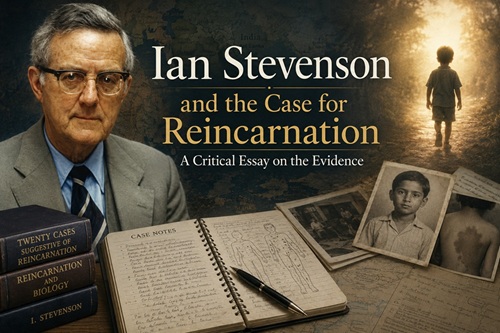
IntroductionFew researchers have done more to bring the concept of reincarnation into serious academic discussion than the Canadian psychiatrist Ian Stevenson (1918-2007). During nearly four decades at the University of Virginia, Stevenson devoted himself to investigating one of humanity's oldest questions: can consciousness survive death and be reborn in another body? Unlike many advocates of the paranormal, Stevenson approached the subject with remarkable restraint. He avoided sensational claims, preferred painstaking fieldwork over speculation, and consistently described his findings as merely "suggestive" rather than conclusive. His work earned respect even from many skeptical scholars. Few questioned his sincerity or diligence. Yet despite documenting more than 2,500 cases of children claiming to remember previous lives, Stevenson failed to convince the wider scientific community that reincarnation had been demonstrated. His legacy therefore occupies an unusual position: he produced perhaps the strongest empirical case ever assembled for reincarnation, while simultaneously illustrating why extraordinary claims remain so difficult to establish scientifically. Stevenson's Research ProgramStevenson's investigations focused on a surprisingly narrow phenomenon. He sought out young children, typically between the ages of two and six, who spontaneously spoke about previous lives. According to Stevenson, these children often described another family, another home, another occupation, and sometimes even another name. Many also displayed intense emotional attachments to people they had supposedly known in a former existence. Over many years Stevenson collected reports from India, Sri Lanka, Lebanon, Burma, Thailand, Turkey, Alaska, and eventually Europe and North America. His best-known publication, Twenty Cases Suggestive of Reincarnation (1966), introduced these investigations to an international audience. Later he expanded his research into the massive two-volume work Reincarnation and Biology (1997), which concentrated on birthmarks and birth defects allegedly corresponding to injuries suffered by deceased individuals. Unlike many paranormal investigators, Stevenson personally interviewed witnesses, compared testimonies, visited locations, examined hospital records whenever possible, and attempted to document each case before memories became distorted. His work represented genuine field research rather than armchair speculation. Why the Cases Appeared So PersuasiveSome of Stevenson's strongest cases remain genuinely intriguing. Children occasionally identified villages they had never visited, recognized relatives of deceased persons, or described occupations and family events that seemed difficult to explain by ordinary means. In several widely discussed cases, children accurately identified possessions or recognized former acquaintances during visits to another family. Even more striking were Stevenson's birthmark investigations. He argued that some children were born with unusual marks or congenital deformities that corresponded closely to fatal wounds recorded in autopsy reports of the deceased individual they supposedly remembered. These cases created the impression that not only memories but even physical characteristics might somehow survive death. Such reports undoubtedly deserve careful investigation. They are far more interesting than the caricature sometimes presented by critics who dismiss every case as obvious fraud or fantasy. Stevenson himself was careful not to overstate the evidence, recognizing that unusual observations do not automatically establish an extraordinary conclusion. The Limits of Anecdotal EvidenceThe greatest weakness in Stevenson's work does not lie in obvious mistakes but in the nature of the evidence itself. Every case was investigated after the remarkable events had already taken place. By the time Stevenson arrived, parents had already discussed the child's statements, neighbors had exchanged stories, memories had begun to evolve, and possible sources of information had become difficult to reconstruct. Modern cognitive psychology has demonstrated repeatedly that human memory is not a faithful recording device. Memories are reconstructed rather than replayed. Witnesses unintentionally modify details over time, forget inconsistencies, and gradually create more coherent narratives. Even honest observers become increasingly confident about details that may never have occurred exactly as remembered. This retrospective character fundamentally limits the evidential value of Stevenson's cases. No matter how conscientious his interviews were, they could never recover the precise sequence of events that occurred before the investigation began. The Influence of CultureAnother important consideration is the cultural environment in which most of Stevenson's strongest cases were found. The majority originated in societies where belief in reincarnation is already deeply embedded in religious and cultural traditions. In countries such as India and Sri Lanka, children grow up hearing stories about rebirth, karma, and previous lives. This cultural background creates fertile conditions for confirmation bias. Parents may interpret unusual childhood remarks through the lens of reincarnation. Communities become eager to identify matching deceased individuals. Children who receive attention for their statements may unconsciously elaborate upon them, while cases that fail to produce convincing identifications simply disappear without notice. None of this requires deliberate deception. Expectations alone can strongly influence memory, questioning, and interpretation. Psychological research has repeatedly shown that people often perceive exactly what they expect to find. The Problem of Information LeakagePerhaps the most mundane explanation is also one of the most powerful. Information can travel through countless unnoticed channels. Children overhear conversations between adults. Neighbors gossip about local tragedies. Visiting relatives discuss family histories. Small communities often share extensive knowledge without anyone consciously remembering where they first learned particular facts. Psychologists refer to this phenomenon as cryptomnesia: information is retained while its source is forgotten. A child may sincerely believe that certain knowledge arose spontaneously when it actually originated from forgotten conversations or observations. Because Stevenson generally investigated cases months or even years after they began, eliminating every possible route of information transfer was virtually impossible. The inability to identify a source does not demonstrate that no source existed. Birthmarks and Biological ProblemsStevenson's research on birthmarks is often presented as his strongest evidence, yet it also raises significant scientific difficulties. Some correlations between congenital marks and documented wounds are certainly striking, but the interpretation remains highly subjective. Birthmarks are extremely common, and with thousands of cases some similarities are statistically inevitable. Moreover, there is no known biological mechanism capable of transmitting injuries from one deceased individual to an unrelated embryo. Invoking reincarnation simply transfers the mystery from one place to another without explaining how such transmission could occur. Scientific explanations normally connect observations through mechanisms that can themselves be investigated. Stevenson's hypothesis offered no such mechanism. This does not mean the observations were fabricated, only that they remain unexplained. An unexplained observation is not automatically evidence for reincarnation. Reincarnation Is Not the Only Possible ExplanationEven if every one of Stevenson's factual claims were accepted at face value, reincarnation would not necessarily follow. Numerous alternative explanations remain possible, including coincidence, selective reporting, unconscious suggestion, cryptomnesia, memory distortion, or psychological mechanisms that are still poorly understood. Ironically, some parapsychologists have argued that telepathy or clairvoyance could account for many of the cases. If children somehow acquired information about deceased individuals through extrasensory means, they would not literally be those individuals reborn. In other words, even paranormal explanations do not uniquely support reincarnation. This illustrates a common problem in reasoning. Showing that conventional explanations appear inadequate does not automatically validate one preferred alternative. The Philosophical Problem of Personal IdentityAn even deeper issue concerns the nature of personal identity itself. Suppose a child genuinely possesses memories belonging to another individual. Does that establish that the child is the same person? Most philosophers would answer no. Memories alone do not constitute identity. Personal identity involves continuity of consciousness, personality, brain function, and psychological development. Modern neuroscience generally understands autobiographical memory as dependent upon the physical organization of the brain. When the brain dies, that organization disappears. Consequently, reincarnation requires much more than memory transfer. It requires demonstrating that consciousness itself survives bodily death and retains a coherent identity capable of entering another organism. Stevenson's work never established this broader claim. Why Science Remains UnconvincedScience does not reject reincarnation because it is philosophically impossible. Rather, it remains unconvinced because the available evidence falls short of the standards required for extraordinary claims. Scientific theories gain acceptance through reproducible observations, controlled experiments, predictive success, and mechanisms that integrate with broader scientific knowledge—or through overwhelming evidence strong enough to force a revision of existing theories. Stevenson's investigations satisfied none of these criteria. They were careful observational studies but not controlled experiments. They generated fascinating anomalies rather than reproducible demonstrations. Consequently, most scientists continue to regard reincarnation as an interesting hypothesis rather than an established fact. Stevenson's Enduring ContributionDespite these criticisms, Ian Stevenson deserves considerable respect. He transformed the study of reincarnation from a purely religious doctrine into an empirical research program. His investigations remain valuable not only for parapsychologists but also for psychologists, anthropologists, historians of religion, and scholars interested in memory, belief, and human experience. Perhaps his greatest strength was intellectual modesty. Unlike many modern defenders of paranormal phenomena, Stevenson rarely claimed more than his evidence warranted. His famous description of his cases as "suggestive" rather than conclusive reflected an admirable scientific caution. His work reminds us that skepticism should not become dogmatism. Strange human experiences deserve investigation, even when they ultimately prove to have ordinary explanations. ConclusionIan Stevenson remains the most important scientific investigator ever to examine claims of reincarnation. His enormous body of work is characterized by exceptional diligence, careful documentation, and a commendable reluctance to overstate his conclusions. Many of his individual cases remain genuinely puzzling and continue to stimulate debate decades after they were first reported. Nevertheless, the cumulative evidence does not establish reincarnation as a scientific reality. The cases remain vulnerable to memory distortion, cultural expectations, information leakage, confirmation bias, and multiple competing interpretations. Most importantly, they lack the reproducibility and explanatory mechanisms required by modern science. Stevenson's achievement, therefore, was not proving reincarnation but demonstrating that some human experiences remain difficult to explain. Whether future research will uncover unknown psychological processes, hidden social mechanisms, or genuinely novel aspects of consciousness is impossible to predict. For now, however, the evidence points to a cautious conclusion: Ian Stevenson assembled the strongest case for reincarnation yet produced, but that case remains intriguing rather than compelling, and suggestive rather than demonstrative. Appendix: Why the Hypothesis of Souls Leads to Metaphysical ConundrumsThe Problem of Personal IdentityThe hypothesis of reincarnation is often presented as though it requires only one additional assumption: that human beings possess a soul capable of surviving bodily death and entering another body. But this seemingly simple hypothesis immediately generates a remarkable number of metaphysical problems. The more precisely we try to describe what a reincarnating soul is, the harder it becomes to explain how it could possibly perform the functions attributed to it. The first problem concerns identity. What exactly survives death? If the soul carries memories, personality traits, dispositions, moral character, and perhaps even skills from one incarnation to another, then we have something resembling a persisting person. But if it carries none of these things, in what meaningful sense is it the same person? Suppose person A dies and a child, person B, is later born. B has no autobiographical memories of A, no continuous stream of consciousness with A, no body in common with A, and perhaps an entirely different personality. What makes B the reincarnation of A rather than simply another human being? One can answer that the soul itself is the enduring identity. But this merely relocates the problem. We then need an account of what the soul is independently of the psychological characteristics that normally constitute personal identity. Is it an immaterial substance? A bundle of dispositions? A carrier of information? A field? A metaphysical individual that somehow remains numerically identical despite losing virtually every feature by which we recognize an individual person? Stevenson and the Soul InferenceThe problem becomes particularly acute in cases such as those investigated by Ian Stevenson. Stevenson collected reports of children who appeared to remember previous lives, sometimes accompanied by unusual behavioural traits, phobias, birthmarks, or alleged memories corresponding to deceased individuals. Even if some of these cases are accepted as anomalous and difficult to explain, they do not by themselves establish the existence of a soul. They establish, at most, that some form of information or psychological continuity may be occurring that conventional explanations have not adequately accounted for. This distinction is crucial. An unexplained transfer of information is not equivalent to the survival of a personal soul. The Brain-Soul ProblemThe second problem concerns the relationship between soul and brain. During ordinary life, mental states appear extraordinarily dependent upon the brain. Damage to particular brain regions can alter memory, personality, emotional regulation, language, perception and even one's sense of self. Dementia can progressively destroy autobiographical memory. Anaesthesia can interrupt conscious experience. Drugs can profoundly alter perception and personality. Brain stimulation can produce specific experiences and behavioural changes. If the soul is the true bearer of consciousness and memory, why should alterations to the brain so systematically alter the contents and character of consciousness? The traditional answer is that the brain is merely an instrument through which the soul expresses itself. A damaged brain, on this account, is analogous to a damaged television: the signal remains intact even though the receiver is impaired. This analogy, however, does not explain the evidence; it merely redescribes it. More importantly, the television analogy predicts that the signal should remain independently accessible somewhere. In the case of a damaged brain, we have no independent access to a corresponding intact personality waiting outside the damaged receiver. The Problem of Information TransferThe analogy also becomes difficult when the alleged soul is supposed to acquire a new brain at reincarnation. If the brain is the receiver and the soul is the transmitter, what determines which memories and dispositions are transmitted into the new receiver? Why are almost all memories lost? Why do only fragmentary and highly selective traces occasionally appear? This leads to perhaps the deepest problem: the information problem. A reincarnating soul apparently needs some mechanism by which information from one life can be transferred to another. But what exactly is transferred? Memories are not abstract entities floating independently of their neural implementation. They are associated with highly complex patterns of synaptic connectivity, cellular activity and biochemical modification. If a deceased person's memories are somehow preserved in an immaterial soul, we require an account of how enormously complex information can be encoded in a nonphysical substrate. And if the soul does not preserve memories but instead preserves something more abstract—say, tendencies, dispositions or karmic impressions—the problem simply changes form. What is a "disposition" when detached from a nervous system, sensory history and developmental environment? How is it encoded? How is it transmitted? How does it interact causally with an embryo and developing brain? The hypothesis therefore seems to require an invisible information-storage and information-transfer system for which we have no established mechanism. The Population ProblemThere is also a population problem. Traditional reincarnation theories often emerged in societies in which the number of human beings was relatively small and comparatively stable. But the modern human population has exploded from roughly one billion people in the early nineteenth century to more than eight billion today. If souls are reincarnating human beings, where did the additional souls come from? Several possibilities exist. New souls could be continually created. Souls could migrate between humans and animals. There could be a vast reservoir of temporarily unincarnated souls. Or reincarnation could operate according to some mechanism that does not require a fixed population of souls. None of these solutions is impossible as a metaphysical speculation. But each adds another layer of machinery to the theory. The original hypothesis—"people reincarnate"—quietly becomes a much larger cosmological system involving soul creation, soul migration, intermediate states and rules governing incarnation. The Human-Animal ProblemThe animal question produces another difficulty. If souls can inhabit different species, what constitutes the identity of a soul across radically different forms of consciousness? If a human soul becomes a dog, does the dog possess the human's memories? If not, what exactly has survived? If a dog's soul becomes a human being, what psychological continuity could possibly establish that relationship? The answer is often that karma, rather than explicit memory, provides the continuity. But this creates another problem. Karma begins to function as a metaphysical bookkeeping system: actions performed by one individual generate consequences experienced by another individual who does not remember having performed them. The Moral Problem of KarmaThis raises a fundamental question about moral responsibility. Why should person B suffer for something person A did if B has no memory of A's actions and no psychological continuity with A? The response that A and B are "really the same soul" solves the problem only if the soul itself is regarded as the morally relevant individual. But this is precisely what the theory has yet to establish. The karmic system therefore faces a philosophical dilemma. If psychological continuity matters for personal identity, reincarnation appears to break that continuity. If the soul is the true bearer of identity, then the theory must first establish the existence and persistence of this soul independently of the karmic doctrine it is being used to support. The Paradox of MemoryThere is also a paradox concerning memory. If remembering a previous life is evidence of reincarnation, then forgetting it should presumably make reincarnation undetectable in the overwhelming majority of cases. But if virtually everyone reincarnates and almost nobody remembers previous lives, then the theory becomes largely insulated from empirical testing. Conversely, if memories are normally erased between incarnations, why would evolution—or whatever mechanism governs reincarnation—occasionally permit unusually detailed memories to survive? The theory needs a mechanism capable both of systematically destroying autobiographical continuity and of occasionally preserving it. Without such a mechanism, the exceptional cases remain difficult to interpret. The Developing BrainA further conundrum concerns the relation between reincarnation and development. A newborn infant begins life with a nervous system that is radically immature. Its cognitive capacities develop through interaction with its environment. Language, autobiographical memory, social identity and conceptual thought emerge gradually. If a mature adult soul enters this developing organism, why does the newborn not possess the adult's mature cognitive capacities? Again, the obvious answer is that the soul's memories and abilities are inaccessible until the brain develops sufficiently. But this makes the brain extraordinarily powerful: it determines which aspects of the supposedly surviving personality can actually manifest. The soul begins to look less like the carrier of personality and more like a hypothetical repository whose contents are filtered by the developing nervous system. Survival Is Not the Same as ReincarnationThe philosophical difficulty is therefore not merely that reincarnation is difficult to prove. It is that the concept of a reincarnating soul becomes increasingly elusive as we try to make it precise. There is an important distinction between saying "consciousness survives death" and saying "a soul reincarnates." The first is already a profound metaphysical claim, but the second adds a theory of personal identity, information preservation, embodiment and causal transmission. A hypothesis that begins as an explanation of anomalous memories can therefore end up requiring an entire metaphysical architecture. The Underdetermination of the EvidenceThis is why evidence for reincarnation and evidence for souls should not be treated as interchangeable. Suppose, for the sake of argument, that a future researcher established beyond reasonable doubt that a child possesses accurate information about a deceased person that could not have been acquired through ordinary means. That would be extraordinary evidence. But several competing interpretations would remain possible: survival of personality, transfer of information, some unknown psi mechanism, a collective or distributed memory process, or something else entirely. The empirical anomaly would not automatically tell us which ontology produced it. The Soul as an Explanatory PlaceholderThis is ultimately the central metaphysical conundrum. The soul hypothesis is often invoked to explain phenomena that are difficult to explain physically. Yet "soul" can become a placeholder for precisely the mechanism that needs to be explained. The soul remembers because it has memory. It reincarnates because it is capable of reincarnation. It transfers information because it somehow carries information. That is not necessarily circular reasoning, but it risks becoming explanatory redescription rather than explanation. A Modest ConclusionThe most intellectually cautious conclusion is therefore not that reincarnation has been disproved. It has not. Nor is it that anomalous cases such as Stevenson's should simply be dismissed. Some cases remain genuinely intriguing and deserve careful investigation. The stronger conclusion is that moving from anomalous evidence to a theory of immortal souls involves a substantial—and often unacknowledged—metaphysical leap. The question is not merely whether something survives death. It is: What survives, in what form, by what mechanism, with what continuity, and why should that surviving entity count as the same person? Until those questions have plausible answers, the soul remains less a demonstrated explanation than a metaphysical hypothesis carrying a surprisingly large amount of explanatory baggage.
Widget is loading comments...
|