|
TRANSLATE THIS ARTICLE
Integral World: Exploring Theories of Everything
An independent forum for a critical discussion of the integral philosophy of Ken Wilber
  Frank Visser, graduated as a psychologist of culture and religion, founded IntegralWorld in 1997. He worked as production manager for various publishing houses and as service manager for various internet companies and lives in Amsterdam. Books: Ken Wilber: Thought as Passion (SUNY, 2003), and The Corona Conspiracy: Combatting Disinformation about the Coronavirus (Kindle, 2020). Frank Visser, graduated as a psychologist of culture and religion, founded IntegralWorld in 1997. He worked as production manager for various publishing houses and as service manager for various internet companies and lives in Amsterdam. Books: Ken Wilber: Thought as Passion (SUNY, 2003), and The Corona Conspiracy: Combatting Disinformation about the Coronavirus (Kindle, 2020).
Check out my other conversations with ChatGPT The Democracy IndexMeasuring Democracy, or Measuring the West?Frank Visser / ChatGPT
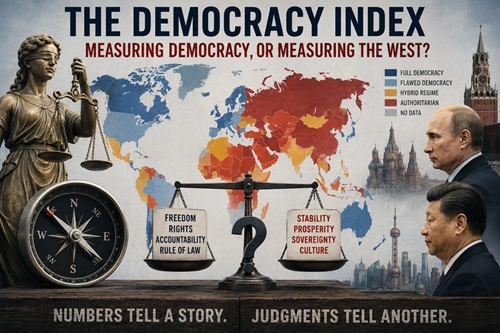
Every year, the Economist Intelligence Unit publishes its Democracy Index, producing what looks like a remarkably simple answer to a remarkably complicated question: which countries are democratic, and which are not? The latest edition, covering 2024, evaluates 167 countries and territories. It concludes that global democracy has continued to deteriorate: the global average fell to 5.17, its lowest level since the index began in 2006. Only about 45% of the world's population lives in a democracy, according to the EIU, while 39% live under authoritarian rule and 15% in hybrid regimes. These findings are certainly worth taking seriously. But there is a prior question that is less frequently asked: what exactly is being measured when we measure "democracy"? And an even more uncomfortable question follows: to what extent does the Democracy Index measure democracy itself, and to what extent does it measure conformity to a particular—largely Western liberal—conception of democracy? The answer is: probably both. Democracy is not a natural constantThere is no thermometer for democracy. We can measure voter turnout, the number of political parties, the frequency of elections, press freedom, judicial independence, civil liberties and many other things. But deciding which of these constitutes "democracy," how important each is, and how they should be combined involves normative judgments. The EIU is actually quite explicit about its conceptual framework. Its index consists of 60 indicators divided into five categories: electoral process and pluralism, functioning of government, political participation, political culture, and civil liberties. The five category scores are then simply averaged to produce an overall score from 0 to 10. Countries are subsequently classified as full democracies, flawed democracies, hybrid regimes or authoritarian regimes. This is a perfectly defensible methodology. But it isn't politically neutral. Consider "political culture." What kind of political culture counts as democratic? Presumably one characterized by tolerance, participation, trust in democratic institutions and acceptance of democratic procedures. Fine—but these are not merely empirical properties like temperature or population size. They embody a particular understanding of what a good political order should look like. The same applies even more strongly to "civil liberties." The EIU's conception of democracy is therefore not simply electoral democracy. It is something closer to liberal constitutional democracy: competitive elections plus individual rights, pluralism, institutional constraints, accountable government and a particular conception of political legitimacy. That is a legitimate conception of democracy. But it is not the only possible one. The Western fingerprintThere is an obvious historical reason for this. The modern vocabulary of liberal democracy emerged primarily from European and North American political traditions: constitutionalism, parliamentary government, individual rights, freedom of speech, separation of powers, religious toleration, universal suffrage and the rule of law. Many of these principles have subsequently become global norms, especially through the United Nations and international human-rights law. They should not therefore simply be dismissed as "Western." But their historical origin matters. When a predominantly Western institution constructs a global scale and puts countries such as Norway, Sweden, Denmark, Finland and New Zealand at the top, while placing China, Saudi Arabia, Russia and other non-liberal political systems at the bottom, one should at least ask whether the result partly reflects the assumptions built into the measuring instrument. The interesting point is that this does not mean that the rankings are necessarily wrong. It means that we should distinguish between two claims: "These countries score poorly according to this conception of democracy." and "These countries are objectively less democratic." The first is an empirical statement about a measurement system. The second is a much stronger philosophical claim. But "Western bias" can become an excuseThere is an equally serious danger on the other side. The accusation of Western bias can become a convenient rhetorical escape hatch for authoritarian governments. A government can imprison opposition politicians, censor newspapers, manipulate elections and eliminate independent civil society—and then dismiss criticism by saying: "That is merely Western liberalism. Our political culture is different." But cultural difference cannot explain everything. There are some fairly robust empirical features associated with political freedom: whether citizens can organize opposition parties, whether elections are genuinely competitive, whether governments can be peacefully removed, whether journalists can investigate those in power, whether citizens can criticize their leaders without fear, and whether courts can constrain the executive. If these things disappear, calling the resulting system "democracy" simply because its rulers claim to represent the people does not solve the problem. This is why the liberal component of the EIU index is not arbitrary. Democracy without meaningful political competition and individual political rights can easily become majoritarian authoritarianism. The question is therefore not whether liberal values belong in a democracy index. They probably do. The question is how much weight they should receive, and whether other democratic traditions and institutional forms are being adequately represented. Democracy is more than elections—but also less than liberalismThere is a curious paradox here. Critics sometimes complain that Western democracy indices are too liberal because they include civil liberties and institutional constraints. Yet democracy is also sometimes defined too narrowly in precisely the opposite direction: as simply the existence of elections. Neither extreme is satisfactory. A country can hold elections while the opposition is intimidated, the media controlled and the judiciary subordinated to the executive. Such a system may possess electoral legitimacy without possessing meaningful democratic accountability. Conversely, a country can have exceptionally strong liberal institutions while suffering from low political participation, declining trust and weak popular engagement. Democracy therefore has several dimensions that can pull in different directions. This is one reason alternative measurement projects are useful. V-Dem, for example, explicitly distinguishes between electoral, liberal, participatory, deliberative and egalitarian conceptions of democracy rather than collapsing everything immediately into one number. Its dataset contains hundreds of indicators and multiple democracy indices. That is methodologically more revealing. Instead of asking: "What is Country X's democracy score?" we can ask: "How democratic is Country X in what respect?" That is a much better question. Who gets to define "political culture"? The most problematic category may actually be political culture. Political institutions can be compared relatively straightforwardly. Does an opposition party exist? Are elections competitive? Can the government be voted out? But political culture is considerably more elusive. Western democracies tend to value individual autonomy, adversarial politics, freedom of expression and institutional distrust of government. Other societies may place greater emphasis on social harmony, communal obligations, hierarchy, consensus or political stability. Does a society become less democratic because its citizens prefer consensus to confrontation? Not necessarily. Indeed, Western political culture sometimes treats intense partisan competition as evidence of democratic vitality when it can also produce paralysis, polarization and institutional breakdown. The United States provides a useful warning here. It remains a "flawed democracy" in the EIU framework rather than a full democracy. The fact that the United States is not automatically placed at the pinnacle of the democratic hierarchy is actually one of the strengths of the methodology. A genuinely useful index must be capable of criticizing its own political civilization. The curious case of the Nordic countriesThe extraordinary performance of the Nordic countries illustrates both the strength and weakness of the index. Norway, Sweden, Finland, Denmark and Iceland consistently appear near the top. There are good reasons for this. They have competitive elections, high institutional trust, strong civil liberties, functioning governments, independent media and relatively inclusive political systems. But notice what else they have in common: they represent a very specific historical synthesis of liberal democracy, social democracy, strong welfare states, high state capacity, secularization, education and relatively egalitarian social structures. The Democracy Index therefore sometimes seems to reward an entire Nordic model of modernity, not simply democracy. This is not necessarily a flaw. Perhaps that model really does provide unusually favorable conditions for democratic government. But correlation should not be confused with definition. A country does not become more democratic merely because it resembles Denmark. What about non-Western democratic traditions?Here the critique becomes more interesting. India, for example, possesses a long and complicated democratic tradition, enormous electoral participation and peaceful transfers of power, but also severe problems involving civil liberties, minority rights, political polarization and institutional independence. Japan has developed an exceptionally stable parliamentary democracy, but its political system emerged through a very different historical trajectory from European liberalism. Botswana has often been praised for its relatively stable democratic institutions despite its very different socioeconomic and historical circumstances. Taiwan is particularly interesting because it combines a Chinese cultural heritage with a highly developed liberal democracy. These cases complicate the crude opposition between "Western democracy" and "non-Western alternatives." They suggest something more interesting: democratic institutions can be transplanted, adapted and indigenized. There is no single cultural route to democracy. The problem of expert judgmentThere is another methodological issue that deserves attention: who does the scoring? The EIU uses expert assessments alongside other evidence. That is unavoidable to some degree because many political qualities cannot be directly observed or reduced to a single statistic. But expert coding inevitably introduces interpretation. V-Dem has explicitly confronted this problem by using multiple expert coders and statistical models that estimate disagreement and uncertainty rather than pretending that political judgments are perfectly objective. The EIU's methodology is considerably more opaque in comparison. V-Dem researchers have previously criticized democracy indices including the EIU's for limited transparency and extensive reliance on expert-coded indicators. This does not mean that the EIU's scores are fabricated or unreliable. It means that a score such as 7.35 should not create the illusion of scientific precision. There is no meaningful political difference between 7.35 and 7.42 that the decimal points magically reveal. The number is a useful summary of a complicated judgment. It is not a physical measurement. One number hides many democraciesThis is perhaps the biggest conceptual problem with all democracy rankings. Imagine two countries. Country A has excellent elections and very high political participation, but weak civil liberties. Country B has exceptionally strong civil liberties and an independent judiciary, but low voter participation and declining trust in political institutions. They could easily end up with similar aggregate scores. But they have radically different democratic profiles. The single number hides the interesting information. This is why the EIU's five components are actually more valuable than its league table. The underlying dimensions tell us something about how a democracy succeeds or fails. The ranking tells us merely where it sits. And league tables encourage precisely the wrong kind of thinking: democracy becomes a competition in which countries compete for positions rather than a complex institutional achievement that can deteriorate in different ways. Western countries should be judged by the same standardThere is also a welcome feature of contemporary democracy indices that deserves emphasis: they increasingly apply their standards to Western countries themselves. The EIU does not give the United States a free pass simply because it is the world's most powerful liberal democracy. Freedom House likewise explicitly states that its standards apply across geographical and cultural boundaries and assesses countries according to actual political rights and civil liberties. That matters. A genuinely Western-biased index would presumably produce a comforting map in which the United States and its allies were always democratic champions. Reality is messier. The United States, France, Britain and other established democracies have experienced democratic backsliding, declining institutional trust, polarization, restrictions on civil liberties and challenges to constitutional norms. If a democracy index is capable of identifying these problems, its Western origin does not automatically invalidate it. Indeed, self-criticism is one of the strongest arguments against the claim that the entire enterprise is merely Western propaganda. Democracy is a contested universalThe deeper issue is philosophical. There are two bad positions. The first says: Western democracy is simply the universal standard, and every society should be judged by how closely it approximates the Western model. The second says: Every society has its own conception of political legitimacy, so there can be no meaningful universal criteria for judging democracy. The first is ethnocentric. The second makes comparative political analysis almost impossible—and potentially gives authoritarian regimes an intellectual alibi. A better position is to recognize universal principles without assuming a universal institutional template. Political equality, meaningful participation, accountability, peaceful succession of power, freedom from arbitrary coercion and the capacity of citizens to contest political authority are defensible as broadly universal democratic principles. But the institutional arrangements through which these principles are realized can legitimately vary. Parliamentary systems need not look identical. Federalism is not necessary. Presidentialism is not necessary. Consensus democracy is not the same as majoritarian democracy. Electoral systems can differ enormously. Democracy has a family resemblance, not a single blueprint. So, is the Democracy Index Western-biased?Yes—but that statement requires qualification. It is Western in its intellectual genealogy, its liberal conception of democracy, its emphasis on individual civil liberties and its assumptions about the desirable relationship between citizen and state. But this does not make it worthless, nor does it make its conclusions automatically wrong. Many of the values it measures have escaped their Western origins and become part of a genuinely global political vocabulary. The Universal Declaration of Human Rights itself provides part of the normative foundation for Freedom House's methodology. The real problem is not that the Democracy Index is "Western." The real problem is that a complex, multidimensional and culturally contested phenomenon is compressed into a single numerical hierarchy. That compression creates an illusion of objectivity. Perhaps the best way to use the Democracy Index is therefore not to ask: "Which country is number one?" but: "What conception of democracy is being measured, what assumptions are built into that conception, and where does each country succeed or fail according to those criteria?" That turns the index from a global scoreboard into what it should be: a comparative analytical instrument. And there is one final irony. If democracy is genuinely about citizens having the ability to question authority, challenge conventional wisdom and participate in defining the rules by which they are governed, then a democracy index itself should be treated democratically. It should be questioned. It should be contested. And, like democracy itself, it should never be allowed to become unquestionable. Appendix: Russia and China — Two Different Challenges to the Liberal-Democratic ModelRussia and China are often grouped together in Western democracy rankings as authoritarian regimes. At the level of classification, that is defensible. But analytically they are quite different political systems, and treating them as interchangeable obscures more than it reveals. Russia: Electoral authoritarianismRussia is the easier case. The country has elections, political parties, a parliament and a constitution, but these institutions no longer provide meaningful mechanisms for replacing the political leadership. Opposition figures have been imprisoned, exiled or otherwise prevented from competing effectively; independent media have been severely restricted; and the political system has become increasingly centered on Vladimir Putin. The important distinction is therefore between electoral institutions and electoral competition. Russia has the former but increasingly lacks the latter. This makes "electoral authoritarianism" or "competitive authoritarianism" more informative descriptions than simply saying "Russia is not a democracy." Elections continue to perform important functions: they provide legitimacy, mobilize supporters, register public discontent and help the regime monitor society. But they do not constitute a credible mechanism through which an organized opposition can peacefully take power. The invasion of Ukraine accelerated this authoritarian consolidation. Wartime censorship, repression of dissent and the criminalization of criticism of the military have dramatically narrowed the political sphere. There is therefore little reason to regard contemporary Russia as a liberal democracy. On virtually any reasonable definition involving competitive elections, political pluralism, freedom of expression and meaningful constraints on executive power, Russia performs poorly. But there is an important qualification. Russia's authoritarianism should not be explained simply as an expression of "Russian culture." Russia has experienced periods of genuine political pluralism, particularly during the chaotic 1990s. The trajectory toward authoritarianism was political and institutional, not an inevitable consequence of Russian civilization. Nor should Russia's current system be confused with Soviet totalitarianism. Contemporary Russia retains private property, substantial social autonomy, religious organizations, elections and considerable room for private life. It is authoritarian, but it is not the Soviet Union resurrected. China: authoritarianism with substantial political participationChina presents a more difficult theoretical case. The People's Republic of China is unquestionably authoritarian in the conventional liberal-democratic sense. The Chinese Communist Party monopolizes national political power. There is no realistic mechanism through which an opposition party can win national elections and replace the Communist Party. Freedom of expression and association are constrained, political dissent is suppressed, and the judiciary is not independent of the Party-state. On these criteria, China scores very poorly on the EIU Democracy Index—and rightly so. But simply calling China "undemocratic" leaves out an important question: what kind of political legitimacy does the Chinese system claim, and how does it obtain it? China does not primarily justify its political system through competitive multiparty elections. Its legitimacy rests on a different combination: economic performance, national development, social stability, nationalism, bureaucratic competence, responsiveness to popular concerns and the claim that the Communist Party represents the long-term interests of the Chinese people. There is also substantial political participation below the national level. Citizens participate in local elections, neighborhood organizations, consultations, petitions and various forms of administrative feedback. None of this amounts to liberal democracy, because the fundamental distribution of political power remains outside electoral contestation. But it does demonstrate that political participation and political competition are not identical concepts. That distinction is important when evaluating the Democracy Index. The legitimacy problemChina raises a difficult question for Western democratic theory. Suppose a government cannot be voted out of office, but is highly responsive to public opinion, provides effective administration, enjoys considerable popular support and delivers improvements in living standards. Is it democratic? The liberal answer is essentially: no. And there is a strong argument for that answer. Without the possibility of organized opposition taking power, citizens lack the ultimate political sanction that makes rulers accountable. A government can be responsive today while becoming arbitrary tomorrow. But the Chinese case demonstrates that democratic legitimacy and regime legitimacy are not the same thing. A government can possess legitimacy in the eyes of many citizens without being democratic in the liberal sense. That distinction is sometimes lost in Western discussions of China. The Chinese "performance legitimacy" argument China's economic transformation has therefore become an important part of the political argument. Since the late 1970s, hundreds of millions of people have experienced enormous improvements in material living standards. China has developed sophisticated infrastructure, expanded education and created a highly capable state apparatus. This does not prove that the Chinese political system is democratic. It does, however, undermine the simplistic assumption that authoritarian government necessarily implies governmental incompetence or popular rejection. The Chinese Communist Party has demonstrated an unusual capacity for long-term policy implementation. The more interesting question is whether performance legitimacy can substitute indefinitely for electoral accountability. That remains uncertain. Economic growth can slow. Inequality can become politically destabilizing. Corruption can undermine trust. Policy mistakes can become catastrophic when there are insufficient institutional mechanisms for openly challenging the leadership. The COVID-19 pandemic illustrated precisely this tension. China's state demonstrated extraordinary capacity for mobilization, but the political system's restrictions on information and dissent also contributed to serious problems, particularly during the early stages of the pandemic and later during the prolonged zero-COVID period. The same institutional characteristics can therefore produce both impressive state capacity and dangerous rigidity. Russia and China should not be placed in the same boxThe contrast is revealing. Russia under Putin is heavily personalized. The political system revolves around a dominant leader and a network of security, bureaucratic and oligarchic interests. China is much more institutionalized. Xi Jinping has concentrated power to an extraordinary degree, but the Communist Party remains a vast bureaucratic organization penetrating virtually every level of the state and society. China therefore cannot be understood simply as "Xi Jinping's dictatorship" in the way Russia can more plausibly be described through Putin's personal political dominance. China also possesses something Russia increasingly lacks: a coherent governing ideology and an extensive institutional structure for recruiting, educating and managing political elites. The two systems therefore represent different forms of authoritarianism. Russia resembles personalized electoral authoritarianism. China resembles party-state authoritarianism with consultative and participatory mechanisms. Both fail the liberal-democratic test. They fail it for rather different reasons. What the Democracy Index gets rightThe EIU is therefore justified in placing both countries in its authoritarian category. If democracy means that citizens possess a meaningful institutional mechanism for choosing among competing political programs and replacing their rulers, neither Russia nor China qualifies. The index's emphasis on civil liberties is equally important. Political participation without freedom to organize, criticize and associate is severely constrained. The Western liberal conception therefore captures something fundamental rather than merely imposing an arbitrary cultural preference. What the Democracy Index missesAt the same time, the single authoritarian label conceals important differences. Russia and China have radically different political institutions, state capacities, relationships between government and society, forms of political participation and sources of legitimacy. More importantly, the binary distinction between "democratic" and "authoritarian" can obscure a broader spectrum of political accountability. China has mechanisms of vertical accountability—bureaucrats are evaluated by superiors—and forms of social feedback that can influence policy. Russia has considerably fewer effective constraints on the presidency. Neither constitutes liberal democracy, but neither is politically identical to North Korea either. This is where multidimensional democracy measures are superior to simple rankings. V-Dem's distinction between electoral, liberal, participatory, deliberative and egalitarian dimensions is particularly useful because it allows us to see precisely what is missing rather than merely assigning a country a low score. The crucial distinction: democracy versus good governmentUltimately, China forces us to separate two questions that are often conflated: How democratic is a government? and How effectively does a government govern? These are different variables. A democracy can be badly governed. An authoritarian regime can be highly competent. A democracy can protect individual rights while suffering from paralysis. An authoritarian government can mobilize resources with extraordinary speed. The democratic argument is not that elections guarantee good government. It is that political accountability provides citizens with a mechanism for correcting bad government without having to overthrow the political system itself. That is a much more modest—and much stronger—argument. Russia and China as a test of Western democracyRussia and China therefore expose both the strength and limitation of the Democracy Index. It is correct to classify both as authoritarian. But if the index encourages us to think that "authoritarian" is a sufficient description, it becomes analytically impoverished. Russia demonstrates the dangers of personalized power, suppressed opposition and the erosion of institutional checks. China demonstrates something more intellectually challenging: a sophisticated, highly capable authoritarian state can generate substantial political legitimacy without becoming liberal-democratic. The Western response should not be to pretend that China is secretly democratic. Nor should it be to dismiss Chinese political legitimacy as mere propaganda. The more intellectually honest conclusion is that China represents a genuine alternative model of political organization—but not necessarily an alternative model of democracy. And that distinction is crucial. China challenges the claim that liberal democracy is the only possible form of legitimate and effective government. It does not, by itself, disprove the claim that liberal democracy provides the strongest institutional safeguards against arbitrary political power. That remains the central unresolved question—and perhaps the most important one any global Democracy Index should measure.
Widget is loading comments...
|