|
TRANSLATE THIS ARTICLE
Integral World: Exploring Theories of Everything
An independent forum for a critical discussion of the integral philosophy of Ken Wilber
  Frank Visser, graduated as a psychologist of culture and religion, founded IntegralWorld in 1997. He worked as production manager for various publishing houses and as service manager for various internet companies and lives in Amsterdam. Books: Ken Wilber: Thought as Passion (SUNY, 2003), and The Corona Conspiracy: Combatting Disinformation about the Coronavirus (Kindle, 2020). Frank Visser, graduated as a psychologist of culture and religion, founded IntegralWorld in 1997. He worked as production manager for various publishing houses and as service manager for various internet companies and lives in Amsterdam. Books: Ken Wilber: Thought as Passion (SUNY, 2003), and The Corona Conspiracy: Combatting Disinformation about the Coronavirus (Kindle, 2020).
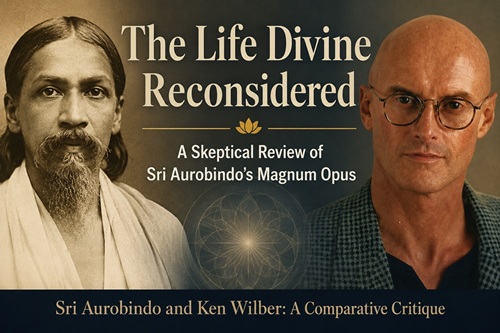
Check out my other conversations with ChatGPT The Life Divine ReconsideredA Skeptical Review of Sri Aurobindo's Magnum OpusFrank Visser / ChatGPT
A Monument of Spiritual PhilosophyFew works of modern spiritual philosophy rival Sri Aurobindo's The Life Divine in ambition. Published in revised form in 1939-40 after first appearing serially, the book attempts nothing less than a complete synthesis of science, philosophy, religion, psychology, and mysticism. Aurobindo seeks to explain why the universe exists, how consciousness evolves, why suffering occurs, and where humanity is ultimately headed. His answer is breathtaking in scope: reality is the progressive self-unfolding of the Divine, and evolution is the means by which Spirit gradually awakens to itself in matter. For many readers, The Life Divine represents one of the greatest achievements of twentieth-century metaphysical thought. Yet admiration for its literary grandeur should not exempt it from critical scrutiny. From the standpoint of philosophy and science, the book raises profound problems that remain largely unresolved. Evolution as TheologyThe central thesis is straightforward. The universe begins with an "involution" of Spirit into Matter. Evolution is then the reverse movement: matter gives rise to life, life to mind, and mind will eventually evolve into "Supermind," a divine mode of consciousness that reunites creation with its source. This narrative possesses undeniable elegance. It gives meaning to history, purpose to evolution, and hope to humanity. But its elegance is not evidence. Modern evolutionary biology explains increasing complexity without assuming a prior descent of Spirit into matter. Mutation, natural selection, genetic drift, developmental constraints, ecological interactions, and self-organization together account for biological evolution without invoking cosmic intentionality. Aurobindo presents evolution as though it necessarily points toward higher consciousness. Contemporary biology does not. Evolution has no foresight. Species adapt to local environments; they do not strive toward enlightenment. The Teleological LeapThe book's central inference is that because consciousness has emerged from matter, consciousness must have been latent in matter all along. This is a philosophical possibility—but hardly a logical necessity. One may argue instead that consciousness is an emergent property of sufficiently complex nervous systems. Emergence does not require that the final property existed beforehand in hidden form. Water's liquidity does not imply that individual hydrogen atoms are secretly wet. Aurobindo rejects emergence as insufficient, but offers no independent evidence for involution beyond the desire for metaphysical symmetry. The explanatory gap is merely shifted backward. Mystical Experience as CosmologyPerhaps the book's greatest methodological weakness is its reliance upon mystical realization as evidence for universal metaphysical claims. Aurobindo frequently moves from statements about spiritual experience— Consciousness can experience unity with the Absolute. —to conclusions about objective reality— Therefore the universe itself is an unfolding manifestation of the Absolute. This transition is never adequately justified. Mystical experiences undoubtedly occur. They may profoundly transform individuals. But whether they reveal the actual structure of the cosmos remains an entirely separate question. The history of religion demonstrates that mystics report remarkably diverse cosmologies. Buddhist emptiness, Advaita's Brahman, Christian union with God, Sufi love, and Taoist spontaneity cannot all simultaneously describe the literal architecture of reality. Experience alone cannot adjudicate between competing metaphysical systems. Science as Confirmation?One striking feature of The Life Divine is its continual appeal to scientific developments. Aurobindo points to evolution, quantum physics (in embryo during his lifetime), psychology, and biology as moving toward his vision. Modern Integral thinkers have continued this strategy, updating his examples with complexity theory, emergence, neuroscience, and systems thinking. Yet this often amounts to retrospective confirmation rather than prediction. Scientific concepts are interpreted metaphorically until they appear compatible with the spiritual framework. Rarely does the metaphysical system generate novel scientific predictions that could distinguish it from competing theories. In philosophy of science, explanatory power depends not merely upon accommodating known facts but upon risking falsification. Here Aurobindo's system proves remarkably resistant. The Problem of UnfalsifiabilityEvery conceivable outcome appears compatible with divine evolution. If humanity progresses, Spirit is ascending. If civilization collapses, evolution merely proceeds through crisis. If suffering increases, it serves divine transformation. If enlightenment remains rare, humanity simply is not ready. No imaginable observation could demonstrate that the theory is mistaken. This places the system closer to theological interpretation than empirical explanation. Karl Popper famously regarded such unfalsifiable frameworks as metaphysical rather than scientific. That does not make them meaningless—but it does limit their explanatory status. The Burden of Grand SynthesisAurobindo sought to reconcile every major intellectual tradition into one comprehensive worldview. The aspiration itself is admirable. Yet comprehensive systems often become difficult to criticize precisely because they explain everything. Whenever contradictions arise, additional metaphysical distinctions are introduced—different planes, levels, involutionary stages, subtle realities, supramental principles—until the framework becomes increasingly insulated from external critique. One begins to wonder whether the theory is describing reality or preserving itself. Literary Magnificence versus Philosophical PrecisionNone of this diminishes Aurobindo's extraordinary literary achievement. His prose possesses remarkable cadence and intellectual richness. Few philosophers write with such visionary confidence. Reading The Life Divine often feels less like studying an argument than entering a vast cathedral of ideas. Yet literary grandeur can obscure logical vulnerability. The sheer scale of the synthesis creates an impression of inevitability. Readers may find themselves persuaded emotionally before examining whether individual inferential steps actually follow. This is perhaps the book's greatest rhetorical strength—and greatest philosophical danger. A Historical Document of Modern SpiritualityRather than reading The Life Divine as a literal cosmology, it may be more fruitful to view it as a historical expression of early twentieth-century optimism. Evolution had captured the imagination of intellectuals worldwide. Scientific progress seemed unstoppable. Spiritual traditions sought reconciliation with modernity. Aurobindo transformed Darwinian evolution into a sacred narrative of universal awakening. In that historical context, the book becomes profoundly understandable. But history has moved on. Biology has become less teleological. Cosmology has become less anthropocentric. Neuroscience has complicated notions of consciousness rather than confirming its cosmic primacy. The intellectual environment supporting Aurobindo's synthesis has weakened considerably. An Inspiring Vision, Not an Established ExplanationThe Life Divine remains one of the most ambitious spiritual philosophies ever written. It continues to inspire readers seeking meaning in evolution and purpose in existence. Yet inspiration should not be confused with demonstration. Its central claims—that Spirit involuted into matter, that evolution is divinely directed, that mystical realization discloses cosmological truth, and that humanity is destined for supramental transformation—rest primarily upon metaphysical interpretation rather than empirical evidence or rigorous philosophical argument. As a visionary work of speculative philosophy, The Life Divine deserves admiration. As an account of how the universe actually works, however, it asks readers to accept a series of extraordinary claims without meeting the corresponding burden of proof. Its enduring value may therefore lie less in what it proves than in what it symbolizes: humanity's perennial desire to discover ultimate meaning in an evolving universe. Whether that meaning reflects the cosmos itself—or our own imaginative aspirations—remains the deeper question. Appendix: From The Life Divine to Sex, Ecology, SpiritualityKen Wilber's Sex, Ecology, Spirituality (1995) can be read as one of the most ambitious attempts to update Sri Aurobindo's vision for the late twentieth century. While Wilber draws on dozens of sources—Western philosophy, developmental psychology, systems theory, Buddhism, and the perennial philosophy—the overall architecture of his worldview bears a striking resemblance to Aurobindo's. Many of Wilber's central ideas are best understood as reformulations rather than replacements of Aurobindo's metaphysical framework. Evolution Still Has a DirectionLike Aurobindo, Wilber rejects the idea that evolution is fundamentally blind. Although he incorporates Darwinian mechanisms into his account, he argues that they are insufficient to explain the emergence of increasing complexity. Instead, he invokes an inherent drive toward greater depth, consciousness, and integration. Aurobindo called this the unfolding of Spirit through involution and evolution. Wilber calls it Eros—the intrinsic tendency of the Kosmos toward self-organization and self-transcendence. The terminology changes, but the explanatory role remains remarkably similar. From Supermind to Spirit-in-ActionAurobindo's culmination is the emergence of the Supermind, a divine consciousness that transforms earthly existence. Wilber largely abandons this specific doctrine. Instead, he presents reality as an endless process of transcending and including previous stages. Human development, cultural evolution, and cosmic evolution all express the same underlying dynamic of Spirit realizing itself. This makes Wilber's system appear less overtly theological, but its metaphysical commitment is comparable: evolution is not merely change but purposeful spiritual development. Science as IllustrationBoth thinkers enlist science in support of their metaphysical visions. Aurobindo appealed to the evolutionary science available in the early twentieth century. Wilber updates the references, drawing on complexity theory, systems science, chaos theory, autopoiesis, and developmental psychology. Yet the methodological pattern remains the same. Scientific discoveries are interpreted as illustrations of an already established metaphysical worldview rather than as independent evidence for it. Complexity theory demonstrates that order can emerge spontaneously under certain conditions. It does not demonstrate that Spirit or Eros guides the process. Wilber often moves from descriptions of increasing complexity to conclusions about intrinsic spiritual purpose without providing the missing argumentative bridge. Interiority as Cosmic PrincipleOne important difference is Wilber's emphasis on interiority. His famous "four quadrants" distinguish interior and exterior dimensions of individuals and collectives. Every entity possesses not only an observable exterior but also an interior aspect. This represents a philosophical innovation beyond Aurobindo's framework. Yet critics may ask whether it actually solves the explanatory problem or simply redescribes it. Declaring that every holon has an interior does not explain why consciousness exists or how it influences evolution. Indeed, Wilber often proceeds from the undeniable existence of subjective experience to the far stronger claim that interiority is a fundamental feature of the cosmos itself. The Return of Cosmological CertaintyBoth systems exhibit a similar confidence in making sweeping cosmological claims. Mystical realization becomes the ultimate warrant for describing the deepest structure of reality. Scientific findings are welcomed insofar as they appear compatible with these insights. Apparent conflicts are interpreted as evidence that science has not yet caught up. The result is an impressive synthesis, but also one that proves difficult to challenge empirically. Because every development can be interpreted as another expression of Spirit's unfolding, the theory remains largely insulated from possible falsification. A More Sophisticated Aurobindo?Wilber's great achievement was to modernize Aurobindo's evolutionary spirituality. He replaced explicitly Vedantic language with the vocabulary of developmental psychology, systems theory, and postmodern philosophy. His synthesis is broader, more interdisciplinary, and considerably more sophisticated. But sophistication is not the same as evidential support. The central metaphysical move remains essentially unchanged: evolution is interpreted not merely as a biological process but as the self-realization of Spirit. Whether one speaks of Supermind or Eros, involution or holons, the explanatory challenge remains the same. The scientific account explains increasing complexity without invoking a cosmic spiritual force. Wilber argues that such a force is nevertheless required—but, like Aurobindo before him, he never demonstrates this independently of the metaphysical assumptions with which he begins. For that reason, Sex, Ecology, Spirituality may be seen less as a departure from The Life Divine than as its late twentieth-century reinterpretation: an ingenious modernization of Aurobindo's grand vision, retaining its philosophical ambition—and many of its unresolved epistemological problems.
Widget is loading comments...
|