|
TRANSLATE THIS ARTICLE
Integral World: Exploring Theories of Everything
An independent forum for a critical discussion of the integral philosophy of Ken Wilber
  Frank Visser, graduated as a psychologist of culture and religion, founded IntegralWorld in 1997. He worked as production manager for various publishing houses and as service manager for various internet companies and lives in Amsterdam. Books: Ken Wilber: Thought as Passion (SUNY, 2003), and The Corona Conspiracy: Combatting Disinformation about the Coronavirus (Kindle, 2020). Frank Visser, graduated as a psychologist of culture and religion, founded IntegralWorld in 1997. He worked as production manager for various publishing houses and as service manager for various internet companies and lives in Amsterdam. Books: Ken Wilber: Thought as Passion (SUNY, 2003), and The Corona Conspiracy: Combatting Disinformation about the Coronavirus (Kindle, 2020).
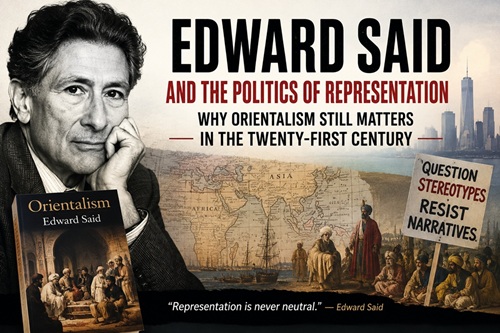
Check out my other conversations with ChatGPT Edward Said and the Politics of RepresentationWhy Orientalism Still Matters in the Twenty-First CenturyFrank Visser / ChatGPT
IntroductionFew books have had as profound an impact on the humanities as Edward Said's Orientalism (1978). It fundamentally changed how scholars think about the relationship between knowledge and power, exposing how Western representations of the "East" often reflected colonial ambitions more than objective reality. Nearly half a century later, Said's ideas continue to shape debates about imperialism, media, identity, and international politics. Yet his work has also generated fierce criticism. Some argue that he overstated Western prejudice, ignored internal diversity, or unintentionally encouraged cultural relativism. Understanding Said today requires appreciating both his lasting insights and his limitations. The Invention of "the Orient"Said's central claim was remarkably simple: the "Orient" was not merely a geographical region but a cultural invention. European scholars, artists, novelists, and colonial administrators portrayed the Middle East, North Africa, and Asia as mysterious, irrational, emotional, despotic, sensual, and fundamentally different from the rational, progressive West. These images appeared repeatedly in literature, travel writing, scholarship, and political discourse. The problem was not that these descriptions were entirely false. Rather, they became stereotypes that justified colonial domination. If the East was backward, then Western rule appeared as civilization. If Eastern societies were incapable of governing themselves, empire could be presented as benevolent. Knowledge became a tool of power. Foucault's InfluenceSaid was deeply influenced by the French philosopher Michel Foucault, who argued that knowledge and power are inseparable. Academic disciplines do not merely describe reality; they help construct it. Oriental studies produced an authoritative discourse that shaped how Europeans understood—and governed—the peoples they colonized. Maps, museums, dictionaries, archaeological expeditions, and ethnographies were not politically neutral enterprises. They often reinforced imperial control. This insight revolutionized fields ranging from history and anthropology to literary criticism. Colonialism Beyond Military RuleOne of Said's enduring contributions was to show that colonialism survives culturally long after formal empires disappear. Films, journalism, political speeches, and even school textbooks continue to recycle familiar images: • the violent Arab • the mystical Indian • the inscrutable Chinese • the tribal African These stereotypes influence immigration debates, foreign policy, and public opinion. After September 11, many commentators noted how media portrayals of Islam often echoed older Orientalist patterns that Said had described decades earlier. Representation Is Never NeutralPerhaps Said's most enduring lesson is methodological. Whenever we encounter descriptions of another culture, we should ask: • Who is speaking? • Who benefits from this representation? • Whose voices are absent? • What assumptions are taken for granted? These questions remain invaluable not only for studying colonialism but also for analyzing modern journalism, social media, and political rhetoric. Criticisms of SaidDespite its influence, Orientalism has attracted substantial criticism. Historians argue that Said painted "the West" with too broad a brush. European scholarship was never a single unified project. Many Orientalists genuinely admired Eastern civilizations, preserved ancient manuscripts, and advanced linguistic scholarship. Others note that Said largely ignored German Orientalism, which developed without significant colonial ambitions in the Middle East. Some scholars also contend that he underestimated the agency of Middle Eastern intellectuals themselves, portraying them primarily as passive objects of Western discourse. The Problem of Reverse EssentialismIronically, critics argue that Said sometimes committed the very error he criticized. Just as Orientalists generalized about "the East," Said often generalized about "the West." European scholarship contained fierce internal disagreements, competing political agendas, and genuine attempts at objectivity. Reducing centuries of scholarship to an imperial discourse risks oversimplification. Reality is usually messier than grand theoretical narratives. Influence on Identity PoliticsSaid's work helped inspire what later became postcolonial studies. Scholars increasingly examined how race, gender, sexuality, and colonial history shape knowledge production. This opened important conversations about marginalized voices and historical injustice. At the same time, critics argue that some later developments drifted toward excessive skepticism about objectivity itself. If every account merely reflects power, can objective knowledge ever exist? Many scientists and historians worry that this question has sometimes been answered too pessimistically. Relevance in a Multipolar WorldToday's world is more complex than the one Said analyzed. China now produces its own narratives about the West. Russia portrays Europe through its own ideological lens. Islamist movements often depict Western civilization in highly stereotyped ways. Nationalist governments everywhere construct simplified images of foreign cultures. In other words, Orientalism has become only one example of a broader phenomenon: civilizations often caricature one another. Representation remains political regardless of who is doing the representing. The Internet Changes EverythingSocial media has transformed cross-cultural representation. Individuals now speak directly across national boundaries without relying solely on newspapers or academic experts. Yet algorithms also amplify stereotypes, outrage, and misinformation. Old Orientalist images coexist with new digital echo chambers. The struggle over representation has become democratized—but not necessarily more truthful. Lessons for TodaySaid reminds us that knowledge is never entirely innocent. Descriptions of cultures always emerge within historical contexts and power relationships. At the same time, criticism of Said reminds us that recognizing bias should not lead us to abandon the pursuit of objective understanding altogether. The challenge is to remain both self-critical and evidence-based. We should question inherited narratives without assuming that all narratives are equally distorted. ConclusionEdward Said remains one of the most influential public intellectuals of the twentieth century because he exposed an uncomfortable truth: ideas can legitimize domination just as effectively as armies. His analysis permanently changed how scholars think about empire, culture, and representation. Yet his work also illustrates the dangers of replacing one sweeping narrative with another. Critical scholarship requires questioning stereotypes wherever they arise—whether they portray East or West, colonizer or colonized. Said's greatest legacy may therefore be less a specific theory than a habit of mind: asking who constructs knowledge, for what purposes, and whose voices remain unheard. That question remains as relevant today as it was in 1978.
HTML Comment Box is loading comments...
|