|
TRANSLATE THIS ARTICLE
Integral World: Exploring Theories of Everything
An independent forum for a critical discussion of the integral philosophy of Ken Wilber
  Frank Visser, graduated as a psychologist of culture and religion, founded IntegralWorld in 1997. He worked as production manager for various publishing houses and as service manager for various internet companies and lives in Amsterdam. Books: Ken Wilber: Thought as Passion (SUNY, 2003), and The Corona Conspiracy: Combatting Disinformation about the Coronavirus (Kindle, 2020). Frank Visser, graduated as a psychologist of culture and religion, founded IntegralWorld in 1997. He worked as production manager for various publishing houses and as service manager for various internet companies and lives in Amsterdam. Books: Ken Wilber: Thought as Passion (SUNY, 2003), and The Corona Conspiracy: Combatting Disinformation about the Coronavirus (Kindle, 2020).
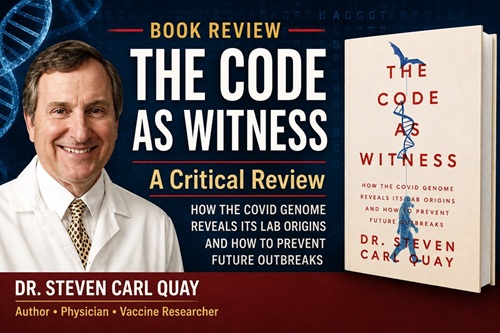
Check out my other conversations with ChatGPT The Code as Witness (2026) by Dr. Steven QuayA Critical ReviewFrank Visser / ChatGPT
With The Code as Witness: How the Covid Genome Reveals its Lab Origins and How to Prevent Future Outbreaks, Dr. Steven Quay enters one of the most contentious scientific debates of the twenty-first century. His central claim is bold: the SARS-CoV-2 genome itself constitutes forensic evidence that the virus was engineered in a laboratory and accidentally released from the Wuhan Institute of Virology. The book further argues that this conclusion should fundamentally reshape international policy on gain-of-function research. Whether or not one agrees with Quay's conclusions, the book deserves attention. It is carefully written, technically ambitious, and raises legitimate questions about biosafety and scientific transparency. Yet it also illustrates the pitfalls of building a sweeping historical narrative upon a collection of disputed molecular clues. The Genome as Detective StoryQuay structures the book as a scientific investigation. Instead of relying primarily on intelligence reports or political allegations, he focuses on the viral genome itself. According to him, features such as the furin cleavage site, codon usage, receptor-binding optimization, and other molecular characteristics collectively point toward laboratory manipulation rather than natural evolution. This is an attractive approach. Genomes do preserve evolutionary history. Molecular biology has repeatedly used genetic evidence to reconstruct transmission pathways and evolutionary origins. Quay therefore presents the virus itself as the ultimate witness. The problem is that genomes rarely function like fingerprints in a criminal investigation. Evolution produces patterns that are often ambiguous. Different evolutionary pathways can generate similar genetic outcomes. Consequently, the same genomic observations can frequently support multiple hypotheses. A Strong Case—But Not a Conclusive OneQuay is at his best when explaining molecular biology to general readers. His descriptions of viral genetics are generally clear and accessible. He also succeeds in explaining why some virologists questioned aspects of SARS-CoV-2 from the very beginning. However, he repeatedly moves from "consistent with" to "therefore proves." This is a significant logical leap. Scientific inference normally distinguishes between: • evidence compatible with a hypothesis, • evidence favoring a hypothesis, • evidence uniquely demonstrating a hypothesis. Much of Quay's evidence belongs in the second category rather than the third. Many evolutionary biologists acknowledge that the lab-origin hypothesis is plausible. Far fewer accept Quay's stronger assertion that the genome itself proves deliberate engineering. The Missing Weight of UncertaintyPerhaps the book's greatest weakness is its limited engagement with uncertainty. Science advances by comparing competing explanations. Although Quay discusses natural spillover, the discussion often serves more as a rebuttal than as a balanced examination of competing evidence. The origin debate remains unresolved precisely because both principal hypotheses face evidentiary gaps. The laboratory hypothesis lacks direct documentation of a precursor virus inside the Wuhan Institute. The zoonotic hypothesis lacks identification of the immediate animal host and transmission chain. Recognizing these uncertainties would not weaken Quay's case. On the contrary, it would strengthen its scientific credibility. Confirmation Bias?Readers familiar with Quay's numerous publications and Senate testimony will recognize that he has consistently defended the laboratory hypothesis since 2020.[1] Consistency is not itself a flaw. The concern is whether the book seriously entertains observations that complicate his preferred explanation. Here the narrative often feels one-sided. Counterarguments tend to be presented briefly before being dismissed. Alternative evolutionary interpretations receive relatively little sustained treatment. As a result, the book sometimes resembles a legal brief more than a scientific review. Politics and ScienceAn unavoidable feature of the COVID-origin debate has been its political polarization. Quay argues that scientific institutions suppressed discussion of laboratory origin, motivated by reputational concerns and conflicts of interest. There is substantial evidence that early public discussion of lab origin was sometimes discouraged and that several influential scientists coordinated messaging during the pandemic. Those historical episodes deserve careful examination. Yet Quay occasionally attributes motives where documentary evidence remains incomplete. Distinguishing institutional behavior from individual intent is important if the goal is objective historical analysis. Gain-of-Function: The Strongest Part of the BookIronically, the most persuasive section may not concern the virus's origin at all. Quay argues that modern gain-of-function research requires far stronger international oversight. Even readers skeptical of his conclusions regarding SARS-CoV-2 may find much to agree with here. The pandemic exposed weaknesses in: • biosafety regulation, • international transparency, • laboratory reporting, • oversight of risky pathogen research. On these broader policy issues, a remarkable consensus has emerged across scientists holding very different views about COVID's origin. Scientific Forensics Has LimitsThe book's title—The Code as Witness—captures both its greatest strength and its greatest weakness. Genomes certainly testify. But they rarely testify alone. A complete forensic reconstruction also requires laboratory notebooks, virus databases, sampling records, epidemiology, intelligence information, and transparent international investigation. The genome is an important witness—but not necessarily the decisive witness Quay claims it to be. Final AssessmentSteven Quay has written an important contribution to the continuing debate over COVID-19's origin. The book is technically sophisticated, accessible to non-specialists, and raises serious questions that deserve scientific attention rather than political dismissal. At the same time, its argumentative style tends toward certainty where the available evidence still supports multiple interpretations. Quay frequently presents probabilistic reasoning as if it constituted definitive proof. Readers should therefore distinguish between the impressive accumulation of suggestive evidence and the stronger claim that the genome alone conclusively establishes laboratory engineering. As a work of scientific advocacy, The Code as Witness is compelling. As a work of dispassionate scientific analysis, it is less convincing. Its lasting contribution may ultimately lie not in settling the origin debate, but in strengthening the case for far more rigorous oversight of high-risk virological research—a conclusion that transcends the unresolved question of where SARS-CoV-2 actually came from. Appendix: The Genomic Evidence for a Laboratory Origin—How Strong Is It?One of the distinctive features of Steven Quay's The Code as Witness is that it treats the SARS-CoV-2 genome itself as forensic evidence. Rather than relying on political or intelligence reports, Quay argues that the virus carries molecular "fingerprints" of laboratory manipulation. His case is cumulative: no single feature proves engineering, but taken together, he argues, the probability of a natural origin becomes vanishingly small. How persuasive are these individual arguments? Here is a critical assessment. 1. The Furin Cleavage Site (FCS)Quay's argument The strongest and most famous argument concerns the insertion of a 12-nucleotide sequence (PRRA) that creates a furin cleavage site between the S1 and S2 domains of the spike protein. This feature immediately attracted attention because: • SARS-CoV-2's closest known relatives lack it. • Furin cleavage sites are known to increase infectivity. • Scientists had previously discussed experimentally inserting such sites into coronaviruses. Quay argues that this insertion is exactly the sort of modification one would introduce to study enhanced infectivity. Scientific assessment This remains one of the strongest pieces of evidence supporting a possible laboratory origin. However: • furin cleavage sites evolve naturally in many virus families; • later-discovered bat coronaviruses show partial similarities; • no direct ancestor has yet been found. Evidential value: ★★★★☆ Strongly suggestive, but not decisive. 2. The CGG-CGG Double CodonQuay's argument The inserted PRRA sequence contains two consecutive CGG codons coding for arginine. CGG is relatively uncommon among coronaviruses but common in human molecular biology laboratories because it is frequently used in synthetic DNA constructs. Quay argues this represents a molecular signature of laboratory synthesis. Scientific assessment This argument received enormous publicity early in the pandemic. Its weakness is that: • CGG codons do occur naturally. • Double CGGs are rare but not impossible. • Codon usage evolves under multiple constraints. Many molecular biologists consider this evidence weak. Evidential value: ★★☆☆☆ Interesting coincidence rather than strong evidence. 3. Absence in Closest Known RelativesQuay's argument None of SARS-CoV-2's closest known relatives possesses the furin cleavage site. Therefore, Quay argues, the insertion did not arise through ordinary evolution. Scientific assessment This is persuasive only if current sampling is nearly complete. Unfortunately, wildlife coronavirus sampling remains extremely incomplete. Thousands—perhaps millions—of bat coronaviruses remain undiscovered. Absence of evidence is not evidence of absence. Evidential value: ★★★★☆ Moderately suggestive. 4. Receptor Binding Domain (RBD) OptimizationQuay's argument The virus appears highly adapted for human ACE2 receptors from the beginning of the pandemic. Quay argues this indicates prior adaptation in laboratory cell culture or humanized mice. Scientific assessment This argument was stronger in early 2020. Subsequent studies showed: SARS-CoV-2 continued adapting substantially after entering humans. Many later variants bind ACE2 much better than the original Wuhan strain. Thus the original virus was not maximally optimized after all. Evidential value: ★★☆☆☆ Much weaker today than it appeared in 2020. 5. Lack of Early EvolutionQuay's argument Unlike SARS-1, SARS-CoV-2 appeared remarkably well adapted immediately after discovery. Quay sees this as evidence that evolution occurred before release. Scientific assessment This observation contains some truth. However: • viruses often circulate unnoticed before detection; • substantial evolution may already have occurred in humans; • early sequence sampling was limited. Evidential value: ★★★☆☆ Reasonable observation with alternative explanations. 6. Restriction Enzyme SitesQuay's argument Some researchers (particularly Michael Worobey's critics and later Jesse Bloom and others discussing related work) have examined whether the arrangement of restriction enzyme recognition sites resembles reverse-genetics systems used in laboratories. Quay incorporates this line of reasoning. Scientific assessment Recent studies have argued that SARS-CoV-2 possesses an unusual restriction map. Other scientists dispute both the statistics and the assumptions. The debate remains unresolved. Evidential value: ★★★☆☆ Potentially important but highly controversial. 7. Codon OptimizationQuay's argument Certain parts of the genome appear unusually optimized for expression in human cells. This is consistent with synthetic biology techniques. Scientific assessment Codon optimization certainly exists in biotechnology. However: • viruses naturally optimize during evolution; • codon preferences vary considerably; • no consensus exists that SARS-CoV-2 shows artificial optimization. Evidential value: ★★☆☆☆ Weak to moderate. 8. Lack of Intermediate FormsQuay's argument No evolutionary intermediate has yet been discovered linking bat viruses to SARS-CoV-2. Quay considers this highly suspicious. Scientific assessment This remains one of the strongest broader arguments. However, history offers caution. Intermediate hosts for other viruses have often taken many years—or decades—to identify. For example: • Ebola reservoirs remained uncertain for decades. • HIV's complete evolutionary pathway required decades of research. Evidential value: ★★★☆☆ Strong absence-of-evidence argument, though not proof. 9. Genomic "Cleanliness"Quay's argument The SARS-CoV-2 genome appears unusually free of evolutionary "messiness." He argues it resembles a finished laboratory construct. Scientific assessment This is perhaps the weakest argument. Evolution regularly produces genomes that appear remarkably "clean." There is no accepted quantitative definition of genomic cleanliness. Evidential value: ★☆☆☆☆ Largely subjective. 10. Cumulative ProbabilityThis is really Quay's central argument. He rarely claims that any single genomic feature proves laboratory origin. Instead he argues that the combination of: • the furin cleavage site, • the CGG codons, • receptor binding, • restriction sites, • absence of intermediates, • laboratory research occurring in Wuhan, creates an overwhelming cumulative case. This resembles the legal concept of circumstantial evidence. The scientific question is whether the individual probabilities can legitimately be multiplied together. Critics argue they cannot, because many of the genomic features are not statistically independent and because the probability estimates themselves are highly uncertain. Overall EvaluationIf one were to rank the genomic arguments by current scientific weight, they might look like this:
Final AssessmentSteven Quay is correct to argue that the genome deserves careful forensic scrutiny. The furin cleavage site, in particular, remains an unusual feature that continues to warrant investigation, especially given documented pre-pandemic research into inserting such sites into coronaviruses. Where his analysis becomes less convincing is in treating a constellation of suggestive observations as if they collectively amount to proof. Each genomic feature has plausible alternative explanations rooted in natural evolutionary processes, and none is universally accepted by virologists as a definitive marker of engineering. The force of Quay's case therefore depends on how one weighs a series of individually uncertain clues. For many readers, the accumulation raises legitimate suspicion; for most of the broader scientific community, however, it still falls short of establishing the laboratory-origin hypothesis beyond reasonable doubt. NOTES[1] We have dealt with Steven Quay's earlier views on the origin of the virus in: Frank Visser, "Was the SARS-Cov-2 virus created in the Wuhan lab?", Appendix 5, www.integralworld.net, September 2020.
Widget is loading comments...
|