|
TRANSLATE THIS ARTICLE
Integral World: Exploring Theories of Everything
An independent forum for a critical discussion of the integral philosophy of Ken Wilber
  Frank Visser, graduated as a psychologist of culture and religion, founded IntegralWorld in 1997. He worked as production manager for various publishing houses and as service manager for various internet companies and lives in Amsterdam. Books: Ken Wilber: Thought as Passion (SUNY, 2003), and The Corona Conspiracy: Combatting Disinformation about the Coronavirus (Kindle, 2020). Frank Visser, graduated as a psychologist of culture and religion, founded IntegralWorld in 1997. He worked as production manager for various publishing houses and as service manager for various internet companies and lives in Amsterdam. Books: Ken Wilber: Thought as Passion (SUNY, 2003), and The Corona Conspiracy: Combatting Disinformation about the Coronavirus (Kindle, 2020).
Check out my other conversations with ChatGPT The Great AI DivideHow Chinese AI Models Challenge Silicon Valley's AssumptionsFrank Visser / ChatGPT
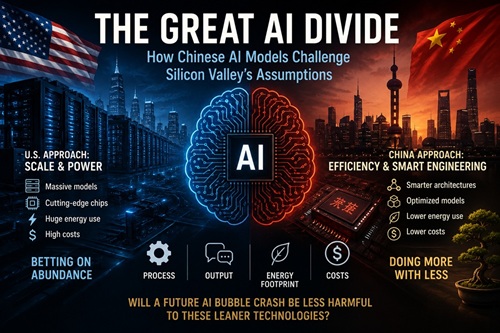
The artificial intelligence revolution has unfolded under two very different philosophies. In the United States, AI development has largely followed the familiar Silicon Valley formula: build ever-larger models, gather unprecedented amounts of computing power, spend billions on infrastructure, and trust that scale itself will produce intelligence. China, while certainly not lacking technological ambition, has increasingly pursued a different strategy. Faced with export restrictions on advanced chips and the necessity of doing more with less, Chinese AI developers have focused on efficiency, optimization, and cost reduction rather than brute-force expansion. The result is not simply a geopolitical rivalry but two competing visions of how artificial intelligence should evolve. One bets on abundance; the other on constraint. One assumes that bigger is better; the other asks how much intelligence can be extracted from every watt of electricity and every GPU hour. Whether one approach ultimately prevails remains uncertain, but together they are reshaping assumptions about what AI is, how it should be built, and who can afford to participate. The American Scaling ParadigmAmerican AI development has been dominated by what researchers call the "scaling hypothesis." Companies such as OpenAI, Google DeepMind, Anthropic, and Meta have invested enormous sums in training foundation models containing hundreds of billions—or, in some cases, perhaps trillions—of parameters. The underlying belief is straightforward. Larger neural networks trained on more data with more computing power consistently acquire new capabilities that smaller systems lack. This scaling has indeed produced impressive results. Models can write essays, generate software, analyze scientific papers, and converse with surprising fluency. Yet these achievements come at extraordinary cost. Training a frontier model today requires tens of thousands of cutting-edge GPUs operating continuously for months. Construction of specialized AI data centers costs billions of dollars. Operating the finished models consumes massive amounts of electricity, while cooling systems require substantial water resources in many locations. Only a handful of companies—and governments—can finance such projects. China's Efficiency RevolutionChina entered this race under different conditions. American export controls have limited Chinese access to the latest AI chips. Rather than halting progress, these constraints encouraged developers to rethink the economics of AI itself. Chinese companies increasingly emphasize efficiency. Instead of simply building larger models, engineers devote considerable effort to compressing networks, optimizing inference, improving data quality, reducing redundant computation, and designing architectures that require fewer parameters to achieve similar performance. This philosophy resembles the history of Japanese automobile manufacturing in the 1970s. When American manufacturers relied on abundant materials and large vehicles, Japanese firms pioneered lean production, minimizing waste while maintaining quality. Something similar may now be happening in artificial intelligence. Less Can Be MoreOne important insight emerging from recent research is that raw parameter count does not necessarily equal intelligence. Techniques such as sparse activation, mixture-of-experts architectures, retrieval-augmented generation, knowledge distillation, and sophisticated reinforcement learning allow smaller models to perform surprisingly well. Instead of activating every parameter for every query, only specialized portions of the network may be used. The apparent size of the model remains enormous, but the actual computational cost of each response falls dramatically. Chinese laboratories have become particularly adept at these engineering optimizations. The consequence is AI that is often cheaper to train, cheaper to operate, and easier to deploy on ordinary hardware. The Energy EquationEnergy consumption may become one of AI's defining economic constraints. Modern AI data centers already consume electricity on the scale of medium-sized cities. Governments increasingly worry about power grids, carbon emissions, semiconductor supply chains, and water availability. An AI model requiring one-tenth the computation may also require roughly one-tenth the electricity. That changes everything. Smaller operating costs mean lower subscription prices, broader deployment in developing countries, and reduced dependence on massive cloud infrastructure. Efficiency is no longer merely an engineering virtue; it has become an economic advantage. Cost as Competitive WeaponAmerican frontier models often require investments measured in billions of dollars. Chinese models increasingly demonstrate that competitive performance can sometimes be achieved at a fraction of these costs. Lower production costs also reduce financial risk. If a company spends $10 billion training a single model, that investment must eventually generate enormous revenue merely to break even. A company spending $200 million faces a much more forgiving business environment. This difference influences not only profitability but innovation itself. Smaller investments permit more experimentation, faster iteration, and greater diversity of approaches. Different Philosophies of OpennessAnother distinction concerns openness. American frontier developers have become increasingly cautious about releasing their most capable models, citing commercial competition and safety concerns. Many Chinese developers, while operating within their own regulatory environment, have aggressively released open-weight models that researchers and companies can adapt locally. This lowers barriers to entry and accelerates downstream innovation. Ironically, geopolitical competition has encouraged greater technological diffusion rather than less. Does Bigger Still Win?This does not mean American models have lost their lead. The largest frontier systems still dominate many benchmarks involving reasoning, multimodal understanding, scientific analysis, and software development. Scale continues to matter. The real question is whether additional gains justify exponentially rising costs. If each incremental improvement requires ten times the investment while producing only modest performance gains, economic rather than technical limits may determine future progress. The semiconductor industry encountered similar diminishing returns decades ago. Moore's Law eventually slowed not because engineers stopped innovating but because physics made further improvements increasingly expensive. Artificial intelligence may face an analogous economic ceiling. Could There Be an AI Bubble?Many economists already compare today's AI investment boom to earlier technological manias. Billions flow into startups with uncertain business models. Data centers are expanding at unprecedented speed. GPU demand continues to exceed supply. Investors often assume that ever-larger models will inevitably generate future profits. History advises caution. The dot-com crash did not occur because the internet failed. It occurred because expectations exceeded realistic economic returns. Artificial intelligence could experience something similar. If revenues fail to justify today's infrastructure spending, heavily leveraged companies may face painful corrections. Why Lean AI May Be More ResilientHere the Chinese emphasis on efficiency may prove significant. Leaner AI systems require less capital. They consume less electricity. They depend on fewer scarce chips. They can run on more affordable hardware. All these characteristics reduce financial vulnerability. Should an investment bubble burst, companies operating efficient models would likely face smaller losses than firms whose business depends upon continuously financing enormous computational infrastructure. This parallels earlier technological revolutions. During economic downturns, firms with lower fixed costs generally survive better than those carrying massive capital expenditures. Efficiency becomes not merely a technical achievement but a form of economic insurance. Beyond the BubbleEven if an AI correction eventually occurs, it is unlikely to resemble a technological collapse. The internet survived the dot-com crash. Railways survived nineteenth-century railway bubbles. Electricity survived speculative investment booms. Useful technologies generally outlive financial excess. Artificial intelligence appears likely to follow the same historical pattern. The companies that emerge strongest, however, may not be those with the largest data centers but those capable of delivering intelligence most efficiently. ConclusionThe rivalry between American and Chinese AI development is increasingly less about ideology than economics. The United States continues to push the technological frontier through unprecedented computational scale. China increasingly demonstrates that careful engineering can achieve competitive results with dramatically lower costs and energy requirements. Both strategies have strengths. Frontier breakthroughs may still require enormous investments in computation, while widespread adoption may favor efficient, affordable systems that can run almost anywhere. If history is any guide, technological revolutions ultimately reward both invention and efficiency. The inventors create new possibilities; the optimizers make them economically sustainable. Should an AI investment bubble eventually deflate, the leaner technologies emerging from China's efficiency-first philosophy may prove more resilient—not because they are necessarily more intelligent, but because they are built on an economic model that demands less capital, less energy, and less faith that bigger will always be better.
Widget is loading comments...
|