|
TRANSLATE THIS ARTICLE
Integral World: Exploring Theories of Everything
An independent forum for a critical discussion of the integral philosophy of Ken Wilber
  Frank Visser, graduated as a psychologist of culture and religion, founded IntegralWorld in 1997. He worked as production manager for various publishing houses and as service manager for various internet companies and lives in Amsterdam. Books: Ken Wilber: Thought as Passion (SUNY, 2003), and The Corona Conspiracy: Combatting Disinformation about the Coronavirus (Kindle, 2020). Frank Visser, graduated as a psychologist of culture and religion, founded IntegralWorld in 1997. He worked as production manager for various publishing houses and as service manager for various internet companies and lives in Amsterdam. Books: Ken Wilber: Thought as Passion (SUNY, 2003), and The Corona Conspiracy: Combatting Disinformation about the Coronavirus (Kindle, 2020).
Check out my other conversations with ChatGPT The Divine Core of the Self?The Hubris of Ken Wilber's Mystical CertaintyFrank Visser / ChatGPT
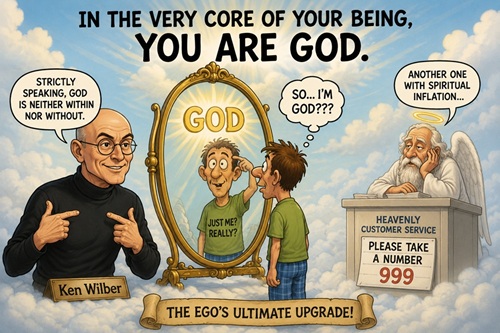
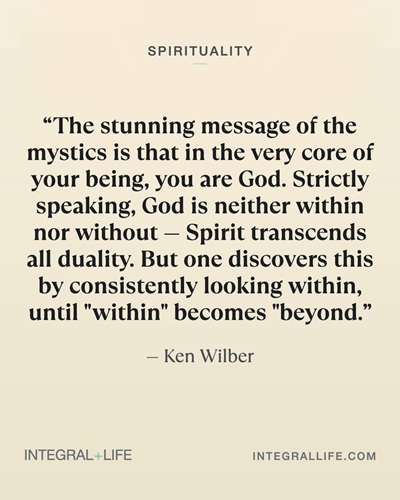
A meme circulating under the banner of Integral Life presents what it calls “the stunning message of the mystics”: “In the very core of your being, you are God.” The sentence is rhetorically magnificent. It is also philosophically loaded, empirically unsupported, and—when stated without qualification—arguably the height of spiritual hubris. The crucial question is not whether people have profound mystical experiences. They do. Nor is it whether such experiences can involve an extraordinary sense of unity, timelessness, boundlessness, or identity with an ultimate reality. They can. The question is: how do we get from the experience to the metaphysical conclusion? How do we get from “I experienced a profound dissolution of the ordinary boundaries of self” to “I am God”? And, more specifically, where did this mysterious “core” come from in the first place? The astonishing leap from experience to ontologyThe meme presents a sequence that appears almost self-evident: You look within. You look deeply enough. The ordinary self disappears. You discover God. But this is not an argument. It is a narrative about an experience. The crucial transition occurs between the phenomenological statement—“I experienced something that felt radically deeper than my ordinary ego”—and the ontological statement—“I have discovered the ultimate nature of reality.” That transition is enormous. A person may experience a sensation of becoming one with the universe. That does not, by itself, demonstrate that the universe is literally a conscious unity. A person may experience timelessness. That does not demonstrate that they have escaped time. A person may experience infinite space. That does not demonstrate that they have encountered metaphysical infinity. And a person may experience the disappearance of the ordinary ego. That does not demonstrate that, underneath the ego, there exists a divine entity called “God.” The experience is real. The interpretation remains open. Wilber repeatedly blurs this distinction. He takes a particular interpretation of mystical experience and presents it as the discovery of a metaphysical fact. The subjective depth of the experience is treated as evidence for the objective truth of the interpretation. But intensity is not verification. A dream can be extraordinarily vivid without being a revelation of another universe. A hallucination can be overwhelmingly convincing without being a perception of an external object. A mystical experience can be profound, transformative, and psychologically authentic without its metaphysical interpretation automatically being true. The experience deserves respect. The conclusion requires argument. But where did the “core” come from?The meme speaks of “the very core of your being” as if this were an obvious anatomical or metaphysical fact. But what exactly is this core? Is it the brain? The brainstem? The integrated activity of the nervous system? The organism as a biological whole? The unconscious? The witnessing consciousness? A metaphysical soul? A universal consciousness? God? The language quietly smuggles in the conclusion. First, we are told that there is a “core” of our being. Then we are told that this core is divine. But why should we assume that a person possesses some inner metaphysical essence at all? The word “core” sounds modest and intuitive. It is anything but. It implies that beneath the layers of personality, memory, biology, social conditioning, culture, language, and embodiment there exists a fundamental inner substance or identity. This is a philosophical hypothesis, not a self-evident discovery. The Buddhist tradition, for example, famously challenges precisely this kind of assumption. What we call the self may be a dynamic process rather than an eternal essence. Contemporary neuroscience likewise gives us no straightforward evidence for a metaphysical divine core hidden somewhere beneath the personality. The ordinary self is not like an onion with a mystical pearl at the center. Peel away the personality, and what do you find? Not necessarily God. You may find altered states of consciousness, changes in attention, reduced self-referential processing, unusual patterns of emotion and perception, a profound sense of unity, or the dissolution of the normal subject-object distinction. But the idea that one eventually reaches an ontological “core” that is literally God is an additional interpretation. And the question remains: why that interpretation rather than another? “You are God” is not as humble as it soundsThere is a familiar rhetorical trick in mystical theology. The statement “you are God” is immediately qualified: “Strictly speaking, God is neither within nor without.” This sounds wonderfully sophisticated. It appears to avoid the crude claim that an individual ego is literally the creator of the universe. But the qualification does not eliminate the original claim. It merely moves it to a higher level of abstraction. The message remains: the deepest truth of who you are is identical with ultimate reality. That may be a coherent metaphysical position. It is often called nondualism, Advaita Vedanta, or something similar. But it is not self-evidently true merely because it is expressed in paradoxical language. In fact, the paradox can make the claim more difficult to challenge. If God is neither within nor without, then any objection can be dismissed as operating within dualistic conceptual categories. If the claim is beyond all distinctions, then ordinary standards of evidence are declared inadequate from the outset. This is philosophically convenient. It also makes the doctrine nearly unfalsifiable. If someone says, “I am God,” we are entitled to ask what exactly this means. If the answer is, “Not the ego, not the body, not the mind, not something inside, not something outside, and beyond all conceptual distinctions,” then the claim begins to approach semantic immunity. It can no longer clearly be distinguished from saying nothing determinate at all. A proposition that cannot possibly be wrong is not necessarily profound. Sometimes it is simply too vague to be tested. The problem of spiritual self-deificationThere is something unmistakably grandiose about telling people that “in the very core of your being, you are God.” Imagine someone saying: “I am a finite biological organism that evolved on one small planet around one ordinary star in one galaxy among hundreds of billions of galaxies.” That statement is scientifically modest. Now compare: “At the core of my being, I am God.” The second statement is cosmically extravagant. Of course, Wilber would object that he does not mean that the individual ego is God. The ego is merely a surface expression. The deeper Self is divine. But this does not entirely solve the problem. It can actually intensify it. The individual is invited to identify with an ultimate metaphysical reality while simultaneously being told that the ordinary, finite self is merely a superficial appearance. The result is a kind of spiritual hierarchy of identity: Your ordinary self? Limited. Your personality? Temporary. Your biological organism? Merely one layer. Your deepest Self? Absolute. This is a remarkably flattering metaphysical arrangement. The ego is apparently told to surrender—but it is offered an extraordinary consolation prize. You are not the small, vulnerable, finite creature you thought you were. You are God. The spiritual ego may be the most difficult ego of all to detect because it has learned to speak the language of self-transcendence. The ego that claims to have transcended the egoThere is a profound irony here. The ordinary ego wants to be special. The spiritual ego wants to be more than special. It wants to be connected to the Absolute. It wants to be one with the cosmos. It wants to have seen what others have not seen. It wants to know the ultimate truth. And if the doctrine says that “you are God,” then the ego has achieved the ultimate promotion. The danger is not that mystical experiences are necessarily narcissistic. Many people report that genuine mystical experiences make them feel less important, more compassionate, and less attached to personal status. The danger lies in the interpretation. A person can experience ego dissolution and then construct an even grander conceptual identity around the experience: “I am not merely Frank, Ken, or whoever. I am the Absolute.” The ordinary ego has not necessarily disappeared. It may simply have been upgraded from king of the personal kingdom to emperor of the universe. “Looking within” does not necessarily take you beyondThe meme claims that one discovers the divine core by “consistently looking within” until “within” becomes “beyond.” This is poetic language. But what does it actually mean? The brain is not a window through which an independent metaphysical realm necessarily becomes visible when one looks hard enough. Meditation changes consciousness. Attention can become extraordinarily refined. The ordinary sense of self can weaken or disappear. The boundaries between self and world can become less distinct. But the direction of attention does not determine the metaphysical nature of what is experienced. Looking inward can reveal the structure of consciousness. It can reveal how the sense of self is constructed. It can reveal the instability of perception. It can reveal how thoughts, emotions, bodily sensations, and the feeling of being a separate subject arise and pass. But none of this logically entails the discovery of God. Indeed, one possible interpretation of mystical experience is not that we discover a divine Self at the core of consciousness, but that we discover the absence of any permanent self at all. The experience may be real while the metaphysical conclusion is wrong. Why does the disappearance of boundaries equal God?This is the central problem. Suppose the distinction between self and world disappears during a mystical experience. Why should the resulting state be called “God”? Perhaps because many religious traditions have historically interpreted it that way. But other traditions interpret similar experiences differently. Some speak of Brahman. Some speak of emptiness. Some speak of Buddha-nature. Some speak of the Tao. Some speak of union with God. Some regard the experience as a temporary state of consciousness without committing to any metaphysical entity at all. The experience does not come with a label attached. The label is supplied by culture, language, expectation, religious tradition, philosophical background, and personal interpretation. This is precisely why the move from mystical experience to metaphysical certainty should be treated cautiously. The mystic may encounter something extraordinary. But what the experience “is” remains an interpretive question. The hidden assumption: consciousness is fundamentalWilber's statement ultimately depends on a much larger metaphysical architecture. Consciousness is not merely something produced by biological organisms. Consciousness is fundamental. The individual mind is an expression of a universal consciousness. The deepest Self is identical with that universal consciousness. And that universal consciousness is what traditions have called Spirit, God, or the Absolute. This is a coherent worldview. But it is a worldview. It is not established merely by having a mystical experience. The central problem is that Wilber often presents this metaphysical system as if it were the cumulative conclusion of the world's contemplative traditions. But the world's contemplative traditions do not speak with one voice. They disagree profoundly about the nature of self, consciousness, reality, God, emptiness, rebirth, liberation, and the relationship between experience and metaphysical truth. There is no single unanimous “message of the mystics.” There are many mystical traditions, interpreted through many cultural and philosophical frameworks. Wilber selects particular strands—especially nondual traditions—and presents their conclusions as the deepest common truth underlying spirituality as a whole. That is a very ambitious act of intellectual synthesis. It is also an enormous act of interpretation. The great metaphysical bait-and-switchThe meme begins with something almost everyone can accept: Human beings possess inner experience. It then moves to something many people can also accept: Some inner experiences can be extraordinarily profound. Then comes the bait-and-switch: Therefore, at the deepest level, you are God. But the conclusion does not follow. The existence of depth in experience does not prove the existence of a divine essence. The dissolution of the ordinary self does not prove the existence of a cosmic Self. The experience of unity does not prove that reality is metaphysically One. The feeling of timelessness does not prove that one has entered eternity. And the feeling of infinite consciousness does not prove that consciousness is literally infinite. These are all possible interpretations. They are not automatic deductions. The humility that mystical certainty should produceThere is a final irony in the meme's language. If mystical experience truly reveals the limitations of the ego, then perhaps the appropriate response should be greater epistemic humility. Not: “I have discovered that I am God.” But: “I have experienced something that radically challenges my ordinary assumptions about the self and reality. I do not yet know what it ultimately means.” That position is less spectacular. It is also intellectually more defensible. The mystical experience may indeed transform a person's understanding of existence. It may make the ordinary ego seem less substantial. It may generate powerful intuitions of unity, depth, and transcendence. But the leap from “I experienced something profound” to “I have discovered the divine essence of my being” is precisely the leap that requires the greatest scrutiny. The “core” may be real. But it may also be a metaphor. It may be a phenomenological feature of consciousness. It may be a culturally shaped interpretation of unusual mental states. It may be a philosophical hypothesis. Or it may be something we do not yet understand. What it is not is something that can simply be assumed. The emperor of the cosmosThe most troubling aspect of Wilber's formulation is not that it is mystical. It is that it transforms a particular mystical interpretation into a universal metaphysical certainty. “You are God” is an extraordinary claim. The burden of proof should therefore be extraordinary as well. Instead, the claim is protected by paradox, by appeals to mystical authority, by the ambiguity of words such as “core,” “Self,” “Spirit,” and “beyond,” and by the suggestion that anyone who questions the conclusion simply has not looked deeply enough within. That is a dangerous structure of argument. Because if you disagree, the problem is not necessarily with the doctrine. Perhaps you have not meditated enough. Perhaps your consciousness is not sufficiently developed. Perhaps you are still trapped in a lower stage. Perhaps you are still identified with the ego. And so the doctrine becomes self-sealing. The enlightened person understands. The skeptic has not yet seen. At that point, spirituality risks becoming a hierarchy of epistemic privilege. And the ultimate privilege is the claim that, beneath the finite human being, there is God. Perhaps the deepest lesson of mystical experience is indeed that the ordinary ego is not the center of the universe. But that is a very different conclusion from saying that the ego—or its metaphysical replacement—is God. The first is a potentially liberating insight. The second may be the grandest form of self-importance imaginable. The question is not whether the mystic can experience a divine core. The question is whether the divine core exists independently of the interpretation the mystic brings to the experience. And before we announce that we have discovered God at the center of our being, perhaps we should first ask a more elementary question: Who, exactly, put God there?
Widget is loading comments...
|