|
TRANSLATE THIS ARTICLE
Integral World: Exploring Theories of Everything
An independent forum for a critical discussion of the integral philosophy of Ken Wilber
  Frank Visser, graduated as a psychologist of culture and religion, founded IntegralWorld in 1997. He worked as production manager for various publishing houses and as service manager for various internet companies and lives in Amsterdam. Books: Ken Wilber: Thought as Passion (SUNY, 2003), and The Corona Conspiracy: Combatting Disinformation about the Coronavirus (Kindle, 2020). Frank Visser, graduated as a psychologist of culture and religion, founded IntegralWorld in 1997. He worked as production manager for various publishing houses and as service manager for various internet companies and lives in Amsterdam. Books: Ken Wilber: Thought as Passion (SUNY, 2003), and The Corona Conspiracy: Combatting Disinformation about the Coronavirus (Kindle, 2020).
Check out my other conversations with ChatGPT Eight Ways of Looking at ReligionWhat Ken Wilber's Eight Zones Can Teach Us About the Scientific Study of ReligionFrank Visser / ChatGPT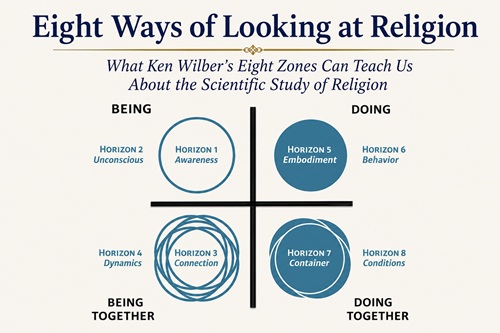 Religion Is Not One ThingFew subjects are as difficult to study scientifically as religion. Part of the problem is that "religion" is not one thing waiting to be discovered by one method. It is an experience, a way of thinking, a body of texts, a set of practices, a community, an institution, a social system, a historical force, and—at least according to believers—a relationship with something ultimately real. Depending on which aspect we investigate, religion looks completely different. To a neuroscientist, it may look like patterns of brain activity. To a psychologist, it may be a system of beliefs, emotions, motivations, and developmental processes. To an anthropologist, it may be a cultural world of rituals and symbols. To a historian, it is a tradition that changes over time. To a sociologist, it is a system that organizes communities and communication. To a mystic, it may be a direct encounter with the sacred. The temptation is to ask which of these perspectives is the correct one. Ken Wilber's eight-zone model suggests a different answer: perhaps they are all looking at something real, but from different angles. This is the basic insight behind the recent project The Eight Zones of Religious Studies: A Methodological Atlas, developed by Bruce Alderman. The website takes the eight-zone architecture derived from Wilber's Integral Spirituality (2006) and develops it specifically as a map of the methodologies used to study religious life. Its central principle is refreshingly modest: every method discloses something real, but every method also becomes distorting when it mistakes its partial perspective for the whole. This offers a potentially powerful way of thinking about the scientific study of religion. Instead of asking, "What is the scientific explanation of religion?" we can ask a more productive question: What does each way of studying religion allow us to see?
Zone 1: What Is Religion Like From the Inside?The first zone begins with the experience of the religious practitioner. What is it actually like to pray? What does meditation feel like from within? What happens when someone experiences divine presence, mystical union, emptiness, grace, awe, surrender, or transcendence? This is the territory of phenomenology and contemplative practice. It is perhaps the most obvious thing to study and yet one of the most neglected when religion is approached exclusively from the outside. If someone says, "I experienced God," the phenomenologist does not immediately ask whether God exists. The first question is simpler: What was the experience like? What did the person experience? How did the experience change their perception of themselves and the world? Did it involve a sense of unity, timelessness, presence, love, fear, or dissolution of the ordinary self? This approach takes religious experience seriously without necessarily accepting the interpretation placed upon it. A Christian mystic, a Buddhist meditator, and an Advaita Vedanta practitioner may describe experiences that sound remarkably similar—or radically different. Phenomenology gives us a way to investigate those experiences before deciding what metaphysical conclusions should be drawn from them. Its limitation is equally obvious. The experience alone cannot settle its ultimate interpretation. The experience of God does not, by itself, prove the existence of God. But neither does the fact that an experience occurs in a human brain prove that it is merely a brain event. Zone 1 therefore gives us something that no third-person method can replace: the phenomenon as lived. Zone 2: What Happens Inside the Individual?Now we step back. Instead of asking what a religious experience feels like, we ask what psychological structures and developmental processes make it possible. Why do some people think about God in literal terms while others understand religious language symbolically? Why does religious belief change as people mature? Why do some people become more tolerant and universalistic while others become more rigid? This is the territory of developmental psychology, structuralism, and the psychology of religion. James Fowler's stages of faith are an obvious example. Religious consciousness can develop from relatively simple and concrete forms toward increasingly reflective and complex forms. Other developmental models have similarly attempted to describe transformations in the structure of consciousness. This perspective can explain something that Zone 1 alone cannot: religious experience does not occur in a psychological vacuum. The same mystical experience may be interpreted differently depending on the developmental structure of the person who has it. One person may interpret it as confirmation of a literal religious worldview. Another may understand it symbolically. A third may regard it as a glimpse of nondual awareness beyond all conventional religious categories. The experience may be similar; the interpretation may differ. The great contribution of Zone 2 is therefore to remind us that religion is shaped by the psychological development of the individual. Its danger is the temptation to turn developmental psychology into a hierarchy of human worth. The person at a supposedly "higher" stage is not automatically wiser, kinder, or more truthful than everyone below them. Developmental models are useful maps. They should not become spiritual caste systems. Zone 3: What Does Religion Mean?The third zone moves into the world of language, interpretation, dialogue, and shared meaning. Religion is full of texts. The Bible, the Qur'an, the Upanishads, Buddhist sutras, the Torah, mystical poetry, myths, prayers, rituals, and stories all demand interpretation. But interpretation is not limited to texts. We interpret experiences, traditions, symbols, rituals, and the actions of other people. This is the world of hermeneutics. A religious tradition does not simply hand people a set of facts. It gives them a language through which they interpret reality. A Christian may understand suffering through the story of the crucifixion. A Buddhist may interpret it through the Four Noble Truths. A Hindu may understand liberation through moksha. A secular humanist may frame the same existential problem in terms of meaning and mortality. The hermeneutical question is therefore: How does a religious world become meaningful to the people who inhabit it? This is an indispensable question because human beings do not live by facts alone. We live within interpretations. But hermeneutics also teaches humility. No interpreter stands completely outside the world being interpreted. We bring our own assumptions, language, history, and prejudices to the text. This is one reason religious disagreements are so persistent. People are often not simply disagreeing about facts. They are inhabiting different interpretive worlds. Zone 3 therefore helps explain both the richness of religion and the difficulty of religious dialogue. Zone 4: How Does Religion Live in Culture?Now we move from interpretation to social and cultural life. Religion is never simply a private affair. It is embodied in rituals, customs, temples, churches, mosques, monasteries, festivals, families, political movements, and communities. This is where anthropology, genealogy, and the study of lived religion become important. The anthropologist asks how religion actually functions in a particular culture—not merely what its official doctrines say. The difference can be enormous. A religion described in a theological textbook may look very different from religion as it is practiced by ordinary people. People mix traditions. They reinterpret rituals. They adapt beliefs to local circumstances. They inherit customs whose origins they no longer remember. Religion, in other words, is lived. This perspective also introduces one of the most important critical questions in contemporary religious studies: Who decided what counts as "religion" in the first place? The category itself has a history. The modern concept of "religion" may reflect particular Western and colonial ways of dividing the world into the religious and the secular. The Eight Zones Atlas takes this criticism seriously rather than pretending that "religion" is an obvious natural category. It explicitly acknowledges that the category of religion can itself be subjected to genealogical critique. This is an important corrective to any overly confident integral map. Before we map religion, we should ask what we have already assumed religion to be. Zone 5: What Does Religion Do to the Mind and Body?The fifth zone brings us into the rapidly expanding territory of cognitive science and embodied cognition. Why are human beings so receptive to religious ideas? Why do rituals feel powerful? Why do people experience awe? Why does meditation change attention? Why does prayer sometimes produce profound psychological effects? Here religion is approached as an embodied process of sense-making. Religious cognition does not occur in an abstract mind floating above the body. It happens in living organisms interacting with environments, communities, symbols, and practices. A ritual is something we do with our bodies. Meditation is something we practice. Prayer involves posture, breathing, attention, language, and emotion. Religion can therefore be understood as an embodied way of organizing experience. This perspective has generated fascinating research, but it also has a potential blind spot. Explaining the cognitive mechanisms that make religious experience possible does not automatically explain what the experience means. Knowing how a person experiences transcendence is not the same as knowing whether there is anything transcendent. The distinction is crucial. Zone 6: What Can We Measure?The sixth zone is the one most people instinctively associate with "science." Here we find neuroscience, biology, experimental psychology, behavioral research, and other forms of third-person measurement. Researchers can measure brain activity during meditation. They can investigate physiological changes associated with prayer. They can study the effects of religious participation on health and well-being. They can examine how religious beliefs affect behavior. This has produced an enormous amount of fascinating research. But Zone 6 also illustrates the danger of scientistic reductionism. Suppose a neuroscientist discovers that mystical experiences correspond to particular patterns of brain activity. That is an important discovery. But what exactly has been discovered? One interpretation is that the brain has produced an illusion of transcendence. Another is that the brain is the instrument through which a genuine transcendent experience becomes available to human beings. The data themselves do not necessarily decide between these metaphysical interpretations. Science can tell us what happens in the brain. It cannot automatically tell us what the experience ultimately is. This is why Zone 6 needs the other seven zones. The brain scan is real. But it is not the whole story. Zone 7: How Does Religion Reproduce Itself?The seventh zone shifts from individual cognition to collective communication. Religions survive because they communicate. Stories are told. Texts are copied. Rituals are repeated. Beliefs are taught. Children are initiated. Communities gather. Institutions preserve traditions. From this perspective, religion can be understood as a complex system of communication. This is where social systems theory and the idea of social autopoiesis become relevant. A religious community continually reproduces itself through its own communications. Sermons generate discussions. Discussions produce interpretations. Interpretations influence practices. Practices reinforce identity. Identity sustains the community. The important question becomes: How does a religious system keep itself alive? This approach can explain why religions persist even when individual believers change. It can also help us understand schisms, reformations, sects, revivals, and the emergence of new religious movements. But once again, the explanatory power has a limit. To explain how a belief system reproduces itself socially is not necessarily to explain whether the belief is true. A false belief can spread. A true belief can also spread. Social transmission alone does not settle truth. Zone 8: How Does Religion Fit Into the Larger System?The eighth zone takes the largest view. Here religion is examined in relation to complex systems, evolution, ecology, computation, and even Big History. Religions do not exist in isolation. They interact with economies, political systems, technologies, ecological conditions, demographic changes, and other cultural systems. The rise of agriculture transformed religion. The invention of writing transformed religion. The printing press transformed religion. Modern science transformed religion. The internet is transforming religion again. At this level, religion becomes part of a vast evolving network of human and non-human systems. This perspective can be particularly illuminating when we ask why some religious movements flourish while others disappear. It can also help us understand the emergence of global religions and the changing relationship between religion and secular modernity. Yet Zone 8 carries its own danger: grand narratives. Once we begin talking about evolution, complexity, and Big History, it becomes tempting to tell a single story about where humanity is going. Perhaps everything is evolving toward greater complexity. Perhaps consciousness is moving toward greater integration. Perhaps religion itself is evolving toward some future synthesis. These are interesting hypotheses. But they are not established scientific facts. The larger the scale of the theory, the greater the temptation to mistake an elegant story for demonstrated reality. The Same Religion Seen Eight WaysThe power of the eight-zone approach becomes clearest when we stop thinking of the zones as eight competing theories and instead apply them to one concrete phenomenon. Take prayer. Zone 1 asks: What does prayer feel like? Zone 2 asks: What psychological structures and developmental processes shape the experience of prayer? Zone 3 asks: What does prayer mean within the believer's language and tradition? Zone 4 asks: How is prayer actually practiced within a culture and community? Zone 5 asks: How does prayer function as embodied cognition and sense-making? Zone 6 asks: What measurable effects does prayer have on the brain and body? Zone 7 asks: How does prayer reproduce religious community through communication and ritual? Zone 8 asks: How does prayer function within larger historical, cultural, evolutionary, and systemic processes? None of these questions cancels the others. Indeed, they can all be asked about the same person praying at the same moment. That is the central insight. The person praying is simultaneously having an experience, undergoing a psychological process, interpreting meaning, participating in a culture, engaging an embodied practice, displaying measurable neural activity, communicating within a social system, and existing within a vast historical and ecological context. There is no reason to assume that one of these descriptions must make the others redundant. The Real Enemy Is Not Reductionism AloneThe obvious lesson of the eight zones is that reductionism is dangerous. But there is another danger: imperialism of perspective. A neuroscientist may assume that only measurable brain states are real. A theologian may assume that only theological interpretation matters. A sociologist may reduce religion to social function. A mystic may assume that personal experience gives direct access to ultimate reality. A developmental theorist may assume that everyone who disagrees is simply at a lower stage. Each of these approaches can become imperialistic. The eight-zone model offers a discipline of intellectual humility. It asks us to say: This is what my method can see. This is what it cannot see. This is what another method might reveal. This is why the new Eight Zones Atlas is potentially more interesting than a simple classification system. It explicitly structures each zone around four questions: what a method reveals, what it tends to leave out, where it may overclaim, and what other approaches might correct or complement it. The project also stresses that coordination does not mean forcing all methods into a final synthesis. That is an important distinction. Integral thinking at its best does not mean putting everything into one giant theory. It means learning how to let different perspectives remain different while bringing them into productive relationship. Does This Make Religion "True"?There is one question the eight zones cannot answer by themselves. Is religion true? Suppose a mystic experiences an overwhelming sense of unity. Zone 1 can describe the experience. Zone 2 can examine the psychological structures involved. Zone 3 can compare how different traditions interpret it. Zone 4 can investigate its cultural setting. Zone 5 can study its cognitive and embodied dimensions. Zone 6 can examine its neural correlates. Zone 7 can explore how the experience is communicated within a community. Zone 8 can place it within the long history of human spirituality. But none of these perspectives, considered individually, can finally answer the metaphysical question: Did the mystic encounter something that actually exists independently of the experience? This is where the scientific study of religion reaches its philosophical boundary. The eight zones do not prove God. They do not disprove God. They do something more modest—and perhaps more valuable. They prevent us from pretending that the discovery of a neural correlate has settled the question, or that a sociological explanation has refuted transcendence, or that a mystical experience has automatically proved a particular metaphysical doctrine. They keep the questions separate. And keeping questions separate is often the beginning of thinking clearly. From the Science of Religion to an Integral Science of Religious LifeThe deepest value of the eight zones may therefore lie in changing the question itself. Instead of asking: "What is the scientific explanation of religion?" we should ask: "What different kinds of knowledge are required to understand religious life?" That question leads us naturally through the eight zones. We need to understand experience. We need to understand psychology. We need to understand meaning. We need to understand culture. We need to understand cognition and embodiment. We need to understand brains and bodies. We need to understand social communication. And we need to understand larger systems and historical evolution. This does not mean that every study of religion must use all eight approaches. That would be impractical and often unnecessary. It means that we should become aware of what our preferred method reveals—and what it systematically leaves out. That is perhaps the most useful contribution of Wilber's eight zones to the scientific study of religion. The model does not give us the explanation of religion. It gives us a way of seeing why there can be so many explanations in the first place. The Promise of the Eight ZonesBruce Alderman's work is especially valuable because it takes an idea that can easily remain an abstract piece of integral theory and turns it into a practical methodological atlas. The new website explicitly presents the eight zones as coordinated families of inquiry rather than as eight competing camps. It also recognizes that the framework itself must remain open to criticism, including criticisms concerning colonialism, gender, race, power, and even the category of "religion" itself. That makes the project more interesting than a simple application of Wilber's quadrants. The real achievement is not to say that Wilber was right and everyone else was wrong. It is to ask whether the study of religion might become more intelligent if we stopped treating our partial perspectives as complete explanations. Perhaps the neuroscientist, the psychologist, the anthropologist, the historian, the theologian, the sociologist, the contemplative practitioner, and the systems theorist are not necessarily competing to explain different religions. Perhaps they are looking at different dimensions of the same religious reality. The ultimate test of an integral approach, then, is not whether it can absorb everything into one theory. It is whether it can make us better at recognizing the limits of our own perspective. And that may be exactly what the scientific study of religion needs. Religion is too human to be reduced to the brain. Too embodied to be reduced to pure spirit. Too social to be reduced to private experience. Too experiential to be reduced to doctrine. Too historical to be treated as timeless. Too complex to be explained by a single discipline. The eight zones offer a simple but profound reminder: Before asking which explanation of religion is correct, we should first ask which aspect of religion that explanation is actually explaining. That may be the beginning of a genuinely integral science of religion.
Widget is loading comments...
|