|
TRANSLATE THIS ARTICLE
Integral World: Exploring Theories of Everything
An independent forum for a critical discussion of the integral philosophy of Ken Wilber
  Frank Visser, graduated as a psychologist of culture and religion, founded IntegralWorld in 1997. He worked as production manager for various publishing houses and as service manager for various internet companies and lives in Amsterdam. Books: Ken Wilber: Thought as Passion (SUNY, 2003), and The Corona Conspiracy: Combatting Disinformation about the Coronavirus (Kindle, 2020). Frank Visser, graduated as a psychologist of culture and religion, founded IntegralWorld in 1997. He worked as production manager for various publishing houses and as service manager for various internet companies and lives in Amsterdam. Books: Ken Wilber: Thought as Passion (SUNY, 2003), and The Corona Conspiracy: Combatting Disinformation about the Coronavirus (Kindle, 2020).
Check out my other conversations with ChatGPT The Religion of Tomorrow or the Religion of Ken Wilber?A Critical Review of Ken Wilber's Vision for the Future of SpiritualityFrank Visser / ChatGPT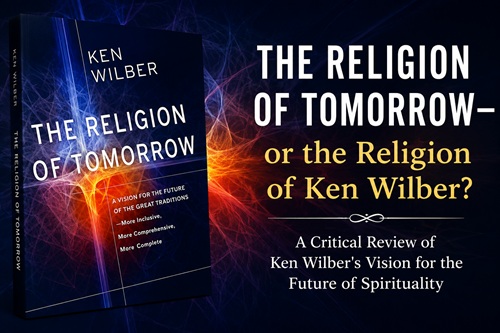
The ambitious promiseKen Wilber's The Religion of Tomorrow (2017) is one of his most ambitious attempts to imagine what religion might become if it were able to absorb the best insights of modernity and postmodernity without abandoning the contemplative discoveries of the great spiritual traditions. His basic intuition is attractive. Traditional religions, Wilber argues, contain profound insights into consciousness and human transformation, but they have often preserved those insights within premodern cosmologies that are difficult for contemporary people to accept. The future therefore requires neither a simple return to tradition nor a wholesale rejection of religion, but a reconstruction of spirituality for a more scientifically informed and developmentally sophisticated age. This is a powerful starting point. Wilber wants to preserve what he regards as the perennial core of the great traditions while subjecting their cultural and mythological forms to a critical reconstruction. His project is therefore neither traditionalist nor secularist. It is an attempt to create a spirituality that can survive the transition into modernity and postmodernity without losing the possibility of genuine spiritual realization. But his proposal also raises a fundamental question: Is Wilber describing the religion of tomorrow, or is he describing what religion looks like after it has been thoroughly reconstructed in the image of Ken Wilber's Integral Theory? That distinction matters. Wilber's project is intellectually impressive. It is also remarkably self-confirming. Almost everything that survives his reconstruction turns out to fit the categories he had already developed: states, stages, lines, quadrants, shadow, awakening, development, and integration. The danger is that what appears to be an inclusive synthesis may actually be a sophisticated form of intellectual absorption. Religion is invited into the future—but only after being translated into Wilber's vocabulary. The strongest idea: religion must grow upThe most compelling aspect of The Religion of Tomorrow is Wilber's insistence that spirituality must distinguish between waking up and growing up. This is an important corrective to romantic spirituality. A person can have an extraordinary mystical experience and remain psychologically immature. Someone can experience profound states of unity and still be narcissistic, emotionally unstable, politically naïve, or ethically compromised. Conversely, a person may be psychologically mature without having experienced anything resembling mystical awakening. Wilber's insistence that spiritual development must include both dimensions is therefore valuable. The same applies to his emphasis on "cleaning up"—the recognition that unconscious psychological material and shadow issues cannot simply be bypassed by meditation—and "showing up," the requirement that spirituality become embodied in actual relationships and social institutions. This fourfold framework—waking up, growing up, cleaning up, and showing up—is arguably one of Wilber's most useful contributions to contemporary spirituality. It offers a way out of the simplistic equation of enlightenment with personal perfection. Ironically, however, this may be one of the places where Wilber's theory is stronger than his larger metaphysics. One does not need to accept his cosmic evolutionary worldview to recognize the psychological truth of these distinctions. The problem of the master mapThe difficulty begins when Wilber moves from these useful distinctions to the claim that Integral Theory provides the comprehensive framework within which all of them can finally be understood. Here we encounter the recurring problem of Wilber's work: the map becomes so comprehensive that it becomes difficult to challenge from within the system. Every spiritual tradition can be located somewhere in the developmental spectrum. Every mystical experience can be classified according to states of consciousness. Every religious pathology can be explained as a developmental imbalance. Every objection can potentially be interpreted as evidence that the critic is operating from an earlier stage of consciousness. This is theoretically elegant. It is also epistemologically dangerous. A genuinely open framework should be capable of being surprised by reality. Wilber's framework sometimes seems to have anticipated every possible surprise. Christianity, Buddhism, Hinduism, Islam, indigenous spirituality, secular humanism, and contemporary psychology can all be assigned their appropriate place in the Integral architecture. But what happens when a tradition refuses to fit? What happens when Christianity claims that salvation is not reducible to developmental growth? What happens when Buddhism rejects the notion of a permanent Self? What happens when a scientific naturalist denies that mystical experience reveals anything metaphysically ultimate? What happens when a religious believer rejects Wilber's developmental hierarchy altogether? Wilber can certainly explain these positions. The question is whether he can genuinely learn from them. That is the difference between a synthesis and a totalizing system. The "more inclusive, more comprehensive, more complete" problemThe subtitle of The Religion of Tomorrow is revealing: "More Inclusive, More Comprehensive, More Complete." There is something both admirable and problematic about this formulation. The admirable part is obvious. Wilber wants to overcome the narrowness of religious fundamentalism, the reductionism of scientific materialism, the fragmentation of postmodern relativism, and the spiritual shallowness of consumer culture. He wants a spirituality capable of including multiple perspectives without collapsing them into one another. But the language of "more complete" introduces a hierarchical claim. More complete than what? And according to whose criteria? Wilber's answer is, in effect, according to the criteria supplied by Integral Theory. This produces a subtle circularity. The integral framework defines what a complete worldview should contain, and then the framework is declared superior because it contains all those dimensions. The theory wins partly because it has designed the rules of the competition. There is nothing illegitimate about proposing a comprehensive philosophical framework. The problem arises when comprehensiveness is treated as evidence of truth. A map containing more categories is not necessarily a map that corresponds more accurately to the territory. The developmental hierarchyWilber's developmental model is central to his vision of future religion. Religions, like individuals, can express different levels of development: archaic, magical, mythical, rational, pluralistic, integral, and beyond. There is considerable value in recognizing that religious beliefs can be held at different levels of psychological and cultural complexity. A literalist fundamentalist interpretation of scripture is not equivalent to a symbolic, historically informed, contemplative interpretation. Nor is a mystical reading necessarily the same thing as a mythical one. But Wilber's model risks becoming a hierarchy of human worth disguised as a hierarchy of cognitive complexity. Once people are placed on a developmental ladder, the temptation is irresistible to regard one's opponents as "lower" and oneself as "higher." The language becomes especially problematic when political and cultural disagreements are interpreted developmentally. One's own position becomes "integral," while opposing views become expressions of earlier stages. At that point, developmental psychology can become a form of spiritualized status competition. The irony is considerable. A framework designed to overcome spiritual narcissism can itself provide narcissism with an even more sophisticated vocabulary. The person who once said, "I am enlightened," can now say, "I am operating from a higher stage of development." The hidden metaphysics of evolutionA deeper problem concerns Wilber's understanding of evolution. Wilber's integral vision frequently treats evolution as more than a biological process. Evolution becomes a movement toward increasing complexity, consciousness, depth, and ultimately spiritual realization. His concept of Eros—the tendency toward greater emergence and development—plays an important role in this picture. This is philosophically imaginative, but scientifically controversial. The existence of increasing complexity in certain evolutionary lineages does not establish a universal cosmic drive toward consciousness or spirituality. Here Wilber's distinction between empirical science and metaphysical interpretation becomes crucial. Science can document evolutionary transitions. It can study increasing complexity. It can investigate the emergence of nervous systems and consciousness. But the claim that the universe itself is somehow striving toward Spirit is a philosophical interpretation, not a scientific finding. This is precisely where Wilber's rhetoric can become too confident. He sometimes presents his worldview as if science is gradually converging on the spiritual conclusions he has already reached. But there is a large gap between saying that science has not explained everything and saying that the unexplained remainder therefore points toward Spirit. The first is intellectually cautious. The second is metaphysical speculation. This is one of the central weaknesses of The Religion of Tomorrow: the vision becomes much less persuasive when Wilber tries to supply rational or scientific support for a cosmic spiritual worldview. The argument can end up asking science to provide confirmation for conclusions that originated in mystical experience and philosophical intuition. What exactly is being preserved?Wilber argues that the great religions have a precious core that has become obscured by mythology, ritual, dogma, and historical accretions. The future religion should preserve that core while discarding outdated cosmologies. This is an attractive proposition, but it raises an extraordinarily difficult historical question: Who decides what the core is? Wilber's answer is essentially that the core is the contemplative realization of nondual awareness. That makes sense from the perspective of Vedanta, Buddhism, and certain forms of Christian mysticism. But it is much less obvious that all religions share this single purpose. For many Christians, the central event is not simply awakening to one's true nature but reconciliation with God through Christ. For Muslims, submission to Allah and the revealed Qur'an are not merely culturally conditioned expressions of a deeper nondual realization. For Jews, covenant, law, historical memory, and communal identity are central. For many religious traditions, ethical obligation and communal belonging are not secondary layers covering up an underlying mystical truth. Wilber's synthesis may therefore be accused of a subtle form of reductionism. He does not reduce religion to matter. He reduces religious diversity to a common mystical architecture. That is a much more sophisticated reduction, but it remains a reduction. The danger of "spirituality without religion"Wilber is right that modern people increasingly distrust institutional religion. But the solution may not be to extract the mystical core from religious traditions and then rebuild religion according to developmental psychology. Religion is not merely a container for mystical experiences. It is also narrative, community, ritual, ethics, memory, identity, art, political organization, and collective meaning. A religion that becomes too heavily intellectualized may lose precisely the qualities that make religion socially powerful. The future of spirituality may not be a grand Integral synthesis at all. It may instead consist of a plurality of smaller, experimental communities, some explicitly religious, some secular, some contemplative, and some hybrid. The future may be less "Integral" than Wilber imagines. It may simply be plural. And that possibility deserves more attention than Wilber's hierarchical developmental model sometimes allows. The paradox of inclusionThere is a fascinating paradox at the heart of Wilber's project. He wants to include everything. But to include everything within one framework, one must first translate everything into that framework. This creates the possibility that the "integral" approach becomes less inclusive precisely because it is so comprehensive. A genuinely pluralistic future religion might allow Buddhism to remain Buddhist, Christianity Christian, Islam Islamic, and secular humanism secular—while creating spaces for dialogue and mutual learning. Wilber's model instead tends to place them all on a developmental map. The difference is subtle but important. In the first model, traditions encounter one another. In the second, they are interpreted by a higher-order theory. The first risks fragmentation. The second risks intellectual imperialism. The challenge for the future may be to find a third possibility: integration without absorption. The most valuable Wilber—and the least convincing WilberMy assessment of The Religion of Tomorrow is therefore deeply ambivalent. The most valuable Wilber is the psychologist of spirituality. He reminds us that mystical awakening does not automatically produce maturity. He insists that meditation should be accompanied by psychological work, ethical development, cultural awareness, and social engagement. He recognizes that religious traditions contain different levels of interpretation and that modern spirituality cannot simply pretend that the last several centuries of science and psychology never happened. This Wilber deserves serious attention. The least convincing Wilber is the metaphysician who moves from these psychologically and philosophically plausible observations toward a grand theory of cosmic evolution in which consciousness and Spirit appear to be woven into the very structure of the universe. That second Wilber asks us to accept far more than the evidence warrants. The first says: Human beings can develop, awaken, heal, and become more integrated. The second says: The universe itself is evolving toward Spirit, and Integral Theory explains why. The first is a profound hypothesis about human possibility. The second is a metaphysical worldview. They should not be confused. A religion of tomorrow may need less certainty, not morePerhaps the deepest criticism one can make of Wilber's vision is that his religion of tomorrow may be too certain about what tomorrow will look like. The future of religion is unlikely to be determined by a single master framework. The world is becoming simultaneously more secular and more religious, more scientifically sophisticated and more spiritually experimental. Traditional religions are changing, fragmenting, hybridizing, and sometimes reviving in unexpected forms. Wilber's great contribution may therefore lie not in predicting the future of religion but in giving us conceptual tools for thinking about its problems. His categories can help us ask better questions. Do we need awakening without psychological maturity? Can mystical insight coexist with unresolved shadow? Can spiritual traditions incorporate science without surrendering to scientism? Can development occur without hierarchy becoming arrogance? Can we honor multiple perspectives without collapsing into relativism? These are excellent questions. But we do not necessarily need Wilber's entire cosmology to answer them. Conclusion: A useful provocation, not a final blueprintThe Religion of Tomorrow is best understood not as a blueprint for the religion that will actually emerge, but as a provocative thought experiment about what spirituality might become if it took modern knowledge seriously. Wilber's central insight—that spirituality must wake up, grow up, clean up, and show up—is more compelling than his claim that all these dimensions can be placed within a single developmental-cosmic hierarchy. His vision succeeds when it is modestly psychological and culturally diagnostic. It becomes less convincing when it presents its own integral categories as the inevitable architecture of reality. The religion of tomorrow, if there is one, may indeed be more inclusive, more comprehensive, and more complete. But it may also be less hierarchical, less systematized, and less certain of possessing the final map. Perhaps the real religion of tomorrow will not be the one that finally integrates everything. Perhaps it will be the one that has learned to live intelligently with what cannot be integrated. And that may be the point at which Wilber's project reaches its own limit—and becomes most interesting.
Widget is loading comments...
|