|
TRANSLATE THIS ARTICLE
Integral World: Exploring Theories of Everything
An independent forum for a critical discussion of the integral philosophy of Ken Wilber
  Frank Visser, graduated as a psychologist of culture and religion, founded IntegralWorld in 1997. He worked as production manager for various publishing houses and as service manager for various internet companies and lives in Amsterdam. Books: Ken Wilber: Thought as Passion (SUNY, 2003), and The Corona Conspiracy: Combatting Disinformation about the Coronavirus (Kindle, 2020). Frank Visser, graduated as a psychologist of culture and religion, founded IntegralWorld in 1997. He worked as production manager for various publishing houses and as service manager for various internet companies and lives in Amsterdam. Books: Ken Wilber: Thought as Passion (SUNY, 2003), and The Corona Conspiracy: Combatting Disinformation about the Coronavirus (Kindle, 2020).
Check out my other conversations with ChatGPT The Wilber ProblemWhere My Critique May Be Going WrongFrank Visser / ChatGPT
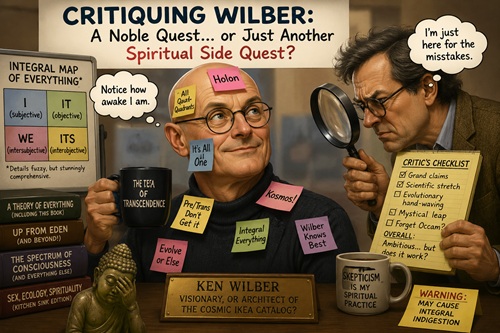
The Danger of Becoming What You OpposeI have spent a great deal of time criticizing Ken Wilber. I have questioned his metaphysics, challenged his evolutionary narratives, examined his claims about spirituality, scrutinized his treatment of science, and repeatedly returned to what I see as the gap between his extraordinary intellectual ambition and the evidential foundations of some of his conclusions. I have also been sharply critical of the Integral community when it appears to protect Wilber from serious criticism. Much of this criticism remains, in my view, justified. But there is a danger that arises when one criticizes a thinker for a long time: the critique itself can become a system. The critic can begin to see everything through the lens of the criticism. What started as intellectual skepticism can gradually become an interpretive habit in which the subject is almost always expected to confirm the critic's prior conclusions. That possibility deserves to be taken seriously. The uncomfortable question, therefore, is not whether Ken Wilber has weaknesses. He clearly does. The question is whether my own approach to Wilber has weaknesses that distort the picture. I think it does. The Confirmation Bias of the CriticThe most obvious danger is confirmation bias. If I repeatedly search for examples of Wilber's overstatements, inconsistencies, questionable science, metaphysical leaps, or rhetorical excesses, I will find them. Wilber has written an enormous amount over several decades. His work contains enough complexity, ambition, speculation, revision, and controversy to provide abundant material for criticism. But the same is true in reverse. If someone approaches Wilber looking for evidence of genius, spiritual profundity, or intellectual originality, they will find plenty of that too. This creates an asymmetry that is easy to overlook. A critic can accumulate dozens of examples demonstrating that a thinker is wrong without adequately representing why intelligent people have found that thinker compelling in the first place. There is a difference between showing that someone is mistaken and explaining why their work has had such extraordinary influence. I sometimes risk emphasizing the first while underplaying the second. The result could be a distorted portrait: Wilber as the man who gets things wrong, rather than Wilber as an unusually ambitious thinker whose mistakes are inseparable from the scale of the intellectual project he undertook. The Problem of Reading Wilber Through His Weakest ArgumentsAnother danger is that I may sometimes give too much weight to Wilber's weakest formulations. Wilber is an exceptionally prolific writer. His ideas have evolved. His terminology has shifted. His arguments have been revised, reformulated, and occasionally abandoned. Some of his statements are clearly speculative, some are rhetorical, and some are intended as provocative shorthand rather than as carefully defended propositions. A critic can easily isolate a particularly vulnerable statement and treat it as representative of the entire system. That is intellectually tempting because it makes criticism easier. But it may not always be fair. The stronger question is not, "Can I find a bad sentence in Wilber?" Of course I can. The stronger question is, "What is the best version of Wilber's argument, and does that version survive criticism?" That is a much more demanding standard. If I criticize Wilber primarily by collecting his most questionable claims, I may win individual arguments while missing the deeper intellectual structure of his work. The Difference Between Metaphysics and Empirical ClaimsOne of the recurring themes in my criticism is Wilber's movement between empirical science and metaphysical interpretation. I think this criticism has real force. Wilber sometimes appears to borrow the authority of science for claims that science itself does not establish. Evolutionary biology, neuroscience, developmental psychology, and physics can become ingredients in a much larger metaphysical narrative that goes well beyond what the evidence warrants. But here too I need to be careful. There is nothing inherently illegitimate about metaphysics. Science cannot, by itself, answer every question that human beings ask. Questions about meaning, value, consciousness, existence, and the nature of reality inevitably take us beyond straightforward empirical description. My criticism becomes weaker if it implicitly assumes that only scientifically testable claims are legitimate. That would be a crude scientism, and I do not want to fall into it. The real issue is not whether metaphysics is allowed. It is whether metaphysical claims are clearly distinguished from empirical claims, whether the transition between them is justified, and whether speculative conclusions are presented with an appropriate degree of confidence. That distinction is crucial. If I blur it, I risk criticizing Wilber for doing something that every serious philosopher does: moving from empirical knowledge toward philosophical interpretation. The Risk of Treating Spirituality as a Failed ScienceRelatedly, I may sometimes judge spiritual claims according to standards they were never intended to meet. A mystical experience is not a laboratory experiment. A meditation practice is not necessarily a scientific hypothesis. A person's experience of unity, transcendence, or nonduality cannot simply be dismissed because it cannot be independently measured in the same way as a chemical reaction. My skepticism should therefore not become reductionism. It is perfectly reasonable to say that an experience of the Absolute does not establish that the Absolute exists. But it is another thing to say that the experience itself is meaningless or worthless. Wilber's strongest contribution may lie precisely here. He takes subjective spiritual experience seriously as a domain of human experience that deserves systematic attention. I can challenge his interpretation of that experience without denying the experience itself. This distinction becomes especially important when dealing with Wilber's own mystical claims. I have often emphasized the epistemological gap between "I experienced ultimate reality" and "I therefore know what ultimate reality is." That gap is real. But the opposite error would be to assume that because mystical experience does not prove a metaphysical conclusion, it has no epistemic or existential significance whatsoever. The skeptical position should be more nuanced than that. The Risk of the Materialist Straw ManThere is another danger in my critique: sometimes the opposition between Wilber and materialism may become too sharply drawn. Wilber has often portrayed conventional science as philosophically inadequate because it cannot account for consciousness, subjectivity, interiority, meaning, or values. There is something important in that criticism. The problem is that "materialism" is an extraordinarily broad term. There are crude forms of reductionism that really do struggle to explain subjective experience. But contemporary philosophy of mind contains many positions that are more sophisticated than the caricature of "everything is nothing but atoms." Emergentism, physicalism with non-reductive commitments, neutral monism, panpsychism, functionalism, predictive processing, embodied cognition, and other approaches complicate the picture considerably. If I sometimes treat "materialism" as a single opponent, I may inadvertently make Wilber's critique easier than it should be. A serious critic should ask whether Wilber has actually defeated the strongest contemporary naturalistic alternatives—not merely an outdated version of reductionism. That is a much harder challenge. The Problem of HindsightI also have the advantage of hindsight. Wilber developed many of his ideas decades ago. I can now compare them with contemporary scientific knowledge, current developmental psychology, modern evolutionary theory, and a much more sophisticated understanding of consciousness research. That is legitimate, but it can also be unfair. Ideas should be judged partly in their historical context. Some of Wilber's formulations may appear naïve today because the intellectual environment has changed. Some of his claims may have been reasonable hypotheses at the time but have since become less convincing. Others may have anticipated questions that are still unresolved. The historian's question therefore matters: What was Wilber trying to accomplish at the moment he wrote this? What intellectual problems was he responding to? Which alternatives were available to him? Without that context, criticism can become a form of retrospective superiority. The Temptation to Reduce Wilber to His PersonalityThere is also a psychological danger. Wilber's style can be irritating. His confidence can appear excessive. His claims to intellectual comprehensiveness can provoke resistance. His conflicts with critics and his occasional dismissiveness toward opponents can make him an easy target. But none of this settles the truth of his ideas. A person's personality is not an argument. If I become too focused on Wilber's rhetorical style, his self-presentation, or his intellectual persona, I may start treating those features as evidence against the substance of his work. That would be a mistake. The proper question is always: Is the argument sound? One can dislike Wilber's tone and still recognize that he has made important contributions. Conversely, one can admire his intellectual brilliance and still conclude that some of his arguments fail. Keeping those two judgments separate is essential. The Danger of the Reverse Pre/Trans FallacyWilber famously developed the concept of the pre/trans fallacy: the idea that higher states of consciousness can be confused with lower, pre-rational states because both transcend ordinary rationality. But perhaps there is a reverse version of the same problem. The skeptical critic can confuse everything that appears irrational with everything that is genuinely transrational. In other words, because some spiritual claims are pre-rational, irrational, or pseudoscientific, one can become suspicious of all claims that transcend conventional rationality. That would be a serious mistake. The fact that some people believe in angels, cosmic energies, or spiritual hierarchies does not prove that all forms of contemplative experience are nonsense. Nor does the fact that some spiritual teachers make extravagant claims invalidate every form of meditation or mystical philosophy. A robust skepticism must distinguish between the genuinely profound, the psychologically interesting, the philosophically defensible, and the empirically unsupported. That is harder than simply rejecting the entire package. The Echo Chamber ProblemThere is an irony here. I have criticized spiritual thinkers for creating echo chambers around themselves. I have criticized Integralists for interpreting criticism as evidence that critics are less evolved. I have criticized the use of AI when it merely reinforces a person's existing worldview. But I am not immune to the same dynamic. If I repeatedly ask AI to analyze Wilber critically, the system will become increasingly familiar with the critical frame I have established. It can help me identify patterns, sharpen arguments, find inconsistencies, and formulate objections. But it can also become a sophisticated confirmation machine. The danger is not that AI necessarily "agrees" with me. The danger is subtler. It can become increasingly good at helping me articulate my existing position. That is useful—but it is not the same as truth-seeking. The solution is not to stop using AI. It is to deliberately use it against oneself. Ask for the strongest defense of Wilber. Ask for the best version of Integral Theory. Ask what the critic is missing. Ask which criticisms are weak, outdated, or unfair. Ask whether a particular objection actually defeats the argument or merely exposes an ambiguity. A critic needs an adversarial AI as much as a believer needs a skeptical one. The Risk of Negativity Becoming an IdentityThere is perhaps an even deeper problem. Criticism can become rewarding. It is intellectually satisfying to expose contradictions. It is satisfying to discover that an apparently grand theory contains weaknesses. It is satisfying to puncture intellectual pretensions. But if one becomes too comfortable in the role of the critic, criticism itself can become a kind of identity. Then the question subtly changes. Instead of asking, "Is Wilber right?" one starts asking, "What is wrong with Wilber?" Those are not the same question. The first is open-ended. The second presupposes the conclusion. I need to guard against this. My objective should not be to defeat Wilber. It should be to understand him accurately enough that both his strengths and weaknesses become visible. That may occasionally require defending him against criticisms that I myself have previously made. What I Still Think the Critique Gets RightAcknowledging these weaknesses does not require abandoning my skepticism. I still think there are serious problems in Wilber's work. His tendency to construct vast theoretical systems from heterogeneous sources remains problematic. His use of scientific terminology sometimes exceeds what the evidence can support. His developmental models can appear overly confident and culturally biased. His metaphysical conclusions often outrun his empirical premises. His concept of an evolutionary movement toward higher consciousness remains difficult to establish objectively. And the Integral community's tendency, at times, to treat criticism as evidence of insufficient development remains worthy of scrutiny. But criticism is strongest when it does not need to exaggerate. Wilber's actual weaknesses are substantial enough. There is no need to pretend that he has contributed nothing valuable. There is no need to deny the originality of his synthesis. There is no need to dismiss contemplative experience because some of its interpretations are questionable. There is no need to portray naturalism as a complete philosophy of life in order to criticize Integral metaphysics. The more nuanced the critique becomes, the more persuasive it becomes. The Wilber I May Have UnderestimatedPerhaps the greatest weakness in my approach is that I may sometimes underestimate what Wilber was actually trying to do. Wilber was not merely attempting to explain consciousness. He was attempting to construct a comprehensive map that could place science, psychology, spirituality, culture, biology, politics, and contemplative experience into a single framework. That project may ultimately fail. Indeed, I believe some of its central claims are difficult to defend. But the ambition itself deserves recognition. There are very few contemporary thinkers willing to attempt intellectual synthesis on such a scale. Even when Wilber's synthesis breaks down, the attempt can be illuminating. His errors can reveal the difficulty of connecting domains that are usually kept separate. In that sense, Wilber may be more valuable as a provocateur of questions than as the provider of final answers. That is not a small achievement. From Debunking to DiscriminationThe best version of my critique, then, should move beyond debunking. Debunking asks: Where is Wilber wrong? Discrimination asks: What is right, what is wrong, what is speculative, what is profound, what is outdated, and what remains genuinely unresolved? The second approach is more difficult. It also produces a more interesting Wilber. Instead of the Integral theorist who has everything figured out, we encounter a thinker whose greatest strengths and greatest weaknesses arise from the same source: an extraordinary desire to see the whole. The desire for the whole can produce grandiosity. It can also produce synthesis. The search for ultimate truth can encourage metaphysical overreach. It can also encourage questions that narrower disciplines neglect. The confidence to challenge established paradigms can produce intellectual arrogance. It can also produce originality. Wilber's weaknesses do not cancel his strengths. His strengths do not excuse his weaknesses. The real intellectual task is to hold both together. A Critic's Final ResponsibilityThe final responsibility of a critic is therefore not to destroy the object of criticism. It is to remain capable of being surprised by it. If I approach every new Wilber text expecting to discover another contradiction, I may find one—and miss something else. If I assume that every spiritual claim conceals an epistemological error, I may become blind to genuine dimensions of human experience. If I assume that every Integral synthesis is intellectually confused, I may fail to recognize when Wilber has identified a real problem that deserves attention. The greatest test of skepticism is not whether it can say no. It is whether it can still say yes when the evidence warrants it. That is perhaps the most important challenge I can pose to my own writing on Ken Wilber. I do not need to become a Wilberian. But I do need to become a better critic of Wilber. And that means recognizing that the most interesting question is not whether Ken Wilber is right or wrong. It is where he is right, where he is wrong, and why the difference matters.
Widget is loading comments...
|