|
TRANSLATE THIS ARTICLE
Integral World: Exploring Theories of Everything
An independent forum for a critical discussion of the integral philosophy of Ken Wilber
  Frank Visser, graduated as a psychologist of culture and religion, founded IntegralWorld in 1997. He worked as production manager for various publishing houses and as service manager for various internet companies and lives in Amsterdam. Books: Ken Wilber: Thought as Passion (SUNY, 2003), and The Corona Conspiracy: Combatting Disinformation about the Coronavirus (Kindle, 2020). Frank Visser, graduated as a psychologist of culture and religion, founded IntegralWorld in 1997. He worked as production manager for various publishing houses and as service manager for various internet companies and lives in Amsterdam. Books: Ken Wilber: Thought as Passion (SUNY, 2003), and The Corona Conspiracy: Combatting Disinformation about the Coronavirus (Kindle, 2020).
Check out my other conversations with ChatGPT Ken Wilber Is Not the AnswerWhy the Integral Empire Needs Its Greatest Challenge YetFrank Visser / ChatGPT
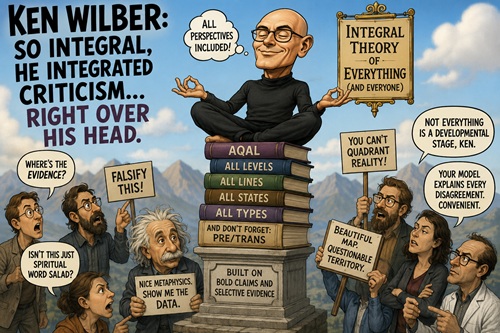 The Philosopher Everyone Talks About—and Too Few People ChallengeKen Wilber has achieved something extraordinary. He has built one of the most ambitious intellectual systems of our time, combining psychology, spirituality, evolutionary theory, developmental models, philosophy, meditation, cultural criticism, and systems thinking into a single overarching vision. His books have attracted a devoted international following, inspired conferences and organizations, and influenced countless people searching for a framework large enough to contain both science and spirituality. And yet there is a strange paradox at the heart of Wilber's success. The more comprehensive his system becomes, the more necessary it is to question it. Wilber's project is often presented as an integral approach because it promises to include multiple perspectives rather than reducing everything to one dimension. Science is included. Subjective experience is included. Culture is included. Social systems are included. Developmental psychology is included. Meditation and mystical experience are included. But inclusion is not the same as validation. A theory can include everything and still get many things wrong. That is precisely why Wilber deserves more criticism, not less. Not because he is uniquely bad, but because he is uniquely influential. The larger the intellectual claims, the greater the obligation to test them. If Wilber wants to offer a framework capable of integrating the major domains of human knowledge, then that framework should be subjected to the same relentless scrutiny that scientists apply to competing theories. Instead, something else has often happened. Wilber has become, for some of his followers, less a thinker to be critically examined than a thinker through whom other thinkers are examined. That is the point at which an intellectual movement risks becoming an intellectual culture. And cultures develop immune systems against criticism. The Integral Theory of EverythingWilber's great strength is also his greatest vulnerability: the sheer scale of his ambition. He does not merely propose a psychological model. He offers a map of reality. Consciousness evolves. Cultures evolve. Individuals develop through stages. Societies develop through stages. Spiritual realization represents a higher dimension of human development. The universe itself is understood through a developmental and evolutionary framework. His famous four-quadrant model seeks to ensure that no single perspective becomes reductively dominant. This is intellectually seductive. It is also extraordinarily difficult to substantiate. The larger the synthesis, the easier it becomes to move from established knowledge to interpretation, from interpretation to speculation, and from speculation to metaphysical assertion—without always clearly marking the transition. A reader can begin with something relatively uncontroversial, such as the fact that human beings have subjective experiences and exist within social systems. A few pages later, the argument may have moved into developmental stages of consciousness, evolutionary spirituality, involution, or nondual awareness. The danger is not that these ideas are necessarily false. The danger is that they can acquire the appearance of scientific credibility simply because they are embedded in an enormous intellectual architecture. The bigger the building, the more convincing the scaffolding can look. But a comprehensive map is not necessarily an accurate map. The Problem of the MapWilber's four quadrants are perhaps the clearest example. The distinction between interior and exterior, individual and collective, is useful. It reminds us that human beings can be studied from multiple perspectives. Consciousness cannot simply be reduced to brain chemistry, just as social structures cannot be reduced to individual psychology. Fine. But from this modest insight, Wilber's system expands into a highly elaborate architecture of "all quadrants, all levels, all lines, all states, all types." The conceptual multiplication is impressive. But does each additional category increase explanatory power? That is the question that should be asked more often. A framework can become more comprehensive simply by adding more boxes. But a theory does not become more accurate merely because it contains more distinctions. Sometimes complexity is genuine sophistication. Sometimes it is accumulated vocabulary. The challenge for Integral Theory is therefore not to demonstrate that it can classify everything. It is to demonstrate that its classifications actually explain something better than competing frameworks do. What predictions does the model make? Which claims could prove it wrong? Which observations would force an integral theorist to abandon part of the system? These are not hostile questions. They are the questions any serious intellectual framework should welcome. The Missing Ingredient: FalsifiabilityWilber's system has often been criticized for being difficult to falsify. This criticism deserves much more attention. If someone disagrees with Integral Theory, there always seems to be a possible explanation. Perhaps they are operating from a lower developmental stage. Perhaps they are trapped in a particular quadrant. Perhaps they are confusing pre-rational with trans-rational. Perhaps they have failed to integrate their own shadow. Perhaps they are privileging one perspective at the expense of others. Perhaps they simply have not yet reached the level of consciousness required to understand the argument. This creates a dangerous asymmetry. The theory can explain the critic, but the critic cannot easily challenge the theory. Once a framework possesses the ability to diagnose every disagreement as evidence of the opponent's developmental limitations, it becomes remarkably resistant to refutation. That is precisely when intellectual humility becomes essential. A theory that can explain everything must be especially careful not to explain away everything. The Pre/Trans TrapWilber's famous pre/trans distinction is one of his most influential contributions—and one of the areas most in need of critical examination. The basic insight is valuable. Not every departure from ordinary rational consciousness is spiritual transcendence. Regression, psychosis, fantasy, infantile fusion, and mystical realization should not automatically be placed in the same category. But the distinction becomes problematic when it is used too broadly. Once you divide human experience into "pre-rational" and "trans-rational," you risk creating a hierarchy in which disagreement with spiritual claims can itself be interpreted as evidence of insufficient development. The skeptic says: "There is no evidence for this." The integralist may respond: "You are trapped in rational reductionism." The critic says: "Your mystical experience may be psychologically generated." The response may be: "You are confusing the pre with the trans." At that point, the argument has stopped being an empirical discussion. It has become a contest over developmental status. And that is a contest the theory is structurally designed to win. The Mystical Experience ProblemWilber has spoken extensively about mystical and nondual experiences. His own experiences have played an important role in his intellectual development. These experiences may be profound. They may be transformative. They may even be among the most important experiences a human being can have. But a profound experience is not automatically a metaphysical discovery. This distinction is crucial. A person can experience unity without proving that reality itself is metaphysically One. A person can experience timelessness without demonstrating that time is ultimately unreal. A person can experience boundless consciousness without establishing that consciousness is the fundamental substance of the universe. The experience is real as an experience. The interpretation remains open to debate. This is where Wilber's system sometimes moves too quickly from phenomenology to ontology—from "this is what consciousness can experience" to "this is what reality ultimately is." That leap deserves scrutiny. The history of religion is filled with people who have had extraordinary experiences and interpreted them in radically different ways. Buddhists, Hindus, Christians, Sufis, mystics, psychedelically induced experiencers, and secular meditators can all report profound alterations in consciousness. The experiences may overlap. The metaphysical conclusions often do not. That should make us cautious. The Evolutionary Story That May Be Too ConvenientWilber's evolutionary narrative is perhaps his most ambitious move. Evolution, in his framework, is not merely biological adaptation. It is part of a larger movement toward greater complexity, consciousness, integration, and spiritual realization. This is an inspiring story. But inspiration is not evidence. Biological evolution does not have a known destination. It does not demonstrably aim toward enlightenment. Complexity can increase, but it can also decrease. Evolution produces bacteria, parasites, trees, humans, viruses, and countless extinct forms. It has no obvious moral hierarchy. Human beings may value consciousness. That does not mean the cosmos does. The danger here is subtle. Once spiritual development is placed inside the story of cosmic evolution, human aspirations can be projected onto the universe itself. We want evolution to mean progress. We want consciousness to have a purpose. We want history to be going somewhere. Wilber's system gives these intuitions an impressive philosophical vocabulary. But vocabulary does not turn aspiration into fact. The Integralist Immune ResponsePerhaps the most interesting phenomenon surrounding Wilber is not Wilber himself. It is what happens when people criticize him. Some integralists respond thoughtfully. They engage the argument, acknowledge weaknesses, and distinguish between Wilber's stronger and weaker claims. Others respond differently. They defend Wilber by invoking his achievements. They point to the vastness of his system. They argue that critics have misunderstood him. They suggest that the critic has not read enough. Or they imply that the critic lacks the developmental capacity to appreciate the theory. This is understandable. Every intellectual movement develops loyal defenders. But loyalty can become a liability when it replaces examination. A genuinely integral response to criticism would be to welcome it. If Integral Theory is as powerful as its advocates believe, it should survive criticism. Indeed, it should improve because of criticism. A theory that becomes stronger when challenged is intellectually alive. A theory that becomes more defensive when challenged is becoming ideological. Why Wilber Needs CriticsThe irony is that Wilber's own philosophy provides the strongest argument for criticizing him. If multiple perspectives are necessary, then Wilber himself needs multiple perspectives. If no single quadrant captures the whole, then neither can Wilber's own framework. If development involves transcendence and inclusion, then Integral Theory itself must be capable of transcending and including its earlier formulations. If we are genuinely committed to "all perspectives," then the skeptical, materialist, empirical, reductionist, and anti-metaphysical perspectives cannot simply be assigned a lower developmental status and dismissed. They must be taken seriously. The integral challenge is therefore not to destroy Wilber. It is to de-absolutize him. Ken Wilber should be treated as an important thinker, not as an intellectual final authority. His ideas should be explored, tested, criticized, revised, and sometimes rejected. His insights should be separated from his metaphysics. His useful distinctions should be distinguished from his speculative extrapolations. His psychological observations should be evaluated independently of his spiritual conclusions. His developmental theories should be examined empirically rather than accepted because they fit elegantly into his larger worldview. That would not diminish Wilber. It would make the conversation around him more mature. The Emperor Needs a MirrorThere is something deeply ironic about a movement dedicated to seeing more perspectives that sometimes seems unable to see itself from the outside. Perhaps this is the greatest challenge facing Integral Theory today. Not whether Wilber is right or wrong. Not whether spirituality is real or illusory. Not whether consciousness is fundamental or emergent. The deeper question is whether a theory designed to integrate everything can itself become an object of integration. Can Integral Theory include its own critics?Can it tolerate the possibility that some of its central claims are mistaken? Can it accept that mystical experience does not necessarily reveal ultimate reality? Can it acknowledge that evolution may have no spiritual direction? Can it recognize that developmental hierarchies can become tools of intellectual self-protection? Can it admit that a theory of everything may contain too much theory and too little evidence? These questions are not attacks from outside the integral project. They are invitations to take the project seriously. The Future of Integral Thought Begins with DisagreementThe next generation of integral thinking should not be about defending Ken Wilber. It should be about moving beyond him. That does not mean abandoning everything he has contributed. His insistence on multiple perspectives, developmental complexity, interiority, culture, and the importance of spiritual experience remains valuable. But no thinker should become indispensable. The greatest tribute to Wilber would not be to preserve his system unchanged. It would be to challenge it so thoroughly that whatever survives is stronger, more modest, more empirically grounded, and more intellectually honest. Every great intellectual tradition eventually faces this test. Does it become a school of thought? Or does it become a school of loyalty? Wilber's legacy will ultimately depend not on how many people agree with him, but on whether his ideas can withstand people who disagree with him. That is why Ken Wilber needs to be challenged more than almost anyone else in the integral world. Not because he has failed. But because he has succeeded. The more influential the thinker, the more powerful the challenge must be. And if Integral Theory really means integral, then it should be ready for the one perspective it has never fully mastered: the perspective of the critic.
Widget is loading comments...
|