|
TRANSLATE THIS ARTICLE
Integral World: Exploring Theories of Everything
An independent forum for a critical discussion of the integral philosophy of Ken Wilber
  Frank Visser, graduated as a psychologist of culture and religion, founded IntegralWorld in 1997. He worked as production manager for various publishing houses and as service manager for various internet companies and lives in Amsterdam. Books: Ken Wilber: Thought as Passion (SUNY, 2003), and The Corona Conspiracy: Combatting Disinformation about the Coronavirus (Kindle, 2020). Frank Visser, graduated as a psychologist of culture and religion, founded IntegralWorld in 1997. He worked as production manager for various publishing houses and as service manager for various internet companies and lives in Amsterdam. Books: Ken Wilber: Thought as Passion (SUNY, 2003), and The Corona Conspiracy: Combatting Disinformation about the Coronavirus (Kindle, 2020).
Check out my other conversations with ChatGPT Beyond Groupthink?A Critical Evaluation of Joseph Dillard's Early Geopolitical VisionFrank Visser / ChatGPT
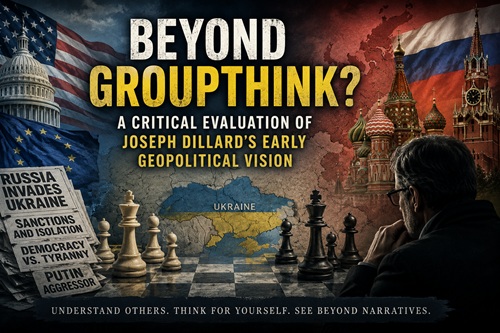 An Integral Critique Turns toward GeopoliticsJoseph Dillard's essay "The Ukraine Crisis: An Opportunity to Wake Up Out of Groupthink" (2022) marks the beginning of what has since become a sustained engagement with geopolitics. Although written in the immediate aftermath of Russia's invasion of Ukraine, the essay is less a commentary on military events than an attempt to challenge what Dillard regards as the intellectual and moral assumptions underlying Western responses to the conflict. It introduces themes that recur throughout his later writings: skepticism toward mainstream Western narratives, sympathy for realist explanations of international politics, criticism of liberal interventionism, and dissatisfaction with what he sees as the ideological capture of Integral Theory by Western progressivism. As an early statement of Dillard's geopolitical philosophy, the essay deserves careful consideration. It is provocative, ambitious, and refreshingly willing to question prevailing orthodoxies. At the same time, it illustrates the difficulties that arise when legitimate skepticism toward one dominant narrative gradually hardens into confidence in an alternative narrative. The result is a work that contains genuine insights while also displaying significant analytical limitations. Challenging the Moral Simplicity of Wartime NarrativesOne of the essay's greatest strengths lies in its rejection of moral simplification. Dillard argues that understanding an adversary is not equivalent to endorsing that adversary, a distinction that is often lost during periods of international crisis. Public debate, particularly in the early months of the Ukraine war, frequently reduced the conflict to a struggle between democracy and authoritarianism, leaving little room for discussion of Russia's historical security concerns, NATO expansion, or the complicated political evolution of post-Soviet Ukraine. In urging readers to examine these factors, Dillard performs a valuable intellectual service. International conflicts almost never emerge from a single cause or a single act of aggression. They develop through long histories of mutual suspicion, failed diplomacy, conflicting strategic interests, and accumulated grievances. Recognizing these complexities does not diminish responsibility for the invasion itself, nor does it justify violations of international law. Rather, it reflects the elementary principle that explanation differs from justification. This distinction places Dillard broadly within the realist tradition of international relations. Like many realist scholars, he argues that states primarily pursue security rather than moral ideals, and that ignoring this reality leads to strategic miscalculation. Whether one agrees with his conclusions or not, this emphasis on structural causes provides a useful corrective to purely moralistic accounts of international politics. A Timely Critique of Integral Political ThinkingDillard also raises important questions about the application of Integral Theory to geopolitics. He criticizes what he sees as the tendency among Integral thinkers to classify entire nations according to developmental models such as Spiral Dynamics. In this framework, Western liberal democracies are often implicitly associated with higher developmental stages, while geopolitical rivals are interpreted as expressions of more primitive levels of consciousness. Dillard argues that this approach mistakes psychological development for geopolitical analysis. Nations do not behave primarily according to levels of consciousness but according to geography, military capability, historical memory, economic interests, and security calculations. Developmental psychology may illuminate individual values and cultural trends, but it cannot replace traditional geopolitical analysis. This criticism is persuasive. Ken Wilber's AQAL framework was developed primarily as a model of human consciousness and cultural evolution rather than as a theory of international relations. Attempts to explain military alliances, energy politics, or territorial conflicts primarily in developmental terms often produce simplistic conclusions that underestimate the enduring importance of power politics. Dillard is therefore justified in warning against an overly psychologized understanding of world affairs. The Appeal of Geopolitical RealismThroughout the essay, Dillard consistently favors realism over liberal internationalism. He views great-power competition as a permanent feature of international politics rather than an unfortunate residue of earlier historical stages. From this perspective, Russia's actions cannot be understood solely through moral condemnation but must be situated within broader questions of strategic balance and perceived threats. This realist orientation encourages readers to ask uncomfortable questions. How would any major power respond if a rival military alliance steadily expanded toward its borders? To what extent do historical experiences shape national security doctrines? Can moral principles alone explain foreign policy decisions? These are entirely legitimate questions, and Dillard deserves credit for insisting that they remain part of public discussion. His realism serves as a reminder that international politics often involves tragic choices rather than contests between absolute good and evil. Yet realism itself has limitations. While it explains why states seek security, it does not determine whether every security claim is objectively justified. Great powers frequently exaggerate external threats, interpret neighboring states through the lens of historical trauma, or invoke security concerns to legitimize expansionist ambitions. Realism therefore explains behavior without necessarily validating it. From Healthy Skepticism to Selective SkepticismWhere Dillard's analysis becomes less convincing is in the asymmetry of his skepticism. One of the essay's central themes is that Western media, governments, and intellectual institutions are susceptible to conformity, ideological bias, and propaganda. This observation is hardly controversial. Democratic societies are certainly capable of producing simplified narratives during periods of conflict, and journalists often rely heavily on official sources during rapidly developing crises. The difficulty arises because Dillard applies this critical scrutiny far less consistently to alternative sources of information. Western intelligence assessments are frequently questioned, while Russian security claims often receive a more charitable hearing. Mainstream journalism is treated with suspicion, whereas dissenting analyses sometimes appear to enjoy an implicit presumption of greater credibility. Such asymmetry risks replacing one form of confirmation bias with another. A genuinely critical approach requires applying identical standards of evidence to all actors, regardless of ideological preference. Every government, whether democratic or authoritarian, engages in strategic communication, selective disclosure, and propaganda. No state possesses a monopoly on truthfulness or deception. The strongest form of skepticism is therefore symmetrical. It subjects every narrative to equal scrutiny rather than assuming that opposition to one dominant discourse automatically produces greater accuracy. The Problem with "Groupthink"The organizing concept of Dillard's essay is groupthink. He argues that Western societies have fallen into a collective psychological pattern that discourages independent thought and suppresses alternative interpretations of geopolitical events. There is undoubtedly some truth in this diagnosis. During periods of war, emotional polarization often narrows public debate. Social media intensifies conformity pressures, while political leaders naturally seek public unity. Nuanced positions can quickly become marginalized as audiences gravitate toward morally satisfying narratives. Nevertheless, Dillard's use of the concept occasionally becomes overly expansive. Disagreement with his interpretation is frequently attributed to ideological blindness rather than to reasonable differences in judgment. Once this pattern develops, groupthink risks becoming an all-purpose explanation for opposing viewpoints. Ironically, intellectual communities built around skepticism are themselves vulnerable to groupthink. Alternative media ecosystems can become just as self-reinforcing as mainstream ones, rewarding confirmation while dismissing inconvenient evidence. Every community, whether establishment or dissident, faces the temptation to mistake consensus for certainty. The Psychology of Perspective-TakingDillard's background in Integral Deep Listening adds an unusual dimension to his geopolitical writing. Rather than approaching international conflict solely through strategy or economics, he encourages readers to imaginatively inhabit the perspectives of opposing actors. Such psychological exercises can reduce demonization and foster a deeper appreciation of conflicting worldviews. This emphasis on empathy is admirable. Diplomatic success often depends precisely upon understanding how one's adversaries perceive reality rather than assuming they interpret events identically. Yet empathy has epistemological limits. Understanding why Russia perceived NATO expansion as threatening does not establish that every Russian claim about Ukraine was factually correct. Similarly, understanding Western fears regarding Russian revisionism does not validate every NATO policy. Perspective-taking broadens understanding, but it does not determine truth. The distinction between empathy and evidence must therefore remain clear. The Risks of Historical ConfidenceAnother characteristic already visible in this early essay is Dillard's confidence in predicting historical trajectories. He writes with considerable assurance about the decline of Western influence, the failure of sanctions, the emergence of multipolarity, and the restructuring of the international order. Some of these expectations proved well founded. Russia's economy proved more resilient than many Western analysts initially predicted. The BRICS grouping expanded. China's influence continued to grow. Multipolarity has become a more widely accepted description of the international system than it was only a decade ago. Other predictions have been more ambiguous. Western economies suffered significant disruptions but did not experience systemic collapse. NATO, rather than weakening, expanded with the accession of Finland and Sweden, while European defense cooperation intensified in response to the invasion. These developments suggest a more complicated picture than either triumphalist Western narratives or deterministic forecasts of Western decline anticipated. The broader lesson is methodological. Geopolitical forecasting benefits from probabilistic reasoning rather than categorical prediction. History repeatedly surprises both optimists and pessimists. Reversing Rather Than Escaping PolarizationPerhaps the deepest irony of Dillard's essay lies in its relationship to polarization itself. He criticizes binary thinking and urges readers to move beyond simplistic moral oppositions. This aspiration is commendable. Yet the structure of his own argument sometimes reproduces the very pattern he seeks to overcome. Instead of presenting a nuanced balance between competing narratives, the essay occasionally appears to substitute one polarity for another. The moral certainty of mainstream Western discourse is replaced by an equally confident critique in which Western institutions become the primary source of misunderstanding while Russia assumes the role of the more rational geopolitical actor. The identities change, but the underlying binary remains. Escaping polarization requires resisting both dominant narratives and counter-narratives whenever either becomes insulated from criticism. A Valuable but Incomplete FrameworkJoseph Dillard's early geopolitical writing represents a serious attempt to broaden the conversation surrounding international conflict. His insistence that understanding differs from endorsement, his skepticism toward simplistic moral narratives, and his critique of developmental explanations of geopolitics all make worthwhile contributions. Particularly within the Integral community, where political analysis has often been shaped by psychological models, Dillard's appeal to geopolitical realism offers an important corrective. At the same time, the essay illustrates the challenges facing every intellectual dissident. Skepticism toward dominant institutions can sharpen critical thinking, but it can also become selective. The desire to expose propaganda can inadvertently foster confidence in alternative narratives that deserve equally rigorous examination. Likewise, dissatisfaction with prevailing orthodoxies can tempt one toward sweeping historical predictions that later events only partially confirm. The essay therefore succeeds best as a critique rather than as a comprehensive alternative framework. It effectively exposes weaknesses in liberal moralism and invites readers to think more deeply about power, history, and security. Yet its own explanatory model remains vulnerable to confirmation bias, asymmetrical skepticism, and excessive confidence in historical forecasting. As the opening chapter in Dillard's continuing engagement with geopolitics, "The Ukraine Crisis" is both intellectually stimulating and revealing. It demonstrates the value of questioning consensus while simultaneously reminding us that genuine independence of thought requires maintaining the same critical standards toward every narrative, including those we ourselves find most persuasive. That, perhaps, is the deepest challenge posed by the very concept of groupthink.
Widget is loading comments...
|