|
TRANSLATE THIS ARTICLE
Integral World: Exploring Theories of Everything
An independent forum for a critical discussion of the integral philosophy of Ken Wilber
  Frank Visser, graduated as a psychologist of culture and religion, founded IntegralWorld in 1997. He worked as production manager for various publishing houses and as service manager for various internet companies and lives in Amsterdam. Books: Ken Wilber: Thought as Passion (SUNY, 2003), and The Corona Conspiracy: Combatting Disinformation about the Coronavirus (Kindle, 2020). Frank Visser, graduated as a psychologist of culture and religion, founded IntegralWorld in 1997. He worked as production manager for various publishing houses and as service manager for various internet companies and lives in Amsterdam. Books: Ken Wilber: Thought as Passion (SUNY, 2003), and The Corona Conspiracy: Combatting Disinformation about the Coronavirus (Kindle, 2020).
Check out my other conversations with ChatGPT Can Science Explain Everything?Weinberg's Powerful Defense and Its Philosophical Blind SpotsFrank Visser / ChatGPT
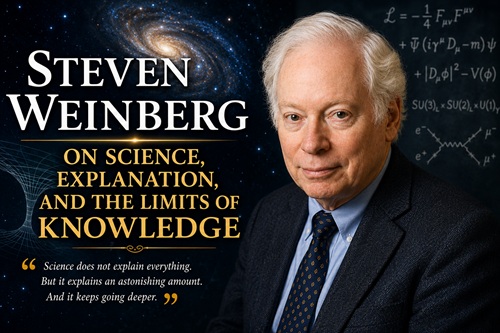 IntroductionSteven Weinberg's essay "Can Science Explain Everything? Anything?" is a concise but forceful defense of scientific explanation against philosophical skepticism.[1] Written during the "science wars" of the 1990s and early 2000s, it rejects the claim that science merely describes the world without truly explaining it. For Weinberg, explanation consists precisely in showing how diverse phenomena follow from a smaller number of deeper principles. The triumph of the Standard Model of particle physics exemplifies this achievement. The essay remains an eloquent statement of scientific realism and reductionism. Yet, from today's perspective, some of its philosophical assumptions appear stronger than the evidence warrants. The Strength of Weinberg's CaseWeinberg begins with an example familiar to every physicist: the remarkable unification of elementary particle physics during the late twentieth century. What once seemed a bewildering collection of particles and forces became understandable through a comparatively simple mathematical framework. This is an excellent illustration of scientific explanation. Instead of merely cataloguing facts, science uncovers regularities and derives seemingly unrelated observations from more fundamental principles. The history of physics—from Newton through Maxwell, Einstein, and quantum field theory—provides many examples of this cumulative explanatory success. Weinberg is also persuasive in rejecting the idea that science simply accumulates descriptions. Explanation always involves reducing complexity to simplicity, identifying mechanisms, and revealing hidden structure. Few would deny that this is one of science's greatest intellectual achievements. Reductionism as Method Versus MetaphysicsThe central weakness of the essay lies in its easy transition from methodological reductionism to ontological reductionism. Methodologically, reductionism has been enormously successful. Chemists explain molecular behavior through physics; biologists explain many cellular processes through chemistry. This hierarchical strategy has repeatedly generated genuine discoveries. But Weinberg sometimes writes as though this methodological success proves that everything is nothing but elementary physics. That conclusion does not follow. Complex systems often display emergent properties that cannot be predicted simply by knowing their microscopic constituents. Weather, ecosystems, economies, brains, and cultures all exhibit higher-level regularities that require their own explanatory frameworks. Their dependence on physics does not eliminate the legitimacy of biology, psychology, or sociology. This is not an anti-scientific objection. It merely recognizes that explanation operates at multiple levels simultaneously. The False Choice Between Physics and PhilosophyWeinberg portrays philosophers who distinguish between description and explanation as erecting an artificial barrier. His criticism is partly justified. Some philosophical discussions do become detached from scientific practice. Yet philosophy asks questions that physics alone cannot answer. For example: What counts as an explanation? Why do mathematical models explain nature so effectively? What distinguishes causal explanation from statistical prediction? What is the status of laws of nature themselves? These are not empirical questions. Ironically, Weinberg's own essay is itself philosophy of science. He is arguing for a particular conception of explanation, realism, and reduction—not reporting an experimental result. The Limits of "Why?"A deeper issue concerns the infinite regress of explanation. Science explains planetary motion through gravitation. Gravity is explained through general relativity. General relativity may someday emerge from quantum gravity. But what explains the ultimate laws themselves? Weinberg openly acknowledges that explanations eventually terminate somewhere. Yet this weakens his confidence that science can, in principle, explain everything. Even a complete "Theory of Everything" would describe why phenomena follow certain equations; it would not necessarily explain why those equations exist rather than others. Science continually pushes the explanatory boundary outward without guaranteeing that every "why?" can ultimately be answered. Consciousness Receives Little AttentionOne notable omission is consciousness. Weinberg assumes that scientific explanation proceeds in essentially the same way across all domains. But conscious experience remains one of the most difficult scientific problems. Neuroscience increasingly explains the mechanisms underlying perception, memory, and attention. Yet explaining why subjective experience accompanies these mechanisms remains controversial. Whether consciousness ultimately yields to reductionist explanation remains an open scientific question, not a settled philosophical fact. The Success of Science Does Not Eliminate Other Forms of UnderstandingWeinberg occasionally writes as though scientific explanation displaces all other forms of understanding. This risks overstating science's domain. History explains events through documentary evidence. Literary criticism interprets texts. Economics models markets. Psychology explains behavior. Each discipline employs methods appropriate to its subject matter. Their explanations need not compete with physics; they answer different kinds of questions at different scales. Recognizing explanatory pluralism does not diminish physics. It acknowledges the layered complexity of reality. Where Weinberg Remains Entirely ConvincingDespite these criticisms, much of the essay has aged remarkably well. Weinberg correctly rejects fashionable relativism that portrays scientific knowledge as merely a social construction. The extraordinary predictive power of modern science strongly supports the existence of an objective external reality, even if our theories remain provisional. His defense of realism was an important corrective during a period when postmodern critiques often blurred the distinction between scientific evidence and cultural interpretation. His confidence that science progressively uncovers deeper patterns has also been vindicated repeatedly in cosmology, genetics, particle physics, and astronomy. ConclusionSteven Weinberg's essay remains one of the clearest defenses of scientific explanation written by a practicing physicist. Its clarity, confidence, and respect for empirical evidence make it a model of scientific prose. Its principal weakness lies not in its science but in its philosophy. Weinberg occasionally assumes that because reductionism has been spectacularly successful, it must therefore provide the final framework for understanding every aspect of reality. That extrapolation goes beyond what science itself establishes. Science undoubtedly explains an astonishing amount. Whether it can explain everything remains, appropriately enough, a question that science alone cannot answer. Appendix: How Idealist Philosophers Have Misused Weinberg's EssayOne striking aspect of Steven Weinberg's essay is that it has been cited by critics of scientific materialism as evidence of science's supposed explanatory failure. A good example is the idealist philosopher Don Salmon, who has argued that Weinberg effectively admits that science cannot explain reality in any ultimate sense. This reading, however, is difficult to sustain once the essay is read in its entirety. Salmon's interpretation rests on a familiar strategy within contemporary idealism. Whenever a scientist acknowledges limits to scientific knowledge—as every responsible scientist eventually does—those limits are taken as evidence that materialism has failed. But this confuses two very different claims. To admit that science may never answer every conceivable "why?" question is not to concede that scientific explanations are fundamentally inadequate. In fact, Weinberg argues almost the opposite. His central thesis is that science has been extraordinarily successful precisely because it explains phenomena by reducing them to increasingly general laws. The inability to explain the ultimate origin of those laws does not diminish the explanatory power of the theories themselves. Newton did not explain why gravity exists, yet his theory explained planetary motion. General relativity explains gravity more deeply without necessarily answering why spacetime has the properties it does. Explanation proceeds by successive approximation, not by reaching an absolute foundation. Salmon frequently argues that "materialism explains nothing," because physical descriptions cannot account for subjective experience or the existence of consciousness itself. This is an overstatement. Materialist neuroscience has explained an enormous range of cognitive phenomena: visual perception, memory formation, language processing, attention, sleep, decision-making, and many neurological disorders. The so-called "hard problem" of consciousness remains unresolved, but an unresolved problem is not equivalent to explanatory bankruptcy. Moreover, Weinberg's essay is not about consciousness at all. It concerns the nature of scientific explanation, especially within physics. To recruit it as an argument against physicalism stretches the text beyond its intended scope. Weinberg neither discusses nor endorses idealism; indeed, throughout his career he consistently defended scientific realism and a broadly naturalistic worldview. Idealist philosophers often exploit another ambiguity. They move from the perfectly reasonable statement that science does not answer every philosophical question to the much stronger conclusion that consciousness, mind, or Spirit must therefore be ontologically fundamental. But this is a classic argument from ignorance. A gap in current scientific explanation does not constitute positive evidence for any particular metaphysical alternative. Ironically, Weinberg himself was careful to distinguish between scientific explanation and metaphysical speculation. He never claimed that physics had solved every philosophical puzzle. Nor did he infer from remaining mysteries that science should yield to spiritual or idealist explanations. His intellectual posture was one of disciplined humility: science explains an astonishing amount, while recognizing that some questions may remain permanently open. This is a lesson that cuts both ways. Scientific reductionists should resist claiming that physics has already explained everything. But idealists should equally resist portraying every unresolved question as a victory for metaphysics. Weinberg's essay supports neither triumphalism nor defeatism. It is a defense of the remarkable explanatory achievements of science, not an admission of their collapse. For that reason, Don Salmon's use of Weinberg is better understood as a rhetorical appropriation than a faithful interpretation. By isolating Weinberg's acknowledgment of explanatory limits while overlooking his sustained defense of reductionist science, Salmon turns a nuanced essay into evidence for a conclusion its author would almost certainly have rejected. NOTES[1] Steven Weinberg, "Can Science Explain Everything? Anything?", Caltech.edu. This article is based on a talk given at a symposium on "Science and the Limits of Explanation" at Amherst in the autumn of 2000. Published in "The Best American Science Writing" 2002, ed. Matt Ridley.
Widget is loading comments...
|