|
TRANSLATE THIS ARTICLE
Integral World: Exploring Theories of Everything
An independent forum for a critical discussion of the integral philosophy of Ken Wilber
  Frank Visser, graduated as a psychologist of culture and religion, founded IntegralWorld in 1997. He worked as production manager for various publishing houses and as service manager for various internet companies and lives in Amsterdam. Books: Ken Wilber: Thought as Passion (SUNY, 2003), and The Corona Conspiracy: Combatting Disinformation about the Coronavirus (Kindle, 2020). Frank Visser, graduated as a psychologist of culture and religion, founded IntegralWorld in 1997. He worked as production manager for various publishing houses and as service manager for various internet companies and lives in Amsterdam. Books: Ken Wilber: Thought as Passion (SUNY, 2003), and The Corona Conspiracy: Combatting Disinformation about the Coronavirus (Kindle, 2020).
Check out my other conversations with ChatGPT
Check out my other conversations with ChatGPT Freedom Without Foundations?A Critical Review of Timothy Snyder's On Freedom (2024)Frank Visser / ChatGPT
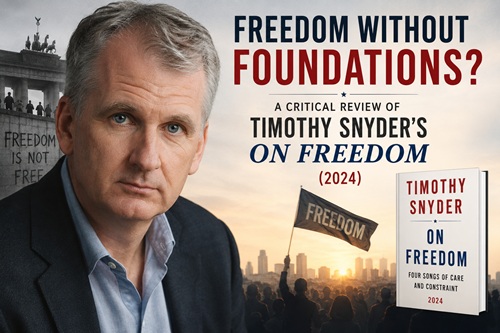 Timothy Snyder has established himself as one of the leading public intellectuals writing about democracy, authoritarianism, and the lessons of twentieth-century European history. His previous books, including Bloodlands, On Tyranny, and The Road to Unfreedom, combined historical scholarship with urgent warnings about the fragility of democratic institutions. In On Freedom (2024), Snyder shifts his focus from diagnosing the dangers of tyranny to asking a more ambitious philosophical question: what is freedom itself? This change of emphasis is significant. Rather than merely defending liberal democracy against authoritarian threats, Snyder attempts to construct a positive vision of what free societies should aspire to become. Freedom, he argues, cannot simply be understood as the absence of oppression. It must be cultivated through education, social trust, responsible institutions, and active civic participation. The result is a thoughtful, humane, and often inspiring book. Yet as political philosophy, it also reveals important weaknesses. Snyder presents an attractive moral vision, but one that sometimes lacks conceptual precision and rests more on ethical conviction than careful analytical argument. Beyond Negative LibertyOne of Snyder's principal targets is the familiar notion that freedom consists simply of being left alone by the state. Drawing upon the long-standing distinction between negative and positive liberty, he argues that formal rights are insufficient if people lack the practical means to exercise them. A citizen may legally possess freedom of speech, but if poverty, ignorance, illness, or relentless propaganda prevent meaningful participation in public life, that freedom exists only in a limited sense. This argument is persuasive. A child raised in severe deprivation is formally free to become a scientist, an artist, or a political leader, yet the opportunities necessary to realize those ambitions are often absent. Likewise, citizens overwhelmed by economic insecurity or systematic disinformation may enjoy constitutional liberties while remaining unable to exercise genuine autonomy. Snyder therefore insists that freedom should be understood not merely as protection from interference but as the capacity to shape one's own life. His emphasis on the enabling conditions of liberty is one of the book's greatest strengths. It serves as a useful corrective to simplistic forms of libertarianism that identify freedom exclusively with the minimization of government. Freedom as a Social AchievementThroughout the book Snyder repeatedly emphasizes that freedom is fundamentally relational. Human beings do not become free in isolation but within networks of trust, education, scientific inquiry, democratic institutions, responsible journalism, and meaningful communities. Freedom is not simply an individual possession but a social achievement sustained through cooperation. Here Snyder's historical perspective proves particularly valuable. Democracies endure not merely because constitutions are written or elections are held but because habits of civic responsibility and mutual trust develop over generations. Institutions cannot function independently of the citizens who sustain them. Snyder reminds readers that liberty requires continuous maintenance rather than passive enjoyment. This perspective offers an important balance to highly individualistic conceptions of freedom and helps explain why democracies can gradually erode without any dramatic constitutional collapse. When Everything Becomes FreedomYet Snyder's greatest strength also reveals one of the book's central weaknesses. As he expands the meaning of freedom to include education, healthcare, scientific literacy, social trust, economic security, responsible journalism, and democratic culture, the concept itself begins to lose its distinctiveness. Each of these conditions undoubtedly contributes to human flourishing. Few readers would deny their importance. The philosophical difficulty arises when these enabling conditions become identified with freedom itself rather than distinguished from it. Freedom increasingly becomes a comprehensive label for virtually everything that allows people to live well. This conceptual expansion creates analytical problems. If education is freedom, healthcare is freedom, economic security is freedom, and democratic participation is freedom, then almost every desirable social goal becomes an expression of freedom. The term gradually loses the specificity that allows it to distinguish one political value from another. Political philosophy has long wrestled with this problem. Concepts become less useful when they attempt to encompass every aspect of human flourishing. Snyder occasionally approaches this point, where freedom risks becoming almost synonymous with the good society itself. Between History and PhilosophyAnother difficulty concerns Snyder's movement between historical description and philosophical prescription. At various moments he writes as a historian explaining how free societies have succeeded or failed. Elsewhere he writes as a moral philosopher describing what freedom ought to mean. At still other points he adopts the role of civic educator encouraging readers toward democratic responsibility. Each perspective has value, but the transitions between them are not always clearly marked. Historical examples illustrate the dangers of authoritarianism, yet they do not necessarily establish the philosophical definition of freedom that Snyder proposes. Readers may therefore find themselves uncertain whether particular claims are intended as empirical observations about political history or normative arguments about how societies should ideally function. The distinction matters because descriptive and prescriptive arguments require different forms of evidence. A historical narrative can illuminate political developments without resolving philosophical debates about the meaning of liberty. Freedom and Civic VirtueOne of the more controversial aspects of Snyder's account is the close relationship he draws between freedom and virtue. Truly free citizens, he argues, should seek truth, reject conspiracy theories, participate in democratic life, cultivate empathy, and take responsibility for the well-being of others. These qualities are presented not merely as desirable consequences of freedom but increasingly as integral components of freedom itself. There is much to admire in this vision. Democratic societies clearly depend upon citizens who value truth, cooperation, and civic responsibility. Yet Snyder sometimes narrows the distinction between liberty and the morally appropriate use of liberty. Classical liberal thinkers generally maintain that individuals remain free even when they make poor choices, embrace foolish ideas, or behave irresponsibly. Snyder's conception leaves less room for this distinction. Freedom begins to resemble virtuous citizenship rather than the broader capacity to choose one's own path. Whether one regards this as an advance or a conceptual confusion will depend largely upon one's political philosophy. Liberalism Without NeutralitySnyder openly rejects the idea that democracies can remain morally neutral. Every political community, he argues, inevitably cultivates certain values. The important question is not whether societies promote values but which values they choose to encourage. His preferred ideals include truthfulness, pluralism, solidarity, democratic participation, scientific inquiry, and mutual care. Few readers will object to these aspirations. Nevertheless, Snyder occasionally underestimates the extent to which contemporary societies disagree about precisely these values. Citizens often dispute what counts as truth, responsible journalism, democratic participation, or civic virtue. His framework therefore assumes a degree of moral consensus that modern democracies increasingly lack. This does not invalidate Snyder's argument, but it does leave unresolved the difficult question of how societies should negotiate profound moral disagreement while remaining genuinely pluralistic. The Missing Evolutionary DimensionPerhaps the book's most notable omission is its limited engagement with evolutionary psychology and cognitive science. Human beings did not evolve primarily as rational democrats. Our species carries deep predispositions toward tribalism, conformity, status competition, motivated reasoning, and in-group loyalty. These tendencies profoundly influence political behavior and help explain why authoritarian movements repeatedly emerge across cultures and historical periods. Snyder emphasizes civic education and institutional design as the principal means of cultivating freedom. While these are undoubtedly important, they operate within psychological constraints shaped over hundreds of thousands of years of human evolution. Democracies succeed not because they eliminate these tendencies but because they partially channel and restrain them. Recognizing these biological realities would strengthen Snyder's analysis by grounding his political ideals in a more realistic account of human nature. Freedom is difficult not merely because institutions are fragile but because our own evolved minds often pull us toward simpler, more tribal forms of politics. A Passionate Defense of Democratic LifeThese criticisms should not obscure the considerable achievements of On Freedom. Snyder writes with remarkable clarity and moral seriousness while avoiding much of the jargon that often burdens academic political philosophy. His historical knowledge allows him to illuminate the practical conditions under which democracies flourish or fail, and his insistence that freedom requires active cultivation offers an important corrective to narrow conceptions of liberty. The book succeeds especially well as an appeal to democratic citizenship. Snyder reminds readers that freedom depends not only upon constitutional protections but upon education, public trust, scientific inquiry, responsible journalism, and civic engagement. In an era of polarization and democratic uncertainty, this message possesses genuine urgency. Conclusion: Moral Vision in Search of Conceptual PrecisionOn Freedom is best understood not as a work of systematic political philosophy but as a humanistic manifesto for democratic renewal. Snyder seeks less to resolve centuries-old debates about liberty than to persuade readers that freedom deserves active commitment and continual defense. Judged on those terms, the book succeeds admirably. As philosophy, however, it leaves important questions unanswered. Its concept of freedom gradually expands to encompass nearly every condition associated with human flourishing, making it difficult to distinguish freedom itself from the many institutions and virtues that support it. Historical examples sometimes substitute for conceptual analysis, moral aspirations occasionally blur with empirical claims, and the biological foundations of human political behavior receive surprisingly little attention. These limitations do not diminish the book's importance. Snyder has written an eloquent defense of democratic civilization at a moment when many of its assumptions can no longer be taken for granted. Yet a truly comprehensive philosophy of freedom requires more than moral inspiration. It also requires conceptual discipline and a realistic understanding of human nature. Snyder offers the former in abundance. The latter remains an unfinished project. Appendix: Timothy Snyder and Ken Wilber on FreedomExternal, Internal, and Nondual FreedomOne of the more interesting comparisons that On Freedom invites is with Ken Wilber's much earlier discussion of freedom in Up from Eden (1981). Although Snyder never engages Wilber's work, both thinkers reject the simplistic notion that freedom means merely the absence of external constraints. Beyond that shared starting point, however, their conceptions diverge dramatically. Wilber distinguishes three increasingly profound forms of freedom. The first is external freedom: political liberty, civil rights, economic opportunity, and freedom from coercion. This corresponds broadly to the liberal tradition and is the kind of freedom Snyder discusses throughout much of his book. Both authors regard these institutional conditions as indispensable, though neither considers them sufficient. The second level is internal freedom. Here Wilber shifts attention from political structures to the psychological condition of the individual. A person may live in a free society yet remain enslaved by fear, compulsive desire, egoic attachment, emotional conditioning, or unconscious drives. Genuine freedom therefore requires self-knowledge and psychological development. In this respect, Wilber echoes themes found in Stoicism, Buddhism, and various contemplative traditions. Snyder touches on personal responsibility and civic character, but he largely avoids this inward dimension. His emphasis remains overwhelmingly social and political rather than psychological. Wilber's third category is nondual freedom, the realization that the individual self is ultimately identical with—or inseparable from—the ground of reality itself. According to this view, enlightenment is the highest form of freedom because it dissolves the duality between subject and object, self and world. Political liberty and psychological maturity are important but remain incomplete until they culminate in spiritual awakening. It is at this point that the two authors part company entirely. Snyder's account remains firmly within a secular humanist framework. Freedom concerns the conditions under which human beings can flourish together in democratic societies. His discussion is grounded in history, ethics, and political institutions rather than metaphysical speculation. Wilber, by contrast, embeds freedom within a grand cosmological narrative of evolution, consciousness, and Spirit. Political liberty ultimately serves as preparation for spiritual realization. From Snyder's perspective, Wilber's third notion of freedom would likely appear unnecessary and philosophically ungrounded. There is no need to posit an Absolute or nondual consciousness to explain why free societies matter or why human beings should cultivate democratic virtues. History, empathy, and civic responsibility provide sufficient foundations. Conversely, Wilber would probably regard Snyder's account as incomplete. However admirable democratic institutions may be, they leave untouched the deeper existential sources of suffering that contemplative traditions identify. One can enjoy political liberty yet remain psychologically fragmented or spiritually alienated. Without inner transformation, external freedom never reaches its fullest expression. Whether this criticism succeeds depends on one's assessment of Wilber's metaphysical framework. Internal freedom can be discussed in entirely secular psychological terms through emotional maturity, cognitive flexibility, self-regulation, and reflective awareness. Modern psychology provides abundant evidence that people often become trapped by unconscious habits and distorted patterns of thought. In this respect, Wilber identifies a genuine dimension of human freedom that Snyder largely overlooks. The notion of nondual freedom, however, occupies a very different epistemic status. It rests on the assumption that mystical experience discloses the ultimate nature of reality rather than simply representing an altered state of consciousness. That assumption remains deeply contested. Contemplative traditions certainly report experiences of profound unity, but whether these experiences reveal metaphysical truths about the universe is another matter entirely. Snyder wisely avoids making such claims. Ironically, Snyder's omission of the spiritual dimension may strengthen rather than weaken his argument. By grounding freedom in institutions, education, historical memory, and civic responsibility, he develops a conception that remains accessible regardless of one's religious or metaphysical commitments. Wilber's broader vision is certainly more ambitious, but it also depends upon philosophical assumptions that many readers—and most contemporary scholars—would regard as speculative. The comparison therefore highlights two very different projects. Snyder asks how human beings can build and preserve free societies. Wilber asks how human beings can ultimately transcend the illusion of separateness itself. The former is political philosophy; the latter is spiritual metaphysics. While both seek liberation, they mean profoundly different things by the word freedom. For readers concerned with the practical challenges facing modern democracies, Snyder's account is likely to prove more immediately relevant. For readers attracted to contemplative traditions, Wilber offers a more expansive—if considerably more controversial—vision of what ultimate freedom might entail.
Widget is loading comments...
|