|
TRANSLATE THIS ARTICLE
Integral World: Exploring Theories of Everything
An independent forum for a critical discussion of the integral philosophy of Ken Wilber
  Frank Visser, graduated as a psychologist of culture and religion, founded IntegralWorld in 1997. He worked as production manager for various publishing houses and as service manager for various internet companies and lives in Amsterdam. Books: Ken Wilber: Thought as Passion (SUNY, 2003), and The Corona Conspiracy: Combatting Disinformation about the Coronavirus (Kindle, 2020). Frank Visser, graduated as a psychologist of culture and religion, founded IntegralWorld in 1997. He worked as production manager for various publishing houses and as service manager for various internet companies and lives in Amsterdam. Books: Ken Wilber: Thought as Passion (SUNY, 2003), and The Corona Conspiracy: Combatting Disinformation about the Coronavirus (Kindle, 2020).
Check out my other conversations with ChatGPT Beyond Left and RightWhy Marlène Laruelle Matters, Understanding Ideology, Nationalism, and the New Geopolitical ImaginationFrank Visser / ChatGPT
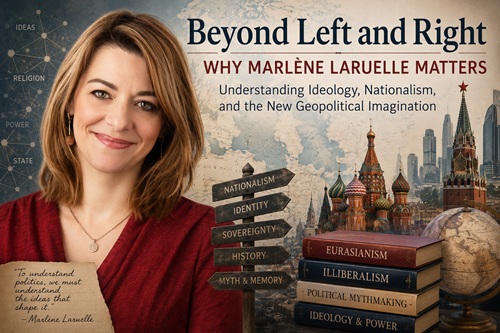 IntroductionIn an era marked by geopolitical rivalry, populist movements, conspiracy thinking, and renewed ideological polarization, the work of French political scientist and historian Marlène Laruelle has become increasingly relevant. While public debate often reduces political conflicts to familiar binaries—democracy versus authoritarianism, left versus right, liberalism versus populism—Laruelle demonstrates that contemporary ideological landscapes are far more complex. Her research on Russia, Eurasianism, nationalism, illiberalism, and political mythmaking reveals how new ideological formations emerge by blending elements that traditional political categories struggle to describe. Rather than acting as either an advocate or critic of the movements she studies, Laruelle approaches them as a careful analyst. This methodological restraint has made her one of the leading scholars of Russian political thought while also giving her broader significance for understanding political developments across Europe, the United States, and beyond. Beyond PutinologyMuch Western commentary on Russia tends to revolve around Vladimir Putin himself, treating Russian politics as little more than the whims of an authoritarian ruler. Laruelle argues that this focus misses the deeper intellectual traditions shaping Russian political culture. Her work explores the historical evolution of ideas such as Eurasianism, civilizational identity, Orthodox nationalism, imperial memory, and conservative modernity. These currents long predate Putin and would likely continue to influence Russian politics even after his departure. By tracing these intellectual genealogies, Laruelle reminds us that political systems are sustained not merely by institutions or personalities but by narratives, myths, and collective identities. Understanding EurasianismPerhaps Laruelle's best-known contribution is her extensive study of Eurasianism. Originally emerging among Russian émigré intellectuals in the 1920s, Eurasianism proposed that Russia belonged neither fully to Europe nor to Asia but represented a unique civilization. In later decades, this concept evolved into various forms of geopolitical and cultural ideology, most famously associated with Alexander Dugin, though Laruelle carefully distinguishes Dugin's interpretation from the broader Eurasianist tradition. Her scholarship demonstrates that Eurasianism is not simply geopolitical strategy. It is a worldview offering answers to questions of identity, history, religion, sovereignty, and globalization. Understanding this worldview helps explain why many Russian elites interpret international relations differently from their Western counterparts. Rather than dismissing Eurasianism as irrational propaganda, Laruelle studies it as a genuine ideological system with internal coherence. The Rise of IlliberalismLaruelle's work extends well beyond Russia. She has become an important interpreter of the global rise of illiberal political movements. Unlike liberal democracy, which prioritizes individual rights and universal norms, illiberal ideologies often emphasize collective identity, national sovereignty, traditional values, and cultural continuity. These movements appear in many countries with strikingly different political histories. Laruelle cautions against treating illiberalism as merely a temporary deviation from liberal democracy. Instead, she argues that it represents a competing political vision responding to perceived failures of globalization, multiculturalism, and technocratic governance. Whether one agrees with these critiques or not, understanding them is essential for understanding contemporary politics. Political MythmakingOne of Laruelle's enduring themes is the role of myth in politics. Modern societies often imagine themselves as purely rational, yet political communities continue to rely on symbolic narratives about national destiny, historical mission, victimhood, exceptionalism, or civilizational conflict. These myths need not be factually accurate to become politically effective. Laruelle studies how historical memory, religious symbolism, imperial nostalgia, and cultural narratives shape political behavior far more deeply than policy debates alone. This insight connects her work with broader traditions in political sociology that emphasize imagination as much as material interests. Against Simplistic LabelsA hallmark of Laruelle's scholarship is her resistance to simplistic categorization. Terms like "far right," "fascist," "authoritarian," or "populist" often function more as moral judgments than analytical concepts. Laruelle does not reject these categories entirely, but she insists they must be applied with historical precision. For example, movements frequently borrow ideas from multiple ideological traditions simultaneously. A nationalist movement may embrace welfare policies traditionally associated with the left while rejecting liberal cultural values. A conservative government may support technological modernization while opposing globalization. Such ideological hybridity complicates inherited political maps. Laruelle therefore encourages scholars to examine how movements actually define themselves rather than forcing them into predetermined taxonomies. The Importance of Intellectual HistoryUnlike many political scientists who emphasize quantitative methods or electoral statistics, Laruelle remains deeply committed to intellectual history. Ideas matter. Concepts migrate across borders, evolve over generations, and sometimes reappear in unexpected forms decades later. By studying philosophical texts, ideological manifestos, religious writings, and political debates, Laruelle reconstructs the intellectual ecosystems from which political movements emerge. This long historical perspective often explains developments that short-term political analysis overlooks. Relevance Beyond RussiaAlthough Laruelle specializes in Russia and Eurasia, many of her insights illuminate broader global developments. Across Europe and North America, questions concerning national identity, immigration, sovereignty, religion, globalization, and cultural memory increasingly shape political competition. Laruelle's work suggests that these debates should not simply be dismissed as irrational reactions or temporary populist waves. They reflect deeper transformations in how societies imagine themselves under conditions of globalization, technological change, demographic shifts, and geopolitical uncertainty. Understanding these transformations requires historical sensitivity rather than ideological reflex. Lessons for Integral TheoryReaders interested in Integral Theory may find Laruelle particularly valuable because she resists grand narratives while remaining attentive to complexity. Integral Theory often seeks comprehensive developmental frameworks capable of integrating politics, psychology, culture, and spirituality. Laruelle represents almost the opposite methodological instinct. She distrusts universal explanatory systems and instead focuses on historical contingency, intellectual diversity, and contextual interpretation. This contrast is instructive. Where Integral Theory sometimes risks fitting political phenomena into pre-existing developmental stages, Laruelle begins with the empirical richness of particular intellectual traditions before drawing broader conclusions. Her scholarship serves as a reminder that complexity often increases rather than decreases when examined carefully. A Model of Scholarly RestraintPerhaps Laruelle's greatest contribution lies not in any single theory but in her scholarly temperament. At a time when academic work often becomes politically polarized, she consistently distinguishes explanation from endorsement. • Studying nationalism does not imply nationalism. • Analyzing authoritarian ideologies does not imply sympathy for authoritarianism. • Understanding political myths does not require believing them. This commitment to analytical neutrality allows Laruelle to illuminate ideological worlds that others either romanticize or demonize. ConclusionMarlène Laruelle exemplifies a style of scholarship increasingly needed in today's fragmented political environment. She combines historical depth with sociological insight, conceptual precision with intellectual openness, and empirical rigor with methodological humility. Her work reminds us that political ideas have histories, identities are constructed rather than given, and ideological movements deserve careful analysis before moral judgment. In an age of polarized discourse and simplistic narratives, this commitment to understanding before condemning—or celebrating—is itself a profound intellectual contribution. Whether one studies Russia, Europe, nationalism, populism, or the future of democracy, Laruelle offers an indispensable lesson: political reality is always more complicated than the categories we use to describe it.
Widget is loading comments...
|