|
TRANSLATE THIS ARTICLE
Integral World: Exploring Theories of Everything
An independent forum for a critical discussion of the integral philosophy of Ken Wilber
  Frank Visser, graduated as a psychologist of culture and religion, founded IntegralWorld in 1997. He worked as production manager for various publishing houses and as service manager for various internet companies and lives in Amsterdam. Books: Ken Wilber: Thought as Passion (SUNY, 2003), and The Corona Conspiracy: Combatting Disinformation about the Coronavirus (Kindle, 2020). Frank Visser, graduated as a psychologist of culture and religion, founded IntegralWorld in 1997. He worked as production manager for various publishing houses and as service manager for various internet companies and lives in Amsterdam. Books: Ken Wilber: Thought as Passion (SUNY, 2003), and The Corona Conspiracy: Combatting Disinformation about the Coronavirus (Kindle, 2020).
Check out my other conversations with ChatGPT Creativity as First Principle?Why Whitehead's Metaphysics Begs the Question and Why Science Starts ElsewhereFrank Visser / ChatGPT
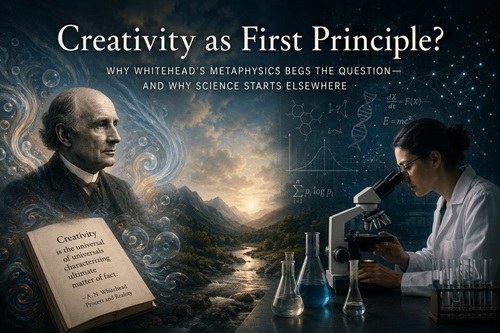 Alfred North Whitehead is widely regarded as one of the twentieth century's most original philosophers. His process philosophy challenged the traditional picture of reality as a collection of static substances, replacing it with a universe composed of events, relations, and continuous becoming. At the heart of this dynamic vision stands a single, foundational concept: Creativity. Whitehead did not regard creativity merely as a feature of biological evolution or human imagination. Rather, he elevated it to the status of an ultimate metaphysical principle—the fundamental reality that makes every act of becoming possible. This bold move has inspired generations of philosophers, theologians, and, more recently, integral theorists such as Ken Wilber. Yet it also raises a serious philosophical concern. By treating creativity as the ultimate explanation for novelty, Whitehead arguably turns the very phenomenon requiring explanation into its own explanatory principle. Instead of explaining creativity, he presupposes it. Creativity as the UltimateIn Process and Reality, Whitehead famously declares that "Creativity is the universal of universals characterizing ultimate matter of fact." This statement gives creativity an extraordinary status. It is not simply one process among many, nor is it identified with God, matter, or mind. Rather, it is the metaphysical condition that underlies every actual occasion, enabling each event to synthesize its inherited past while contributing something genuinely new to the future. Reality is therefore understood not as a collection of enduring things but as an endless stream of creative advances into novelty. This conception possesses undeniable philosophical elegance. It captures the intuition that the universe is fundamentally dynamic rather than static, and it emphasizes the genuine openness of the future. Unlike mechanistic philosophies that reduce change to the rearrangement of pre-existing parts, Whitehead insists that something authentically new comes into existence at every moment. His vision is one of perpetual creation rather than mechanical repetition. The Charge of Begging the QuestionThe difficulty arises when one asks why novelty occurs at all. Whitehead's answer is that Creativity is ultimate. Yet this appears less like an explanation than a restatement of the phenomenon itself. To say that novelty occurs because Creativity produces novelty is arguably circular. It resembles explaining why objects fall by invoking "Fall-ness," or explaining why organisms evolve because "Evolution" is a cosmic force. Such explanations merely rename what they are supposed to explain. Philosophers have long recognized this tendency to transform descriptive concepts into explanatory entities. The process is sometimes called reification: an observed characteristic is elevated into an independent causal principle without any independent justification. In Whitehead's case, creativity begins as an observation about the world—namely, that new forms continually arise—and ends as the metaphysical ground of reality itself. The explanatory gap has not been closed; it has simply been relocated. One might object that every philosophical system must eventually reach fundamental concepts that cannot themselves be explained. Physics currently takes quantum fields or fundamental laws as primitive. Mathematics begins with axioms. Whitehead could therefore reply that Creativity is simply his chosen primitive. Yet there remains an important difference. Successful foundational concepts usually possess explanatory independence. They are not merely the phenomena themselves elevated to ultimate status. Declaring that motion exists because Motion is fundamental would add little to our understanding. Likewise, saying that novelty exists because Creativity is ultimate risks little more than redescribing the phenomenon in grander language. Science Explains Rather Than ReifiesScience approaches the problem of novelty in a fundamentally different way. Rather than assuming creativity as a basic feature of reality, it asks under what conditions genuinely new structures emerge. Scientific explanations seek mechanisms that connect observable phenomena to independently testable processes. The history of gravity illustrates this difference. Aristotle explained falling bodies by appealing to their natural place in the cosmos. Newton replaced this with the mathematically precise concept of universal gravitation. Einstein later reinterpreted gravity as the curvature of spacetime produced by mass and energy. Each step reduced mystery by uncovering deeper mechanisms and generating new empirical predictions. Whitehead's move proceeds in the opposite direction. Observing that novelty exists, he elevates novelty-producing capacity into a metaphysical absolute. Instead of reducing mystery, he sanctifies it. Modern science certainly has no difficulty acknowledging creativity. Stars forge new chemical elements. Evolution generates new species. Human brains produce original ideas. Artificial intelligence discovers unexpected solutions to complex problems. But science does not infer from these observations that Creativity exists as an independent cosmic principle. Rather, creativity is understood as an emergent property arising from the interaction of simpler processes operating under physical laws. Creativity as EmergenceOver the past half century, complexity science has profoundly transformed our understanding of emergence. Researchers have repeatedly demonstrated that remarkably complex and novel patterns can arise from systems governed by relatively simple rules. Conway's famous Game of Life, for example, generates endlessly surprising configurations from only a handful of deterministic instructions. Snowflakes develop intricate and unique crystalline structures without any guiding intelligence. Turbulent fluids, ecosystems, economies, and neural networks all exhibit forms of spontaneous organization that were unimaginable from knowledge of their individual components alone. The central lesson of complexity science is that novelty does not require a separate creative force. It emerges naturally from interactions among many elements, amplified through feedback, constrained by physical laws, and shaped by historical contingencies. Creativity, in this view, is not an additional ingredient inserted into nature. It is what sufficiently complex systems inevitably display. Evolution Without Cosmic CreativityThis contrast becomes especially significant in evolutionary biology. Throughout history, many philosophers have felt that biological evolution requires some intrinsic drive toward greater complexity. Henri Bergson proposed the élan vital. Teilhard de Chardin envisioned evolution progressing toward the Omega Point. Whitehead introduced Creativity as an ultimate principle, while Ken Wilber speaks of Eros as the force driving cosmic development. Modern evolutionary theory, however, has shown that increasing complexity requires no such internal impetus. Random genetic variation continually generates diversity, while natural selection preserves variants that enhance reproductive success within particular environments. Developmental constraints, ecological interactions, and historical contingencies channel the direction of evolutionary change without requiring any built-in tendency toward progress. Evolution appears extraordinarily creative because cumulative selection operating over immense spans of time can produce astonishing complexity from simple beginnings. The creativity lies in the process itself, not in a metaphysical force guiding it. Predictive Power and Philosophical ValueAnother important distinction concerns predictive power. Scientific theories earn credibility by making novel predictions that can be tested against observation. Einstein predicted gravitational lensing long before it was observed. Evolution predicts nested hierarchies of biological relationships, transitional fossils, and genetic similarities. Plate tectonics predicts where earthquakes and volcanoes are most likely to occur. What comparable predictions follow uniquely from Whitehead's doctrine of Creativity? The answer is surprisingly few. One might expect reality to continue producing novelty, but this expectation already follows from well-established scientific theories. Creativity functions primarily as an interpretive framework rather than an explanatory theory. It provides a philosophical lens through which to view reality rather than a mechanism capable of generating new empirical discoveries. This does not make Whitehead's philosophy worthless. On the contrary, it remains one of the richest metaphysical visions of the modern era. It captures something deeply important about human experience: the sense that the world is genuinely unfinished, that the future remains open, and that novelty is woven into the fabric of existence. Whitehead's emphasis on becoming has influenced theology, ecology, systems thinking, and philosophy in ways that continue to bear fruit. Wonder Versus ExplanationUltimately, the difference between Whitehead and science lies not in whether novelty exists but in how novelty should be understood. Whitehead asks what ultimate principle makes creativity possible and answers by positing Creativity itself as fundamental. Science asks instead how novelty emerges from interactions among physical systems and then searches for mechanisms that can be observed, modeled, and tested. These are not merely different answers to the same question; they are different kinds of questions altogether. Whitehead offers a metaphysical vision intended to illuminate the character of reality as a whole. Science offers provisional explanations that can be revised as evidence accumulates. The former seeks conceptual completeness, while the latter embraces explanatory incompleteness as the price of empirical rigor. ConclusionWhitehead's elevation of Creativity to the status of an ultimate principle remains one of the most imaginative and influential ideas in twentieth-century philosophy. It shifted attention away from static substances toward dynamic processes and highlighted the genuine novelty present throughout nature. Yet as an explanation of creativity, it is vulnerable to the charge of begging the question. Declaring Creativity to be fundamental risks explaining creativity by appealing to Creativity itself. The concept serves more as a metaphysical stopping point than as an explanatory mechanism. Modern science adopts a more modest but ultimately more productive strategy. Rather than treating creativity as an irreducible cosmic force, it investigates how novelty emerges from the interaction of simpler processes governed by physical laws. Complexity theory, evolutionary biology, neuroscience, and artificial intelligence all demonstrate that astonishing originality can arise without invoking Creativity as an independent metaphysical principle. Whitehead reminds us that reality is endlessly inventive. Science seeks to understand how that inventiveness actually comes about. Wonder may inspire inquiry, but inquiry begins precisely where wonder refuses to mistake a name for an explanation. Appendix: Why Whitehead Appeals to WilberIt is no surprise that Ken Wilber regards Alfred North Whitehead as one of the great philosophers of the twentieth century. Although Wilber has often criticized aspects of process philosophy—arguing that Whitehead gives too much weight to "prehension" and insufficient attention to enduring developmental structures—the two thinkers share a fundamental metaphysical intuition. Both reject a static, mechanistic universe in favor of a cosmos that is inherently dynamic, developmental, and creative. Most importantly, both seek an explanation of novelty that goes beyond the explanatory resources of conventional science. Whitehead's notion of Creativity provides precisely the kind of philosophical foundation that Wilber's own system requires. Wilber's cosmology revolves around the idea of Eros: an intrinsic drive toward increasing complexity, consciousness, and integration. Throughout his work, he describes evolution as displaying a persistent tendency toward greater depth, richer forms of awareness, and expanding wholes. While he occasionally insists that Eros is merely a poetic metaphor, he often writes as though it were an active force immanent within the universe. The resemblance to Whitehead's Creativity is unmistakable. Both concepts function as ultimate explanatory principles invoked to account for the emergence of novelty. Whitehead thus offers Wilber something more respectable than the vitalism of Henri Bergson or the mystical teleology of Teilhard de Chardin. Because Whitehead's metaphysics is highly sophisticated and couched in rigorous philosophical language, it provides Wilber with an intellectual pedigree for ideas that might otherwise appear overtly spiritual or theological. Creativity can serve as a philosophical bridge between scientific evolution and cosmic purpose. Yet this inheritance also transmits Whitehead's central weakness. If Creativity itself remains unexplained, then Eros inherits the same explanatory problem. Wilber frequently criticizes neo-Darwinian evolution for failing to explain the emergence of novelty, but his own alternative often amounts to saying that novelty appears because Eros drives the universe toward greater complexity. This shifts the mystery rather than resolving it. The question simply becomes: why should Eros possess this creative power? Appealing to Eros no more explains creativity than appealing to Creativity explains novelty. This difficulty becomes especially apparent when Wilber contrasts his position with mainstream evolutionary biology. Modern evolutionary theory does not deny that evolution produces remarkable innovations. Instead, it explains them through cumulative natural processes—mutation, selection, developmental constraints, ecological interactions, and historical contingency. Wilber argues that these mechanisms cannot account for the astonishing creativity of evolution. But replacing them with Eros merely substitutes one unexplained principle for another. Unless Eros can be independently specified, measured, or tested, it functions less as a scientific hypothesis than as a metaphysical placeholder. There is also a deeper affinity between the two thinkers. Both resist what they regard as the reductionism of modern science. Whitehead rejected the seventeenth-century conception of nature as inert matter in motion, while Wilber criticizes what he calls "flatland" or scientific materialism for ignoring consciousness, interiority, and value. In both cases, the proposed remedy is to enrich reality by introducing a deeper organizing principle. Whitehead calls it Creativity; Wilber calls it Eros. Both seek to restore meaning to the cosmos by placing creative becoming at the foundation of existence. Whether this move succeeds depends on what one expects from metaphysics. If the aim is to provide an evocative philosophical vision that emphasizes openness, emergence, and the reality of novelty, Whitehead and Wilber offer compelling narratives. Their systems remind us that the universe is not merely a clockwork mechanism but a history of unfolding complexity. If, however, the aim is to explain how novelty actually arises, their appeal to ultimate creative principles begins to look suspiciously circular. Creativity becomes the explanation of creativity; Eros becomes the explanation of evolutionary innovation. This helps explain both Whitehead's enduring influence and his continuing controversy. He offers a vocabulary that resonates deeply with thinkers dissatisfied with reductionism while avoiding the language of traditional supernaturalism. For Wilber, this is ideal. Whitehead provides a metaphysical framework in which evolution can be understood as inherently meaningful without requiring constant appeals to divine intervention. The price of that elegance, however, is that the central explanatory burden remains largely unfulfilled. Whitehead's Creativity—and Wilber's Eros after it—may inspire philosophical wonder, but they do not yet explain the phenomenon they are intended to illuminate.
Widget is loading comments...
|