|
TRANSLATE THIS ARTICLE
Integral World: Exploring Theories of Everything
An independent forum for a critical discussion of the integral philosophy of Ken Wilber
  Frank Visser, graduated as a psychologist of culture and religion, founded IntegralWorld in 1997. He worked as production manager for various publishing houses and as service manager for various internet companies and lives in Amsterdam. Books: Ken Wilber: Thought as Passion (SUNY, 2003), and The Corona Conspiracy: Combatting Disinformation about the Coronavirus (Kindle, 2020). Frank Visser, graduated as a psychologist of culture and religion, founded IntegralWorld in 1997. He worked as production manager for various publishing houses and as service manager for various internet companies and lives in Amsterdam. Books: Ken Wilber: Thought as Passion (SUNY, 2003), and The Corona Conspiracy: Combatting Disinformation about the Coronavirus (Kindle, 2020).
Check out my other conversations with ChatGPT
Climate ChangeThe Great Transformation of the Earth SystemFrank Visser / ChatGPT
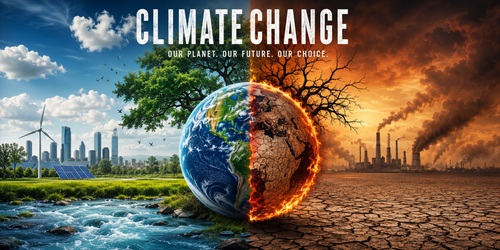 Climate change is often discussed as though it were a single problem with a single solution: carbon dioxide emissions are rising, temperatures are increasing, and humanity must “do something” about it. That description is not wrong, but it is radically incomplete. Climate change is simultaneously a problem in physics, geology, ecology, economics, technology, politics, ethics, and human psychology. The central scientific conclusion, however, is remarkably clear. Human activities—above all the combustion of coal, oil, and natural gas, together with land-use change and agriculture—have unequivocally caused global warming. The global surface temperature had reached approximately 1.1°C above the 1850-1900 average during 2011-2020, and the climate system has continued to warm since then. The World Meteorological Organization reports that 2015-2025 were the eleven warmest years in the instrumental record, while 2025 was approximately 1.43°C above the pre-industrial average. The important questions, therefore, are no longer simply “Is climate change real?” or “Are humans responsible?” Those questions have been answered by converging evidence from physics, atmospheric chemistry, paleoclimatology, oceanography, satellite observations, and climate modelling. The more difficult questions are these: How does the climate system work? How dangerous is warming? What exactly will happen? Can we still prevent the worst outcomes? What should societies do? Who should pay? And how can we distinguish serious climate science from exaggerated claims, political propaganda, and denial? What exactly is climate change?Weather is the state of the atmosphere over relatively short periods: a storm, a heatwave, a cold spell, or a rainy week. Climate is the statistical pattern of weather over much longer periods, traditionally measured over decades. Climate change therefore does not mean that every day becomes warmer, nor that every individual extreme weather event is caused by global warming. A cold winter does not disprove climate change, just as one hot day does not prove it. Climate concerns long-term changes in averages, variability, and the frequency and intensity of extreme events. “Global warming” refers specifically to the long-term rise in Earth's average surface temperature. “Climate change” is broader. It includes changes in temperature, rainfall, drought, storms, sea level, ocean chemistry, snow, glaciers, ice sheets, ecosystems, and many other components of the Earth system. The planet's climate has always changed. This is an important point, but it is frequently used misleadingly. The existence of natural climate change does not imply that current climate change is natural. The relevant scientific question is not whether the climate has changed before, but what is causing the present change and how rapidly it is occurring. The current warming is fundamentally different from the ordinary fluctuations of recent centuries. Multiple independent lines of evidence show that the rate of recent warming is exceptional over many thousands of years, and the physical fingerprint of the warming matches the consequences of increasing greenhouse gases from human activities. How does the greenhouse effect work?The basic physics is not controversial. The Sun supplies energy to Earth, primarily in the form of visible and shortwave radiation. The Earth's surface absorbs some of this energy and emits energy back toward space as infrared radiation. Certain atmospheric gases absorb and re-emit some of this outgoing infrared radiation. This process slows the loss of heat to space. The natural greenhouse effect is not a problem. Without it, Earth would be far colder and much less hospitable to life. The problem is that human activities have increased the concentration of greenhouse gases in the atmosphere. Carbon dioxide is the most important long-lived greenhouse gas produced by fossil-fuel combustion. Methane, nitrous oxide, and several industrial gases also contribute substantially. The result is not that the atmosphere somehow creates energy from nothing. Rather, the atmosphere becomes more effective at retaining energy. The climate system then warms until the planet once again reaches an energy balance between incoming solar energy and outgoing radiation. This warming does not occur instantaneously. The oceans absorb enormous amounts of heat, and the climate system has substantial inertia. Consequently, even if humanity stopped increasing atmospheric greenhouse-gas concentrations tomorrow, some further warming and other climate changes would continue because of the heat already stored in the Earth system. Why are carbon dioxide emissions so important?Carbon dioxide is not the only greenhouse gas, but it is central for several reasons. First, human societies emit enormous quantities of it by burning fossil fuels. Second, CO2 remains influential for a very long time. Some of the carbon emitted today will remain in the atmosphere and the broader carbon cycle for centuries or longer. Third, cumulative CO2 emissions are closely related to the eventual amount of warming. This is why climate change differs from many conventional pollution problems. If a factory stops emitting a short-lived pollutant, concentrations may fall relatively quickly. With carbon dioxide, stopping emissions prevents additional accumulation, but it does not instantly restore the atmosphere to its previous condition. The ocean and terrestrial ecosystems absorb a substantial portion of human CO2 emissions. This has slowed atmospheric warming, but it comes at a cost. The ocean is warming and becoming more acidic as it absorbs carbon dioxide. Ocean acidification threatens organisms that depend on carbonate chemistry, including corals and many shell-forming organisms. Is the warming really caused by human beings?Yes. The evidence is not based on one temperature graph or one computer model. It is a large, mutually reinforcing body of evidence. The atmosphere contains more carbon dioxide than it did before industrialization. The carbon has chemical and isotopic characteristics consistent with fossil carbon. The atmosphere is warming in a pattern expected from greenhouse-gas forcing. The lower atmosphere is warming while the stratosphere cools, a pattern inconsistent with increased solar output but consistent with greenhouse-gas-driven warming. Nights and winters have generally warmed substantially in many regions. The oceans are accumulating heat. Glaciers and ice sheets are losing mass. Sea levels are rising. Natural factors have not disappeared. Volcanic eruptions can produce temporary cooling. Solar activity varies. El Niño and La Niña redistribute heat within the climate system. Earth's orbital parameters change over very long timescales. But these factors cannot explain the observed modern warming. The conclusion of the IPCC is unequivocal: human activities, principally through greenhouse-gas emissions, have caused global warming. NASA likewise describes human activity as the principal cause of the observed warming trend. The claim that “climate has always changed” is therefore scientifically true but logically irrelevant to the question of what is causing today's change. What evidence do we have that the planet is warming?The evidence comes from virtually every major component of the climate system. Global surface temperatures have risen substantially since the nineteenth century. The oceans are warming and have absorbed most of the excess energy accumulating in the climate system. Glaciers are retreating in almost every major mountain region. Greenland and Antarctica are losing ice mass. Arctic sea ice has declined substantially. Snow cover has decreased in many regions. Sea level has risen and the rate of rise has accelerated. The ocean has become more acidic. These changes are not independent curiosities. They form a coherent physical pattern. If thermometers alone showed warming, one might debate the reliability of the measurements. But when thermometers, ocean measurements, satellites, ice cores, glaciers, sea-level gauges, and ecological observations all indicate a rapidly changing climate, the conclusion becomes exceptionally robust. The WMO's latest assessment also emphasizes the growing imbalance in Earth's energy system. The ocean has continued to absorb enormous amounts of heat, while extreme heat, heavy rainfall, and other climate-related hazards have caused widespread disruption. Does global warming mean that every extreme event is caused by climate change?No. But climate change is altering the probabilities and characteristics of many extreme events. A useful analogy is loaded dice. Climate change does not necessarily create every individual heatwave, flood, drought, or storm. Natural variability remains important. But warming the planet changes the conditions under which such events occur. A hotter atmosphere can produce more dangerous heatwaves. A warmer atmosphere can hold more water vapour, increasing the potential for intense precipitation. A warmer ocean can provide additional energy to some tropical cyclones. Higher sea levels make coastal flooding more severe. Drier conditions can increase wildfire risk in some regions, although fire risk also depends on vegetation, land management, ignition sources, and local weather. The scientific question is therefore not usually “Did climate change cause this event, yes or no?” It is often more accurately framed as: “How did climate change alter the probability or severity of this event?” Attribution science has become increasingly capable of answering that question. Why does one or two degrees matter?A global average temperature change of one or two degrees can sound trivial. The human body experiences temperature differences of several degrees every day. But the global climate average is not the temperature of one room. It is the average temperature of the entire planet, including oceans, continents, polar regions, and the atmosphere. A change in the global average represents a massive alteration in the total energy balance of the Earth system. The difference between a global average warming of 1.5°C and 2°C is therefore not equivalent to the difference between a mild spring day and a warm spring day. Every additional increment of warming increases risks. Heat extremes become more severe. Ice loss increases. Sea-level rise continues for centuries. Ecosystems face greater stress. Agricultural and water risks grow. Some changes become increasingly difficult or impossible to reverse on human timescales. This is why the phrase “every fraction of a degree matters” is scientifically meaningful. Climate risk is not a switch that suddenly turns on at 1.5°C and remains absent below it. It is a gradient. What are the main consequences?The consequences are diverse because climate change affects a system rather than a single variable. Heat is among the most direct dangers. Extreme heat can kill, reduce labour productivity, increase energy demand, and place enormous stress on health systems. Urban areas can become particularly dangerous because concrete and asphalt retain heat. Water systems are also affected. Some regions experience more intense rainfall and flooding, while others experience increasing drought. A warmer atmosphere can intensify the hydrological cycle, but the consequences depend heavily on geography and circulation patterns. Food production is vulnerable to heat stress, drought, floods, shifting growing seasons, pests, and water scarcity. Agricultural impacts are not uniform: some regions may temporarily benefit from longer growing seasons or increased carbon dioxide fertilization under particular conditions. But the overall risks increase as warming intensifies, particularly when multiple stresses occur simultaneously. The cryosphere—the frozen component of the Earth system—is changing rapidly. Glacier loss threatens water supplies in some regions. Ice-sheet loss contributes to sea-level rise. Arctic changes affect ecosystems and communities. Sea-level rise creates long-term risks for coastal settlements, infrastructure, agriculture, and freshwater supplies. Even if global warming were eventually halted, sea levels would continue responding to ocean warming and ice-sheet dynamics for a very long time. Ecosystems face a combination of temperature stress, altered precipitation, ocean acidification, habitat shifts, invasive species, and extreme events. Some species can migrate or adapt. Others cannot move quickly enough or possess sufficient genetic or ecological flexibility. Climate change also interacts with existing social inequalities. Poorer populations often have fewer resources to protect themselves against heat, floods, crop failure, and displacement, even though historically they have contributed less to cumulative greenhouse-gas emissions. Is climate change an environmental problem or a human problem?It is both, but calling it merely an “environmental problem” understates its scope. Climate change affects food systems, public health, housing, infrastructure, insurance, migration, economic development, national security, and political stability. It is a problem of the entire relationship between industrial civilization and the physical systems on which civilization depends. This does not mean that climate change automatically causes war or societal collapse. Such claims are often too simplistic. Social outcomes depend on institutions, governance, wealth, technology, inequality, and political decisions. The same physical climate hazard can produce very different outcomes in different societies. A heatwave in a wealthy city with reliable electricity, public health systems, and access to cooling is not equivalent to a heatwave in a poor region without those resources. Climate change is therefore partly a problem of vulnerability. The physical hazard matters, but exposure and the ability to respond matter too. Are climate models reliable?Climate models are not crystal balls. They do not predict the exact weather on a particular day decades in the future. They are mathematical representations of the climate system based on physical principles. They simulate interactions among the atmosphere, oceans, land, ice, and other components. Their reliability must be judged according to what they are designed to do. They cannot tell us precisely what the weather will be in a particular town on 16 July 2050. They can, however, estimate how the probability distributions of temperature, precipitation, sea level, and other variables change under different greenhouse-gas scenarios. Models have uncertainties. Some aspects of clouds, regional precipitation, ice-sheet dynamics, and ecological responses are particularly difficult to represent. But uncertainty does not mean ignorance. In many cases, the direction of change is highly robust. Indeed, one of the most important misconceptions about climate science is that uncertainty means that the problem may be harmless. The opposite can be true. Uncertainty includes the possibility that some risks are worse than central estimates suggest. A rational response to uncertainty is not automatically inaction. It depends on the consequences of being wrong. Are scientists exaggerating?Some climate communication has undoubtedly been exaggerated, sensationalistic, or politically motivated. That is true in virtually every major public debate. But this should not be confused with the scientific evidence itself. The scientific literature does not say that the world will end on a specific date. It does not say that humanity will necessarily become extinct. It does not say that every disaster is caused by climate change. It does not justify every policy proposed in the name of climate action. The serious scientific conclusion is more measured and, in a sense, more disturbing: continued greenhouse-gas emissions increase climate risks, some changes are already unavoidable, and the magnitude of future damage depends substantially on how rapidly emissions are reduced. That is a stronger argument than apocalyptic rhetoric because it does not depend on exaggeration. What is the 1.5°C target?The 1.5°C target emerged from international climate negotiations and reflects an attempt to limit the most dangerous consequences of global warming. It should not be interpreted as a magical physical boundary. The difference between 1.49°C and 1.51°C is not scientifically dramatic. Risk increases progressively. Nevertheless, 1.5°C is important as a political and ethical benchmark. The higher the warming, the greater the risks. The target represents an effort to limit those risks as much as possible. The world is now approaching and, according to recent assessments, likely to temporarily exceed the 1.5°C threshold on relevant timescales. UNEP's 2025 Emissions Gap Report projects approximately 2.3-2.5°C of warming this century under full implementation of current national pledges, and approximately 2.8°C under current policies. It also concludes that a higher exceedance of 1.5°C is very likely within the next decade. This is not a reason to abandon climate action. It is a reason to accelerate it. The difference between 1.6°C, 1.8°C, 2°C, 2.5°C, and higher levels remains enormously important. Failing to achieve one target does not make every other target irrelevant. Is it already too late?For some consequences, yes. Some warming is already locked in. Some glaciers will continue to decline. Sea level will continue to rise. Certain ecological losses cannot simply be reversed. But “too late to prevent all climate change” is not the same as “too late to influence the future.” The future climate is not predetermined. The difference between moderate warming and very high warming could determine the scale of future damage to societies and ecosystems. This is perhaps the most important point in the entire debate. Climate action is not a binary choice between “saving the planet” and “doing nothing.” It is a question of how much additional warming humanity chooses to impose. Every tonne of greenhouse gas not emitted reduces future warming. Every fraction of a degree avoided reduces risk. Can renewable energy solve the problem?Renewable energy is indispensable, but the word “solve” requires precision. Solar and wind power can replace substantial amounts of fossil-fuel electricity. Battery storage, expanded transmission grids, demand management, hydropower, geothermal energy, nuclear power, and other technologies can contribute to a lower-carbon energy system. But electricity is only one part of the global energy system. Industry, aviation, shipping, heavy transport, heating, agriculture, and land use present additional challenges. There is no single technological solution. Climate mitigation requires a portfolio. Electrification is powerful where it is practical. Clean electricity can replace fossil fuels in transport and heating. Energy efficiency can reduce demand. Industrial processes must be redesigned. Methane emissions must be reduced. Deforestation must be limited. Some difficult residual emissions may require carbon dioxide removal. The good news is that the technological options have improved considerably. UNEP notes that the technologies needed for major emissions reductions are available and that the rapid expansion of wind and solar provides substantial opportunities for faster action. The central obstacle is increasingly not the absence of technological possibilities but the political, economic, institutional, and geopolitical difficulty of deploying them rapidly enough. What about nuclear power?Nuclear power is neither a universal solution nor something that can rationally be excluded from the climate debate. Its major advantage is that it can generate large amounts of electricity with very low operational greenhouse-gas emissions. Its disadvantages include high capital costs, long construction times in many countries, waste management, safety concerns, and political opposition. Different countries have different energy systems. In some, nuclear power may play an important role in decarbonization. In others, renewables, storage, transmission, efficiency, and demand reduction may provide a more rapid path. The sensible question is not whether nuclear power is ideologically “good” or “bad.” It is whether particular nuclear technologies and projects can contribute cost-effectively and safely to reducing emissions within the required timeframe. Can carbon capture and carbon removal save us?Carbon capture and storage can potentially reduce emissions from certain industrial processes and power systems. Carbon dioxide removal can remove CO2 from the atmosphere through approaches including reforestation, soil management, direct air capture, and other methods. These technologies may be important. But they should not be treated as a license to continue unlimited fossil-fuel combustion. Large-scale carbon removal remains technologically, economically, energetically, and ecologically constrained. Some methods compete for land and water. Others require substantial energy and infrastructure. The basic priority is therefore straightforward: reduce emissions at the source as rapidly as possible, while developing carbon removal for genuinely difficult residual emissions and for the possibility of drawing down some atmospheric CO2. The more societies delay emissions reductions, the more they may become dependent on uncertain future technologies. Is adaptation as important as mitigation?Yes. Mitigation addresses the cause: reducing greenhouse-gas emissions and increasing removals. Adaptation addresses the consequences: preparing for heat, floods, droughts, sea-level rise, changing agricultural conditions, and other impacts. Even a world that stopped emitting greenhouse gases immediately would still experience further climate change because of the warming already accumulated in the system. Adaptation is therefore unavoidable. Adaptation can include early-warning systems, improved flood protection, heat-resistant infrastructure, urban planning, drought-resistant crops, water management, coastal planning, and stronger health systems. But adaptation has limits. A wealthy city may adapt to a certain amount of sea-level rise. A small island or a low-income community may face far more severe constraints. At sufficiently high levels of warming, some impacts cannot simply be adapted away. Mitigation and adaptation are therefore complements, not alternatives. Is individual action meaningful?Yes, but individual action must be understood correctly. Changing one's diet, reducing unnecessary consumption, using less energy, choosing lower-carbon transport, and supporting climate-conscious policies can matter. Individuals also influence social norms and political systems. But climate change is fundamentally a systems problem. A person cannot personally redesign an electricity grid, decarbonize steel production, transform agriculture, or establish international climate policy. The rhetoric of individual responsibility can therefore become misleading when it implies that climate change is primarily caused by consumers making bad personal choices. Individuals operate within infrastructures and institutions. A person may wish to travel by train rather than plane, but the availability, price, and convenience of those options are politically and economically determined. A person may wish to buy a low-carbon product, but the production system determines what is available. The most effective individual action is therefore often political and civic: supporting policies, institutions, technologies, and social movements that make lower-carbon choices easier and more widespread. Is climate action economically destructive?Climate policy has costs. Pretending otherwise is poor economics. Replacing infrastructure is expensive. Energy transitions create winners and losers. Some regions and industries depend heavily on fossil fuels. Poorly designed policies can increase energy costs, damage livelihoods, or generate political backlash. But the alternative is not “no cost.” Climate change itself produces costs through damage, health impacts, crop losses, infrastructure destruction, ecosystem degradation, and adaptation requirements. The economic question is therefore comparative: what are the costs of reducing emissions compared with the costs of continued warming? The answer depends on policy design, technology, timing, and distribution. A rapid transition can be economically disruptive. A delayed transition may produce more severe physical and economic damage and require more abrupt change later. A just transition is therefore not a sentimental addition to climate policy. It is a practical necessity. Policies must address workers, regions, households with limited incomes, and countries whose historical contribution to warming has been relatively small. Who is responsible?Responsibility is unequal. Historically, industrialized countries have contributed disproportionately to cumulative greenhouse-gas emissions. Contemporary emissions, however, are increasingly distributed across a changing global economy. Some developing countries now emit large quantities in absolute terms, while their per-capita emissions may remain substantially lower than those of wealthy nations. There are therefore several different ways of measuring responsibility: Historical cumulative emissions. Current annual emissions. Per-capita emissions. Consumption-based emissions, which assign emissions to the consumers of goods rather than simply to the countries where those goods are produced. The answer to “Who is responsible?” depends partly on which of these dimensions one considers. Climate politics becomes impossible when one side speaks only about historical responsibility and the other only about current emissions. Both dimensions matter. The moral and political challenge is to combine responsibility for past emissions with the practical necessity of reducing emissions everywhere. Why is climate politics so difficult?Because climate change creates a classic collective-action problem. The atmosphere is shared globally. The benefits of reducing emissions are distributed across the planet and across future generations. The costs of transition are often concentrated in particular industries, regions, and populations. A country may fear that acting alone will make its industries less competitive. A company may benefit financially from continued fossil-fuel use. A consumer may prefer cheap energy. Politicians operate on short electoral cycles, while climate benefits may unfold over decades. There is also organized misinformation, ideological polarization, economic self-interest, and distrust of institutions. Yet politics is not merely an obstacle. Political decisions have already transformed energy systems, reduced other forms of pollution, created technological markets, and altered national economies. The climate problem is difficult, but it is not unique in human history. Societies have repeatedly mobilized to confront large-scale challenges when the political will existed. What is the greatest danger: climate change or climate panic?Both exaggeration and denial are dangerous, but they are not symmetrical. Denial delays action by falsely claiming that the problem does not exist or is not caused by human activity. Apocalyptic exaggeration can produce fatalism: if catastrophe is inevitable, why bother acting? The most intellectually defensible position lies between these extremes. Climate change is a serious and potentially very damaging transformation of the Earth system. It is not evidence that the planet is about to become uninhabitable. Humanity is not facing a single predetermined future. There are risks, probabilities, thresholds, feedbacks, uncertainties, and choices. The future depends substantially on what societies do. The central misconception: treating climate change as a yes-or-no questionMuch public debate remains trapped in a primitive binary. Either climate change is a hoax, or the world is ending. Either renewable energy will save everything, or climate policy is pointless. Either humans can perfectly control the climate, or they can do nothing. None of these alternatives is scientifically serious. Climate change is a matter of degrees—literally and figuratively. The planet will continue to warm to some extent. Some consequences are unavoidable. Some are still preventable. Some uncertainties concern the possibility of outcomes worse than central estimates. Some technological solutions are promising but unproven at the necessary scale. The proper response is therefore neither complacency nor hysteria. It is risk management on a planetary scale. The real question is not whether humanity can stop climate change Humanity cannot return the climate system instantly to the conditions of 1750. The real question is how much additional change we choose to impose.We can continue adding greenhouse gases to the atmosphere at a high rate, producing progressively greater warming and risk. We can reduce emissions gradually and accept substantial additional warming. Or we can accelerate the transition toward a low-carbon energy and production system and limit the eventual damage as much as possible. The IPCC's synthesis of the evidence is clear: every increment of additional warming increases multiple and concurrent hazards, while rapid and sustained reductions in greenhouse-gas emissions would slow warming within decades. The latest emissions assessments also show the uncomfortable gap between what governments have promised and what current policies are actually delivering. Yet they simultaneously show that the future is not fixed: the projected warming under current policies is not the same as the warming under more ambitious action. Conclusion: a problem of knowledge, responsibility, and choiceClimate change is not fundamentally a mysterious problem. The underlying physics has been understood for more than a century. The modern evidence is extraordinarily extensive. The basic causal relationship is no longer seriously in doubt within climate science: human greenhouse-gas emissions are warming the planet. The difficult questions concern consequences, distribution, politics, technology, and ethics. How much warming is acceptable? Who should bear the costs? How quickly can energy systems be transformed? How should poorer countries develop? How much should present generations sacrifice for future ones? Which technologies should be supported? How much uncertainty is acceptable? These are legitimate questions. They should be debated vigorously. But the debate must begin from reality. Climate change is neither a fabricated crisis nor a simple apocalypse. It is a large-scale alteration of the physical conditions under which human civilization and the biosphere operate. The planet will survive climate change. The question is what kind of planet human beings will inhabit, and how much avoidable damage they will impose on themselves, other species, and future generations. The future climate is not entirely within our control. But it is also not beyond our influence. That is the central fact—and the central responsibility.
Widget is loading comments...
|