|
Search through thousands of pages on Integral Theory
TRANSLATE THIS ARTICLE
Integral World: Exploring Theories of Everything
An independent forum for a critical discussion of the integral philosophy of Ken Wilber
SEE MORE ESSAYS WRITTEN BY FRANK VISSER
NOTE: This essay contains AI-generated content
Check out my other conversations with ChatGPT
Evolution in Four Dimensions
A Powerful Expansion of Evolutionary Theory
Or an Overextended Theory of Everything?
Frank Visser / ChatGPT
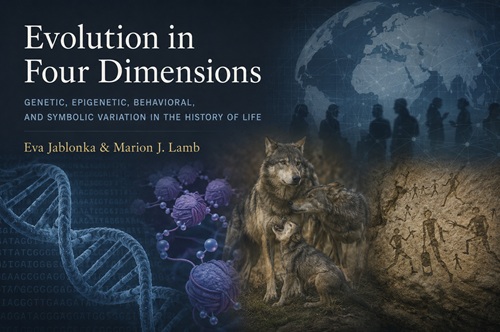
Eva Jablonka and Marion J. Lamb's Evolution in Four Dimensions: Genetic, Epigenetic, Behavioral, and Symbolic Variation in the History of Life is one of the most ambitious attempts to challenge the gene-centered understanding of evolution. First published in 2005 and substantially revised in 2014, the book argues that heredity is not exhausted by DNA sequence transmission. Evolution, the authors maintain, operates through four interacting inheritance systems: genetic, epigenetic, behavioral, and symbolic.
This is an important corrective to simplistic versions of genetic determinism. But the book also illustrates a recurring problem in evolutionary theory: the tendency to move from the entirely reasonable claim that “there is more to heredity than DNA” to the much more controversial claim that every form of stable transmission should be treated as a comparable evolutionary inheritance system.
The result is a book that is at its strongest when expanding our understanding of heredity—and at its weakest when its pluralism becomes a kind of conceptual inflation.
The book's central achievement: heredity is not the same thing as DNA
The most important contribution of Evolution in Four Dimensions is its insistence that evolutionary biology must take inheritance seriously in a broader sense than the transmission of DNA sequences.
The genetic dimension is the familiar one: DNA sequence variation, mutation, recombination, and the transmission of genetic differences between generations.
The epigenetic dimension concerns the transmission of cellular states and regulatory patterns that are not reducible simply to changes in DNA sequence. The behavioral dimension includes socially transmitted behaviors that can persist across generations. The symbolic dimension concerns the specifically human transmission of information through language, symbols, and other cultural systems.
This is a valuable framework. An organism does not inherit a naked DNA sequence and then construct itself in a vacuum. It inherits a developmental system. It inherits a cellular environment. It may inherit symbiotic relationships, parental effects, ecological circumstances, socially transmitted behaviors, and—especially in humans—a vast symbolic and cultural legacy.
Any evolutionary theory that ignores these facts is incomplete.
But the central question is not whether these phenomena exist. They obviously do. The difficult question is: in what precise sense are they evolutionary inheritance systems, and how should they be integrated with the established theory of evolution by natural selection?
That is where the book becomes much more controversial.
The target: the “Modern Synthesis” as a straw man
Jablonka and Lamb repeatedly present the Modern Synthesis as a narrowly gene-centered theory in which evolution consists essentially of the selection of random genetic mutations.
This target is recognizable. It is the textbook caricature of the Modern Synthesis: random mutation produces variation, natural selection sorts it, and DNA is the hereditary material.
But it is not a particularly accurate description of the actual scope of evolutionary biology.
The Modern Synthesis was never simply the proposition that “genes are the only things that matter.” Nor was it necessarily committed to the claim that all phenotypic variation must arise from completely random processes. Evolutionary biology has long recognized mutation biases, developmental constraints, phenotypic plasticity, gene-environment interaction, maternal effects, niche construction, sexual selection, genetic assimilation, and many other phenomena.
The more interesting question is not whether such phenomena occur. It is whether they require a fundamental revision of the Darwinian framework or whether they can be incorporated into an expanded evolutionary theory without replacing its central logic.
Jablonka and Lamb often seem to move too quickly from “the old picture was too simple” to “a new conceptual architecture is required.”
That is a much stronger claim.
The epigenetic dimension: important, real, and easily exaggerated
The strongest section of the book is arguably its treatment of epigenetic inheritance.
Cells can transmit regulatory states across cell divisions. In some cases, epigenetic effects can persist across generations. Environmental conditions can influence developmental and regulatory processes. Some inherited phenotypic effects are therefore not adequately described by a simple sequence of DNA mutations.
All of this is scientifically important.
The problem arises when epigenetics is presented as if it constitutes a general alternative to genetic inheritance rather than a complex set of mechanisms that frequently interact with, depend upon, and ultimately operate through organisms whose developmental systems are genetically encoded.
“Not encoded in the DNA sequence” does not mean “independent of genes.”
A cell's capacity to establish, maintain, erase, and transmit epigenetic states is itself the product of biological machinery. DNA sequences encode the proteins and regulatory systems involved in DNA methylation, chromatin remodeling, histone modification, small-RNA pathways, and countless other processes.
This does not make epigenetics genetically reducible. The distinction between genetic information and epigenetic regulation remains biologically meaningful. But the relationship is one of deep interdependence, not simple opposition.
The rhetoric of “genes versus epigenetics” is therefore misleading. The real biology is more interesting: genes, cellular states, developmental processes, and environments form a dynamically coupled system.
The book occasionally recognizes this complexity. But its polemical structure sometimes encourages the reader to see epigenetic inheritance as a revolutionary alternative to the genetic framework rather than as one component of a larger developmental system.
The Lamarckian temptation
The authors are perfectly aware that their position has Lamarckian implications. Indeed, the book explicitly attempts to rehabilitate aspects of the inheritance of acquired characteristics.
This is where precision becomes essential.
There is no scientific reason to reject a mechanism merely because Lamarck proposed something vaguely similar. If an environmentally induced change is heritable, then it is heritable regardless of whether it reminds us of Lamarck.
But the fact that some acquired changes can be inherited does not vindicate Lamarckism in its classical form.
Lamarck's theory was not simply:
Sometimes organisms acquire traits and some of those traits are inherited.
It involved a much broader account of adaptation, use and disuse, and the directed transformation of organisms in response to their needs.
Modern biology has indeed discovered mechanisms through which environmental influences can affect inheritance. But this does not mean that organisms generally generate adaptive hereditary variation because they “need” it. Nor does it mean that the environment routinely instructs the genome—or the organism—as to which adaptive traits should be produced.
The danger is that the word “Lamarckian” begins to function as a rhetorical umbrella for a variety of quite different phenomena: epigenetic inheritance, developmental plasticity, genetic assimilation, behavioral transmission, niche construction, and culturally mediated evolution.
These mechanisms are not equivalent.
A stress-induced epigenetic change in a plant, the transmission of a bird's song, the cultural learning of a tool-making technique, and a mutation affecting a protein sequence are all heritable in different senses. But calling them four parallel dimensions of evolution does not by itself explain how they differ mechanistically.
The behavioral dimension: transmission is not automatically heredity
The behavioral dimension is fascinating but conceptually slippery.
Animals can learn from one another. Behaviors can spread through populations. Social traditions can persist for generations. In some species, behavioral traditions clearly influence ecological conditions and selective pressures.
But the existence of behavioral transmission does not automatically make behavior equivalent to genetic inheritance.
A behavior can be socially transmitted without being reliably inherited. It can be learned by one generation and disappear in the next. It can be copied with high fidelity or transformed beyond recognition. It can depend on environmental conditions that are not themselves transmitted.
The central issue is therefore not simply whether information is transmitted. It is whether there is a sufficiently stable system of transmission, variation, and differential persistence for an evolutionary process to occur.
In this respect, behavioral evolution is perfectly compatible with a broad Darwinian framework. The real question is whether it requires the same theoretical status as genetic inheritance.
The authors are right to insist that socially transmitted behavior can affect evolutionary trajectories. But the conceptual move from “behavior influences evolution” to “behavior is an independent inheritance dimension equivalent to genes” requires much more argument than the book sometimes provides.
The symbolic dimension: where the framework becomes most expansive
The symbolic dimension is the most ambitious—and the most problematic.
Human language and culture clearly generate forms of inheritance that are not reducible to genetic transmission. Children inherit languages, norms, technologies, institutions, narratives, and symbolic systems from previous generations.
There is no question that culture evolves.
But the biological and cultural evolutionary processes are not simply identical. Cultural transmission can be extraordinarily rapid, horizontal, intentional, strategic, and institutionally organized. Cultural traits can be copied, modified, reconstructed, and deliberately designed in ways that have no close equivalent in ordinary biological inheritance.
The result is not that cultural evolution is unimportant. Quite the opposite. It is so distinctive that assimilating it too quickly into a general four-dimensional model risks obscuring its uniqueness.
A symbolic system is not merely another replicator.
This is where the book's pluralism begins to resemble a taxonomy of everything that can be transmitted.
• Genes are transmitted.
• Epigenetic states can be transmitted.
• Behaviors can be transmitted.
• Symbols can be transmitted.
But transmission alone is not enough to establish theoretical equivalence. A theory of evolution must also explain the mechanisms generating variation, the fidelity of transmission, the population structure involved, the role of selection, the possibility of drift, the dynamics of competition, and the causal relationship between different inheritance systems.
The book often supplies examples of transmission more readily than it supplies a general mathematical or causal framework for integrating the four dimensions.
The problem with “four dimensions”
The title is elegant. The conceptual architecture is less so.
The four categories are not obviously equivalent.
• Genetic inheritance involves physical molecular replication and recombination.
• Epigenetic inheritance involves the transmission of cellular regulatory states through specific molecular mechanisms.
• Behavioral inheritance often involves learning and social interaction.
• Symbolic inheritance involves language, culture, institutions, and intentional communication.
These are not four versions of the same process. They are different causal systems operating at different organizational levels.
One could therefore ask whether “four dimensions” is a genuine theoretical framework or simply a useful classification scheme.
The authors' most persuasive argument is that evolutionary theory should recognize multiple inheritance systems. Their less persuasive argument is that these systems can be placed into a single symmetrical architecture.
There is an asymmetry here that the book sometimes underplays. Genetic inheritance is not merely one information channel among four interchangeable channels. Genes participate in the construction of the very organisms that establish epigenetic states, learn behaviors, and create symbolic systems. The other dimensions can feed back on biological evolution, certainly. But the causal architecture is not a flat four-way democracy.
A hierarchy of causal dependence remains.
The book's most important blind spot: selection is not the enemy
One of the book's recurrent rhetorical targets is the idea that natural selection has been given too much explanatory power.
This criticism has some merit. Natural selection is not a magic word. Saying that a trait was “selected for” does not automatically explain its origin, development, inheritance, or ecological context.
But the alternative is not to minimize selection. It is to distinguish the different stages of evolutionary explanation.
• Development generates phenotypic variation.
• Inheritance determines what can persist across generations.
• The environment affects survival and reproduction.
• Natural selection changes the frequencies of heritable variants.
These processes are deeply interconnected. Evolutionary biology has become increasingly interested in developmental systems, plasticity, ecological feedback, and multiple inheritance. But none of this makes natural selection obsolete.
The danger in some versions of the extended evolutionary synthesis is that “selection” becomes identified with an old-fashioned gene-centered worldview. Once that happens, every mechanism that generates variation or modifies development is presented as an alternative to selection.
But variation and selection are not rival explanations.
A developmental process can bias variation. An epigenetic mechanism can generate heritable phenotypic differences. A behavior can alter the environment. Niche construction can change selection pressures.
And then selection still occurs.
The central question is not whether natural selection explains everything. It does not. The question is how these other processes modify the production of variation, inheritance, and selection.
That is a more difficult and more scientifically productive question than the simple opposition between “gene-centered Darwinism” and “four-dimensional evolution.”
The book's hidden strength: it is more Darwinian than its rhetoric suggests
Ironically, the actual biology presented in Evolution in Four Dimensions is often less revolutionary than the rhetoric surrounding it.
The book describes variation, inheritance, differential persistence, environmental feedback, developmental plasticity, and selection. In many cases, these phenomena can be integrated into an expanded Darwinian framework.
What is revolutionary is perhaps less the empirical material than the authors' insistence that evolutionary biology should stop treating DNA as the only relevant vehicle of inheritance.
That insistence is valuable.
But a scientific theory is not improved merely by adding more categories. It is improved when the causal relationships among those categories become clearer.
The question is therefore not: Are there more than genes?
Obviously there are.
The question is: How do genetic, epigenetic, developmental, behavioral, ecological, and cultural processes causally interact to produce evolutionary change?
That is the real theoretical challenge.
A useful antidote to genetic reductionism—but not a replacement for evolutionary theory
Evolution in Four Dimensions deserves its reputation as an important and provocative book. It is lucid, imaginative, richly documented, and intellectually ambitious. Even sympathetic reviewers have noted that the book becomes increasingly speculative as it moves from epigenetic mechanisms toward behavioral and symbolic evolution.
Its greatest contribution is its attack on a crude form of genetic reductionism. Genes are not isolated blueprints. Organisms develop within complex cellular, ecological, social, and cultural environments. Heredity is more multidimensional than a simple DNA-copying metaphor suggests.
But its central framework is ultimately more persuasive as a provocation than as a complete theory.
The four dimensions are not obviously equivalent. Epigenetic inheritance is not simply a second genome. Behavioral transmission is not automatically heredity in the biological sense. Cultural evolution is not merely a third or fourth form of genetic evolution. And the discovery of additional inheritance systems does not, by itself, overthrow the logic of natural selection.
The book is therefore best understood not as the replacement of Darwinian evolution, but as an argument for expanding the causal architecture of evolutionary biology.
Its most important message is not that genes no longer matter.
It is that genes were never the whole story.
Its greatest weakness is that, in reacting against a simplistic gene-centered picture, it occasionally risks replacing one oversimplification with another: a four-dimensional taxonomy in which fundamentally different forms of transmission are placed side by side and called a unified theory.
The future of evolutionary biology will probably not belong either to the one-dimensional gene-centric caricature attacked by Jablonka and Lamb or to a perfectly symmetrical four-dimensional model.
It will belong to a more difficult synthesis: one in which genes, development, organisms, environments, behavior, ecological inheritance, and culture are understood as parts of a genuinely hierarchical and reciprocal causal system.
That would be a more complicated theory than either genetic reductionism or four-dimensional pluralism.
It would also be closer to the biology.
|

 Frank Visser, graduated as a psychologist of culture and religion, founded IntegralWorld in 1997. He worked as production manager for various publishing houses and as service manager for various internet companies and lives in Amsterdam. Books: Ken Wilber: Thought as Passion (SUNY, 2003), and The Corona Conspiracy: Combatting Disinformation about the Coronavirus (Kindle, 2020).