|
TRANSLATE THIS ARTICLE
Integral World: Exploring Theories of Everything
An independent forum for a critical discussion of the integral philosophy of Ken Wilber
  Frank Visser, graduated as a psychologist of culture and religion, founded IntegralWorld in 1997. He worked as production manager for various publishing houses and as service manager for various internet companies and lives in Amsterdam. Books: Ken Wilber: Thought as Passion (SUNY, 2003), and The Corona Conspiracy: Combatting Disinformation about the Coronavirus (Kindle, 2020). Frank Visser, graduated as a psychologist of culture and religion, founded IntegralWorld in 1997. He worked as production manager for various publishing houses and as service manager for various internet companies and lives in Amsterdam. Books: Ken Wilber: Thought as Passion (SUNY, 2003), and The Corona Conspiracy: Combatting Disinformation about the Coronavirus (Kindle, 2020).
Check out my other conversations with ChatGPT Measuring AltitudeHas Integral Theory Finally Validated 'Altitude'?Frank Visser / ChatGPT
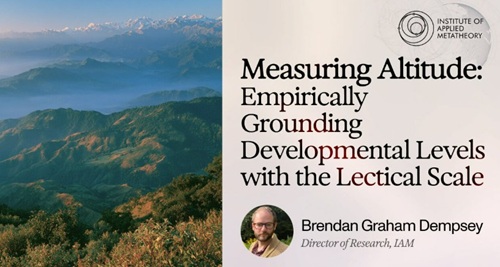 From Conceptual Mapping to Empirical MeasurementOne of the longstanding criticisms of Ken Wilber's Integral Theory has concerned its central concept of altitude. In Integral Psychology (2000), Wilber proposed that the many developmental stage models—those of Lawrence Kohlberg, Robert Kegan, Jane Loevinger, James Fowler, and others—could be aligned along a single developmental spectrum represented by his familiar color bands (Amber, Orange, Green, Teal, Turquoise, etc.). Yet these alignments were largely based on comparing stage descriptions rather than on direct empirical measurement, a procedure Sara Ross memorably criticized as a developmental "telephone game." Brendan Graham Dempsey's recent white paper, Measuring Altitude, represents the most ambitious attempt yet to remedy this weakness. Rather than comparing published descriptions, he uses Theo Dawson's Lectical Assessment System (LAS) to score over 540 developmental interview transcripts drawn from five classic developmental traditions. The goal is straightforward: determine whether these different developmental models converge on a common underlying scale of hierarchical complexity. This is a worthwhile project. Whether it succeeds in validating Wilber's broader notion of altitude is another matter. The Study's Main FindingsThe paper analyzes interview material from Kohlberg's moral reasoning studies, Cheryl Armon's evaluative reasoning research, James Fowler's faith development interviews, Jane Loevinger's ego development research, and a small illustrative sample from Robert Kegan's constructive-developmental theory. Each interview was independently scored using the Lectical Assessment System, which measures hierarchical complexity without reference to the original developmental model. The reported correlations are impressive: • Moral development: r = .85 (n = 403) • Evaluative reasoning: r = .82 (n = 61) • Faith development: ρ = .72 (n = 54) • Ego development: ρ = .60 (n = 20) • Kegan: illustrative trend only (n = 5) Moreover, equivalent stages from different theories cluster around similar Lectical scores. A Stage 3 in Kohlberg, for example, falls roughly within the same complexity range as Stage 3 in Fowler or Armon. From this Dempsey concludes that the different developmental "lines" ascend a common mountain of hierarchical complexity. An Important ContributionThe paper deserves genuine credit for several reasons. First, it explicitly acknowledges the methodological weakness of Wilber's original altitude charts and attempts to replace interpretive alignments with direct measurement. This alone represents progress. Second, the Lectical Assessment System is an established instrument within the neo-Piagetian tradition, with published validation studies supporting its reliability and domain-generality. Rather than inventing a new measure tailored to Integral Theory, Dempsey adopts an existing framework developed independently of Wilber's work. Third, the results strongly suggest that several well-known developmental models are indeed tracking a common dimension of increasing hierarchical complexity. This is an interesting empirical finding in its own right, regardless of its implications for Integral Theory. Where the Paper OverreachesThe difficulty arises when the paper moves from these findings to much broader conclusions. The demonstrated result is relatively modest: Several developmental models correlate substantially with an independently measured scale of hierarchical complexity. The claimed result is considerably stronger: Wilber's altitude construct has been empirically validated. These are not the same claim. Correlation with hierarchical complexity does not automatically establish the existence of a single overarching developmental 'Altitude' governing the whole person. At most, it shows that several developmental models constructed within broadly similar neo-Piagetian traditions capture increasing structural complexity. That is an important finding, but it is not yet a validation of Integral Theory's broader developmental synthesis. The Missing "Center of Gravity"Perhaps the most significant omission concerns the notion of a developmental center of gravity. Wilber has long argued that individuals possess an overall developmental level around which their various capacities cluster. This assumption underlies the entire AQAL framework and the famous psychograph. Contemporary developmental psychology has become much more cautious. Researchers increasingly emphasize that development is domain-specific, context-sensitive, and uneven. Individuals often display sophisticated reasoning in one domain while remaining relatively undeveloped in another. Cognitive sophistication does not guarantee emotional maturity; moral reasoning need not track political judgment; scientific expertise may coexist with magical thinking in other areas of life. Dempsey largely sidesteps this issue. His study compares developmental models rather than actual persons across multiple developmental domains. Demonstrating that moral stages and faith stages both correlate with hierarchical complexity is not the same as demonstrating that individuals possess a stable, measurable overall altitude. That remains an open empirical question. Ironically, the Paper Acknowledges ThisOne of the paper's most interesting passages appears in its limitations section. Dempsey explicitly cautions against interpreting the findings as a revival of traditional global stage theories. Instead, following the neo-Piagetian consensus, he writes that the results should be understood in terms of a person's "typical functional range of complexity across overlapping self-relevant domains," not as "a monolithic mental structure that progresses in lockstep." This is an important concession. It significantly weakens the stronger interpretations often given to Wilber's altitude concept. If there is no monolithic developmental structure, then altitude becomes less an overall level of consciousness than a statistical tendency across related domains. Ironically, this qualification sits uneasily beside the paper's triumphant conclusion. Methodological CaveatsThe paper itself notes several limitations, but they deserve greater emphasis. The strongest evidence comes from moral development, where the sample exceeds 400 interviews. The evidence becomes much thinner elsewhere. The Kegan analysis rests on only five exemplar texts and is explicitly described as illustrative. The ego-development analysis includes only twenty participants and relies on proxy interviews rather than the original assessment instrument. Upper developmental stages remain sparsely represented throughout the datasets. There is also a broader issue. Most of the developmental models examined descend from closely related Piagetian or neo-Piagetian traditions. Finding convergence among them is therefore less surprising than demonstrating convergence with theories emerging from fundamentally different research traditions. Finally, the study measures hierarchical complexity, not consciousness itself. Integral Theory often treats altitude as encompassing wisdom, awareness, spiritual realization, and worldview. Those broader claims remain largely untouched by the present research. A Curious TensionPerhaps the paper's greatest tension lies between its scientific caution and its rhetorical confidence. Throughout the discussion, Dempsey carefully qualifies the findings, acknowledges limitations, and rejects simplistic global stage theories. Yet the concluding paragraph declares: "The bands are real; the mountain has a height; and we can measure it." This flourish goes beyond what the evidence itself establishes. The data show that hierarchical complexity provides a useful common metric across several developmental models. They do not demonstrate that Wilber's complete altitude framework—including its color spectrum, center of gravity, and unified vertical dimension of consciousness—has been empirically confirmed. Conclusion: An Important Study, But Not the Final Word
Measuring Altitude is probably the strongest empirical defense of Integral Theory's developmental claims published to date. It represents a genuine advance over Wilber's original conceptual alignments by grounding comparisons in a common measurement system. At the same time, the paper validates something narrower than its rhetoric sometimes suggests. It provides evidence that several developmental models share a common dimension of hierarchical complexity. It does not establish that human beings possess a single measurable developmental altitude or center of gravity in the robust sense often assumed within Integral Theory. Ironically, Dempsey's own methodological caution points toward the more modest conclusion. Development appears to involve recurring patterns of increasing complexity across multiple domains, but contemporary developmental science remains skeptical that these patterns collapse into one overarching developmental axis. Hierarchical complexity may prove to be an important common metric—but whether it constitutes Wilber's elusive 'Altitude' remains very much an open question. NOTES[1] Brendan Graham Dempsey, "Measuring Altitude: Empirically Grounding Developmental Levels with the Lectical Scale", Institute of Applied Metatheory, 23 pages, no date.
Widget is loading comments...
|