|
TRANSLATE THIS ARTICLE
Integral World: Exploring Theories of Everything
An independent forum for a critical discussion of the integral philosophy of Ken Wilber
  Frank Visser, graduated as a psychologist of culture and religion, founded IntegralWorld in 1997. He worked as production manager for various publishing houses and as service manager for various internet companies and lives in Amsterdam. Books: Ken Wilber: Thought as Passion (SUNY, 2003), and The Corona Conspiracy: Combatting Disinformation about the Coronavirus (Kindle, 2020). Frank Visser, graduated as a psychologist of culture and religion, founded IntegralWorld in 1997. He worked as production manager for various publishing houses and as service manager for various internet companies and lives in Amsterdam. Books: Ken Wilber: Thought as Passion (SUNY, 2003), and The Corona Conspiracy: Combatting Disinformation about the Coronavirus (Kindle, 2020).
Check out my other conversations with ChatGPT Eros in an Empty Cosmos?Why Ken Wilber's Cosmic Evolutionism Struggles with the Rarity of LifeFrank Visser / ChatGPT
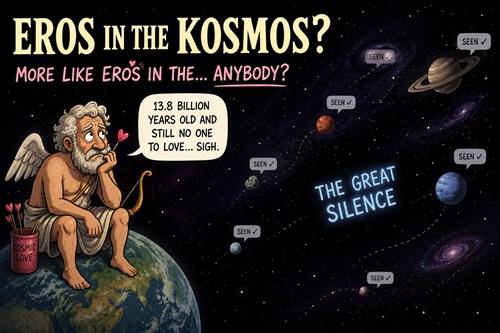 Introduction: The Mystery of an Apparently Lifeless UniverseOne of the most ambitious claims in Ken Wilber's integral philosophy is that evolution is not merely a biological process but an expression of a deeper cosmic tendency. In his writings, especially in Sex, Ecology, Spirituality, Wilber presents evolution as driven by an inherent principle he calls Eros: a creative force within the Kosmos that pushes matter toward increasing complexity, consciousness, and self-transcendence. For Wilber, the emergence of life, mind, culture, and spirituality is not an accidental sequence of events but a meaningful unfolding. The universe is not simply evolving; it is, in some sense, evolving toward greater depth. The appearance of consciousness on Earth is evidence of a universal evolutionary impulse. Yet modern astronomy and astrobiology present a profound challenge to this interpretation. The more we learn about the cosmos, the more remarkable—and perhaps more problematic—the rarity of life appears to be. After decades of searching, we have found no confirmed evidence of life elsewhere, even in our own solar system. The universe contains hundreds of billions of galaxies, each with hundreds of billions of stars, yet intelligent life may have appeared only once, on a small planet orbiting an ordinary star. This raises a fundamental question: if Eros is a universal cosmic principle, why does the cosmos appear so overwhelmingly empty? Wilber's Evolutionary Metaphysics: Eros as a Cosmic DriveWilber's concept of Eros is not simply biological reproduction or sexual attraction. He borrows the ancient Greek idea of Eros as a principle of attraction, creativity, and movement toward higher unity. In his evolutionary framework, Eros explains the emergence of increasingly complex forms: • atoms forming molecules, • molecules forming cells, • cells forming organisms, • organisms producing minds, • minds moving toward self-awareness and spiritual realization. Evolution, in this interpretation, is not merely a blind process of variation and selection. It contains an internal directionality. Wilber often contrasts this with reductionist materialism. A purely mechanistic worldview, he argues, cannot explain why complexity and consciousness emerge at all. The appearance of life and mind points toward a deeper pattern within reality. The problem is that the empirical evidence for such a pattern is far less clear than Wilber suggests. The Great Silence: A Universe That Does Not Look AliveThe modern scientific picture presents a striking paradox. The universe is approximately 13.8 billion years old. It contains enormous numbers of potentially habitable planets. The basic ingredients for life—carbon, water, organic molecules—are widespread. From a purely statistical perspective, one might expect life to be common. Yet so far, the evidence points in the opposite direction: life appears to be extraordinarily rare, or at least extraordinarily difficult to detect. The solar system itself is a useful test case. We have explored planets, moons, asteroids, and environments that once seemed promising. Mars shows evidence of ancient rivers and potentially habitable conditions. The icy moons of the outer planets, such as Europa and Enceladus, contain subsurface oceans and chemical energy sources. Venus may once have had conditions suitable for life. Still, after extensive investigation, there is no confirmed discovery of even simple microbial life beyond Earth. This creates a tension for cosmic Eros. If the universe has an intrinsic tendency toward life and consciousness, why does that tendency seem so dramatically ineffective? A Cosmic Force That Produces Almost Nothing?Gravity is universal. Electromagnetism is universal. Nuclear forces operate everywhere we observe them. Their effects are measurable across the cosmos. But Eros, as Wilber describes it, behaves very differently. If Eros is a fundamental tendency of the Kosmos, we might expect to observe life emerging wherever suitable conditions exist. Instead, life appears to require an extraordinary chain of circumstances: • a stable star, • a suitable planetary distance, • long-term climate stability, • the presence of essential elements, • geological cycles, • protection from catastrophic radiation, • enough time for evolutionary experimentation. Even after these conditions are met, the transition from chemistry to biology remains poorly understood. The transition from simple life to complex organisms took billions of years on Earth. The transition from complex organisms to technological intelligence occurred only once, very recently, in Earth's history. The evidence suggests not a cosmic river flowing toward consciousness, but a highly contingent historical process. The Anthropic Problem: Mistaking Our Existence for Cosmic IntentionWilber's argument risks falling into a form of anthropic reasoning: because consciousness exists, the universe must contain a tendency toward consciousness. But this reverses the logic. We observe a universe compatible with our existence because we could not observe any other kind of universe. The fact that humans are here does not necessarily mean the universe was heading toward humans. Evolutionary biology provides a powerful alternative explanation. Natural selection does not push organisms upward toward greater complexity. It preserves traits that improve survival and reproduction in particular environments. Evolution has produced extraordinary complexity, but it has also produced: • parasites, • blind cave organisms, • extinct lineages, • evolutionary dead ends, • billions of years without technological intelligence. The history of life does not resemble a ladder climbing toward consciousness. It resembles a branching tree shaped by contingency. The Problem of Scale: Earth as an Exception, Not a RuleWilber's cosmic interpretation was developed largely from the perspective of Earth's evolutionary history. On Earth, there is a clear increase in complexity over billions of years: • simple chemistry, • early life, • multicellular organisms, • nervous systems, • brains, • symbolic culture. But Earth history is not necessarily a model of the universe. It may represent a rare local trajectory. The danger is cosmic extrapolation: taking one extraordinary example and assuming it reveals a universal law. A rare phenomenon can still be profound. A single Mozart does not prove that the universe has a Mozart-producing principle. A single technological civilization does not necessarily demonstrate a cosmic drive toward intelligence. The existence of consciousness may be one of the universe's greatest surprises precisely because it is not inevitable. Eros as Metaphor Rather Than MechanismOne possible rescue of Wilber's idea is to interpret Eros metaphorically rather than scientifically. As a poetic description of the human experience of evolution, Eros captures something real: the universe has produced beings capable of understanding the universe. Complexity does emerge. Novel forms arise. The cosmos has become, at least locally, aware of itself. But metaphorical truth is different from scientific explanation. The problem begins when Eros is treated as a literal cosmic force comparable to gravity or electromagnetism. Unlike those forces, Eros has no measurable properties, no predictive framework, and no independent evidence. It risks becoming an explanation that simply restates the mystery: "Life exists because the universe tends toward life." But the actual scientific question remains: "Why does life exist at all, and why does it appear to be so rare?" The Deeper Irony: A More Humble Cosmic Vision May Be More AstonishingWilber's vision attempts to elevate humanity by placing consciousness within a grand cosmic narrative. But there is another interpretation that is equally profound. Perhaps consciousness is not the expected outcome of the universe. Perhaps it is a fragile, improbable emergence against enormous odds. A cosmos mostly composed of dark matter, stars, empty space, and silent planets has nevertheless produced beings capable of contemplating its existence. That does not diminish consciousness. It may make it more extraordinary. The scientific picture does not require a cosmic Eros to make existence meaningful. The rarity of life may itself be the source of its value. Conclusion: The Empty Cosmos as a Challenge to Integral EvolutionismWilber's Eros in the Kosmos remains one of the most ambitious attempts to provide philosophical meaning to evolution. It expresses a powerful intuition: that the emergence of consciousness feels too remarkable to be merely accidental. But the astronomical evidence creates a serious challenge. A universe that appears overwhelmingly barren does not easily support the idea of a universal evolutionary impulse toward life and consciousness. The problem is not that Wilber sees evolution as meaningful. Meaning is a legitimate philosophical question. The problem is that he moves too quickly from the undeniable fact that evolution happened on Earth to the much larger claim that the cosmos itself is oriented toward consciousness. The universe may indeed contain wonder, creativity, and depth. But whether it contains Eros—a built-in drive toward higher consciousness—remains an unanswered metaphysical speculation rather than an established feature of reality.
Widget is loading comments...
|