|
TRANSLATE THIS ARTICLE
Integral World: Exploring Theories of Everything
An independent forum for a critical discussion of the integral philosophy of Ken Wilber
  Frank Visser, graduated as a psychologist of culture and religion, founded IntegralWorld in 1997. He worked as production manager for various publishing houses and as service manager for various internet companies and lives in Amsterdam. Books: Ken Wilber: Thought as Passion (SUNY, 2003), and The Corona Conspiracy: Combatting Disinformation about the Coronavirus (Kindle, 2020). Frank Visser, graduated as a psychologist of culture and religion, founded IntegralWorld in 1997. He worked as production manager for various publishing houses and as service manager for various internet companies and lives in Amsterdam. Books: Ken Wilber: Thought as Passion (SUNY, 2003), and The Corona Conspiracy: Combatting Disinformation about the Coronavirus (Kindle, 2020).
Check out my other conversations with ChatGPT Antoinette Brown BlackwellThe Woman Who Challenged Darwin with ScienceFrank Visser / ChatGPT
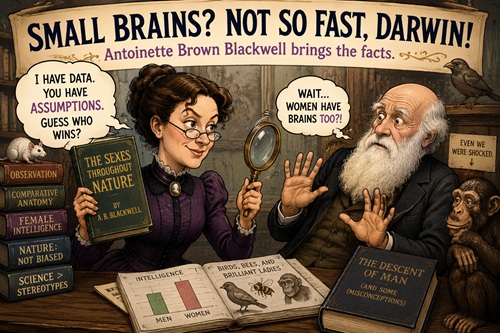 Charles Darwin transformed biology by explaining the origin of species through natural selection. Yet, like many Victorian intellectuals, he also carried assumptions about gender that today appear deeply flawed. In The Descent of Man (1871), Darwin argued that men had evolved superior intellectual capacities because they competed more intensely for mates and resources, while women remained relatively unchanged due to their primary role in childrearing. Few people dared to challenge Darwin on scientific grounds. One remarkable exception was Antoinette Brown Blackwell (1825-1921), an American philosopher, theologian, suffragist, and the first woman ordained as a Protestant minister in the United States. Rather than rejecting evolution, she embraced it—but insisted that Darwin had allowed Victorian prejudice to contaminate his science. Her 1875 book, The Sexes Throughout Nature, stands as one of the earliest systematic feminist critiques of evolutionary biology. Darwin's Theory of Female InferiorityDarwin never doubted women's intelligence altogether. Rather, he argued that natural selection and sexual selection had produced enduring differences between the sexes. He wrote: "The chief distinction in the intellectual powers of the two sexes is shown by man's attaining to a higher eminence..." According to Darwin: • men evolved greater intelligence through competition, • women evolved nurturing instincts, • male genius represented an evolutionary achievement, • female intellect remained comparatively less developed. To modern readers, these claims seem obviously shaped by Victorian social norms. Yet in the 1870s they were widely accepted as objective science. Blackwell thought otherwise. Fighting Darwin on His Own TurfUnlike many religious critics, Blackwell did not reject evolution. She accepted: • common descent, • adaptation, • natural selection, • biological continuity. Her objection was methodological. Darwin, she argued, had generalized from a society in which women were systematically denied education, property rights, professional opportunities, and political participation. One cannot infer biological inferiority from social inequality. In modern terminology, she distinguished between evolved traits and cultural effects—a distinction evolutionary psychology continues to wrestle with. Nature Shows Complementarity, Not HierarchyBlackwell surveyed the animal kingdom looking for evidence. Instead of finding universal male superiority, she observed astonishing diversity. Across species: • females often display greater endurance, • females frequently choose mates, • maternal behavior requires sophisticated cognition, • survival depends upon cooperation as much as competition. She argued that evolution repeatedly favors complementary specialization rather than linear superiority. The sexes develop different strengths because different ecological roles require different adaptations. Difference does not imply inferiority. This was a remarkably sophisticated evolutionary argument for the nineteenth century. The Hidden Bias in Scientific ObservationPerhaps Blackwell's greatest insight concerns scientific objectivity itself. She noted that nearly all scientists studying sex differences were men. Their observations were filtered through assumptions they scarcely recognized. Today this sounds familiar. Modern philosophy of science has shown that: • research questions reflect cultural assumptions, • observational categories contain implicit values, • scientific communities possess collective biases. Blackwell anticipated what later thinkers such as Sandra Harding, Donna Haraway, and Helen Longino would develop much more systematically. She argued that science becomes more objective—not less—when excluded voices enter the conversation. Neither Romanticism nor Biological DenialImportantly, Blackwell did not claim that men and women are identical. She rejected both extremes. Against Darwin, she denied hierarchy. Against early egalitarianism, she denied complete sameness. Instead she proposed mutual dependence. Human evolution had produced two sexes with overlapping but distinct capacities. This middle position sounds surprisingly contemporary. Current evolutionary biology generally recognizes average sex differences while simultaneously emphasizing enormous overlap between the sexes and the decisive role played by environment, education, and culture. Where Blackwell Was Ahead of DarwinHistory has largely vindicated Blackwell on several important points. First, Darwin underestimated the effects of culture. Educational opportunity dramatically alters intellectual achievement. Second, Darwin assumed that nineteenth-century gender roles reflected evolved biology rather than historical circumstance. Third, Blackwell correctly emphasized female agency in evolution. Modern studies increasingly recognize that females actively shape evolutionary outcomes through mate choice, parental investment, cooperation, and social learning. Finally, Blackwell appreciated that evolution often favors cooperation rather than perpetual competition. This insight has become central to contemporary evolutionary theory, from kin selection to reciprocal altruism, multilevel selection, and theories of social evolution. Where Darwin Still WinsBlackwell was not correct about everything. Her own Victorian commitments sometimes led her toward idealized notions of feminine moral superiority. Modern evolutionary biology also supports Darwin's central insight that sexual selection can produce average cognitive and behavioral differences between males and females. The disagreement today concerns degree, developmental mechanisms, and interpretation—not whether any average differences exist. Moreover, Darwin's general evolutionary framework has proven extraordinarily successful, whereas Blackwell's broader philosophical synthesis never became influential within biology. Yet this should not obscure her achievement. She showed that one could accept evolution while criticizing the biases embedded within evolutionary interpretation. Why She Was ForgottenBlackwell occupies an unusual place in intellectual history. She was: • too scientific for conservative religion, • too religious for many secular scientists, • too evolutionary for anti-Darwin feminists, • too feminist for Victorian academia. She fell between intellectual camps. As a result, Darwin became a scientific icon while Blackwell largely disappeared from textbooks. Only recently have historians of science rediscovered her contributions. Lessons for TodayBlackwell's story remains surprisingly relevant. Scientific theories are produced by human beings embedded within cultures. This does not invalidate science. Rather, it reminds us that scientific objectivity is achieved through continual criticism, replication, and the inclusion of diverse perspectives. Darwin himself exemplified this process. His theory has survived because later generations corrected its weaknesses while preserving its strengths. Blackwell contributed precisely this kind of corrective. She demonstrated that accepting evolution does not require accepting every social conclusion drawn from it. Scientific progress advances not only through bold new theories but also through equally bold criticism. Conclusion: A Forgotten Pioneer of Scientific FeminismAntoinette Brown Blackwell deserves recognition not merely as America's first female minister or as an early suffragist, but as one of the first scholars to challenge evolutionary theory from within the scientific framework itself. She understood something that remains essential today: evidence must always take precedence over inherited assumptions—even when those assumptions belong to the greatest scientists of the age. Darwin revolutionized our understanding of life. Blackwell reminded us that even revolutionary thinkers remain children of their own times. Her legacy is therefore not that she defeated Darwin, but that she improved the conversation Darwin had begun. In doing so, she anticipated a central principle of modern science: objectivity is strengthened, not weakened, when previously marginalized voices are able to question prevailing assumptions.
Widget is loading comments...
|