|
TRANSLATE THIS ARTICLE
Integral World: Exploring Theories of Everything
An independent forum for a critical discussion of the integral philosophy of Ken Wilber
  Frank Visser, graduated as a psychologist of culture and religion, founded IntegralWorld in 1997. He worked as production manager for various publishing houses and as service manager for various internet companies and lives in Amsterdam. Books: Ken Wilber: Thought as Passion (SUNY, 2003), and The Corona Conspiracy: Combatting Disinformation about the Coronavirus (Kindle, 2020). Frank Visser, graduated as a psychologist of culture and religion, founded IntegralWorld in 1997. He worked as production manager for various publishing houses and as service manager for various internet companies and lives in Amsterdam. Books: Ken Wilber: Thought as Passion (SUNY, 2003), and The Corona Conspiracy: Combatting Disinformation about the Coronavirus (Kindle, 2020).
Check out my other conversations with ChatGPT ‘Every Theory of Consciousness’A Critical Review and Comparison with WilberFrank Visser / Grok
Every Theory of Consciousness - Alex O'Connor and Closer To Truth
The video is a ~2.2-hour conversation between Alex O'Connor (CosmicSkeptic) and Robert Lawrence Kuhn on "Every Theory of Consciousness" (published July 2026). Kuhn, creator of the PBS series Closer to Truth, discusses his ambitious "Landscape of Consciousness" map/project, which categorizes hundreds of theories of consciousness (over 400 in related work). The discussion is a meta-exploration of how these theories differ, overlap, and relate, rather than a deep defense of any one. Summary of Key ContentKuhn explains the motivation: Consciousness has been his lifelong passion (stemming from a teenage realization that all inquiry comes through the brain). After interviewing countless experts for Closer to Truth, he undertook the massive task of organizing the "jumble" of theories for a journal article, leading to an interactive map. 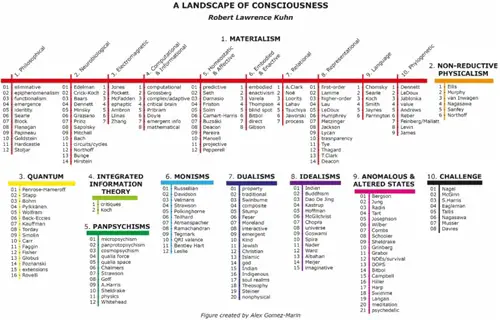
A Landscape of Consciousness (Click to enlarge)
Core Structure (Rough Linear Spectrum + Categories):Materialism/Physicalism (dominant category, ~50% of theories): Consciousness emerges from or is identical to physical processes in the brain. Subcategories include reductive, computational/functionalist, etc. Non-reductive Physicalism: Still fully physical but with distinct "feels" or higher-level properties. Quantum and Dimensional Theories: Involve quantum effects or extra dimensions. Information Theories: Information (sometimes fundamental, beyond standard computation) as key (e.g., Integrated Information Theory / IIT is discussed later). Panpsychism: Consciousness (or proto-consciousness) is fundamental to all matter. Monism / Dualism / Idealism: Broader metaphysical views—e.g., everything is mind (idealism), mind and matter are distinct (dualism), or one neutral substance. Anomalous/Altered States: Informed by psychedelics, near-death experiences, meditation, etc. (not theories per se, but drivers of them). Challenge Category: Skeptical or meta views questioning if the problem is solvable, if humans can understand it, or if it's ill-posed. Highlights from Discussion:• Clarifying boundaries: What counts as materialism? Differences between panpsychism, materialism, idealism, and monism (e.g., overlaps and subtle distinctions). • Do all these theories really differ, or are many semantic/repackaging? • Property dualism. • Significance of psychedelic experiences. • Quantum consciousness and IIT. • Theological approaches. • Ends on how "theory of mind" (understanding others' minds) can foster unity amid philosophical diversity. The map itself is praised as an extraordinary, neutral resource: Clickable, with overviews of individual theories. It's not evaluative but taxonomic. ReviewStrengths:Excellent for orientation: Consciousness studies are notoriously fragmented and confusing. Kuhn's map and this discussion provide a clear, high-level framework that helps viewers navigate the landscape without getting lost in specifics. Alex O'Connor is an ideal host—curious, sharp, and good at probing distinctions. Balanced and comprehensive: Kuhn emphasizes exploration over advocacy. He draws from decades of interviews, making it authoritative yet accessible. Timely and useful: With rising interest in consciousness (AI, psychedelics, neuroscience), this demystifies the "hard problem" debates (how/why physical processes give rise to subjective experience). Production: Solid timestamps, visuals of the map, and engaging back-and-forth. Weaknesses/Criticisms:It's long and high-level/meta, so it won't satisfy those wanting deep dives into specific theories (e.g., full IIT explanation or critiques of panpsychism). Some sections risk feeling like definitional hair-splitting. Neutrality has limits: Taxonomy inherently involves judgment calls on categorization, and overlaps blur lines (as they discuss). No strong resolutions or new arguments—it's more survey than breakthrough, which is fine for the goal but may leave some wanting Kuhn's personal leanings more explicitly. Overall: Highly recommended (9/10 for its niche). It's one of the best "big picture" resources on theories of consciousness available—ideal for students, philosophers, or anyone overwhelmed by the topic. Watch the map alongside it. Kuhn's project is a genuine public service in a field full of specialized papers. If you're new to the area, it will clarify a lot; if experienced, it offers a valuable organizing lens. The closing note on theory of mind uniting people is a nice humanistic touch. Ken Wilber's Integral Approach as a Potential Solution (or Dissolution) to the Mind-Body ProblemKen Wilber, a key figure in transpersonal psychology and developer of Integral Theory (often summarized as AQAL: All Quadrants, All Levels, All Lines, All States, All Types), offers one of the more ambitious attempts to integrate the diverse perspectives discussed in the Kuhn/O'Connor conversation. His framework is frequently referenced in consciousness studies as a "meta-theory" that could encompass or reconcile many of the categories on Kuhn's map.[1] Core of Wilber's Model: The Four Quadrants
Wilber argues that reality, including consciousness, manifests in four irreducible dimensions (quadrants) of any holon (whole/part entity). Reductionist approaches fail because they privilege one quadrant over others: • Upper-Left (UL) - “I” (Intentional/Subjective): First-person interior experience — thoughts, feelings, states of consciousness, the felt sense of awareness. This is the phenomenological, introspective side. • Upper-Right (UR) - “It” (Behavioral/Objective): Third-person exterior, measurable correlates — brain states, behavior, physiology, neuroscience data. This is the domain of empirical science and materialism. • Lower-Left (LL) - “We” (Cultural/Intersubjective): Shared interiors — cultural worldviews, ethics, collective meaning, language, and mutual understanding (hermeneutics). • Lower-Right (LR) - “Its” (Social/Interobjective): Exterior systems — social structures, institutions, economies, ecological contexts. Consciousness is not located solely in the brain (UR), nor purely in subjective experience (UL), nor reducible to culture or society. It is distributed across all four quadrants, which tetra-evolve together. Every interior (Left-Hand) has a corresponding exterior (Right-Hand) correlate, but neither can be reduced to the other without losing essential aspects. Levels, Lines, States, and the SpectrumWilber layers this with developmental levels (or waves/stages) that unfold in each quadrant — from matter to body to mind to soul to spirit. He also includes lines (multiple intelligences), states (e.g., waking, dreaming, meditative, psychedelic), and the self-system that navigates them. This creates a multi-dimensional lattice far richer than flat materialism or simple dualism. Prana/chi/subtle energies often serve as a bridging "missing link" between mind and body in traditional systems, which Wilber incorporates as correlates across levels. Relation to the Mind-Body ProblemWilber views the classic mind-body problem as arising from quadrant confusion and reductionism. Solutions vary by aspect: • The empirical correlation (mind and brain) is handled by recognizing UL-UR correspondence without identity. • Deeper integration comes through development: higher stages (e.g., transrational, nondual awareness) reveal mind and body as expressions of a deeper unity (Spirit or nondual consciousness). • Ultimate "solution" is often nondual realization (e.g., Zen satori or Big Mind), where the subject-object divide dissolves experientially. This is not a reductive physicalist answer (like many materialist theories on Kuhn's map) nor pure idealism, but an integral nondualism that honors all perspectives. It aligns with panpsychism or monism in some ways while incorporating scientific rigor and spiritual depth. It also explains why psychedelics, meditation, and altered states (Kuhn's "anomalous" category) are relevant: they reveal higher states and facilitate growth. Strengths and Relevance to the Video• Comprehensiveness: Wilber's AQAL model could serve as an overarching organizer for Kuhn's landscape, showing how materialism (heavy UR), idealism (UL-dominant), dualism, panpsychism, quantum/info theories, and challenges all capture partial truths. • Practicality: It offers not just theory but practices for "Growing Up, Cleaning Up, Waking Up, etc.," making it actionable. • Critiques: Some see it as overly syncretic or hierarchical; others note it still leaves the "hard problem" (exact mechanism of correlation) somewhat open, though reframed as a feature of multi-perspectival reality rather than a fatal flaw. In the context of the Kuhn/O'Connor discussion, Wilber represents a sophisticated "monism" or integrative approach that transcends many of the divides while respecting the map's diversity. It exemplifies the "theory of mind" unity theme by weaving first-, second-, and third-person perspectives into a coherent whole. Readers interested in bridging the video's categories may find Wilber's works (Integral Psychology, A Theory of Everything, or his Journal of Consciousness Studies paper) a natural next step. Criticisms of Wilber's Solution to the Mind-Body ProblemWilber's Integral Theory (AQAL model with four quadrants, levels, etc.) is praised for its ambition but has faced substantial criticism, particularly regarding its handling of the mind-body problem. Critics argue it reframes rather than truly solves the issue. Here is a balanced overview: Major CriticismsPromissory Integralism / Failure to Explain Interaction (The "Hard Problem"):Wilber's model correlates interiors (UL: subjective mind) with exteriors (UR: brain/body) across quadrants but does not provide a mechanistic or causal account of how they interact or how subjective experience arises from (or relates to) physical processes. It is often called "promissory" — it promises an integration (via development to nondual stages or Whiteheadian process elements) but defers the actual explanatory work. This is seen as no better than promissory materialism. Critics argue it leaves the causal relationship between quadrants mysterious, akin to "and then a miracle occurs." Incomplete Quadrants and Reductionism:Some contend Wilber underdevelops intersubjectivity (Lower-Left), reducing it too heavily to linguistic or cultural exchanges, leaving one quadrant "vacant" or imbalanced. This tilts the entire model. Despite claims of non-reductionism, the framework is accused of subtle reductionism (e.g., in its treatment of panpsychism or feeling) or of imposing a hierarchical "integral operating system" that marginalizes perspectives outside its structure. Over-Systematization, Hyperbole, and Empirical Weakness:The AQAL map is criticized as overly neat and rigid, forcing diverse traditions (Eastern, Western, scientific, mystical) into a single lattice, sometimes misrepresenting or flattening them. Development is portrayed as more linear/hierarchical than evidence supports. Lack of rigorous empirical testing for the full system. While it draws on existing research (e.g., developmental stages), the grand synthesis resists easy falsification — objections are often absorbed as "lower-level perspectives." Style issues: Accusations of arrogance, spiritual hyperbole, and cult-like tendencies among followers ("Wilberians"). Claims about evolution, reincarnation, or ultimate stages are seen as unsubstantiated. Metaphysical and Epistemological Problems:Reliance on unprovable metaphysical assumptions (e.g., irreducible quadrants, Spirit as ultimate). Critics from participatory or postmodern paradigms argue it privileges a rational-integral meta-perspective while claiming universality. Nondual realization (the "ultimate solution") is experiential but hard to validate intersubjectively or scientifically, raising questions about its universality or applicability. Other Specifics:Issues with evolution theory, cross-cultural interpretations, and handling of emergence or feeling in panpsychism/Whiteheadian elements. Potential for "integral apartheid" or elitism in stage models (higher stages seen as better). Strengths of These CriticismsPhilosophical Rigor: They highlight genuine gaps in explanatory power, especially the persistent hard problem, pushing Integral Theory toward greater precision rather than grand claims. Empirical and Pluralistic Demand: They defend scientific standards and the "otherness" of diverse traditions against over-integration, preventing the model from becoming a closed system. Practical Caution: Warnings about cultish tendencies or hyperbole encourage critical engagement over dogmatic adoption, which benefits the field. Testability: By pointing out unfalsifiability risks, they strengthen the potential for future refinement or empirical validation of AQAL elements. Counterpoints: Strengths of Wilber's ApproachHolistic Integration: It excels at mapping partial truths from materialism, dualism, idealism, panpsychism, etc., into a coherent (if imperfect) framework. This directly addresses the fragmentation Kuhn discusses. Multi-Perspectival Power: The quadrants encourage balanced inquiry (subjective + objective + cultural + systemic), useful in psychology, conflict resolution, therapy, and personal development. It avoids the "flatland" of pure physicalism. Developmental and Practical Depth: Emphasizes growth through stages/states, with actionable practices (meditation, shadow work). This goes beyond abstract philosophy to transformation. Influence and Breadth: No other single thinker has synthesized so many fields. Even critics acknowledge its value as an orienting map; it has inspired applications in business, ecology, healthcare, and more. Nondual Orientation: For many, the experiential emphasis on transcending subject-object duality provides a lived "dissolution" of the problem that theory alone cannot achieve. In Summary: Wilber's solution is strong as a meta-framework for organizing perspectives and guiding practice but weaker as a definitive causal resolution to the mind-body problem. Criticisms are robust on explanatory and empirical grounds but sometimes undervalue its pragmatic and integrative utility. As with Kuhn's map, it is best used as a tool for navigation rather than a final dogma. For deeper engagement, compare Wilber's Integral Psychology or Sex, Ecology, Spirituality with critiques from sources like Christian de Quincey, Frank Visser (Integral World), or David Lane. NOTES[1] See also: "Wilber's Integral Theory", closertotruth.com, which is filed under the Anomalous & Altered States category, together with 28(!) contenders.
In the end, the absence of a final answer may not reflect a failure of inquiry but the limits of its tools. Science, bound by the objective, cannot penetrate the subjective except by analogy. Philosophy, rich in conceptual distinctions, cannot produce a mechanism. Dualism, idealism, and monism each offer frameworks that feel complete only within their own assumptions. The problem endures because consciousness is not just another phenomenon to be cataloged but the medium in which all other phenomena appear. Until the nature of explanation itself is reimagined—until subject and object cease to be opposing poles—the hard problem will remain just that: hard, unsolved, and perhaps unsolvable, a horizon that recedes with every step forward. (AI Assistant on Closer to Truth)
Widget is loading comments...
|